Language is a uniquely human trait. By this we mean that of all the living species on Earth, only humans possess a faculty for language and only humans communicate with language—although we also know that humans communicate with things other than language (as do other species). Although we might share with bees that we can signal meaning through a dance move, and although we might share with some birds the use of whistle noises to convey an idea, no animal other than humans possesses the ability to modify a noun with a relative clause or the ability to determine that John seems sad is a fine sentence but John seems asleep is not.
So, why is language a uniquely human trait? What is language? In this module we will explore language as a formal and at times very abstract system. We will go beyond the layman’s concept of language expressed in terms such as “don’t use bad language” and “I speak three languages.” We will go beyond the common conceptualization of language as a set of rules such as “Use whom instead of who after prepositions.” We will go beyond the widely held belief that language is communication—although readers can explore the nature of communication in another module.
Language as Mental Representation
Every speaker of a language is also a “knower” of language. That is, underlying every act of language use there lurks implicit knowledge about language. This knowledge is not the everyday kind of knowledge such as “Don’t say ain’t” and “Verbs must agree with their subjects (in some languages).” Knowledge of language can involve complex and abstract features, as we will see later. Important here is that this underlying knowledge is implicit. Let’s call this knowledge “mental representation.” What does implicit mean? Let’s begin with a non-linguistic example. Every reader of this module knows what “round” is. Marbles are round. Baseballs are round. Doughnuts are (generally) round. U.S. coins are round. Wedding bands are round. But what is the definition of round? As a reader tries to answer this question, he or she will sit and think, attempting to come up with an answer. But this sitting and thinking suggests that the actual knowledge underlying “round” is deep and implicit, probably even abstract. The person trying to come up with a definition has to reason it out. I’ve tried this question on audiences when I give lectures and inevitably all responses to the question are wrong. Thus, even if we can make our knowledge somehow explicit through reasoned thought, we are often wrong for concepts such as “round.” (For the reader dying of curiosity, “round” means that each surface point is equidistant from a center point.)
When it comes to language, the term implicit suggests that mental representation consists of knowledge that a person cannot easily describe or cannot describe at all. Although we will explore this in detail in the sections that follow, here is a good example. In English, we can say You told Harry about which book? as well as Which book did you tell Harry about? That is, the phrase which book can move from one spot to another spot. But you can only say You told Harry about which politician caught in a sex scandal? and not Which politician did you tell Harry about caught in a sex scandal? That is, which politician is not free to move the way which book was in the previous example. The question is, “Why?” Every speaker of English would recognize the Which politician…? sentence as bad or weird, but when asked why, that person would fumble for an answer or simply say, “I don’t know. It just sounds bad.” When someone says, “I don’t know. It just sounds bad,” that person is indicating that he or she is relying on implicit knowledge; that is, his or her mental representation. The knowledge is clearly there; the person is simply unable to articulate it. Again, we will see more examples of this later and will drive the point home when we talk about pedagogical and prescriptive grammars much later in this module.
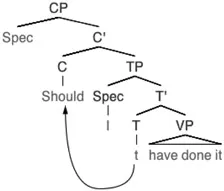
As stated above, language is also complex and abstract. It is abstract because there is much about the nature of language (our implicit knowledge) that defies simple and easy explanations. Before looking at a linguistic example, let’s return to the definition of “round”: each surface point is equidistant from a center point. The reader might think, “Of course, that’s so simple.” But it really isn’t that simple when we begin to deconstruct the definition. For example, what’s a “surface”? What’s a “point”? What’s a “center”? What does “equidistant” mean? And so on. Each of the constructs within the definition of “round” also involves implicit, abstract knowledge, making the overall definition of “round” much more complex than what meets the eye. The same is true for language. Again, we will see examples of this in the sections that follow, but for the present purposes, we can illustrate linguistic abstractness in the following example. English allows contractions such as I’ve done it and Who do you wanna invite to the party? But English does not allow the same contractions in Should I’ve done it? and Who do you wanna fire John from his job? Contractions are prohibited in English under certain conditions, namely, when an element has moved from one part of the sentence to another, leaving what we call a trace behind. For example, I’ve done it is a contraction of I have done it. Nothing intervenes between I and have, so contraction is possible. But Should I have done it? is derived from I should have done it. When the modal should moves, it leaves behind a hidden (i.e., invisible and inaudible) copy of itself known as a trace, which linguists represent as a small t. Here is an example. Should I t have done it? This little t, which marks the spot left by should, blocks the contraction of I and have. Here is what this looks like if linguists were to draw a tree to represent the sentence (ignore all the symbols for now and just focus on how the movement of should is depicted).
The idea of moving items, leaving traces, and so on, involves a level of abstraction we don’t normally think about every day when it comes to language. At the same time, the blocking of contractions is complex: it involves multiple aspects of language (e.g., movement, restrictions on movement, traces and trace theory).
A major issue in second language research has been to what extent learners develop an underlying implicit and abstract/complex system. The answer is that they do, and parts of the system may be indistinguishable from what native speakers have in their representations while other parts are different. Another module on second language acquisition will touch upon this idea in more detail and will indicate further readings for you. In this module, we will merely point out now and then what we know about what second language learners have in their heads.
So far, we have seen complexity only at the level of how a sentence operates, but language overall is complex because it has so many different components that work together to form what we call sentences or utterances. To illustrate this complexity, we will briefly talk about some major components of language: phonology, lexicon, morphology, syntax, and pragmatics, to name some. We begin with phonology.