- 256 pages
- English
- ePUB (mobile friendly)
- Available on iOS & Android
eBook - ePub
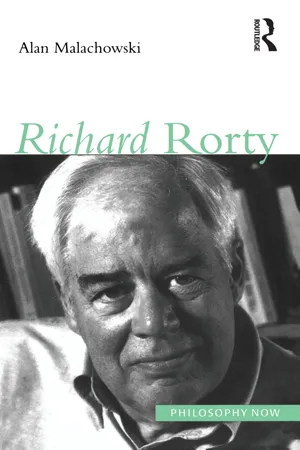
Richard Rorty
About this book
Richard Rorty is notorious for contending that the traditional, foundation-building and truth-seeking ambitions of systematic philosophy should be set aside in favour of a more pragmatic, conversational, hermeneutically guided project. This challenge has not only struck at the heart of philosophy but has ricocheted across other disciplines, both contesting their received self-images and opening up new avenues of inquiry in the process. Alan Malachowski provides an authoritative overview of Rorty's considerable body of work and a general assessment of his impact both within philosophy and in the humanities more broadly. He begins by explaining the genesis of Rorty's central ideas, tracking their development from suggestions in his early papers through their crystallization in his groundbreaking book, "Philosophy and the Mirror of Nature". Malachowski evaluates some of the common criticisms of Rorty's position and his ensuing pragmatism. The book examines the subsequent evolution of his ideas, focusing particularly on the main themes of his second major work, Contingency, Irony, and Solidarity. The political and cultural impact of Rorty's writings on such diverse fields as feminism, cultural and literary theory, and international relations are also considered, and the author explores why Rorty's work has generally found its warmest reception in these areas rather than among mainstream philosophers.
Information
Chapter 1
Platonic yearnings
‘Platonism’ in the sense in which I use the term does not denote the (very complex, shifting, dubiously consistent) thoughts of the genius who wrote the Dialogues. Instead, it refers to a set of philosophical distinctions (appearance—reality, matter—mind, made—found, sensible—intellectual, etc.): what Dewey called ‘a brood and nest of dualisms’. These dualisms dominate the history of Western philosophy, and can be traced back to one or another passage in Plato. Dewey thought, as I do, that the vocabulary which centers around these traditional distinctions has become an obstacle to our social hopes. (PSH: xii)
I wanted very much to be some kind of Platonist, and from 15–20 I did my best. But it didn’t pan out. (WO: 9)
Richard Rorty’s philosophical career is epitomized by the tensions between these two quotations. He is frequently depicted as an analytic philosopher, originally of no mean talent, who unfortunately strayed from the fold to become, in Jonathan Rée’s catchy phrase, “the bad boy of American philosophy” (Rée 1998: 7). This common characterization tends to trap Rorty in an incessant crossfire. For many philosophers now strenuously maintain that he strayed too far — beyond, even, the bounds of academic respectability. Then there are others, equally vocal, who continue to claim that Rorty did not stray nearly far enough, that, while still hostage to an outmoded and politically suspect analytical agenda, he is far less ‘bad’ than he ought to be.
Rorty’s own, relatively late, account of his intellectual development and philosophical motivation discloses a more complex and, in the end, much more interesting, picture. It is a picture in which such incendiary disputes over his status regarding analytic philosophy fade quietly into the background.
Orchids and the oppressed
The account comes in the form of an engagingly frank and, at times, uncustomarily intimate essay: “Trotsky and the Wild Orchids” (WO), first published in Wild Orchids and Trotsky: Messages from American Universities (Edmundson 1993). In this intriguingly entitled piece, Rorty tells us that he came to philosophy enthused by a prior purpose, only to find it could not be fulfilled: “I have tried to say something about how I got into my present position — how I got into philosophy and then found myself unable to use philosophy for the purpose I originally had had in mind” (WO: 5). As his account unfolds, we find a bookish and yet very passionate Rorty emerging. We discover a precocious, idiosyncratic individual whose interests, even by his early teens, already prefigured the main themes of his much later writings such as Contingency, irony, and solidarity.
This Rorty just knew when he was twelve years old: “that the point of being human was to spend one’s life fighting social injustice” (WO: 6). But, at the same time, he had various “private, weird, snobbish, incommunicable interests” he just could not let go of. These included an obsession with the mysterious ‘orchids’ of his title:
I was not quite sure why those orchids were so important, but I was convinced that they were. I was sure that our noble, pure, chaste North American wild orchids were morally superior to the showy, hybridized, tropical orchids displayed in florists’ shops. I was also convinced that there was a deep significance in the fact that they are the latest and most complex plants to have been developed in the course of evolution. (WO: 7)
Rorty felt an increasingly uncomfortable tension between the urgency of his political concerns for the plight of the ‘oppressed’, such as union organizers, sharecroppers or coloured firemen, and the seductively timeless pull of his “dubious esotericism”:
I was uneasily aware, however, that there was something a bit dubious about this esotericism — this interest in socially useless flowers. I had read (in the vast amount of spare time given to a clever, snotty, nerdy only child) bits of Marius the Epicurean and also bits of Marxist criticism of Pater’s aestheticism. I was afraid that Trotsky (whose Literature and Revolution I had nibbled at) would not have approved of my interest in orchids.
(WO: 7)
Hence by the time he escaped the clutches of the “playground bullies” and went on to the University of Chicago, he longed to find a way of unifying these disparate concerns, to square his interests in both Trotsky and the orchids: “I wanted to find some ‘intellectual’ or aesthetic framework which could let me — in a thrilling phrase which I came across in Yeats — ‘hold reality and justice in a single vision’” (WO: 7). The ‘reality’ Rorty gestures towards by way of Yeats’s ‘thrilling phrase’ was irredeemably esoteric. It was the blissful focus of his ‘socially useless’, private interests:
By ‘reality’ I meant, more or less, the Wordsworthian moments in which in the woods around Flatbrookville (and especially in the presence of certain coralroot orchids, and of the smaller yellow lady slipper), I had felt touched by something numinous, something of ineffable importance. (WO: 7–8)
Failures of reconciliation
What were Rorty’s options? As he recalls things, “much of the University of Chicago” was “enveloped in a neo-Aristotelian mystique” (WO: 8). Ironically, given his later predilections, this helped to make Dewey’s pragmatism, with its forthright eschewal of all ‘absolutes’, seem far too superficial for Rorty’s high-minded project of ‘reconciliation’. Furthermore, since Dewey was revered by the people Rorty had grown up with, pouring intellectual scorn on him was “a convenient form of adolescent revolt” (WO: 8–9).
In the light of T. S. Eliot’s “suggestions that only committed Christians (and perhaps only Anglo-Catholics) could overcome their unhealthy preoccupations with their private obsessions, and so serve their fellow humans with proper humility” (WO: 9), even religion seemed a better bet.
But only briefly. A “prideful inability” to take the recitation of the General Confession seriously led Rorty to abandon his unwieldy “attempts to get religion” (ibid.). After this spiritual disappointment, Rorty “fell back on absolutist philosophy” (ibid.), and on Platonism in particular.
He had read through enough Plato during his “fifteenth summer” to persuade himself that Socrates was right to equate virtue and knowledge. However, when looking back, Rorty also suggests his view was deeply coloured by a stubborn perception that, because there was no other way of bringing ‘numinous reality’ and ‘social justice’ into harmony, there was but one choice: “Socrates had to be right” (WO: 9). On that noble, but perhaps rather unstable, basis, Rorty was moved to major in philosophy:
I figured that if I became a philosopher, I might get to the top of Plato’s ‘divided line’ — the place ‘beyond hypotheses’ where the full sunshine of Truth irradiates the purified soul of the wise and good: an Elysian field dotted with immaterial orchids. It seemed obvious to me that getting to such a place was what everybody with any brains really wanted to do. (WO: 9)
True to his fluctuating form up to this point, Rorty’s ‘Platonic phase’ did not last very long. The conflicts that inveigled him there in the first instance resurfaced with a vengeance. He was unable even to conceive how a Platonic philosopher could ever proceed without striving for either “argumentative power over others” or “a sort of incommunicable, private bliss” (WO: 10). To Rorty, both goals “seemed desirable”, but he still “could not see how they could be fitted together” (ibid.). On top of this, he was seriously bothered by another, more general problem, one that appeared to threaten “the whole Socratic—Platonic idea of replacing passion by reason” (ibid.). This ‘predicament’ would later resonate in various related forms throughout much of his work in philosophy. The problem was simply, and yet devastatingly, this: How can any philosophers ever furnish objective, “non-circular justification” of their views?
Without such ‘justification’, it seemed that traditional philosophy, the ambitious kind of thinking that derived from the Greeks, would have drastically to trim its sails. And Rorty had begun to doubt seriously whether this kind of ‘justification’ was possible: “The more philosophers I read, the clearer it seemed that each of them could carry their views back to first principles which were incompatible with the first principles of their opponents, and that none of them ever got to that fabled place ‘beyond hypotheses’” (WO: 10). By now, as he moved from Chicago to take a PhD at Yale, Rorty was irksomely aware that, with his grand fixation on ‘reconciliation’, he had painted himself into a tricky corner.
It appeared that his choice of views and corresponding intellectual positions as a philosopher would always be unstable. They would be vulnerable to attacks on their ‘foundations’ and exposed to the ravages of time for as long as they survived such attacks. At any juncture, such choices might be devastatingly undermined simply by being made to look ‘arbitrary’. There was little prospect of finding a position-independent source of justification for particular philosophical views because “there seemed to be nothing like a neutral standpoint from which alternative first principles could be evaluated” (WO: 10). And this meant — or so it appeared to Rorty then — that no significantly principled philosophical position could be demonstrated to be ‘objectively’ (or ‘in reality’) better than any other such position. Furthermore, the ‘immaterial orchids’ were left dangling. The hallowed places where they sprang up could not be reached, it had apparently transpired, by mere philosophizing. Chained, as Nietzsche described it, “by the Socratic love of knowledge and the delusion of being thereby able to heal the eternal wound of existence” (Nietzsche 1967: s. 18), a philosopher must forever forfeit the illumination of orchidaceous bliss. It would be some time before Rorty conceived of a utopia, the vanguard of which would be constituted by ‘ironists’, those who had carved out a personal space for bliss and also learned to live with, perhaps even celebrate, ‘philosophical instability’.
Hegelian detour
Rorty has never achieved the kind of ideal philosophical reconciliation of personal and public interests he sought in youth. But he began to ‘see through’ the whole project when he ‘rediscovered Dewey’. A lengthy detour, starting with Hegel’s monumental Phenomenology of Spirit, a book that had greatly influenced Dewey himself, prepared much of the ground.
Rorty took Hegel to be saying the sort of things that chimed very congenially with his own growing sense of how philosophy should be done absent the very possibility of impartial justification or ‘neutral ground’: “Granted philosophy is just a matter of out-redescribing the last philosopher, the cunning of reason can make use even of this sort of competition. It can use it to weave the conceptual fabric of a freer, better, more just society” (WO: 11).
Since Rorty sensed he had something of a “flair for redescription” (WO: 10), he also felt he could freely turn his philosophical hand to matters of social justice. Perhaps he could even “do what Marx wanted done — change the world” (WO: 11). As for those ineliminable orchids, Rorty hit on an ad hoc solution by moving on to an agreeable substitute in the shape of the similarly esoteric and refined pleasures of Proust’s Remembrance of Things Past:
Proust’s ability to weave intellectual and social snobbery together with the hawthorns around Combray, his grandmother’s selfless love, Odette’s orchidaceous embraces of Swann and Jupien’s of Charlus, and with everything else he encountered —to give each its due without feeling the need to bundle them together with the help of a religious faith or a philosophical theory — seemed to me as astonishing as Hegel’s ability to throw himself successively into empiricism, Greek tragedy, Stoicism, Christianity and Newtonian physics, and to emerge from each, ready and eager for something completely different. (WO: 11)
Here, it seemed, Rorty had at last begun to achieve an acceptable degree of harmony in his outlook without having to put a reconciliatory squeeze on his personal interests: “It was the cheerful commitment to irreducible temporality which Hegel and Proust shared —the specifically anti-Platonic element in their work — that seemed so wonderful” (WO: 11).
Rediscovering Dewey
Rorty returned to Dewey roughly twenty years after he “decided that the young Hegel’s willingness to stop trying for eternity and just be the child of his time, was the appropriate response to disillusionment with Plato” (WO: 12). In Rorty’s belatedly opened eyes, Dewey could now be seen as a philosopher who showed that it was possible to take on board everything Hegel had taught about the advantages of setting aside ‘certainty’ and ‘eternity’ without needing to compensate by way of anything grand and unscientific like ‘pantheism’. Over the years, he became Rorty’s “principal philosophical hero” (PSH: xii).
From Derrida to Heidegger
We will discuss Rorty’s response to Dewey in a bit more detail when we examine his ‘pragmatism’ in Chapter 3. Meanwhile, we should note that while Rorty was ‘rediscovering Dewey’, he also had his first encounter with, on the face of it, a very different kind of thinker: Jacques Derrida. This encounter led him “back to Heidegger” (WO: 12). Some forty years later, Rorty generously praised the role that the philosopher Hubert Dreyfus played in facilitating his encounters with ‘European’ thought:
My own acquaintance with European philosophy owes almost everything to Dreyfus. Back in the late 1950s, when I was at Wellesley and Dreyfus was at Harvard, he encouraged me to read Merleau-Ponty and tried to convince me that Husserl was not nearly as pointless as I thought. Had I not been intrigued by his account of Husserl’s break with Descartes, I should never have taught Cartesian Meditations. By helping John Wild and others translate the early portions of Sein und Zeit and letting me reproduce copies of the result, Dreyfus made it possible for me to assign bits of that book to my Wellesley classes. (This underground, unauthorised, mimeographed translation was the basis for most teaching of Heidegger in the United States prior to the publication, in 1962, of the Macquarries and Robinson translation. People whose German was weak but knew Dreyfus had a head start.) Toward the end of the 60s, when I started reading Derrida, Dreyfus was one of the few friends with whom I could hash over La Voix et le Phenomène and who could explain to me what was going on in Paris. (Rorty 2000: ix–x)
Such encounters instigated a chain of perceived ‘similarities’ in Rorty’s readings of various philosophers. These enabled him to eventually weave together a number of threads in his thinking:
I was struck by the resemblances between Dewey’s, Wittgenstein’s and Heidegger’s criticisms of Cartesianism. Suddenly things began to come together. I thought I saw a way to blend a criticism of the Cartesian tradition with the quasi-Hegelian historicism of Michel Foucault, Ian Hacking and Alasdair MacIntyre. I thought that I could fit all these into a quasi-Heideggerian story about the tensions within Platonism.
(WO: 12)
The ‘story’ — “the result of this small epiphany” (WO: 12) as Rorty modestly describes it — was published in 1979 as Philosophy and the Mirror of Nature, Rorty’s first major book-length work. This text questions the dominance of ‘theory of knowledge’ in Western philosophy and thereby opens up the horizons of its practice to an extent that may never have been achieved before. This “large-scale, frontal assault on representationalist epistemology and metaphysics” (Ramberg 2000: 351) is the main focus of Chapter 2.
C...
Table of contents
- Cover
- Half Title
- Title
- Copyright
- Contents
- Dedication
- Preface and acknowledgements
- A note on the text
- Abbreviations
- Introduction
- 1 Platonic yearnings
- 2 Conversation
- 3 Pragmatism
- 4 Contingency
- 5 Liberalism
- 6 Some critics
- 7 Rorty's legacy
- Guide to further reading
- Bibliography
- Index
Trusted by 375,005 students
Access to over 1.5 million titles for a fair monthly price.
Study more efficiently using our study tools.
Frequently asked questions
Yes, you can cancel anytime from the Subscription tab in your account settings on the Perlego website. Your subscription will stay active until the end of your current billing period. Learn how to cancel your subscription
No, books cannot be downloaded as external files, such as PDFs, for use outside of Perlego. However, you can download books within the Perlego app for offline reading on mobile or tablet. Learn how to download books offline
Perlego offers two plans: Essential and Complete
- Essential is ideal for learners and professionals who enjoy exploring a wide range of subjects. Access the Essential Library with 800,000+ trusted titles and best-sellers across business, personal growth, and the humanities. Includes unlimited reading time and Standard Read Aloud voice.
- Complete: Perfect for advanced learners and researchers needing full, unrestricted access. Unlock 1.5M+ books across hundreds of subjects, including academic and specialized titles. The Complete Plan also includes advanced features like Premium Read Aloud and Research Assistant.
We are an online textbook subscription service, where you can get access to an entire online library for less than the price of a single book per month. With over 1.5 million books across 990+ topics, we’ve got you covered! Learn about our mission
Look out for the read-aloud symbol on your next book to see if you can listen to it. The read-aloud tool reads text aloud for you, highlighting the text as it is being read. You can pause it, speed it up and slow it down. Learn more about Read Aloud
Yes! You can use the Perlego app on both iOS and Android devices to read anytime, anywhere — even offline. Perfect for commutes or when you’re on the go.
Please note we cannot support devices running on iOS 13 and Android 7 or earlier. Learn more about using the app
Please note we cannot support devices running on iOS 13 and Android 7 or earlier. Learn more about using the app
Yes, you can access Richard Rorty by Alan Malachowski in PDF and/or ePUB format, as well as other popular books in Philosophy & Literary Criticism Theory. We have over 1.5 million books available in our catalogue for you to explore.