Digital video, audio, and text have never been more popular, and educators need to know how to make new media work in all types of learning environments. The Educator's Guide to Producing New Media and Open Educational Resources provides practical advice on how to produce and use open access resources to support student learning. This realistic "how-to" guide is written for education professionals in any discipline seeking to transform their instruction with technology.
eBook - ePub
The Educator's Guide to Producing New Media and Open Educational Resources
- 134 pages
- English
- ePUB (mobile friendly)
- Available on iOS & Android
eBook - ePub
The Educator's Guide to Producing New Media and Open Educational Resources
About this book
Information
1 New Media and Open Educational Resources Defined
Teachers have been creating educational media for a very, very long time! Beginning with the earliest textbooks written by teachers and designed to help their students better understand course content, and evolving as media production tools became easier to access and use, educators have been producing, reusing, and sharing media for as long as classrooms have existed. In the classroom, traditional production media and tools include bulletin boards, craft paper, butcher paper, felt, magic markers, mimeograph machines, copiers, and computers with printers. Today, there are new media options and open educational resources (OERs) that allow anyone with a networked computer to create and share sophisticated instructional presentations that range from well-designed handouts to elaborate video productions. It is an exciting time to be a teacher, and we consider ourselves fortunate to have an opportunity to share our knowledge of new media and OERs with you.
We have been teaching since the 1980s, and we have been producing digital media to share with our students and colleagues for almost as long. For us, it started with paper banners, signs and cards created with Print Shop, and brief interactive multimedia programs produced with HyperCard and accessed by students using Macintosh computers with 9" black and white screens. Our successes with digital instructional media led us from our classrooms in Oregon and New Jersey to Indiana University where we met and earned our PhDs in instructional systems technology, to our current positions as professors at California State University, Fullerton (Tim) and East Carolina University (Abbie). Today, we regularly produce, and make available free-of-charge, instructional videos, syllabi, graphics, podcasts, and curated media. We have received a great deal of recognition for our instructional media and are deeply gratified that our colleagues and students find them useful.
For over a quarter of a century, we have been creating and sharing digital resources for teaching and learning, and we are not alone in our efforts. Educators around the world are using new media to produce and share instructional activities we could only once dream of. The purpose of this book is to get you started adding OERs to your instructional practice, creating them using new media, and sharing them with others. Defining the terms “new media” and “open educational resource” is a good place to begin.
New Media Defined
New media is a “catchall term used to define all that is related to the Internet and the interplay between technology, images and sound” (Socha & Eber-Schmid, 2014). It is an all-encompassing phrase for just about any digitally produced piece that combines images, sound, and/or interactivity.
It may help to think of new media as being different from “traditional” media. Traditional media is pretty much everything analog: printed pages, video created and presented using tape, audio on tape or phonograph disk, live theater, television or radio broadcast through the air, and film. If it is media produced and presented without the use of computing tools, it is most likely traditional media. New media is the digital production and presentation of moving images, sound, text, and interactivity. New media is most often networked media as well; it is distributed by placing it in publicly accessible locations on the internet and is most often sharable in that it allows individuals to create links that lead to the media via alternate networks such as Twitter, Reddit, or Facebook.
Open Educational Resources Defined
The higher education information technology organization EDUCAUSE defines OERs as anything that can be used for teaching, learning, or research at little or no cost (EDUCAUSE, 2010). The William and Flora Hewlett Foundation defines OERs as “…teaching, learning, and research resources that reside in the public domain or have been released under an intellectual property license that permits their free use and re-purposing by others… Open educational resources include full courses, course materials, modules, textbooks, streaming videos, tests, software, and any other tools, materials, or techniques used to support access to knowledge” (William and Flora Hewlett Foundation, 2013, p. 16).
Open educational resources or OERs generally refer to digital resources used in online or hybrid learning environments. Digital video, audio, animation, interactive tools, illustrations, infographics, and slide-show presentations are all possible OER formats. Anything one produces digitally and shares at little or no cost with teachers and students can be considered an OER.
If it serves as a teaching tool, is readily available via laptop, desktop, tablet, or smartphone, and is no cost (or low cost) to use, it is an open educational resource or OER produced with new media. Because the terms as we define them encompass a great many varieties of teaching material, the quality of these materials ranges from professionally produced using the state-of-the-art production tools or “really great” to amateur productions using inexpensive resources or “a good start.” The most important measure of any OER, though, is its usefulness as a teaching tool.
Making Use of Open Educational Resources
Educators everywhere can and do make use of OERs. Elementary and secondary teachers in public and private schools, college and university faculty in post-secondary settings, and corporate and government trainers and instructors all regularly employ OERs. University faculty use images, videos, tutorials, homework exercises, eBooks, infographics, audio podcasts, games and simulations, tests and quizzes, and slideshow presentations they find freely available on the internet (Allen & Seaman, 2014). Elementary, middle, and high school teachers are making similar use of OERs (see edutopia.org for a variety of examples), as are corporate trainers and instructional designers (Elkeles, Phillips, & Phillips, 2015).
There is an established tradition of sharing instructional materials among educators. Long before the internet and digital media production, teachers and trainers shared instructional materials with colleagues. Networked new media makes it particularly easy to distribute similar materials, and the low- or no-cost aspects of OERs make them an attractive addition to the textbooks, worksheets, audio-visual media, and software available for purchase.
Video
Instructional videos available via web-based sources such as YouTube, TeacherTube, and Vimeo are used for instruction by embedding the video within a webpage or providing a link to the video. Khan Academy (www.khanacademy.org) is a popular example of a large collection of instructional videos freely available and easily incorporated into online and classroom settings (Figure 1.1).

Figure 1.1 An example of a video placed within a course that uses the blackboard learning management system. The video is actually housed on YouTube and is separate from the course itself. It can be reused in other courses and shared using media other than blackboard
Audio
Instructional audios are available in a variety of formats, one of the most popular being podcasts (digital audio available via the internet) through sources such as iTunes and Stitcher. Traditional media networks such as National Public Radio (NPR) also produce and make podcasts freely available (Figure 1.2).
Lesson Plans, Textbook Alternatives, and Curriculum Sharing Sites
There are an almost overwhelming number of sites that provide lesson plans, textbook alternatives, and curricula for teachers at every grade level. Edutopia (edutopia.org) is a good place to start looking into the more respected and popular of these. For an example, see the article “Open Educational Resources (OER): Resource Roundup on the Edutopia website” (Edutopia, 2014).

Figure 1.2 Cover art of a podcast. We produce and distribute episodes of the award-winning podcast series, Trends & Issues in Instructional Design, Educational Technology, and Learning Sciences, (trendsandissues.com) using our personal computers and software readily available on the internet
Source: Abbie Brown, PhD.
One of the oldest and most respected OER repositories is MERLOT (Multimedia Educational Resource for Learning and Online Teaching: www.merlot.org). The OERs in the MERLOT repository are peer-reviewed, and members of the MERLOT group may create and share their own materials using the MERLOT Content Builder Tool.
The United Nations Educational, Scientific and Cultural Organization (UNESCO) supports the use of OERs worldwide. You can find more about UNESCO’s OER initiatives on their website (unesco.org) in the Communication and Information → Themes section (UNESCO, 2015). Another excellent resource for OERs is the OER Commons (www.oercommons.org). The site contains a large number of OER materials and is searchable by subject, grade level (from preschool to adult education), and standards (e.g., Common Core).
Exploring Open Educational Resources
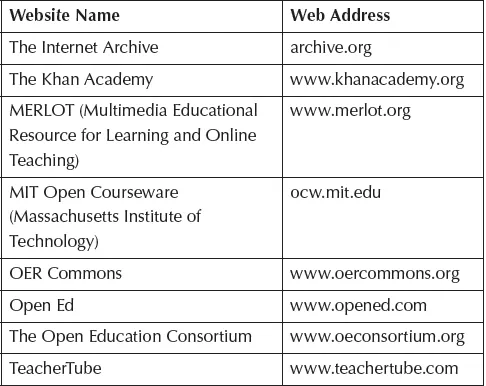
In the following chapters, you will learn how to produce your own OERs. Before you get started, it is a good idea to explore the OERs produced by others that are freely available. You will find things you can use as-is, and you will find inspiration for what you might create on your own. Table 1.1 provides a list of some of the most established and respected OER repositories used for a variety of grade levels.
Exploring the currently available OERs would provide you with ideas for using them in your own instruction and inspire you to create OERs of your own. In our experience, creating OERs with new media is an exciting and rewarding activity. As you master new media and gain experience producing OERs, you may find, as we have, new worlds of professional practice that improve and energize you as an educator.
Table 1.1 A list of some of the most established and respected OER repositories available on the internet
Summary
New Media is a term used to describe any digitally created media; it is often shared via networked computing (the internet, tablet or smartphone apps, etc.). Open Educational Resources or OERs are any instructional resources that are produced and/or distributed using new media that are available free or at minimal cost. The quality of currently available OERs ranges from expertly produced media to items created by aspiring amateurs. OERs are used in a wide variety of instructional settings, from elementary schools to universities and business settings. A number of excellent OER repositories currently exist and are worth exploring.
2 Digital Video
Video has been an important instructional asset for more than half a century. Broadcast television has been used to effectively teach everything from basic literacy and numeracy (e.g., Sesame Street) to university courses for credit (e.g., Sunrise Semester). More recently, digital videos presented on the internet have gained in popularity. Websites such as Lynda.com and Khan Academy are examples of vast collections of digital videos that provide instruction on topics ranging from song writing to electrical engineering.
Distribution and Access
Traditional broadcast video requires complex and expensive production and distribution. Producing a single episode of Sesame Street costs over $600,000 and requires a large team of professional educators, artists, and technicians. Digital video production can be equally expensive, but it can also be remarkably inexpensive. A single individual can produce highly effective instructional videos using basic computing tools and distributing them through free, web-based resources. As an example, Salman Khan, the founder of Khan Academy, got started with instructional video creating brief mathematics tutorials and distributing them on YouTube.
Distribut...
Table of contents
- Cover
- Half Title
- Title Page
- Copyright Page
- Dedication
- Table of Contents
- Acknowledgments
- 1. New Media and Open Educational Resources Defined
- 2. Digital Video
- 3. Digital Audio
- 4. Digital Text
- 5. Curated Digital Media
- 6. Copyright Considerations
- 7. Instructional Media Production and Evaluation
- References
- Index
Trusted by 375,005 students
Access to over 1.5 million titles for a fair monthly price.
Study more efficiently using our study tools.
Frequently asked questions
Yes, you can cancel anytime from the Subscription tab in your account settings on the Perlego website. Your subscription will stay active until the end of your current billing period. Learn how to cancel your subscription
No, books cannot be downloaded as external files, such as PDFs, for use outside of Perlego. However, you can download books within the Perlego app for offline reading on mobile or tablet. Learn how to download books offline
Perlego offers two plans: Essential and Complete
- Essential is ideal for learners and professionals who enjoy exploring a wide range of subjects. Access the Essential Library with 800,000+ trusted titles and best-sellers across business, personal growth, and the humanities. Includes unlimited reading time and Standard Read Aloud voice.
- Complete: Perfect for advanced learners and researchers needing full, unrestricted access. Unlock 1.5M+ books across hundreds of subjects, including academic and specialized titles. The Complete Plan also includes advanced features like Premium Read Aloud and Research Assistant.
We are an online textbook subscription service, where you can get access to an entire online library for less than the price of a single book per month. With over 1.5 million books across 990+ topics, we’ve got you covered! Learn about our mission
Look out for the read-aloud symbol on your next book to see if you can listen to it. The read-aloud tool reads text aloud for you, highlighting the text as it is being read. You can pause it, speed it up and slow it down. Learn more about Read Aloud
Yes! You can use the Perlego app on both iOS and Android devices to read anytime, anywhere — even offline. Perfect for commutes or when you’re on the go.
Please note we cannot support devices running on iOS 13 and Android 7 or earlier. Learn more about using the app
Please note we cannot support devices running on iOS 13 and Android 7 or earlier. Learn more about using the app
Yes, you can access The Educator's Guide to Producing New Media and Open Educational Resources by Tim D. Green,Abbie H. Brown in PDF and/or ePUB format, as well as other popular books in Education & Education General. We have over 1.5 million books available in our catalogue for you to explore.