- 336 pages
- English
- ePUB (mobile friendly)
- Available on iOS & Android
eBook - ePub
About this book
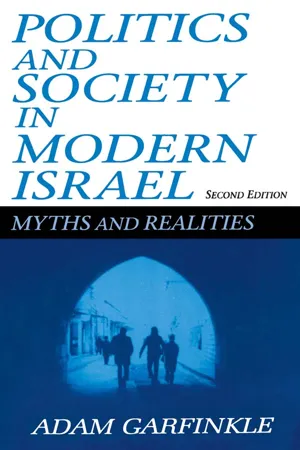
With full coverage of recent dramatic events in Israeli politics from the Rabin assassination through the May 1996 elections, this work provides an up-to-date introduction to Israeli politics and society. It seeks to convey a strong sense of everyday life in Israel, the nuances and contradictions of Israeli identity, the ethnic composition and institutional structure of Israeli society, as well as Israeli political culture and the issues that dominate the country's domestic and foreign policy.
Trusted by 375,005 students
Access to over 1.5 million titles for a fair monthly price.
Study more efficiently using our study tools.
Information
1
Introduction
Any book about the modern state of Israel must examine several areas of sociopolitical reality: the historical origins of the modern state; its main social and economic institutions; its general political culture; its electoral, judicial, and administrative bodies; its public policy agenda; and its foreign and national security policy. Key to all these topics, however, is understanding the process whereby Israeli experience is turning the Jewish historical mythos into modern Jewish reality.1
More than is the case with most countries, the origin of the present state of Israel is to be found in a set of ideas, not in the organic political evolution of a group of people living in a particular place over an extended period, which is how almost all other modern polities have developed. These ideas, which have roots in the ancient past but which speak to the modern (post-eighteenth-century) condition of the Jewish people, have a generative nature about them. Generative? I mean by generative only that, as in all other cases, beliefs about the past give rise to, or generate, expectations of the future.
In most cases, such expectations flow from historical continuity and resonate with extensive collective experience. For example, the United States has been a representative democracy within a large, ultimately continental-scale, state for the better part of two centuries; nearly all Americans expect that this will remain the case long into the future. This is certainly not an unreasonable belief, but that is not the point here. The point here is that the belief helps foster the ensuing reality. But understanding Israel means understanding the relationship between beliefs and expectations when the historical experience in question has been strikingly discontinuous. In such circumstances, reality is as likely to confound expectations as to confirm them. What happens then?
When reality delivers a rude shock to individuals, the response varies. Some people adjust their expectations and beliefs in the light of reality, as in “Well, I’m not going to be a millionaire by the time I’m thirty after all, so I’d better adjust my way of living and learn to appreciate what I have.” But others prefer to reinterpret reality to fit their beliefs and expectations, as in “I must become a millionaire by the time I’m thirty, so I’ll make riskier investments, take legal shortcuts, and work against those ‘conspiring’ against me.” The former strategy promises some short-term emotional pain but longer-term satisfaction. The latter strategy avoids short-term pain but risks long-term disaster.
Societies traffic in the same sorts of problems and basically employ the same sort of options for coping, although, obviously, societal beliefs present a far more complex phenomenon than individual ones. (An entire nation cannot lie on a psychiatrist’s couch, for example.) The founders of the modern state of Israel expected certain realities to come to pass. Some of these have in fact come to pass, but others have not. How is Israel coping with its disappointments? For that matter, how is it coping with its achievements, which invariably raise the twin questions of every younger generation in any land: “So what?” and “What have you done for me lately?”
Israel the Exceptional
The beginning of wisdom in understanding the implications of the distance between mythos and reality in the modern Israeli experience is the recognition that Israel is not an ordinary country. At the base of its differences is the aforementioned discontinuity of its historical experience. Let us count some of the ways in which this is manifest.
In an ordinary country, most members of the main nationality that make up the country live inside it, not outside of it. But there are more Jews living outside of Israel than inside it. (There are more Jews just in the New York City metropolitan area than there are in Israel.) Such states are called projection states; there are not many in the world (Armenia, Botswana, Grenada, Greece before about 1850, maybe Lebanon but nobody knows for sure), but when they do exist it makes a big difference in the country’s politics.
In no nation except Israel can the majority of people read and understand texts their forefathers wrote some four thousand years earlier. Israelis, whose native language is modern Hebrew, can.2
Most nations—and here we speak of like-minded groups of people, not territories, states, or governments—are bound together by a myth of tribal bloodlines, like that of Romulus for Italy and Russ for Russia; and it is literally true that most nations are extensions and elaborations of tribes or clan groups that expanded over time. Jews have the myth, for all Jews are supposedly descended from the Patriarchs and Matriarchs: Abraham, Isaac, and Jacob; Sarah, Rebecca, Leah, and Rachel. But they do not have the reality. Through centuries of diverse exiles and the intermarriages and conversions in and out of Judaism that took place in every generation, the genetic stuff of modern Jewry—and of modern Israel in particular, which is a modern Jewish genetic melting pot—is more diverse than just about any nation on earth.
In ordinary countries one can distinguish readily between ethnicity and religious affiliation among the people who live within it. There are French Catholics and French Protestants, and even French Muslims and French Jews. To be a Frenchman does not presuppose a religious identification. On the other hand, there are Muslims who are Arab and Muslims who are Turks, Indonesians, Bosnians, Albanians, and Malays. To be a Muslim does not presuppose a particular ethnic identification. But with Israelis and Jews it is not so simple. There are Israeli citizens who are not Jews—about 17 percent are Arabs, mostly Muslim but many Christian—but clearly Israel is a self-described Jewish state and was created as such. So the proper noun Jew can be set in distinction to Muslim, in which case one is contrasting religion; and Jew can just as readily be set in distinction to Arab, in which case one is contrasting ethnicity.
What this points to is that Jews are not just a religious group but also a people, and to become a Jew by religion is to become a member of the Jewish people as well. Obviously, therefore, Jews are not a race, although there are racial (that is to say, genetic) commonalities between large groups of Jews. Yet religion as such does not define a Jew, either. Not all Jews— and only a minority of Israelis—are religious, but they still consider themselves, and are, members of the Jewish people. Perhaps the best way to put it is this: Jews are people defined largely by possession of a common religious civilization, the longevity of which has produced racially identifiable clusters, and who today express that civilization in a variety of ways ranging from traditional observance to various forms of secularism, including secular nationalism.
This has created huge complications for Israeli law. Zionism stresses Jewish identity as a national group, not as a religious group. Yet there is no obvious way to define a Jew outside of at least basic religious criteria. A case in point is that of “Brother Daniel.” In the early 1960s, a man named Daniel Rufeison, who was born a Jew but who later became a Catholic monk, petitioned Israeli courts to be declared a Jew and have that inscribed on his identity card. “Brother Daniel” wanted Israeli citizenship under the Law of Return, a law that enables Jews to become instant citizens of Israel upon immigration (others can also become citizens, but there is a standard waiting period just like in the United States). The Israeli High Court, in a split decision, said no—that the common definition of a Jew was such that someone who actively professed another religion could not be considered a Jew. While the Court did not dare elevate Jewish religious law (halaka) as the binding authority in the decision, thus, in effect, making the state subordinate to religious law, its judgment certainly fuzzed the matter very thoroughly. And fuzzed it remains, as Israeli politicians and diaspora Jewish leaders battle over the question of “Who is a Jew?” which often as not comes down to “Who is a Rabbi?” But more of this later on.
To make matters even more complicated, most Jews who are not Israeli citizens consider themselves members of the Jewish people, and this binds them emotionally to Israel regardless of how they feel about religion. In the American context, for example, we typically refer to Italian Americans, Irish Americans, and African Americans, but to American Jews. Note which word is the identifying noun and which the descriptive adjective. This is suggestive of why Americans of Italian or Irish or Polish decent do not have the same kind of relationship to Italy, Ireland, and Poland as most American Jews have to Israel.
In an ordinary country, too, political sovereignty is based on typical historical relationships among territory (the country), people (the nation), and government (the state). Most typically, the nation has long lived on the territory, and the state has evolved organically over time as an outgrowth of authority relationships in society. The sense of nation as a conceptual unity grows from people having lived together in more or less the same place for a very long time, having intermarried, and having spoken the same living, if evolving, daily language.
It follows from what has already been said that this is not so for Israel. Ancient Israel developed in more or less such an ordinary way, but between the years 135 and 1948, the great majority of Jews lived in what they conceived to be exile, their land ruled by a procession of foreigners: Romans, Byzantine Greeks, Arabians, Crusaders, Seljuk Turks, Mamelukes, Egyptians, Ottoman Turks, and Britons. The Hebrew language became a language of liturgy and religious study as Jews adopted other languages for daily life depending on where they lived. For a very long time, then, Jews had no common spoken language and lived on no common territory.
During the exile, and despite the diversity of historical experiences within it, the concept of a unitary Jewish peoplehood was maintained through the power of an evolving portable religious civilization, rabbinic Judaism—in other words, through the power of an idea. Jewish self-identification was shaped not only by redacted memory of the ancient past and more recent history, both as interpreted through this evolving civilization, but also by the common experience of political powerlessness, more than occasional persecution, and the varied and often highly creative synergies that developed between Jewish culture and the cultures in which Jews lived.
As a result of the experiences of these long years, the Jewish mythos evolved further. The initial fusion of monotheistic religion, a literary culture that expressed it, and a Land that concretized and sustained both, was changed to accommodate a new set of abstract attributes developed to define the essence of the Jewish spirit and the role of the Jewish people in exile. In this evolved formulation, the key element of the Land was not lost but abstracted. From the time of Abraham himself, Zion was always regarded as a representation of monotheistic culture, not just a place. The Land became a conceptual unity, instead of just a collection of valleys and hillocks, because the Jews saw God as a unity and the Jewish people as a unity as well. In exile, then, the representational nature of the Land was not as difficult to carry away from the Middle East as it might otherwise have been.
Nevertheless, Jewish thinkers clearly interpreted their post-exilic experience as an extension of the historical narrative contained in the Bible. The Zionist movement, which arose in the latter part of the nineteenth century in Europe, sought to express, condense, and reshape that mythos in quest of the rebirth of Jewish political sovereignty in the ancient Jewish homeland. The key aim was the reconcretizing of the idea of the Land, and in this Zionism succeeded. The restoration of Jewish sovereignty after an exile so diverse in its geographic and social manifestations, and so long in years, is unprecedented in human history. It is first the uniqueness of the Jewish historical experience and second the achievement of the Zionist movement that has given rise to virtually all of the out-of-the-ordinary circumstances we have just noted.
As a result of the Jewish self-consciousness of its own history, when the modern state of Israel came into being in May 1948, a new Jewish self-image wrought by Zionism came into being with it. As noted, it mingled ancient, exilic, and modern elements, sometimes deliberately, sometimes not. This image has shaped, and has itself been reshaped by, the Israeli experience ever since. To a lesser but still very significant extent, it has also changed the images and self-images of Jews still scattered throughout the world.
This mixture of images shows up today throughout Israeli culture, politics, and foreign policy. What is crucial, however, is that just as this mythos has shaped Jewish political culture in Israel, so the experience of independent Israel is reshaping the Jewish mythos itself. The relationships between Jewish religion and society, between Israel and the Jewish diaspora, and also between Israelis and Arabs in Israel and the Middle East generally, are all in flux thanks to more than half a century of independent, modern Israel.
In short, the story of Israel is to a considerable extent the story of an ongoing dialectic between mythos and reality. In this, Israel is no different from any other society, for the social world is everywhere autogenic—self-constructed— a collective projection of human intentionality. But owing to the peculiarities of Jewish history, perhaps nowhere on earth is this process so dramatically clear as it is in looking at modern Israel, a country that may be said to have willed itself back into existence from the ether of history. Having done so, however, Israelis now face the often unnerving task of reconciling myth with reality. Most of the major divisions in Israeli society and politics revolve around conflicting views and methods of how to do just that.
The Egg that Was a Golf Ball: Political Culture
So, the social world is full of autogenic dialectical relationships, is it? This is a mouthful, but it is an important mouthful, well worth a moment’s reflection and unpacking.
It is the nature of social life that it freezes into itself the conceptions we have of it, or as I.W. Thomas once wrote: “If men define situations as real, they are real in their consequences.” Another way of putting this is to recall the well-known notion of a “self-fulfilling prophecy,” the observation that, for better or worse, people act on the basis of what they believe, and the actions taken very often work out to confirm the belief. For example, one’s little sister at age fourteen thinks she’s unpopular because she imagines herself to be unattractive, so she acts defensively and strange, thereby becoming unpopular and reinforcing her erroneous interpretation of why this is (“I’m unattractive”). The cycle is eventually broken when someone she cares for is persistently nice to her, or when she finally takes a serious look in the mirror.
The truth is that whole societ...
Table of contents
- Cover
- Half Title
- Title Page
- Copyright Page
- Dedication
- Table of Contents
- Preface to the Second Editon
- 1. Introduction
- 2. In the Beginning
- 3. Society and Polity at Independence
- 4. Society and Political Economy in Contemporary Israel
- 5. Political Institutions and Issues
- 6. Foreign Policy: Sources and Substance
- 7. Peace and Normalcy?
- Epilogue
- Notes
- Glossary of Hebrew Terms and Acronyms
- Suggested Readings
- Index
Frequently asked questions
Yes, you can cancel anytime from the Subscription tab in your account settings on the Perlego website. Your subscription will stay active until the end of your current billing period. Learn how to cancel your subscription
No, books cannot be downloaded as external files, such as PDFs, for use outside of Perlego. However, you can download books within the Perlego app for offline reading on mobile or tablet. Learn how to download books offline
Perlego offers two plans: Essential and Complete
- Essential is ideal for learners and professionals who enjoy exploring a wide range of subjects. Access the Essential Library with 800,000+ trusted titles and best-sellers across business, personal growth, and the humanities. Includes unlimited reading time and Standard Read Aloud voice.
- Complete: Perfect for advanced learners and researchers needing full, unrestricted access. Unlock 1.5M+ books across hundreds of subjects, including academic and specialized titles. The Complete Plan also includes advanced features like Premium Read Aloud and Research Assistant.
We are an online textbook subscription service, where you can get access to an entire online library for less than the price of a single book per month. With over 1.5 million books across 990+ topics, we’ve got you covered! Learn about our mission
Look out for the read-aloud symbol on your next book to see if you can listen to it. The read-aloud tool reads text aloud for you, highlighting the text as it is being read. You can pause it, speed it up and slow it down. Learn more about Read Aloud
Yes! You can use the Perlego app on both iOS and Android devices to read anytime, anywhere — even offline. Perfect for commutes or when you’re on the go.
Please note we cannot support devices running on iOS 13 and Android 7 or earlier. Learn more about using the app
Please note we cannot support devices running on iOS 13 and Android 7 or earlier. Learn more about using the app
Yes, you can access Politics and Society in Modern Israel by Adam Garfinkle in PDF and/or ePUB format, as well as other popular books in Politik & Internationale Beziehungen & Diplomatie & Abkommen. We have over 1.5 million books available in our catalogue for you to explore.