- 240 pages
- English
- ePUB (mobile friendly)
- Available on iOS & Android
eBook - ePub
About this book
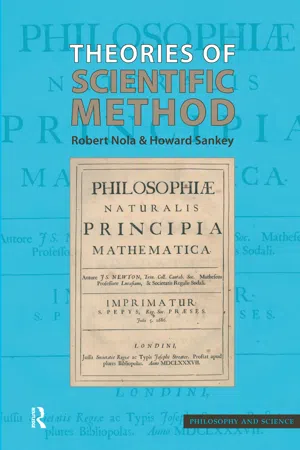
What is it to be scientific? Is there such a thing as scientific method? And if so, how might such methods be justified? Robert Nola and Howard Sankey seek to provide answers to these fundamental questions in their exploration of the major recent theories of scientific method. Although for many scientists their understanding of method is something they just pick up in the course of being trained, Nola and Sankey argue that it is possible to be explicit about what this tacit understanding of method is, rather than leave it as some unfathomable mystery. They robustly defend the idea that there is such a thing as scientific method and show how this might be legitimated. This book begins with the question of what methodology might mean and explores the notions of values, rules and principles, before investigating how methodologists have sought to show that our scientific methods are rational. Part 2 of this book sets out some principles of inductive method and examines its alternatives including abduction, IBE, and hypothetico-deductivism. Part 3 introduces probabilistic modes of reasoning, particularly Bayesianism in its various guises, and shows how it is able to give an account of many of the values and rules of method. Part 4 considers the ideas of philosophers who have proposed distinctive theories of method such as Popper, Lakatos, Kuhn and Feyerabend and Part 5 continues this theme by considering philosophers who have proposed naturalised theories of method such as Quine, Laudan and Rescher. This book offers readers a comprehensive introduction to the idea of scientific method and a wide-ranging discussion of how historians of science, philosophers of science and scientists have grappled with the question over the last fifty years.
Information
8. Probability, Bayesianism and methodology
The theory of probabilistic inference has come to occupy a prominent place in methodology Over the past fifty years subjective Bayesianism has been regarded (by many but not all) as the leading theory of scientific method. Here and in Chapter 9 we set out what this theory is, how it comes to encompass many of the aspects of method explored elsewhere in this book and what its strengths and weaknesses may be. Section 8.1 sets out the axioms of probability along with some of their more important consequences. These lead quite naturally to Bayes's theorem, a result discovered by the eighteenth-century cleric Thomas Bayes, which is central to all probabilistic thinking. The theorem comes in many different forms several of which are mentioned in §8.2 in order to bring out the different ways in which it can be applied. Once this is set out it is possible to outline a theory of the confirmation of a hypothesis by evidence (§8.3). In §8.4 it is shown that the H-D method can be placed in this setting; its good aspects turn out to be special cases of Bayes's theorem. This setting also provides a theory of confirmation for the H-D method, something that it lacks.
There are a number of different ways in which the probability calculus can be interpreted. Some interpret it in an objectivist way, for example Jeffreys in his attempt to show that there is an objective way of assigning prior probabilities to hypotheses (see §5.6). This is to be contrasted with the widely adopted alternative view in which probability is understood as a coherent subjective, or personal, degree of belief This position is explored in the remainder of this chapter beginning with §8.5, which sets out the subjectivist position, taking its cue from the work of Ramsey. Coherent subjective degrees of belief are those that ought to be in conformity with the probability calculus. If they do not conform then there is an argument that says that a "Dutch book" can be made against a person such that they can never win in their bets against nature. This is an important result in the metamethodology of subjective Bayesianism, which lays the foundations for the normativity of the rules of the probability calculus; §8.6 outlines some of the metamethodological issues involved here. Another important aspect of subjective Bayesianism is the rule of conditionalization (§8.7). These three sections provide the core of the subjectivist Bayesian approach.
In Chapter 9 we consider a range of further matters to do with Bayesianism such as: whether the rules of the probability calculus need supplementation in order to provide a theory of scientific method; the problem of priors; its account of new and old evidence; the extent to which it can accommodate aspects of inference to the best explanation; what justification of induction it can provide; and its account of some of the values and rules mentioned in Part I. Although there are some successes, there are also some shortcomings to note. Whatever the verdict on Bayesianism as an overall theory of method, it is the pivot around which much current work in methodology turns.
8.1 Principles and theorems of probability
We commonly speak of the probability of a hypothesis H given evidence E, and abbreviate this as "P(H, E)" (some write this as "P(H/E)"). This is sometimes called relative probability, the probability of H relative to E. More commonly it is called the posterior probability (following Laplace's terminology); it is the probability of H coming after the evidence. It is also called the conditional probability, the probability of H on the condition of E.
This is to be distinguished from another probability, P(E, H), in which the order of E and H is the reverse of that given in P(H, E). This used to be called inverse probability, but following Fisher's usage it is more commonly called the likelihood of hypothesis H in the light of evidence E (and is sometimes written as L(H, E)).
The difference between the two forms can be illustrated as follows. If we think of hypothesis H as given and fixed and we let E vary over different kinds of evidence E1, E2,... Em, then P(H, Ei), i = 1, 2,... m, will represent the different probabilities of the same hypothesis for different evidence. That is, from the stance of the same hypothesis H, different pieces of evidence will make H probable, less probable or more probable. Now think of £ as a constant and let H vary in P(E, H) (or in L(H, E)). That is, H varies over the hypotheses H1, H2, ..., Hn, thereby yielding various likelihoods P(E, Hi), i = 1,2, ..., n. We can now ask: how probable do the various Hi make the same evidence E? Or, how likely are the Hi in the light of E? P(E, Hi) represents various likelihoods that different hypotheses Hi confer on the same evidence E. From the stance of the same evidence, different hypotheses will make that evidence more likely, less likely or unlikely.
H and E can be any propositions whatever. The hypothesis H can be taken quite broadly to be any of the following: a theory (e.g. in the case of Newtonian mechanics the conjunction of the three laws of motion and the law of universal gravitation); a single law or generalization; a singular hypothesis of the sort to be determined in courts of law (e.g. whether or not some person is guilty as charged); a medical hypothesis about the cause of a patients symptoms; or a singular claim of history (e.g. Napoleon was poisoned with arsenic when exiled in St Helena). Similarly, what counts as evidence E can be broad, from a singular report of observation, a conjunction of many pieces of data, lower-level laws, and the like.
We can also consider the probability of a hypothesis H all by itself in the absence of any evidence. This we shall write as: P(H). Sometimes this is called the absolute probability, or the unconditional probability (as opposed to conditional probability given above) in that no conditions of evidence are required. More commonly it is called the prior probability, that is, prior to considering any evidence. This can also be represented as a relative probability. If we let "S" stand for only logical truths or tautologies, then we can write "P(H)" as "P(H, S)". That is, we consider the probability of H given only logical truths and not any empirical and/or contingent evidence.
What is the connection between prior and posterior probability? Posterior probability is commonly defined in terms of prior probability as follows:

The rationale behind this definition can be seen with the help of the Venn diagram below (Figure 8.1) to represent probability relations.

Figure 8.1 Venn diagram for definition of posterior probability in terms of prior probability.
Consider the rectangle, which properly contains two oval figures each of a given area. The area of each oval over the total area of the rectangle yields a fraction between 0 and 1. Let the ovals represent hypothesis H and evidence E\ their prior probabilities can then be given as one of these fractions (of the respective oval area over the area of the whole rectangle). H and E overlap in the area (H & E). Suppose that one throws a dart at the rectangle and hits the evidence area E. (The supposition makes no sense when the evidence area E is zero.) Then we can ask: what is the probability that the dart also hits the hypothesis area H? It could only do so if it hits the overlap area of H & E. So, what is the probability that, given that the dart hits E, that it also hits H? In effect we are asking: what is the probability of H given E, that is, P(H, E)? Looking at the diagram we can work this out. It is the fraction obtained from the intersection area (H & E) over the total area of E. Since the areas are proportional to probabilities we can say that it is given by the ratio of P(H & E)/P(E).1
The following sets out what are commonly taken to be the three axioms of the probability calculus, and some of the important principles or theorems that follow from them, which have a central role in scientific reasoning and method. Axiom 1: 0 ≤ P(H) ≤ 1 That is, the (prior or absolute) probability of a hypothesis H lies between 0 and 1, and includes 0 and 1 as lower and upper bounds. The same axiom also holds for conditional probabilities: 0 ≤ P(H, E) ≤ 1. Axiom 2: P(...
Table of contents
- Cover
- Half Title
- Title
- Copyright
- Contents
- Abbreviations
- Acknowledgements
- Introduction
- I The idea of methodology
- II Inductive and hypothetico-deductive methods
- III Probability and scientific method
- IV Popper and his rivals
- V Naturalism, pragmatism, realism and methodology
- Epilogue
- Notes
- Bibliography
- Index
Trusted by 375,005 students
Access to over 1.5 million titles for a fair monthly price.
Study more efficiently using our study tools.
Frequently asked questions
Yes, you can cancel anytime from the Subscription tab in your account settings on the Perlego website. Your subscription will stay active until the end of your current billing period. Learn how to cancel your subscription
No, books cannot be downloaded as external files, such as PDFs, for use outside of Perlego. However, you can download books within the Perlego app for offline reading on mobile or tablet. Learn how to download books offline
Perlego offers two plans: Essential and Complete
- Essential is ideal for learners and professionals who enjoy exploring a wide range of subjects. Access the Essential Library with 800,000+ trusted titles and best-sellers across business, personal growth, and the humanities. Includes unlimited reading time and Standard Read Aloud voice.
- Complete: Perfect for advanced learners and researchers needing full, unrestricted access. Unlock 1.5M+ books across hundreds of subjects, including academic and specialized titles. The Complete Plan also includes advanced features like Premium Read Aloud and Research Assistant.
We are an online textbook subscription service, where you can get access to an entire online library for less than the price of a single book per month. With over 1.5 million books across 990+ topics, we’ve got you covered! Learn about our mission
Look out for the read-aloud symbol on your next book to see if you can listen to it. The read-aloud tool reads text aloud for you, highlighting the text as it is being read. You can pause it, speed it up and slow it down. Learn more about Read Aloud
Yes! You can use the Perlego app on both iOS and Android devices to read anytime, anywhere — even offline. Perfect for commutes or when you’re on the go.
Please note we cannot support devices running on iOS 13 and Android 7 or earlier. Learn more about using the app
Please note we cannot support devices running on iOS 13 and Android 7 or earlier. Learn more about using the app
Yes, you can access Theories of Scientific Method by Robert Nola,Howard Sankey in PDF and/or ePUB format, as well as other popular books in Philosophy & Epistemology in Philosophy. We have over 1.5 million books available in our catalogue for you to explore.