Criminal Justice Procedure gives clear guidance on the most common questions faced by today's law enforcement, offering fresh look at 21st century pre-trial protocol. Unlike other case books, this newly revised edition eschews legal theory in favor of the practical know-how needed to not to parse, but apply criminal law. Emphasis has been placed on just exactly how practitioners should conduct hot-button procedures such as airport and border searches. Moreover, the book also addresses the often dire implications of deviating from proper practice - how a false step can translate into a violation of individual rights, or the inability to successfully prosecute the guilty. This edition has been specifically designed for CJ undergraduate programs (rather than higher-level law schools) and completely reorganized for a more logical flow of topics. Moreover, it is newly focused on the most crucial practical applications of the law in the CJ context. There is also added emphasis on the Fourth, Fifth, and Sixth Amendments.
- 244 pages
- English
- ePUB (mobile friendly)
- Available on iOS & Android
eBook - ePub
Criminal Justice Procedure
1
AN Overview of Criminal Justice in America
The Role of Criminal Procedure in the Criminal Justice Process
Chapter Outline
| 1.1 | Introduction |
| 1.2 | Goals of Criminal Procedure |
| 1.3 | Sources of Criminal Procedural Laws |
| 1.4 | Adversary System of Justice |
| 1.5 | Steps in the Criminal Justice Process |
| 1.6 | Briefing a Case |
| 1.7 | Summary |
Key Terms
- Adversary theory of justice
- Appeal
- Arraignment
- Arrest
- Arrest warrant
- Booking
- Charge
- Closing argument
- Common law
- Conviction
- Cross examination
- Custodial interrogation
- Custody
- Defendant
- Diversion
- Double jeopardy
- Evidence
- Exclusionary rule
- Federalism
- Felony
- Grand jury
- Habeas corpus
- Hearings
- Indictment
- Information
- Investigation
- Jury
- Jury instructions
- Motion
- Plea
- Post-conviction remedy
- Preliminary examination
- Probable cause
- Prosecution
- Reasonable suspicion
- Right to counsel
- Search warrant
- Trial
- Warrant
Learning Objectives
- Understand the goals and importance of criminal procedure.
- Understand key concepts related to the study of criminal procedure.
- Identify the steps in the criminal court process.
- Identify the various sources of laws related to criminal procedure.
- Understand how to brief a legal case.
1.1 Introduction
The issues of crime and its control are concerns for Americans today. The public often registers these concerns when voting, and the impact of crime on public consciousness is seen in recurring opinion polls, which rate it at or near the top of "major unresolved problems in America." The criminal justice system and its processes are presented to most Americans via television's police and courtroom dramas. Numerous television shows depict citizen interactions with police and courtroom processes. Although the popularity of these shows seems to be timeless, most citizens will not interact with the criminal justice system during their lifetimes. For those who do encounter the criminal justice system, most mill interact with the police through incidents such as routine traffic stops or reporting criminal incidents to the police. Others will encounter police as witnesses to crimes, and some will encounter the system as alleged offenders. The primary function of criminal procedure in these encounters is to balance the protection of society with individual rights of the accused. In all cases, the outcome should be for the guilty to be held accountable and the innocent to be cleared as quickly as possible. This text provides an overview of criminal procedure, primarily police interaction with citizens. To the extent that police interaction extends to the trial process, those areas will also be covered.
1.2 Goals of Criminal Procedure
Criminal procedure contains the body of laws and policies that govern citizen interactions with officials. Several goals of criminal procedure have been identified. First, criminal procedure promotes reliable fact finding that is aimed at discovering the truth. A civilized society requires that the rights of all be recognized in the fact-finding process; for example, police cannot secure a confession by torturing a suspect. Such actions are not permissible, even through the argument that the end justifies the means. In our society, we can only take away the rights of one person to the extent that we are prepared to give up that right ourselves. The system is not designed to protect the rights of the innocent, but to protect the rights of all.
Thus, the first goal of promoting reliable fact finding flows directly into the second goal of protecting and promoting fairness in government/citizen interaction. Criminal procedure is the mechanism employed to limit the power of government over citizens and to strike a balance between individual rights and government actions. Individual rights in criminal cases are generally contained within the Fourth, Fifth, Sixth, Eighth, and Fourteenth amendments to the U.S. Constitution. Citizens are protected from unreasonable searches and seizures and coerced self incrimination, and they are guaranteed public trials before a jury of their peers, to name a few individual rights. Although these rights are enumerated in the Amendments to the U.S. Constitution, they originally only protected citizens from actions of the federal government. Many have now been incorporated as protecting citizens against actions from state governments through the Fourteenth Amendment.
Discussions of the powers of state and federal governments lead to the third goal of criminal procedure which is to respect the principles of federalism. Federalism is the separation of powers between the state and federal systems of government. The Tenth Amendment to the U.S. Constitution states that all rights not enumerated in the Bill of Rights are reserved to the states. Each state has its own constitution and its own set of criminal laws. States may grant their citizens more rights than those guaranteed by the U.S. Constitution, but they cannot provide fewer rights. The U.S. Supreme Court is considered the supreme law of the land and will resolve conflicts of procedural issues in cases where citizens challenge the constitutionality of a state or federal procedural issue.
The final goal of criminal procedure is finality of the judgment. Neither citizens nor government benefits from having cases tried and retried ad infinitum. Accordingly, principles of criminal procedure such as double jeopardy speedy trial, and statute of limitations help ensure that prosecutions are timely and that results are final.
1.3 Sources of Criminal Procedural Laws
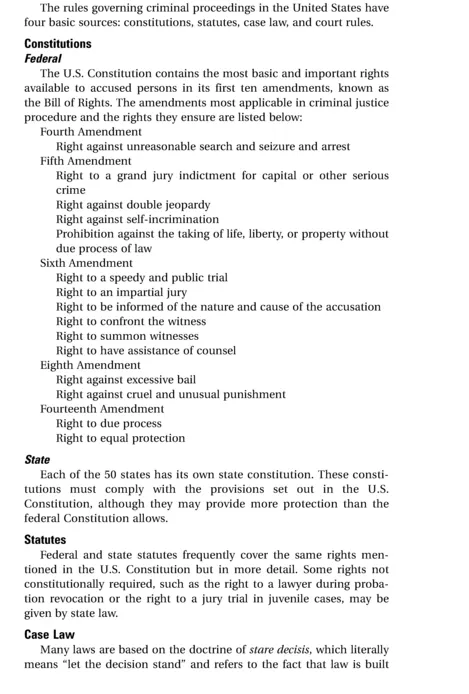
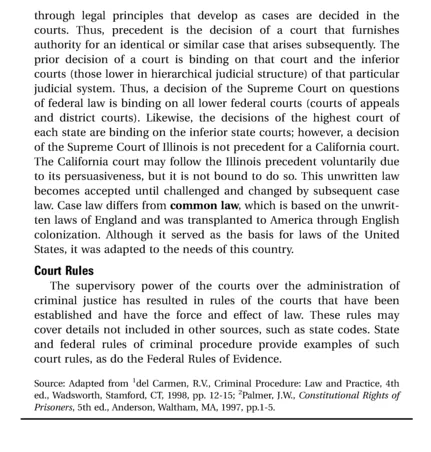
Although many of the rights discussed throughout this book are contained within the Amendments to the U.S. Constitution, state law, statutes, and case laws all contain important provisions that guide criminal procedure. Table 1.1 explains the importance of each of the sources of law.
1.4 Adversary System of Justice
American criminal trials proceed under the adversary (or contest) theory of justice to arrive at the truth in a given case. One characteristic feature of this system is intensive cross-examination of both defense and prosecution witnesses. In a jury trial, it is for the jury, which observes these witnesses, to weigh the evidence and make the ultimate decision in every case—guilty or not guilty. For this reason, an experienced police officer recognizes that a case is far from over once he or she makes an arrest, no matter how careful the preliminary investigation or how meticulous the officer's seizure of evidence.
1.5 Steps in the Criminal Justice Process
1.5.1 Arrest
The initial contact between a citizen and law enforcement officer is likely to occur during an arrest or investigation. At this stage, the Fourth Amendment guarantees citizens the right to be free from unreasonable searches and seizures. Some arrests are based upon arrest warrants signed by a judge or magistrate. The warrant is a written order directing a peace officer (frequently any officer in the state) to take a person into custody on a designated charge. The warrant is issued in the name of the state, and prior to issuance the magistrate must decide whether the facts known to the police reasonably support
TABLE 1.1 SOURCES OF RIGHTS
a conclusion that the person sought to be arrested committed the crime.
Many arrests are made without a warrant. To make a warrantless felony arrest, a law enforcement officer must have probable cause to believe that a crime has been committed and that the defendant committed it. Probable cause will be covered in greater detail in the following chapters. It is, however, the threshold issue for determining the application of the Fourth Amendment.
Shortly after the arrest, when the suspect has been transported to the police station, the suspect will be booked. At booking, basic information about the suspect is recorded in the arrest book. This information includes the suspect's name, the time of the arrest, and the criminal charge. At this point, the suspect may be fingerprinted and photographed.
Just as an arrest warrant is necessary for an arrest, a search warrant is necessary to search for evidence of a crime. Any search conducted without a warrant is presumed to be unreasonable unless it fits within an exception (this principle will be more fully discussed in later chapters, but stems from the Supreme Court case of Katz v. United States, 389 U.S. 347 (1976). Like arrests, searches must also be supported by probable cause. The scope and duration of a search differ depending upon the level of certainty an officer has. A more limited search can be based on reasonable suspicion.
If a citizen is arrested and questioned by officials, the Fifth Amendment attaches and provides protection from self incrimination. The Supreme Court defined the rights of an accused in a custodial interrogation in Miranda v. Arizona, 384 U.S. 436 (1966). Determinations of when Miranda warnings must be read and whether an accused has waived his or her right to remain silent are issues of concern at this stage of the proceeding.
1.5.2 Prosecution or Diversion
Not all arrested persons are fully prosecuted. A suspect may be released without the filing of a formal charge, perhaps because the police believe there is insufficient evidence to hold him. In addition, a defendant may be released to a diversion program. Diversion characteristically involves a discretionary decision on the part of an official that there is a better way to deal with a defendant than to prosecute him. Thus, police or prosecutors may decline to proceed with criminal prosecution in the first instance, or they may exercise discretion to terminate an ongoing case if they conclude that prosecution is inappropriate.
Usually the decision to divert is accompanied by an accused person's promise to take certain rehabilitative steps on his or her own behalf. The authorities may discontinue prosecution of a person arrested for public drunkenness, for example, if the accused complies with certain conditions, such as treatment in a detoxification center or participation in a similar program. Juveniles may be diverted from the juvenile justice process by police who conclude that justice is better served by counseling and releasing youths to their parents or to a community agency. In lieu of formal court proceedings, aged or mentally handicapped persons who have committed nonviolent offenses are frequently diverted from criminal prosecution when it is thought that another person or agency is well suited to assume responsibility for future conduct.
Diversion characteristically uses the potential threat of a temporarily suspended criminal process to encourage rehabilitative conduct by the accused. Diversion often takes place after arrest but before a defendant goes to court; however, diversion of offenders into noncriminal programs may take place later in the process, occurring at any stage of the prosecution prior to conviction.
1.5.3 First Appearance on the Charge
Once the case moves beyond the questioning phase and the accused is formally charged with a criminal offense, the Sixth Amendment provides trial rights to the defendant. Among those rights is the right to be represented by an attorney at all critical stages of the proceedings.
In a typical case that is proceeding to trial, the arrested person is taken before a magistrate shortly after being arrested. The Federal Rules of Criminal Procedure require any federal officer who makes an arrest with or without an arrest warrant to take the arrested person before the nearest available federal magistrate without unnecessary delay The magistrate must in...
Table of contents
- Cover
- Half Title
- Title
- Copyright
- Contents
- Preface
- Online Instructor and Student Resources
- Selected Provisions of the United States Constitution
- Case Citation Guide
- Sample Case Citations
- Chapter 1 An Overview of Criminal Justice in America
- Chapter 2 The Fourth Amendment
- Chapter 3 Arrests
- Chapter 4 Searches: General
- Chapter 5 Exceptions to the Warrant Requirement: Automobile Searches
- Chapter 6 Exceptions to the Warrant Requirement: Plain View, Open Fields, Abandoned Property, and Consent Searches
- Chapter 7 Search Incident to a Lawful Arrest and Hot Pursuit
- Chapter 8 Airport, Border, and Other Exigencies
- Chapter 9 Special Problems: Location of Trial and Double Jeopardy
- Chapter 10 Miscellaneous Proceedings: Juvenile Justice, Misdemeanor Trials, Damage Suits Against Police, and Prisoner Rights
- Chapter 11 The Adversary System
- Appendix to Chapter 1: Grand Jury Procedure
- Appendix to Chapter 2: Motion to Suppress
- Appendix to Chapter 3: Rule 4 of the Federal Rules of Criminal Procedure: Arrest Warrant or Summons on a Complaint
- Appendix to Chapter 4: Rule 41 of the Federal Rules of Criminal Procedure: Search and Seizure
- Appendix to Chapter 9: The Fifth Amendment Double Jeopardy Clause: Application to States
- Appendix to Chapter 10: Pretrial Motions and Hearings
- Appendix to Chapter 11: Plea Bargaining
- Glossary
- Table of Cases
- Index
Trusted by 375,005 students
Access to over 1.5 million titles for a fair monthly price.
Study more efficiently using our study tools.
Frequently asked questions
Yes, you can cancel anytime from the Subscription tab in your account settings on the Perlego website. Your subscription will stay active until the end of your current billing period. Learn how to cancel your subscription
No, books cannot be downloaded as external files, such as PDFs, for use outside of Perlego. However, you can download books within the Perlego app for offline reading on mobile or tablet. Learn how to download books offline
Perlego offers two plans: Essential and Complete
- Essential is ideal for learners and professionals who enjoy exploring a wide range of subjects. Access the Essential Library with 800,000+ trusted titles and best-sellers across business, personal growth, and the humanities. Includes unlimited reading time and Standard Read Aloud voice.
- Complete: Perfect for advanced learners and researchers needing full, unrestricted access. Unlock 1.5M+ books across hundreds of subjects, including academic and specialized titles. The Complete Plan also includes advanced features like Premium Read Aloud and Research Assistant.
We are an online textbook subscription service, where you can get access to an entire online library for less than the price of a single book per month. With over 1.5 million books across 990+ topics, we’ve got you covered! Learn about our mission
Look out for the read-aloud symbol on your next book to see if you can listen to it. The read-aloud tool reads text aloud for you, highlighting the text as it is being read. You can pause it, speed it up and slow it down. Learn more about Read Aloud
Yes! You can use the Perlego app on both iOS and Android devices to read anytime, anywhere — even offline. Perfect for commutes or when you’re on the go.
Please note we cannot support devices running on iOS 13 and Android 7 or earlier. Learn more about using the app
Please note we cannot support devices running on iOS 13 and Android 7 or earlier. Learn more about using the app
Yes, you can access Criminal Justice Procedure by Stacy Moak,Ronald Carlson in PDF and/or ePUB format, as well as other popular books in Law & Criminal Law. We have over 1.5 million books available in our catalogue for you to explore.