- 288 pages
- English
- ePUB (mobile friendly)
- Available on iOS & Android
eBook - ePub
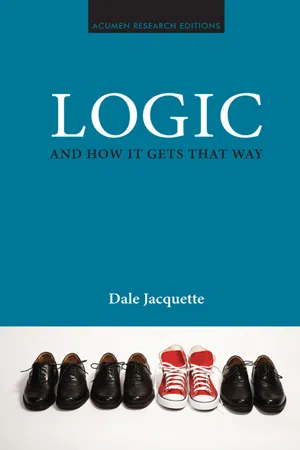
Logic and How it Gets That Way
About this book
In this challenging and provocative analysis, Dale Jacquette argues that contemporary philosophy labours under a number of historically inherited delusions about the nature of logic and the philosophical significance of certain formal properties of specific types of logical constructions. Exposing some of the key misconceptions about formal symbolic logic and its relation to thought, language and the world, Jacquette clears the ground of some very well-entrenched philosophical doctrines about the nature of logic, including some of the most fundamental seldom-questioned parts of elementary propositional and predicate-quantificational logic. Having presented difficulties for conventional ways of thinking about truth functionality, the metaphysics of reference and predication, the role of a concept of truth in a theory of meaning, among others, Jacquette proceeds to reshape the network of ideas about traditional logic that philosophy has acquired along with modern logic itself. In so doing Jacquette is able to offer a new perspective on a number of existing problems in logic and philosophy of logic.
Information
CHAPTER 1
Logical form
CONCEPTS OF LOGIC
If we can explain what logic is, correctly describing in the most general way the nature or concept of logic, then we should have already said enough to understand why logic is important. We may begin, in keeping with customary practice, by saying that logic studies the structural properties of reasoning. Reasoning in turn is an exercise of thought, at least of thoughts considered in the abstract, in which conclusions are drawn inferentially from assumptions.
Assumptions and conclusions, in turn, are propositions. The ontic status of propositions is a frequent subject of philosophical dispute. Propositions can nevertheless be interpreted as sentence tokens or types or the abstract meanings of sentence tokens or types, in which a state of affairs is proposed for consideration, classically as true or false. Logical inference is generally considered to be a syntactical correlation of sentences representing assumptions and conclusions in permissible combinations, or as a semantic relation holding between the possible truth-values of propositions taken respectively as assumptions and conclusions. We may also be able to reason in the sense of drawing inferences from questions and commands, and from direct experiential encounters with the state of the world in the empirical experience of sensation and perception. Logicians have investigated some of these non-propositional formal inferential relations, but the topic has not been widely explored in the philosophical literature. There are already more than enough problems for logicians to consider with respect to the semantics of deductively valid and invalid propositional inference. Still, we cannot disregard these aspects of reasoning if thought processes can sometimes include drawing conclusions from the information content of data, converting propositional input to propositional output. We may use such information in our reasoning not only in deciding on a plan of action, in choosing what to do against the background of a certain set of values, but also in matching means to ends in plotting the course of an action to which we may choose to dedicate our efforts within a reasonable timeframe and with the resources at our disposal. If we are not doing these kinds of things, then, regardless of the merits, nobility, or importance of our values, we may be open to the observation that we are not proceeding rationally.
Logic is a prescriptive discipline that lays down guidelines for correct and incorrect reasoning. As most textbooks struggle to say in just the right terms, logic, as Frege declared already in the late nineteenth century, is not supposed to be psychologistic. By this, Frege means that, as in the scientific study of the North Sea, logic must never be confused with the psychology of individuals engaged in logical reasoning. Logic, consequently, is not the empirical study of how fallible thinking beings actually reason, but a normative explanation of how they ought ideally to reason insofar as they are reasoning correctly.
The situation in contemporary philosophy of logic that has not been sufficiently acknowledged is much the same as one encountered in contemporary ethics. It is the problem of what is to count and how we are to decide what is to count as the ideally correct reasoning to which a formal symbolic or other systematic approach to articulating the requirements of logic must conform. We need not be logical anarchists who decry and apparently despise (and seldom seem themselves to be very good at working with) formal logical systems and standards of any kind in order to wonder where logical standards are supposed to come from and what exactly establishes their credentials in correctly drawing such fundamental distinctions as we expect to hold among logically valid and invalid inferences. The problem, properly acknowledged or not, is one that confronts even the most conservative aprioristic standpoint in philosophy of logic. It is a topic, in any case, that the present enquiry cannot afford to ignore.
LOGICAL UNITS AND REASONING CHAINS
We may identify units or minimal components of reasoning as the smallest possible inferences of which thought and language are capable. These stereotypically involve a single assumption and a single conclusion.
In terms of our previous sketch of the elements of logical reasoning, we can say that logic deals with reasoning episodes. Reasoning is a matter of inference, intrinsic to thought and capable of being represented in language in which there are assumptions and conclusions distinguished by means of inference indicators. Units of reasoning as the smallest possible connections of assumptions and conclusions distinguished by inference indicators can in turn be linked together into larger and larger chains of reasoning in a variety of ways. In principle, there can be no limit to the length or complexity of the reasoning with which logic is concerned. If we recognize that finite human beings and computers as finite state machines can only manageably contain limited chains of reasoning pursued in real time within the practical limitations of memory and cognitive workspace, then we should not expect thinking beings, natural or artificial, to be limited in any way by formal logical and metalogical limitations that presuppose an actual infinity of objects, or infinitely many steps or procedures of an algorithm or database search, as such interesting questions in abstract logical computing theory as the halting problem for Turing machines presuppose. We can additionally think of ongoing disputes in decision-making by indefinitely larger though still finite committees consisting of many persons each contributing their thoughts to a common enterprise, extending beyond the limits of any individual thinker’s abilities.
Reasoning is crucial to policy determinations and to the assessment of and attempt to satisfy needs and wants by matching means to ends in practical judgement. If we think of logic as concerned with the structural properties of reasoning, then the importance of logic in all aspects of our lives should be obvious. Logic establishes indispensable norms or standards for good reasoning, and distinguishes good reasoning from bad, ineffective, or unreliable reasoning. By this means, logic, as the study of the structural properties of units and chains of reasoning, sets requirements for logically correct and logically incorrect inference. Logic posts guidelines that can aid the conscientious reasoner in drawing the kinds of conclusions from assumptions and other sources of information that can in principle facilitate better decision-making at every level of reasoning. From individual planning and evaluating of evidence to the kinds of decisions that confront larger communities and political groups at local, national and international echelons, logic enters into all components of reasoned judgement. We need only think of the decision-making processes at work in choosing how best to manage an agricultural or industrial economy, whether through planning or market forces, or some combination of the two; choosing effective measures for airport security; organizing an educational curriculum or sports event; or deciding on holiday vacation plans. The importance of good reasoning, and hence on a reliable system of correct logical inference, is crucial to all human endeavours in which we do not simply rely on chance, emotion, or uncritically accepted authority or tradition.
DEDUCTIVELY VALID INFERENCE FORMS
If we recognize logic as a normative discipline setting standards for correct reasoning, then the first step in the systematic development of logic is to decide what features of inference contribute to a good argument or unit or chain of reasoning, and what features ought to be avoided if we are to establish guidelines by which to avoid faulty reasoning. We must specify a clearly defined target at which to aim in articulating the most basic principles of logic.
Here it is useful to distinguish between deductive logic and other kinds of reasoning. In particular, we must minimally establish a conceptual division between deductive and inductive inference. Deductive logic constitutes our main concern, which can at least superficially be distinguished from inferences involving probability and statistics. A deductive argument subject to logic in the sense of deductive logic, the main type of logic most often studied simply under the name “logic”, is evaluated according to a standard of deductively valid inference. An inference is deductively valid, so the textbooks say, if and only if it is such that if its assumptions are true, then its conclusions must be true. Alternatively and equivalently, a deductively valid inference is one that is such that it is logically impossible, again on pain of contradiction, for its assumptions to be true and its conclusions false. The necessity that attaches to the conclusion of a deductively valid argument when its assumptions are true provides a conditional guarantee of the argument’s conclusion, in the sense that a contradiction would result if the inference’s assumptions were true but its conclusion failed to be true. We naturally assume that contradictions can never occur, so that the guaranteed truth of the conclusion of a deductively valid argument, provided as always that its assumptions are true, is as strong as that of any possible inference.
We are familiar with deductively valid arguments from much of mathematics. Where axioms are asserted along with stipulated definitions of key terms, and the rules of inference or theorem-proving are deductively correct, we can know with absolute certainty that the theorems of mathematics must be true. The sense of this necessity is once again that things could not possibly be otherwise, for then an outright contradiction would obtain for some proposition p, a formal syntactical inconsistency of the form p and not-p. Since in classical logic and its philosophy we assume that this is impermissible, we have firm grounds for accepting the conclusion of a deductively valid inference, provided we also know that its assumptions are true. Deductively invalid inferences in contrast are also generally known as logical fallacies. It is the structural properties of an inference compositionally explicated that make it deductively valid or deductively invalid. The complementary purpose of a systematic development of logic is to codify the syntactical and semantic principles and to elaborate practical criteria and formal algorithms whereby the structural properties of an inference can ideally be evaluated. This assessment is, in turn, ideally to be conducted in such a way as to determine without any possibility of doubt that a given inference is deductively valid or deductively invalid.
Of course, we can be mistaken, fallible creatures that we are, about almost anything. When judging in particular whether an argument’s assumptions are true, or that the argument has in fact a deductively valid logical structure, we can judge falsely, even if on occasion we do so with psychologically unshakable conviction. We say conditionally in any case that if these requirements are satisfied, then the argument’s conclusion is absolutely guaranteed to be true, leaving it open in many instances whether in fact a valid argument’s assumptions are actually true. With the exception only of sentences that are logically true by virtue of their internal logical forms, sentences such as “If it is raining, then it is raining” or, logically equivalently, “Either it is raining or it is not the case that it is raining”, also known as tautologies, the truth or falsehood of the assumptions and conclusions of inferences is not a matter of logic, but rather of the facts that happen to prevail. Logic cannot tell us whether or not Bern is the capital of Switzerland. If this is true, if it is a fact about the state of things in the world, then we must find out by means other than logic. We rely on natural science, history and other specialized disciplines to determine the truth or falsehood of particular sentences that might be used as assumptions in our reasoning.
That logic is concerned with deductively valid forms of inference requires an account of logical form. What do we mean by a form generally, including the forms of money that Henry Miller describes in his essay, and what more specifically is a form of deductively valid or invalid inference in logic? We take a first step toward understanding the general concept of form by considering the way in which the word is used in ordinary discourse. We speak of forms like those we are asked to complete in applying for a job or ordering something from a store. We must fill in certain parts of the paper or electronic schedule by providing particular content. This can and usually does occur when we supply information including our name and address in what are otherwise nothing but blank spaces. The empty boxes or underlined gaps on a paper form to be completed are fields of information that we are asked to fill in. We also speak generally of forms for other kinds of things in practical everyday affairs, as when someone prepares a wooden form in which to pour concrete in order to make a sidewalk or set of steps. Here also the form is a kind of space to be filled with a certain kind of content. The same is also true of forms for cakes or gelatine desserts. There is a certain empty shape and we must complete it by adding content to the form in order to produce something that will eventually have the same shape by virtue of having been placed in the form.
Logical form is somewhat like these substantive forms, though abstract. What we mean by a logical form is a certain pattern of repeated terms. These could be individual words, like names for things or predicates representing properties, or entire sentences. In the deductively valid (though unsound) inference, all fish are water-dwelling animals, all whales are fish; therefore, all whales are water-dwelling animals, we find several terms being repeated in several places, constituting a definite pattern of repetitions. The repeated terms here are: “all”, which occurs three times; “are”, which also occurs three times; “fish”, “water-dwelling animals” and “whales”, all of which occur precisely twice. Finally, the inference indicator term “therefore” in this unit of reasoning occurs only once. We can generalize the pattern of repetition exemplified here in order to arrive at the most abstract characterization of the logical form or logical structure of the inference by substituting symbols for colloquial terms. This practice not only makes the logical form stand out more prominently so that it is easier to see and compare with the forms of other inferences, but allows us, once we have determined that some such forms are deductively valid and others deductively invalid, to apply these forms as a kind of standard or norm for distinguishing logically correct and incorrect reasoning types.
We perform the substitution of symbols for words in colloquial language in ordinary or informal reasoning in two stages, first replacing substantive terms like “fish” and “whale”, representing individuals or kinds of things, including objects and their properties, and then replacing everyday expressions for logical terms and connectives, such as “all”, “are” and “therefore”, among others. Thus, in the example we have been considering, we can transform the original sentence by substituting “F” for “fish”, “A” for “water-dwelling animal” and “W” for “whale”, first to read: All F are A, all W are F; therefore, all W are A. This is already highly formal, and we can abstract away even more of the content suggested by these letters by substituting multiply interpretable pictographic symbols. Thus, we can write: All ⊗ are ⊕, all ∇ are ⊗; therefore, all ∇ are ⊕. Here it is clear that “⊗” has been uniformly substituted for “F”, “⊕” for “A” and “∇” for “W”. This is already a considerably more formal expression than the original colloquial sentence. What is remarkable is that the very same pattern of relationships is preserved, provided that we make a uniform substitution of extra-logical syntax terms for corresponding terms at each level of abstraction, preserving only the original logical connectives, “all” and “are”, together with the inference indicator, “therefore”. Once we have established that a certain pattern of terms constitutes a valid (or invalid) form of inference in the abstract, we can produce a valid (invalid) argument by making substitutions in the reverse order, going from abstract logical forms to concrete uniform instantiations of these forms in which a particular content is applied. Since we have argued that the original argument about fish, whales and water-dwelling animals is deductively valid on the intuitive grounds that the conclusion cannot possibly be false if the assumptions are true (despite the fact that one of the assumptions is not true), we can obtain indefinitely more valid specific arguments by substituting other concrete terms for the letters “F”, “A” and “W”, or for the even more stylized, less obviously language-related or mnemonic symbols, respectively, ⊗, ⊕ and ∇, availing ourselves of as many of these as our substitution requires. Thus, if the logical form we have now abstracted from the original argument is deductively valid, then we can create another deductively valid (though not necessarily sound) argument by making a uniform substitution of extra-logical terms for extra-logical terms in which we arrive at the following deductively valid inferences: “All ducks are birds, all birds have feathers; therefore, all ducks have feathers”. Or, to take another deductively valid inference with a false assumption and true conclusion as example: “All uncles are female; all females are human beings; therefore, all uncles are human beings”. If we have a complete set of deductively valid and invalid syntactical forms at our disposal, then we can test the validity of a completely and charitably analysed argument by checking to see whether or not its abstract logical form conforms to one of the deductively valid or deductively invalid patterns.
We can go even further beyond the above level of abstraction by taking another, second, step. We do this when we substitute for the other more logical terms and inference indicator something more symbolic. Here, to illustrate, following a choice of precedents in formal symbolic logic, we can rewrite the inference even more abstractly as: ∀x[Fx → Ax], ∀x[Wx → Fx] ⊢ ∀x[Wx → Ax]. We do not have to understand exactly what such substitutions mean in order to appreciate the fact that by permitting such higher-level abstractions from the colloquial expression of inferences we arrive at a very symbolic form of the logic of an argument in which we are now significantly removed from the original specific content involving fish and whales and water-dwelling animals. We have instead in our grasp a clear and concise picture of how the repetitions of terms are related in a specific pattern that constitutes in this case a deductively valid inference form. If the form itself is deductively valid, then any reverse substitution or application of the form we might choose to make by replacing the extra-logical symbols systematically with concept terms, while restoring ordinary language equivalents of the specific logical terms, will produce a deductively valid inference with the same form, but with potentially very different content. We do so here by allowing the universal quantifier “∀” (together with the ...
Table of contents
- Cover
- Half Title
- Title Page
- Copyright Page
- Dedication
- Table of Contents
- Preface
- Introduction: Logic, philosophy, analysis
- 1 Logical form
- 2 Monkey raisins
- 3 The secret life of truth-functions
- 4 Reference and identity
- 5 Intensional versus extensional logic and semantics
- 6 Truth
- 7 Logical and semantic paradoxes
- Conclusion: Moral lessons of logic
- Notes
- References
- Index
Trusted by 375,005 students
Access to over 1.5 million titles for a fair monthly price.
Study more efficiently using our study tools.
Frequently asked questions
Yes, you can cancel anytime from the Subscription tab in your account settings on the Perlego website. Your subscription will stay active until the end of your current billing period. Learn how to cancel your subscription
No, books cannot be downloaded as external files, such as PDFs, for use outside of Perlego. However, you can download books within the Perlego app for offline reading on mobile or tablet. Learn how to download books offline
Perlego offers two plans: Essential and Complete
- Essential is ideal for learners and professionals who enjoy exploring a wide range of subjects. Access the Essential Library with 800,000+ trusted titles and best-sellers across business, personal growth, and the humanities. Includes unlimited reading time and Standard Read Aloud voice.
- Complete: Perfect for advanced learners and researchers needing full, unrestricted access. Unlock 1.5M+ books across hundreds of subjects, including academic and specialized titles. The Complete Plan also includes advanced features like Premium Read Aloud and Research Assistant.
We are an online textbook subscription service, where you can get access to an entire online library for less than the price of a single book per month. With over 1.5 million books across 990+ topics, we’ve got you covered! Learn about our mission
Look out for the read-aloud symbol on your next book to see if you can listen to it. The read-aloud tool reads text aloud for you, highlighting the text as it is being read. You can pause it, speed it up and slow it down. Learn more about Read Aloud
Yes! You can use the Perlego app on both iOS and Android devices to read anytime, anywhere — even offline. Perfect for commutes or when you’re on the go.
Please note we cannot support devices running on iOS 13 and Android 7 or earlier. Learn more about using the app
Please note we cannot support devices running on iOS 13 and Android 7 or earlier. Learn more about using the app
Yes, you can access Logic and How it Gets That Way by Dale Jacquette in PDF and/or ePUB format, as well as other popular books in Philosophy & Language in Philosophy. We have over 1.5 million books available in our catalogue for you to explore.