- 336 pages
- English
- ePUB (mobile friendly)
- Available on iOS & Android
eBook - ePub
Mongolia in the Twentieth Century
About this book
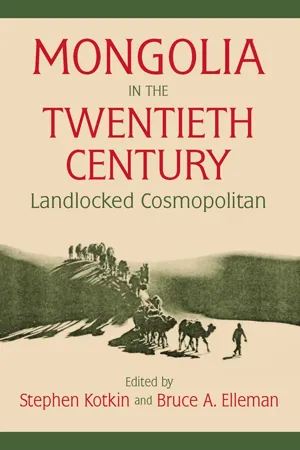
The remote vastness of Mongolia has remained somewhat of a mystery to most Westerners - no less so in the 20th century. Homeland of the legendary conqueror Chingiz Khan, in modern times Mongolia itself has been the object of imperial rivalry. For most of the 20th century it was under Soviet domination. Mikhail Gorbachev began the withdrawal of Soviet troops from Mongolia in 1989, a process completed in 1992. By 1996 a coalition of opposition parties triumphed in national elections, and Mongolia launched itself on a new course. It is perhaps the most intriguing of the post-community "transition" societies. This volume examines Mongol history over the past century, embracing not only Mongolia proper but also Mongol communities in Russia and China. Contributions, based on new archival research and the latest fieldwork, are from the world's top experts in the field - including four authors from Mongolia and others from Japan, Russia, Taiwan, Great Britain and the United States. Stephen Kotkin's introductory chapter is an overview of Mongol studies. The essays in part 1 examine Sino-Russian competition over Outer Mongolia. Part 2 looks at international diplomacy in Mongolia, including the role of Japan. Part 3 focuses on contemporary issues ranging from economic and cultural change to emergent elites. A concluding essay surveys Mongolian foreign policy.
Part III
Mongolia Today
In 1990, Mongolia broke with the USSR, eliminated one-party rule, and embarked on a revolutionary path of political and economic liberalization. Mongolia declared a policy known as the “open door” in order to strengthen trade and economic ties with Japan, the United States, and western Europe. Soon after adopting a new constitution, the democratic government of Mongolia also instituted privatization, financial reform, and trade liberalization.
The Mongols today inhabit an enormous swath of the Asian continent, ranging from Buriatia to the north and northwest of Mongolia, to Uriankhai (Tuva) to the west, parts of Xinjiang and Qinghai to the southwest, large portions of Inner Mongolia to the south and southeast, and various areas in Manchuria, especially the Bargu district of Heilungjiang province, to the east. A linguistic map of Mongol areas would approximate in size all of western Europe 1
As A. Hurelbaatar discusses in his essay, one of the largest groups of Mongols outside Mongolia—approximately 5 million—can be found in China. Although the bulk of these people inhabit China’s northern regions and provinces—with almost 3.5 million in Inner Mongolia, almost 1 million in Manchuria, and perhaps a quarter million to the west in Xinjiang and Qinghai—people who claim Mongol heritage can be found in all of China’s thirty-two autonomous regions, provinces, and municipalities.
In China, there has been an ongoing process of cultural assimilation throughout the twentieth century, as the Mongol people have gradually adopted agriculture, learned to speak Chinese, inter-married with other nationalities, and settled in Han-dominated urban areas. However, since the end of the 1970s the Mongols in China have endured the painful process of readopting their traditional culture, in part by teaching their children how to speak, read, and write Mongolian. This linguistic revival holds out the hope for the Mongols in China of preserving the distinctive cultural and ethnic identity they have formed while being a part of China.
* * *
Even while Mongols in China are undergoing an important cultural revival, Mongols in Mongolia are also attempting to reclaim their heritage. Most importantly, during the MPR’s so-called state socialist era under Soviet tutelage, Mongolia’s nomadic herders were organized into some 300 collective and state farms; while most of these collectives continued to rely on herding, about fifty devoted their energies to agricultural production 2 Following the adoption of Mongolia’s economic reforms in the early 1990s, however, these collectives and state farms were privatized, and most of the land in Mongolia has once again come under individual management.
Decollectivization was not accomplished without extensive economic disruption. Wages plummeted and it is estimated that a quarter of the Mongolian population was pushed under the official poverty line. There has also been considerable demechanization, a result of the rising price of imported oil (mainly from Russia) and the difficulties inherent in locating spare parts; this process has led to a further decline in productive capacity.
As David Sneath discusses in his essay on pastoralism in Mongolia, the changes which are currently being carried out in Mongolia have led to smaller and more diversified herds, to less extensive pasturelands, and to a sharp decrease in the slaughter rate of the herds. These changes in many ways parallel similar pastoral changes during the 1920s following Mongolia’s last great economic upheaval—the adoption of state socialism 3 Therefore, Sneath challenges the assertation that the ongoing market reforms are destroying Mongolia’s traditional pastoral system. Instead, he points to patterns below the formal level of institutions that embody power relations and longer-term shifts.
* * *
Nationalism is without a doubt one of the most important currents in Mongolia today. Arguably, it was the Mongolian nationalist movement that led to the repudiation of communism and the creation of a democratic government. Mongolian nationalism is not a wholly new development, however, and has in fact played an important role during much of Mongolia’s twentieth century history. Perhaps the most important symbol of Mongolian nationalism is Chinggis Khan 4
The question of Mongolian nationalism became especially important during the early 1960s, when the MPR government was forced to consider what kind of ceremony it should adopt to celebrate the eight-hundredth anniversary of Chinggis Khan’s birth 5 This question proved to be both politically and culturally sensitive. Chinggis Khan was a feudal ruler—and therefore anathema to Marxist-Leninist modern developmentalism. Furthermore, the unified Mongol state that he created had conquered and ruled the MPR’s socialist mentor—the USSR—and its less friendly neighbor to the south—the People’s Republic of China 6
In his essay on the eight-hundredth Chinggis Khan anniversary, J. Boldbaatar discusses the importance of this celebration to the Mongolian nationalist movement by explaining how the celebration’s official date—May 31, 1962—was also the thirty-eighth anniversary of the May 31, 1924 Sino-Soviet treaty that had simultaneously guaranteed Mongolian autonomy from China and had also denied Mongolia its true independence. Picking this day to celebrate Chinggis Khan’s anniversary was perhaps a sign of Mongolian resistance to the stewardship of the USSR, and the Chinggis monument erected in Khentii province boldly proclaimed: “Let my body be tired, but my state never be exterminated”7 Although the incipient Mongolian nationalist movement was soon repressed on orders from Moscow, it continued to exist in the hearts of the Mongol people 8 The Chinggis monument, which the MPR government ordered destroyed but which was protected from harm by local officials in Khentii, outlived its opponents.
* * *
The driving force behind the reform movement in Mongolia may have been nationalism, but the reflection of this nationalism can perhaps best be seen in Mongolia’s foreign policy, which has been carefully designed to counteract the dangers inherent in Mongolia’s geopolitical position, trapped as it is between the unstable Russian Federation to the north and the Chinese empire to the south. Mongolia’s foreign policy emphasizes good relations with Western and Asian capitalist countries, a non-aligned and nuclear-free policy, and the decision to demilitarize Mongolia by prohibiting the stationing of foreign troops on its territory.
In his essay investigating nationalism, the elites, and the transformation of Mongolian society, Tom Ginsburg shows how a relatively small group of intellectual and government leaders—perhaps 300 total—has been largely responsible for the enormous changes that Mongolia has undergone. This governing elite shares many similar characteristics: male, born mainly in the 1940s and 1950s, educated primarily in the former USSR or Eastern Europe, and most often trained in technical fields. Below the governing elites are two other groups—intellectuals and technocrats—who have aided their leaders in formulating and implementing the reforms. Finally, the organizations through which the elites express their opinions include various political parties that have been forming and reforming coalitions at a dizzying pace.
Ginsburg concludes that the single most important concern of all of the governing elite, whether they be intellectuals, technocrats, or members of the numerous political parties, is the so-called China threat. It is that perceived threat that ensures the continued cooperation of these otherwise diverse and divisive groups.
Notes
1. Robert Rupen, The Mongolian People’s Republic (Stanford, CA: Hoover Institution Press, 1966), pp. 16–17.
2. Collectivization in Mongolia was started in 1929, abandoned in 1932, and then carried through to conclusion some twenty-five years later. Robert Rupen, How Mongolia is Really Ruled: A Political History of the Mongolian People’s Republic, 1900–1978 (Stanford, CA: Hoover Institution Press, 1979), pp. 53–57.
3. Simukov, “Materialy po kochevomu bytu naselenia MNW,” Sovremennaia Mongolia, No. 2 (15) (1936), p. 49.
4. By the early 1970s, the official line was that Chinggis Khan’s “unification of the tribes was a boon to the land, while his military campaigns … brought only devastation and misery to the conquered lands and peoples. Mongolia herself suffered both culturally and economically, and her people were dispersed over a large part of the sprawling empire. Thus, the country’s own development was seriously retarded by its Most Mighty King”. Albert Axelbank, Mongolia (Tokyo, Japan: Kodansha International Ltd., 1971), pp. 24–25.
5. C.R. Bawden, The Modern History of Mong...
Table of contents
- Cover
- Half Title
- Title Page
- Copyright Page
- Dedication
- Table of Contents
- About the Editors and Contributors
- Acknowledgments
- Note on Transliteration and Abbreviations
- List of Photographs
- List of Tables
- List of Charts
- Preface
- Introduction. In Search of the Mongols and Mongolia: A Multinational Odyssey
- I. Sino-Russian Competition over Outer Mongolia
- II. International Diplomacy Concerning Outer Mongolia
- III. Mongolia Today
- Epilogue. Mongolia’s Foreign Policy Revisited: Relations with Russia and the PRC into the 1990s
- Selected Bibliography
- Index
Trusted by 375,005 students
Access to over 1.5 million titles for a fair monthly price.
Study more efficiently using our study tools.
Frequently asked questions
Yes, you can cancel anytime from the Subscription tab in your account settings on the Perlego website. Your subscription will stay active until the end of your current billing period. Learn how to cancel your subscription
No, books cannot be downloaded as external files, such as PDFs, for use outside of Perlego. However, you can download books within the Perlego app for offline reading on mobile or tablet. Learn how to download books offline
Perlego offers two plans: Essential and Complete
- Essential is ideal for learners and professionals who enjoy exploring a wide range of subjects. Access the Essential Library with 800,000+ trusted titles and best-sellers across business, personal growth, and the humanities. Includes unlimited reading time and Standard Read Aloud voice.
- Complete: Perfect for advanced learners and researchers needing full, unrestricted access. Unlock 1.5M+ books across hundreds of subjects, including academic and specialized titles. The Complete Plan also includes advanced features like Premium Read Aloud and Research Assistant.
We are an online textbook subscription service, where you can get access to an entire online library for less than the price of a single book per month. With over 1.5 million books across 990+ topics, we’ve got you covered! Learn about our mission
Look out for the read-aloud symbol on your next book to see if you can listen to it. The read-aloud tool reads text aloud for you, highlighting the text as it is being read. You can pause it, speed it up and slow it down. Learn more about Read Aloud
Yes! You can use the Perlego app on both iOS and Android devices to read anytime, anywhere — even offline. Perfect for commutes or when you’re on the go.
Please note we cannot support devices running on iOS 13 and Android 7 or earlier. Learn more about using the app
Please note we cannot support devices running on iOS 13 and Android 7 or earlier. Learn more about using the app
Yes, you can access Mongolia in the Twentieth Century by Stephen Kotkin,Bruce Allen Elleman in PDF and/or ePUB format, as well as other popular books in History & 20th Century History. We have over 1.5 million books available in our catalogue for you to explore.