- 370 pages
- English
- ePUB (mobile friendly)
- Available on iOS & Android
eBook - ePub
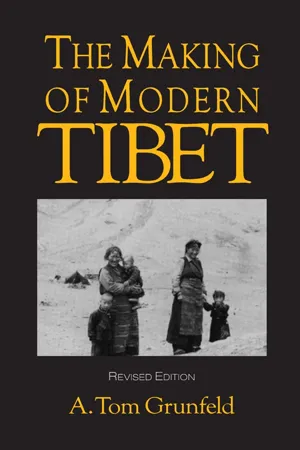
The Making of Modern Tibet
About this book
An account of Tibet and the Tibetan people that emphasises the political history of the 20th century. This book attempts to reach beyond the polemics by considering the various historical arguments, using archival material from several nations and drawing conclusions focused on available documents.
1
_____________________
Tibet as It Used to Be
By all accounts, Tibet is a stunning place. Predominantly a plateau averaging 3.600 m. (12,000 ft.) above sea-level, its landscape includes not only snow- covered mountains but also glaciers and green forest, grasslands and salt lakes. It is surrounded by mountains: the Kunlun range in the north, the Hengduan in the east, the Himalayas in the south and the source of many of Asia’s major rivers: the Tsangpo, which meanders first east and then south to become the Brahmaputra (“son of Brahma”); the Mekong, which flows into Burma and Laos; the Salween which also flows into Burma; the Yangzi (Yangtze) and Yellow Rivers, which flow into China proper; the Sutlej into Pakistan; and the Indus flowing west into Ladakh.
Tibetans have learned to live with the rarefied air and the strong winds that are so common in this cold, dry climate. But the Tibetan climate is not uniform like the Arctic; Tibetans live between 1,200 m. (4,000 ft.) and 5,100 m. (17,000 ft.) above sea-level. Tibet’s numerous valleys create wide-ranging climatic conditions with little precipitation. The capital city of Lhasa, for example, lies at the same latitude as Cairo and New Orleans, although at an altitude of about 3.600 m. (12,000 ft.). But because it is situated in a valley it gets little snow and its yearly temperature ranges from 10 to 24° C (14–74° F)—fairly temperate conditions.
The remoteness of Tibet and the late introduction of a written script in the seventh century have created almost insurmountable obstacles to piecing together accurate accounts about the origins of Tibet and, for that matter, the Tibetans themselves. Not surprisingly, legends abound. Even the origin of the very name “Tibet” is unknown; the name used by the native inhabitants is “Bod” (or “P’ovul”)—“the land of snows.”
There are also difficulties in determining the precise geographical boundaries of Tibet. Tibetans live in an area of about 3.8 million sq. km. (1.5 million sq. miles) or about fifteen times the size of the United Kingdom and half the size of the United States. The political boundaries, however (the Tibet Autonomous Region [TAR]), cover an area of only 1.2 million sq. km. (470,000 sq. miles). The population has been estimated from a low of 1,500,000 to a high of 10,000,000 (see Appendix A). Using the figures accepted by Beijing, the TAR therefore covers 12.5 percent of the area of the People’s Republic of China (PRC) but is home to under 0.002 percent of the PRC’s population.
For the purposes of the general reader Tibet can be divided into several regions. In the central area, with the capital of Lhasa, is the province of U. To the southwest is the province of Tsang, centering on Tibet’s second largest town, Shigatse. To the east is the area known as Kham, today politically divided between the province of Sichuan and the TAR. North of Kham is an area known to Tibetans as Amdo, and to the Chinese as Qinghai, while to the far west is Ngari. The area just north of U and Tsang is called the Chang Dang (Chang Tang), the northern plateau with its desolate deserts and seemingly endless grasslands.
The Social Structure
If there is one point of agreement among scholars it is that Tibet’s original social order has been irreversibly altered by the influence of Chinese communism and the upheavals of 1959. The attempt to rapidly socialize and modernize the Tibetan way of life after 1959 doomed to failure any hope of preserving the unique lifestyle of these people. But that is where agreement ends, for there are two sharply differing views: one holds that the change was beneficial, the other that it was disastrous.
The changes in Tibetan society since 1959 have certainly made it impossible for anthropologists fully to reconstruct what life was previously like. There were some scholars, such as the American anthropologist/missionary Robert Ekvall and the American-trained Chinese scholar Li Anzhe (Li An-che), who lived among the Tibetans before 1950; but for the most part scholars have been forced to study necessarily inexact replications of that society in the communities of exiles in Nepal and India. In the past decade two American anthropologists have been allowed to conduct fieldwork in Tibet while other Tibetan-speaking Western scholars have traveled freely throughout Tibet.1
The best single description of pre-1950 Tibetan society is “feudal.” The word is in quotes here only because it has been a catchword in the seemingly neverending political battles over what Tibetan life used to be like. The Chinese tend to use the term in their popular media in a pejorative sense (although many Chinese academic journals have used it more descriptively),2 and naturally the knee-jerk reaction of China’s opponents has been to deny that feudalism ever existed in Tibet or even to go so far as to argue that it was beneficial.3 The term is used here simply because it is the adjective which comes closest to describing Tibetan society; the parallels between Tibet and medieval Europe are striking.
The Elites
Tibetans were ruled by an unusual form of feudal theocracy that was both centralized—in a government in Lhasa headed by a man known, outside of Tibet, as the Dalai Lama—and also decentralized, giving local control to the countless monastic and aristocratic estates. The central government maintained a military force, issued currency and postage stamps, negotiated with other governments and acted as a final court of appeal. The heads of the feudal estates maintained a monopoly of power over all local matters; the central government normally intervened only when the flow of taxes was disrupted. All the officials in Tibet, both lay and ecclesiastic, in Lhasa and on the estates, came from the same small pool of noble families.
At the very top of the social structure was the Dalai Lama, who was both the secular and ecclesiastical ruler of Tibet. Then came the ger-ba, or aristocratic lords, numbering anywhere from 150 to 300 families. These families could be arranged in four distinct groupings. The most exclusive were the de-bon, or families descended from the ancient kings of Tibet. They were followed closely by the yab-shi, or families descended from previous Dalai Lamas. When a new Dalai Lama is found, or chosen (in a manner described below), his family is immediately ennobled, a custom that
served to anchor the Dalai Lama to the existing system and must be viewed as a strong restraint against his altering the structural status quo since any changes would negatively affect his parents and siblings also.4
The third group of aristocracy were called mi-dra; they were families who had been rewarded with ennoblement as a result of some meritorious service by one of their members. These three were the elites of the elite and made up only twenty-five to thirty families. They were extremely wealthy and almost all government officials were drawn from their ranks.
The final group of aristocracy were known as gyu-ma, or “common.” These hereditary families were the majority of the nobility, although they were only moderately well-off; some were even poor enough to be forced to carry on trade to supplement their incomes. Despite claims to the contrary, heredity and ennoblement were the only avenues for joining the nobility. The rest of the population were serfs and, in much smaller numbers, slaves and outcasts.
As in all agricultural societies, the source of power and wealth was not titles but land. Land was divided among the three ruling groups: the monasteries, the lay nobility, and the Lhasa government (whose village members were known as “the ones who serve the government”). Although there is some dispute over how much of the arable land each group held, it is generally agreed that the monasteries and the lay nobility controlled well over 50 percent—and the best land at that.5
For the lay nobility there were two types of estates. One was the traditional family seat, which was owned outright and could not be sold. It could be confiscated for acts of treason, although this was rare. The other, and more important form, was estates given to the families by the government in exchange for certain obligations such as government service, the orderly collection of taxes, and the supplying of serfs to the Tibetan army. It was this type of estate that promoted the cohesion of the political structure ruling Tibet.
Appointment to government office necessitated the allocation of an estate to cover expenses. There were however very few movable estates. “Family seats” and monastic estates were rarely confiscated. New arable land was hardly ever reclaimed because of the lack of both technical expertise and entrepreneurial motivation. Many of the nobility had only one estate, and single estates were rarely confiscated; the number of estates that were rotated were, therefore, few.
These estates were extremely lucrative. One former aristocrat noted that a “small” estate would typically consist of a few thousand sheep, a thousand yaks, an undetermined number of nomads and two hundred agricultural serfs. The yearly output would consist of over 36,000 kg. (80,000 lb.) of grain over 1,800 kg. (4,000 lb.) of wool and almost 500 kg. (1,200 lb.) of butter.6 To the estate’s proceeds must be added the various perquisites that came with holding office in Tibet.
The nobles’ main functions as government officials were quite straightforward: to collect taxes, settle disputes, punish criminals, and act as a liaison between the central government and the area of Tibet they were administering. For this they received little or no formal salary.7 But this was not a deterrent; on the contrary, there was stiff competition for governmental posts—gifts were even given to obtain one. This was a direct result of the perquisites that accompanied the job. A government official had “unlimited powers of extortion” and could make a fortune from his powers to extract bribes not to imprison and punish people.8 In some cases the nobles themselves would not even bother going to their posts but would send one of their stewards who, by all accounts, tended to be harsher than the masters. There was also the matter of extracting monies from the peasantry beyond the necessary taxes. Their abuse of privileges, their lack of concern for the bulk of the population, and even their practice of taking “temporary wives” while stationed away from Lhasa, meant that “very few nobles [had] a reputation for integrity.”9
One of the most unusual aspects of the Tibetan polity was the dual system whereby every lay official had a clerical counterpart. Usually there was a total of 340 officials, evenly divided, although for a brief period in the 1930s and 1940s there were 200 lay officials and 230 clerical. The monk officials were all from the predominant Gelugpa sect and usually from one of the three major Gelugpa monasteries, all situated in the environs of Lhasa: Drepung, Ganden, and Sera. These monk officials were considered more reliable than their lay counterparts for they had fewer vested interests. They did not individually own estates that they had to worry about losing, nor did they have to worry about offending powerful interests since their clerical status gave them protection. This aspect of the system was sometimes abused when a noble family sent their son to a monastery to acquire monkhood (one night in a monastery was sufficient) solely to make him eligible for one of the official clerical positions.
At the top of the pyramid was one man—the Dalai Lama. Tibetans believe that he is an incarnation of the patron deity of Tibet, Chenrezig (known in Indian Buddhism as Avaloketi’svara). Buddhists believe that individuals go through repeated incarnations until they have performed enough meritorious deeds to free themselves from this cycle and propel them into a state of heavenly bliss called nirvana. Buddhists further believe that there are bodhisattvas who, having reached the very gates of nirvana, have unselfishly denied themselves that release and instead have elected to return to earth in a human form in order to help others achieve that state. The Dalai Lama is believed to be an incarnation of Chenrezig, just such a bodhisattva.
Confusion begins with the very name itself. The Dalai Lama is referred to in non-Tibetan literature as the “Living Buddha” or the “God King.” Neither of these descriptions is apt. A Buddha is one who enters nirvana; therefore a living Buddha is a contradiction. Moreover, the Dalai Lama is neither a “God,” nor a representative of a supreme ...
Table of contents
- Cover
- Title Page
- Copyright Page
- Half Title
- Dedication
- Table of Contents
- Preface to Second Edition
- Acknowledgments
- Frequently Cited Periodicals
- Maps
- Photographs follow page 130
- Introduction
- 1. Tibet as It Used to Be
- 2. The Early History
- 3. Early Foreign Contacts
- 4. The Modern Era
- 5. Foreign Intrigues: I
- 6. The 1950s: The Honeymoon
- 7. The 1950s: Revolt
- 8. Foreign Intrigues: II
- 9. Tibet After 1959
- 10. The Tibetan Diaspora
- 11. The Current Situation
- 12. The Last Decade: 1985–1995
- Appendix A: The Population of Tibet
- Appendix B: Independence
- Notes
- Bibliography
- Index
Trusted by 375,005 students
Access to over 1.5 million titles for a fair monthly price.
Study more efficiently using our study tools.
Frequently asked questions
Yes, you can cancel anytime from the Subscription tab in your account settings on the Perlego website. Your subscription will stay active until the end of your current billing period. Learn how to cancel your subscription
No, books cannot be downloaded as external files, such as PDFs, for use outside of Perlego. However, you can download books within the Perlego app for offline reading on mobile or tablet. Learn how to download books offline
Perlego offers two plans: Essential and Complete
- Essential is ideal for learners and professionals who enjoy exploring a wide range of subjects. Access the Essential Library with 800,000+ trusted titles and best-sellers across business, personal growth, and the humanities. Includes unlimited reading time and Standard Read Aloud voice.
- Complete: Perfect for advanced learners and researchers needing full, unrestricted access. Unlock 1.5M+ books across hundreds of subjects, including academic and specialized titles. The Complete Plan also includes advanced features like Premium Read Aloud and Research Assistant.
We are an online textbook subscription service, where you can get access to an entire online library for less than the price of a single book per month. With over 1.5 million books across 990+ topics, we’ve got you covered! Learn about our mission
Look out for the read-aloud symbol on your next book to see if you can listen to it. The read-aloud tool reads text aloud for you, highlighting the text as it is being read. You can pause it, speed it up and slow it down. Learn more about Read Aloud
Yes! You can use the Perlego app on both iOS and Android devices to read anytime, anywhere — even offline. Perfect for commutes or when you’re on the go.
Please note we cannot support devices running on iOS 13 and Android 7 or earlier. Learn more about using the app
Please note we cannot support devices running on iOS 13 and Android 7 or earlier. Learn more about using the app
Yes, you can access The Making of Modern Tibet by A.Tom Grunfeld in PDF and/or ePUB format, as well as other popular books in History & 20th Century History. We have over 1.5 million books available in our catalogue for you to explore.