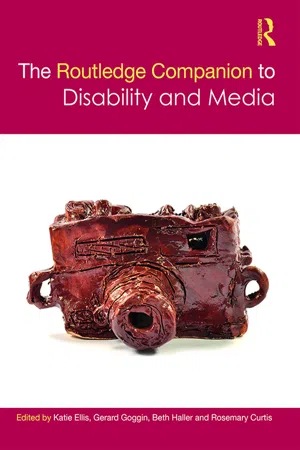
The Routledge Companion to Disability and Media
eBook - ePub

The Routledge Companion to Disability and Media

  1. 424 pages
  2. English
  3. ePUB (mobile friendly)
  4. Available on iOS & Android
eBook - ePub

About this book

An authoritative and indispensable guide to disability and media, this thoughtfully curated collection features varied and provocative contributions from distinguished scholars globally, alongside next-generation research leaders.

Disability and media has emerged as a dynamic and exciting area of contemporary culture and social life. Media–– especially digital technology––play a vital role in disability transformations, with widespread implications for global societies and how we understand communications. This book addresses this development, from representation and audience through technologies, innovations and challenges of the field. Through the varied and global perspectives of leading researchers, writers, and practitioners, including many authors with lived experience of disability, it covers a wide range of traditional, emergent and future media forms and formats.

International in scope and orientation, The Routledge Companion to Disability and Media offers students and scholars alike a comprehensive survey of the intersections between disability studies and media studies

This book is available as an accessible eBook. For more information, please visit https://taylorandfrancis.com/about/corporate-responsibility/accessibility-at-taylor-francis/.

Trusted by 375,005 students

Access to over 1.5 million titles for a fair monthly price.

Study more efficiently using our study tools.

Information

Publisher
Routledge
Year
2019
Print ISBN
9781032085371
eBook ISBN
9781317505693

PART I

Imagining and Representing Disability

1

DISABILITY IMAGINARIES IN THE NEWS

Tanya Titchkosky

Introduction

“Imagine disability; now imagine life with such a problem.” This trope, one that invites people to imagine disability as a problem, is an ordinary part of contemporary life. Making use of news articles and headlines that reproduce this trope, this chapter explores what it means to imagine disability in this way. Tracing how this disability imaginary is at work organizing how readers can expect disability and non-disability to fit together as newsworthy, the following pages will also explicate how “imagination” is best understood as a social phenomenon. While never totally alienated from the possibility of fantasy, imagination here refers to the interpretive character of perception as an “enworlded” phenomenon.1
Throughout, I will regard “imagination” as a complicated interpretive social action, potentially creative, but done always in relation to existing cultural conceptions and images; the products of imagination can be conceived as “imaginaries,” a kind of solidification of sense.2 I will show how “disability imaginaries” are enworlded as alienation incarnate—full of unexamined and unbendable assumptions regarding disability that nonetheless serve to support flights of fancy regarding normalcy. Treating imagination as that social activity that operates between engagement and alienation, between creativity and constraint, I aim to reveal what the invitation to imagine disability both “marks and mirrors.”3 By considering the grounds organizing the ordinary restrictive orders of perception, there arises the possibility of perceiving our lives with disability in new ways, perhaps breaking out of one way of finding disability newsworthy while breaking into others. Media representations of disability offers media producers and consumers an opportunity to reflect on the normative assumptions that ground these representations as well as a chance to perceive, know and do disability differently from how “society made us and believe us to be.”4
After revealing the contours of a disability imaginary common to Western news media, I end by exploring how to live with this imaginary in more vital ways. I do not, however, propose that a more realistic or normal imagery for disability be developed. As Eve Haque has shown, the “real” of media and its documented historical agents are full of imagined characters in need of explication.5 Exploring the limits of an alienated and, even, pathological imaginary is a way to open up the cultural assumptions behind this disability representation. Indeed, by exposing the social imaginaries at play in media accounts of disability, this chapter aims to encourage media producers to want to gain access to those social imaginaries informing even their most “realistic” accounts of disability so that they might produce more vibrant, expansive and complex representations of disability. To do so, however, requires that we first proceed with the assumption of life in disability and one way to do that is to regard media depictions of disability as a representational space that invites cultural critique. This chapter aims to reveal the products of imagination in new ways—representing a hybrid comingling of disability and non-disability reflective of the hope of an unexpected rupture of the ordinary in the social activity of media production and consumption.6

Imagine Disability; Now Imagine Life with This Problem

Contemporary Western news media, invites readers, and not merely from time to time, to imagine disability. We read invitations such as imagine being deaf, blind, a wheelchair user; imagine feeling anxious, depressed or confused; imagine losing an arm, your memory or the ability to speak. This initial invitation serves to move the reader into another imaginative moment but one that can only read disability as the problem of normative disruption. Imagine disability while also imagining raising a child, going on a trip, going to work, preparing dinner or getting out of bed.
Versions of this invitation are extraordinary enough to be narrated and to regularly appear within Western news media:
Can you imagine changing a nappy with your TEETH? Disabled mother who can’t use her arms or legs reveals how she copes with two young children.7
Imagine getting through the day with no arms. That’s my life thanks to thalidomide.8
Can you imagine waking up every morning and doing what she did without being able to feel or move anything below your neck?9
Changing a diaper, washing dishes, getting through the day, are not the ordinary stuff of the news. Yet, such ordinary activities have suddenly and even dramatically become extraordinary and newsworthy. The reader, framed as non-disabled, is supposed to encounter disability as a problem that disrupts the flow of ordinary life and to find this interesting (even though it is easy and common to imagine that disability means only difficulty doing things). After all, these suppositions come into play and are at work in framing the request to “imagine disability as a problem, now imagine life as such.” Through this trope, readers are invited into a restricted imaginary—free to read disability, but only as a problem, a somewhat titillating disruption to the normal way of doing things. Ironically, restricted imaginaries have to restrict their own grounds of possibility (imagination) in order to operate. One way this is done is by imposing the fanciful belief in the singular view. But this is risky, for to imagine the singular meaning as all-encompassing risks the opposite, that we imagine disability as more and other than we make it and believe it to be.
Not only ordinary tasks such as washing dishes or changing diapers but also extraordinary ones, can be used to express a restricted imaginary. Readers are invited, for example, to imagine disability in the face of extraordinary feats, such as racing a car, running a marathon, skydiving, learning calculus, surviving in an inhospitable environment. Consider these examples:
Imagine your life if you had a disability. How many things might you have to give up on? Walking? Sports?
Now imagine you were a professional race car driver who suffered traumatic brain injuries. Medical professionals tell you, you will never recover, let alone drive again.
Rick Bye must not have received the memo.10
Calculus is never a picnic, but imagine if you couldn’t see the numbers on the board.11
Even for the fully able-bodied, the world can be a cruel and challenging place to navigate. In northwest Michigan, we know all too well about low wages, unemployment, under-employment and the zigzagging path to providing enough for yourself or your family. Imagine if, through no choice of your own, you were dealt an even harder card to play. For people with developmental disabilities in this region—and every other, for that matter—often times the impediment to independence and happiness is a lack of opportunity.12
Racing cars and doing calculus, like surviving in a cruel and challenging world, are extraordinary feats. Add disability and the extraordinary is made spectacular, moving unique skills from the register of the exceptional to that of the almost magical. Still, this transformation also includes framing the presumed reader as a non-disabled person who regards disability as a problem that disrupts the accomplishment of extraordinary feats. While it may be difficult to imagine driving a race car or learning calculus, it remains easy to imagine that to do these things while disabled would be difficult, if not impossible.
Spectacular or ordinary, this trope posits disability as a condition that represents a lack of function; given this, things are difficult to do and given this, things will have to be done differently. This leads to what is perhaps the most perplexing matter of all—it hardly seems to be an imaginative act to call disability to mind as “difficulty doing things.”
This disability imaginary is so ubiquitous that it seems to put the activity of imagination out of play. Indeed so ubiquitous is this imaginary, that it seems realistic and true. Nation states as well as the World Health Organization, for example, structure their surveys of disability with exactly the same conception:
Do you or someone in your household have a physical condition or health condition … that reduces the amount or the kind of activity that this person can do?13
Activities are limited because of a long-term condition or health-related problem.14
A disability is an impairment that has a long-term, limiting effect on a person’s ability to carry out day-to-day activities.15
Any restriction or inability to perform an activity in the matter or within the range considered normal for a human being.16
Despite claims to using an updated and more social conception of disability—the International Classification of Functioning, Disability and Health—the World Report on Disability also makes use of the imaginary of difficulty doing things that results from a lack of function:
According to the World Health Survey around 785 million (15.6 percent) persons 15 years and older live with a disability, while the Global Burden of Disease estimates a figure of around 975 million (19.4 percent) persons. Of these, the World Health Survey estimates that 110 million people (2.2 percent) have very significant difficulties in functioning.17
Given the ubiquity of this restrictive disability imaginary, along with the simultaneous naturalization of the notion that it is found in individuals who are understood to possess an inability to function in a way considered normal for a human being, how are we to make sense of this news media call to imagine disability? Perhaps, we can allow the lack of imagination involved in all this to disturb us a little while breaking into h...

Table of contents

  1. Cover
  2. Half Title
  3. Title Page
  4. Copyright Page
  5. Dedication
  6. Table of Contents
  7. List of Figures
  8. List of Tables
  9. Acknowledgments
  10. Notes on Contributors
  11. Foreword by Faye Ginsburg
  12. Introduction: Disability and Media—An Emergent Field
  13. PART I: Imagining and Representing Disability
  14. PART II: Audience, Participation and Making Media
  15. PART III: Media Technologies of Disability
  16. PART IV: Innovations, Challenges and Future Terrains of Transformation
  17. Index

Frequently asked questions

Yes, you can cancel anytime from the Subscription tab in your account settings on the Perlego website. Your subscription will stay active until the end of your current billing period. Learn how to cancel your subscription
No, books cannot be downloaded as external files, such as PDFs, for use outside of Perlego. However, you can download books within the Perlego app for offline reading on mobile or tablet. Learn how to download books offline
Perlego offers two plans: Essential and Complete
  • Essential is ideal for learners and professionals who enjoy exploring a wide range of subjects. Access the Essential Library with 800,000+ trusted titles and best-sellers across business, personal growth, and the humanities. Includes unlimited reading time and Standard Read Aloud voice.
  • Complete: Perfect for advanced learners and researchers needing full, unrestricted access. Unlock 1.5M+ books across hundreds of subjects, including academic and specialized titles. The Complete Plan also includes advanced features like Premium Read Aloud and Research Assistant.
Both plans are available with monthly, semester, or annual billing cycles.
We are an online textbook subscription service, where you can get access to an entire online library for less than the price of a single book per month. With over 1.5 million books across 990+ topics, we’ve got you covered! Learn about our mission
Look out for the read-aloud symbol on your next book to see if you can listen to it. The read-aloud tool reads text aloud for you, highlighting the text as it is being read. You can pause it, speed it up and slow it down. Learn more about Read Aloud
Yes! You can use the Perlego app on both iOS and Android devices to read anytime, anywhere — even offline. Perfect for commutes or when you’re on the go.
Please note we cannot support devices running on iOS 13 and Android 7 or earlier. Learn more about using the app
Yes, you can access The Routledge Companion to Disability and Media by Katie Ellis, Gerard Goggin, Beth Haller, Rosemary Curtis, Katie Ellis,Gerard Goggin,Beth Haller,Rosemary Curtis in PDF and/or ePUB format, as well as other popular books in Social Sciences & Media Studies. We have over 1.5 million books available in our catalogue for you to explore.