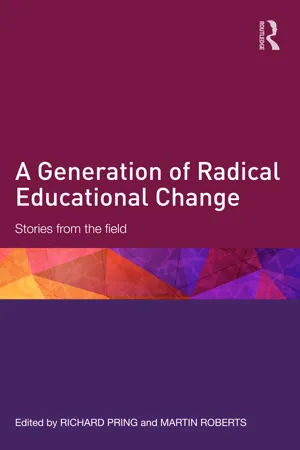
A Generation of Radical Educational Change
eBook - ePub

A Generation of Radical Educational Change

Stories from the field

  1. 226 pages
  2. English
  3. ePUB (mobile friendly)
  4. Available on iOS & Android
eBook - ePub

A Generation of Radical Educational Change

Stories from the field

About this book

How much have teachers and their pupils benefitted from the top-down Westminster-led control of policy held in place by a powerful national inspection regime?

A Generation of Radical Educational Change: Stories from the Field is an exploration of the revolutionary impact of the greater and continuing involvement of central government in education policy-making which began in 1976 and was accelerated by the 1988 Education Act and subsequent legislation.

In the book, a dozen distinguished contributors from a wide range of sectors explain and reflect on how they worked to do their best for their schools, teachers and pupils in these years of great change. They understand the reasons, explained by Lord Baker in his early chapter, for a National Curriculum in 1988, and also the reasons for a more effective national inspection system. Yet their stories accumulate to become a powerful critique of the top-down policies of the last two decades. These policies have been too numerous, short-term, incoherent and partisan; governments have been indifferent to professional opinion and serious research, and have relied excessively on measurable outcomes and simplistic Ofsted judgments. Our current system is narrower and less democratic than it was, but evidence is hard to find that English pupils are doing any better in international comparisons.

The combined reflections in this volume are timely in these years of lively educational debate as are the suggestions for future policy. A Generation of Radical Educational Change is an invaluable read for current and aspiring headteachers, policy makers and those with an interest in education policy and how it evolves.

Trusted by 375,005 students

Access to over 1.5 million titles for a fair monthly price.

Study more efficiently using our study tools.

Information

Publisher
Routledge
Year
2015
eBook ISBN
9781317376088

Part I Introduction

Setting the scene

1 History and Overview of Changes 1976–2014

Martin Roberts and Richard Pring
DOI: 10.4324/9781315673417-1

Introduction

The last 40 years have witnessed such radical changes in the educational and training system that few who are now engaged in teaching, and few among the general public, can have much conception of where the system has emerged. But it is important that they should do so. It is important to see how and why a system has changed in order to understand it critically and to see how it might be changed yet further for the better.
This book therefore seeks to provide an account of those changes, not simply through a historical narrative (although such a narrative permeates the chapters and is explicitly provided in this introductory chapter), but also through the experiences of those who have lived and worked through the changes and who have had to adapt, often critically, to them.
In Chapter 17 we draw together some of the major themes that emerge from the following chapters and make some recommendations for the next generation.

Setting the scene

In particular, the 1944 Education Act preceded our history by several decades. But reference to it is necessary for two reasons. First, it shaped the educational system for 30 years, and the period covered in this book reflects the gradual erosion of that post-war political settlement. Second, such a reference shows starkly how matters have changed.
The 1944 Act created ‘a national service locally administered’. It established a partnership between central government (which had ultimate responsibility for overall expenditure), local education authorities (which provided education to all children ‘according to age, ability and aptitude’), the voluntary bodies (that is churches and non-denominational bodies that provided many of the schools now entering the national system) and the teachers. The Minister had two major responsibilities – to ensure there were enough school places for all pupils and to ensure there were enough teachers to teach them. The Minister had no control over what was taught or how it was taught – these were regarded as too important to be put in the hands of politicians. After all, a war was being fought against totalitarian governments whose government ministers controlled the schools and what was taught in them.
The Act never dictated how ‘according to age, ability and aptitude’ should be interpreted. That was in the hands of the local education authorities (LEAs) and the teachers. Most LEAs interpreted this for the new secondary system of education in terms of three types of school fitting (in the words of the 1943 Norwood Report) three types of adolescent, namely, grammar schools for the few capable of abstract thought and interested in ideas; technical schools for those interested in and capable of the application of ideas in technology; and secondary moderns for the majority who were more concerned with practical activities and the immediate environment. However, some authorities – London County Council, West Riding of Yorkshire and Leicestershire – decided to develop schools attended by children of all abilities and aptitudes as comprehensives.
Subsequent years saw the gradual questioning of this threefold division of adolescents and therefore of schools – a questioning that was evolving significantly during the period covered by this book.
Hence, this chapter provides an outline of the political and social changes that impacted on educational institutions between 1976 and 2015, as these have affected the ‘national system locally administered’. Our contributors illuminate many of them in the following chapters.

The political context

Labour and Conservative governments 1945–2015

In the 70 years since the Second World War, Labour formed governments for 30 years, the Conservatives, including a Tory-dominated coalition, for 40. In our chosen period since 1976, Labour governed for 16, the Conservatives for 23. The sequence was as follows: Labour 1945–1951 (Attlee), Conservatives 1951–1964 (Churchill, Eden, Macmillan, Douglas-Home), Labour 1964–1970 (Wilson), Conservatives 1970–1974 (Heath), Labour 1974–1979 (Wilson, Callaghan), Conservatives 1979–1997 (Thatcher, Major), Labour 1997–2010 (Blair, Brown), Conservative–Liberal Democrat Coalition 2010–2015 (Cameron).
The 1970s were a watershed in British politics. The quadrupling of the oil price after 1973 led to extraordinary inflation, which hit a record 25 per cent per annum in 1975. Simultaneously destructive industrial unrest caused the British economy, already weak, to lurch from crisis to crisis. In 1976, Denis Healey, Labour Chancellor of the Exchequer, had to negotiate a huge loan from the International Monetary Fund. The implicit consensus between the two main parties began to break. The final breaking point was the ‘winter of discontent’ in 1979 when public sector workers, fighting the attempt of Callaghan’s government to sustain a pay policy, went on strike. Rubbish piled up in the street. Schools closed. A public sense that something was badly wrong helped Mrs Thatcher to power. Conservative policy after 1979 consciously shook off the One Nation Toryism of Macmillan and Heath. Similarly Blair’s New Labour, which emerged in the 1990s, distanced itself in policy as well as in name from the Labour values of Wilson, Callaghan and Attlee, further developing policies initiated by Mrs Thatcher.

The pre-1970s consensus

In 1954, The Economist coined the term ‘Butskellism’ to describe the common features of the policies of Butler, the Conservative Chancellor of the Exchequer, and Gaitskell, his Labour counterpart. They both accepted the main achievements of the Attlee government, particularly the welfare state (which meant comparatively high and redistributive taxation) and the nationalisation of the country’s major industries. They believed in a mixed economy with both private and public ownership. They were Keynesian in that they believed that the state should increase public spending in times of crisis to sustain overall demand and avoid significant rises in unemployment. They accepted that trade unions mattered and believed in the effectiveness of local authorities.

The Thatcher/Blair consensus, 1979–the present

The Thatcher government rejected Keynesianism, which it considered to be the cause of serious inflation and the enemy of private enterprise. Influenced by Friedrich Hayek who argued for a diminished role for the state and by Friedman who considered inflation a greater threat than unemployment and whose monetarist doctrine stated that inflation was best reduced by the government controlling the amount of money in circulation, the Conservative government managed to bring inflation under control but at the price of high unemployment, which reached 3.2 million in 1985. Rather than a mixed economy it proved a firm believer in the superiority of private enterprise over public ownership. Major industries were privatised, for example British Gas and British Rail, and where possible market forces were given ever-greater freedom. The ‘big bang’ of 1986 deregulated the financial markets of the City of London and made possible, for good and ill, the rapid expansion of the City as a major player in global finance.
The Centre for Policy Studies, founded by Sir Keith Joseph in 1974 together with Margaret Thatcher and Alfred Sherman, argued the case for a Social Market economy and privatisation of such public monopolies as education and health – more deregulation and liberalisation. It considered ‘educational vouchers’ but thought that too big an undertaking. The philosophical thinking of Hayek and Friedman thereby entered into the management of public services in general and education in particular. It was cogently expressed by Sir Keith Joseph, later to become Secretary of State for Education, that:
the blind, unplanned, uncoordinated wisdom of the market is overwhelmingly superior to the well-researched, rational, systematic, well-meaning, cooperative, science-based, forward looking, statistically respectable plans of government.
(Joseph, 1976)
Thatcher’s government kept a strict control over public expenditure, capping the funds it made available to local government, which it regarded as bloated and too close to the unions. As for public services, where she could not privatise, Mrs Thatcher centralised.
A new ‘management language’ was emerging in a series of Government White Papers that straddled the Thatcher/Blair years. The shift in the control and management of public services was explained in a series of Government White Papers from HM Treasury and the Cabinet Office: Modern Public Services in Britain: Investing in Reform (1988, Cm. 4011); Public Services for the Future: Modernisation, Reform, Accountability (1998, Cm. 4181); The Government’s Measures of Success: Outputs and Performance Analyses (1999, Cm. 4200); Modernising Government (1999, Cm. 4310). One important consequence of these White Papers (and thus of the ‘modernisation’ of public services) was what was referred to as ‘public service agreements’. These were agreements over funding from HM Treasury, first to Departments of State in terms of overall targets, which were then ‘cascaded down’ in more precise forms, to the institutions that were the responsibilities of the respective Departments. In education, this was spelt out partly in terms of the pro portion of students at different schools achieving so many GCSEs at different grade levels. But that gradually emerged as a way of rewarding teachers through ‘performance-related pay’.
Where possible Thatcher’s government cut income tax (for example, Lawson’s 1988 Budget, which reduced the tax on the rich to 40 per cent and on everyone else to 25 per cent). As for the trade unions, breaking their power was a Thatcher priority, broadly supported by public opinion. Here 1984 was the key year when Scargill, the Marxist leader of the National Union of Mineworkers, who had humiliated Heath’s government a decade earlier, called an all-out strike to end pit closures. The government was well prepared with plenty of coal stocks and police effectively deployed to prevent aggressive picketing. After a year the miners went back to work, totally defeated. The government passed a series of laws that severely restricted the power of the unions.
The Conservatives were able to stay in power for 18 years, but not because their policies were particularly popular. In the general election of 1987, when Mrs Thatcher was at her strongest, she won only 42 per cent of the vote with a turnout of 75 per cent of the electorate. Labour’s problem in the 1980s was that it was dominated by the Left and the trades unions, and its moderates had split away to form the Social Democratic Party, which was to merge with the Liberals. Social and economic changes had undermined Old Labour and its traditional working class support in declining industrial areas. More voters thought of themselves as middle class. If Labour was ever to gain power, Blair with his small group of allies – Brown, Mandelson and Gould – decided that the party needed to be rebranded as New Labour and to accept the main Thatcherite policies of privatisation, low taxes, friendly towards business, cool towards the unions and local government, and centralising where public services were concerned. With the UK needing to compete in an increasingly global market, Blair and Brown saw no alternative but to encourage free enterprise. Blair, though he thought Mrs Thatcher a bit dotty, had much respect for her achievements, and she came to regard him as her real successor.
Like Thatcher, Blair’s popularity was less well-rooted than it seemed. The main reason for New Labour’s success in 1997 was the unpopularity of the Conservatives. He won only 44 per cent of the vote, less than Attlee and Wilson, and the voter turnout was lower too, at 71 per cent. His popularity declined in 2001 to 42 per cent of the voters, with 59 per cent voting. In 2005, his share of the vote had further declined to 35 per cent, with 61 per cent of the electorate voting. Throughout these years of radical reform neither Conservatives nor Labour had the explicit support of more than one in three of the electorate. After 2001 it dropped to one in four. More and more young people did not bother to vote.
Though in many ways the New Labour government had its distinctive policies, particularly with regard to relieving child poverty and support of minorities, the main thrust of its economics was similar to that of its predecessor, so much so that Peter Riddell writing in The Times commented that ‘an economist from Mars would conclude that the same government had been in charge throughout the second half of the 1990s’.
The implications for education of this dramatic political change post-1979

Erosion of the political consensus

What did this mean for education? Before 1976, the political consensus accepted that schools should have freedom over the curriculum and gave LEAs the funding and discretion necessary to develop systems that best met local needs. Broadly speaking, it supported the end of selection at 11 plus and the spread of comprehensive schools. In the early 1970s Mrs Thatcher, as Secretary of State for Education, oversaw an accelerating comprehensive programme. The Schools Council, an advisory council on curriculum development and examinations, dominated by teachers but abolished by the Tory Sir Keith Joseph in 1984, was set up in 1964 by the Tory Sir Edward Boyle. The universities, expanding after the Robbins Report of 1963, were independent of government controls, their funding coming mainly through the independent Universities Grants Committee (UGC). Further Education (FE) too was expanding but remained the responsibility of LEAs.
However, when Callaghan spoke at Ruskin College in October 1976 this consensus was disintegrating. Within a few years, governments reduced education spending, the powers of local government and the independence of teachers. They encouraged the market through greater parental choice and a variety of schools (for example, Grant Maintained, City Technology Colleges, Specialist Schools, Academies, Free Schools and University Technical Colleges). The main criterion of the success of the education sector was to be seen in the extent to which it contributed to the economic success of UK plc. Ofsted would ensure accountability. And that accountability was expressed and conducted increasingly in the new language of management, that is, in terms of targets and performance indicators.
The key legislation, of course, was the 1988 Education Act, which in effect replaced that of 1944. Now the government was in charge of pupils’ learning, establishing a detailed National Curriculum with ten levels of assessment, and funding directly (by-passing the LEAs) the new City Technology Colleges. From a ‘national system locally maintained’ was evolving a ‘national system nationally maintained’.
The Conservatives had a deep-seated distrust of what they tended to describe as the ‘education establishment’, which in 2013 the Coalition Secretary of State, Michael Gove, referred to less decorously as ‘the Blob’. This distrust had in the early 1970s been reflected in the Black Papers, edited by Cox and Dyson (1967–1972) for the Centre for Policy Studies, which attacked in particular the growing attachment to comprehensive schools. They were particularly suspicious of university-based teacher training, as reflected in Sheila Lawlor’s paper ‘Teachers Mistaught’ (Lawlor, 1990).
By the Higher and Further Education Act of 1992, both higher and further education passed under greater government control. Mrs Thatcher distrusted university teachers as much as schoolteachers. A Higher Education Funding Council (HEFC) replaced the UGC and made sure that universities directed their efforts towards national priorities as defined by the government that, again like schools, were to increase the economic competitiveness of the UK. As for further education, the polytechnics became independent of LEAs, were renamed universities and funded through the HEFC. Other FE colleges also passed out of LEA control and were funded through the Further Education Funding Council (FEFC) until the new Learning and Skills Council took on its functions in 2001. Both the Labour and Conservative parties in the twenty-first century came to believe that Higher Education (HE) and FE fees were unavoidable, though they argued about the fees’ level.
New Labour accepted the main thrusts of Tory education policy, Choice and Diversity (the title of John Patten’s White Paper in 1992) becoming a mantra. Blair thought teachers were among the forces of conservatism hampering him in his mission to modernise Britain, as set out in the White Papers referred to above. LEAs fared no better. When New Labour introduced its Academies programme in the 2002 Education Act, they would be directly answerable to the Secretary of State. In other ways New Labour was even more centralising than the Conservatives, enacting many laws and regulations and creating quangos. It was stronger too on accountability, Ofsted swelling in its size and authority after 1997. The influential teacher unions of the 1970s, particularly the National Union of Teachers (NUT), declined, especially after the protracted but fruitless strikes of 1985–1987.
Again there was considerable continuity when the Coalition took over from Labour in 2010. Michael Gove, the new Secretary of State, accelerated the Academies programme, introduced academy chains to establish many more academies run by churches, charities and for-profit companies such as Serco and Capita, and increased diversity and choice by introducing Free Schools. He continued the custom of Secretaries of State, if with unusual passion, to intervene in the curricul...

Table of contents

  1. Cover Page
  2. Halftitle Page
  3. Title Page
  4. Copyright Page
  5. Table Of Contents
  6. List of contributors
  7. Foreword by Baroness Estelle Morris
  8. Background
  9. PART I Introduction: setting the scene
  10. PART II Schools
  11. PART III Higher and further education
  12. PART IV Accountability, examinations, qualifications
  13. PART V Reflection on policy matters
  14. PART VI Role of the media
  15. Conclusions
  16. Appendix: major education acts and reports
  17. Subject index
  18. Name index

Frequently asked questions

Yes, you can cancel anytime from the Subscription tab in your account settings on the Perlego website. Your subscription will stay active until the end of your current billing period. Learn how to cancel your subscription
No, books cannot be downloaded as external files, such as PDFs, for use outside of Perlego. However, you can download books within the Perlego app for offline reading on mobile or tablet. Learn how to download books offline
Perlego offers two plans: Essential and Complete
  • Essential is ideal for learners and professionals who enjoy exploring a wide range of subjects. Access the Essential Library with 800,000+ trusted titles and best-sellers across business, personal growth, and the humanities. Includes unlimited reading time and Standard Read Aloud voice.
  • Complete: Perfect for advanced learners and researchers needing full, unrestricted access. Unlock 1.5M+ books across hundreds of subjects, including academic and specialized titles. The Complete Plan also includes advanced features like Premium Read Aloud and Research Assistant.
Both plans are available with monthly, semester, or annual billing cycles.
We are an online textbook subscription service, where you can get access to an entire online library for less than the price of a single book per month. With over 1.5 million books across 990+ topics, we’ve got you covered! Learn about our mission
Look out for the read-aloud symbol on your next book to see if you can listen to it. The read-aloud tool reads text aloud for you, highlighting the text as it is being read. You can pause it, speed it up and slow it down. Learn more about Read Aloud
Yes! You can use the Perlego app on both iOS and Android devices to read anytime, anywhere — even offline. Perfect for commutes or when you’re on the go.
Please note we cannot support devices running on iOS 13 and Android 7 or earlier. Learn more about using the app
Yes, you can access A Generation of Radical Educational Change by Richard Pring,Martin Roberts in PDF and/or ePUB format, as well as other popular books in Education & Education General. We have over 1.5 million books available in our catalogue for you to explore.