Organizations are complex social systems that are not easy to understand, yet they must be managed if a company is to succeed. This book explains networks and how managers and organizations can navigate them to produce successful strategic innovation outcomes. Although managers are increasingly aware of the importance of social relations for the inner-workings of the organization, they often lack insights and tools to analyze, influence or even create these networks.
This book draws on insights from social network theory; insights sharpened by research in a number of different empirical settings including production, engineering, financial services, consulting, food processing, and R&D/hi-tech organizations and alternates between offering critical real business examples and more rigorous analysis.
This concise book is vital reading for students of business and management as well as managers and executives.
Organizations are highly dynamic social entities. They are collections of individuals that collaborate to produce something that none of the individuals could produce by themselves. This poses problems – but also offers opportunities – to management and employees alike in complex organizations. In these pages, we introduce a view of the organization as a set of overlapping networks that are vital to the development of a strategic competitive advantage of the organization: the network based organization.
The search for innovative potential within the organization evidently is not a new one. How to manage, measure, and profit from innovation has received considerable scholarly and managerial attention over past decades (c.f. Davila et al. 2012; Tushman and O’Reilly 2013; Li et al. 2013; Anderson et al. 2014; Lee et al. 2014). These same studies point out that making innovation work has proven to be anything but a straightforward task. Many organizations that depend on their capacity to be at the forefront of new product and service offerings in a diversity of markets and to a plurality of customers have encountered that innovative knowledge does not easily spread inside organizations. An organization that can improve the spread of knowledge internally will be more innovative (Bartlett and Ghoshal 2002; Aalbers et al. 2013).
To compete effectively, being able to innovate continuously is a must. We have found – based on our research and consulting experience – that being able to scale and intervene in organization networks sets apart trailblazing organizations from the rest in this respect. Innovation results from the combination and recombination of existing and newly developed pieces of knowledge. Knowing how to identify the critical resources that can serve as the foundation for new products and services to be brought to the market early on therefore is of high value to most growth aspiring companies. In an organization, having knowledge available and accessible at a moment’s notice to the right people, ensures that it can be innovative, responding quickly to the highly dynamic environments it operates in. Intra-organization networks provide the social infrastructure to manage such exchange effectively.
The structure of social networks and the nature of the ties in them provide essential cues as to what the social interactions in an organization may be expected to deliver. To understand the inner workings of organization networks an understanding of the core notions of organization network analysis and the underlying network theory is essential. This chapter sets out to review these core notions as a point of departure for a fact-based approach to rendering insights into the networks within an organization, as brought to the fore in the remainder of the book.
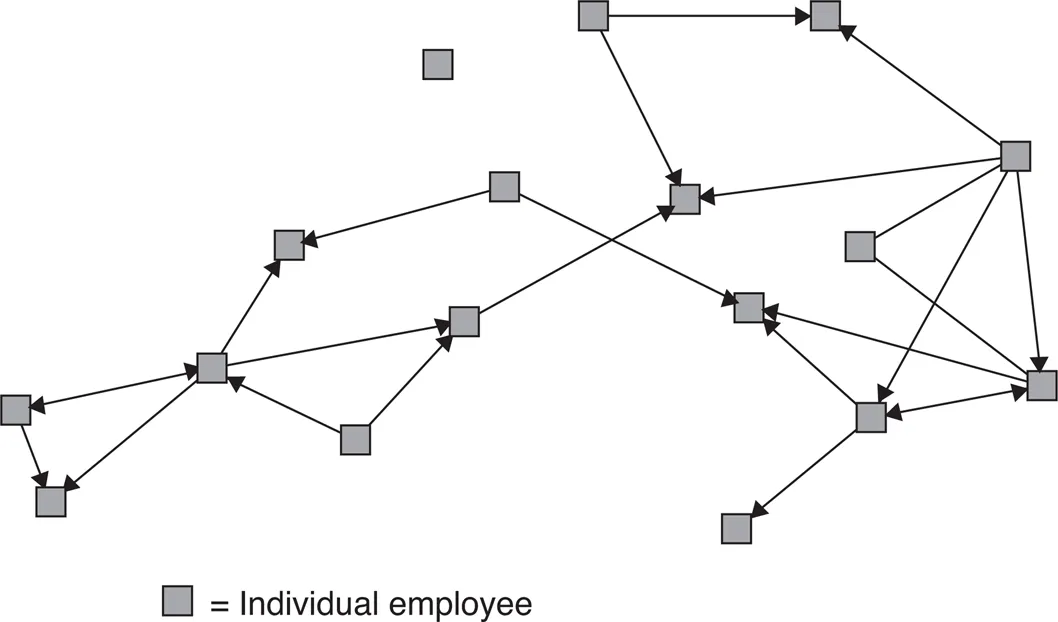
It will have become evident by now that a powerful way in which to understand the social nature of organizations, and the leading way in which to analyze this, is by looking at the organization as a constellation of different networks. A network, in its essence, is the interconnections between nodes constituted by ties. Inside an organization, the people are the nodes who exchange (have ties) with others. The interconnected relations, the ties, show relationships or flows between the nodes. These simple notions easily combine into an intuitive picture of the social fabric of intra-organizational relations, an intra-organizational network (see Figure 1.1 for an example). Managers need to learn the language of networks to understand their organizations better. Others, including fellow scholars, would also benefit greatly from understanding organizations as a constellation of networks.
Here we introduce and discuss key terms drawn from the field of network analysis such as tie, node, tie strength, and centrality, and place these in an organizational context. We do so from an almost technical point of view, and also, importantly, from a strategic point of view, that takes innovation as a prime driver of strategic advantage, as well. We focus on what these terms mean in the context of business and zoom in on intra-organizational networks. Understanding network concepts and the avenues they offer for purposive intervention will augment organization performance and help management to steer towards innovation and sustainable competitive advantage.
Intra-organizational networks may be instrumental, affective, strongly mandated, or largely discretionary. Accordingly, various networks can be identified, from formal or workflow networks that are strongly mandated by management, to informal networks that may or may not form the shadow-vertebrae of an organization. What is actually exchanged is – or can be – very different in each of these networks. The knowledge that is actually exchanged in a network is highly context dependent as well. For an accounting firm, for instance, in one network, accounting data is exchanged, while in another network advice about how best to relate to customers is exchanged, in still other networks new ideas and knowledge that will contribute to innovations for an organization is exchanged. There are networks of individuals discussing last night’s football or basketball game, as well as networks of those who smoke together during breaks. Each network has its own merits to those involved. These are all different networks, each with their own structure and dynamics over time. Individuals can be involved in more than one network at the same time. Any two individuals in an organization can then be connected with another individual in the organization in more than one way. Adapting a view of the organization as a set of diverse, and overlapping networks, provides an alternative path to more traditional modes to understand and enhance the strategic competitive advantage of the organization.
Approaching the organization as a constellation of networks offers an intuitive yet thorough insight into its functioning. Social networks are easily understood, since they are close to just about anybody’s immediate understanding of family, friends, and society. Networks can be visualized readily thanks to the latest advancements in the field of Information Technology and network analytics, and can be monitored over time, offering an additional intuitive appeal. More fundamentally, based on a combination of sociological and mathematical (graph) theory, organization network analysis helps us to determine how the social influences individuals face affect their behavior in ways that are often not comprehensible to the individuals themself.
Figure1.1 An intra-organizational network
Organizations increasingly become (socially) complex, even when they are small. In large part this increased social complexity is due to the stronger emphasis by firms to continuously innovate. Firms have to innovate faster to adapt to changing market conditions: three-quarters of the 1,500 global senior executives taking part in the annual Boston Consulting Group Innovation Survey judge innovation to be crucial for their business growth strategy, identifying innovation as a top three priority for their company (Wagner et al. 2014). Despite the high priority and increased spending on innovation, 70 percent of these same executives rate the innovation capability of their firm as only average – and 13 percent indicates it even as weak (Wagner et al. 2014). A continuous flow of innovation can create sustainable organization competitiveness and growth, but is not achieved easily (Moran 2005).
Innovation is, however, a fundamentally social activity. While our insights pertain to other activities that are important to organizations, we therefore focus primarily on how organizational networks shape organizational innovativeness. In this book we thus offer insights on how the networks in an organization affect an important activity of organizations that determines their competitive position now and in the future: innovation. Our goal is to better understand how social networks affect the extent to which an organization is innovative, and offer insights into how innovation may be stimulated by leveraging these social networks in their organization.
Innovation in networks
Knowledge is the most valuable asset and an important source of competitive advantage for an organization (Grant 1996; Teece et al. 1997). Scholars have emphasized that effective transfer of knowledge between employees within an organization increases the organization’s innovativeness and creativity (Davenport and Prusak 1998; Tushman 1977; Moorman and Miner 1998; Perry-Smith and Shalley 2003; Tsai 2001; Hansen et al. 2005).
In social networks, information is generated, dispersed, screened and enhanced (Campbell et al. 1986; Coleman 1990; Granovetter 1973). This can provide all kinds of benefits, to all kinds of players outside of a focal firm. Entrepreneurs who are properly networked are more likely to succeed. Venture capitalists rely heavily on their networks when making investment decisions. Even in rather mature markets, where changes are rare and incremental, and where one as an employee, business unit leader, or CEO are well aware of someone’s individual circumstances and the circumstances of one’s peers and competitors, one’s network of contacts determines the extent to which one will be able to differentiate, and ultimately to be more successful than someone’s competitor. If someone has friends in his network who are particularly innovative, this person is more likely to be innovative too. Such contacts are likely to span beyond that person’s immediate, daily, social contacts. A network provides actors with access to valuable information well beyond what someone could process on its own (Burt 1997). Someone’s network surrounding may actually act as additional discretionary processing capacity to one’s own processing capability (Kijkuit and van den Ende 2010). While Information Technology may make much information accessible too, the sensitive, complex (partly because tacit) and valuable information is likely to be available through personal connections only. In order to make the best use of these connections, it is vital to be positioned in a network in a way that does not lead to information overload, while still allowing one to tap into a diversity of creative and original potential. The personal connections are important to screen and enhance information (Kijkuit and van den Ende 2010).
Simply aiming to have “more transfer of knowledge” is unlikely to be successful, however. Knowledge transfer is by no means self-evident and automatic (Szulanski 1996). Knowledge usually is spread throughout the organization and may not be available where it might best be put to use (Cross et al. 2001; Moorman and Miner 1998; Szulanski 2003). Many actors may be involved with the flow of knowledge in an organization, and even if they are willing to exchange it, they may not be aware of who might be in need of what knowledge they have. Knowledge proves to be one of the most difficult resources to manage. A clear understanding of the relevant networks in an organization, their structure and dynamics, is crucial.
Successfully organizing innovation processes is no mean feat. According to Joseph Schumpeter, innovation is the combination and recombination of knowledge. Combining or recombining existing knowledge can in itself constitute (the basis for) an innovation, or it can give rise to the development of new knowledge and insights based on the combination. The sources for these different pieces of knowledge usually are spread across the organization, and outside of it, among different individuals. As knowledge from different corners in organization coalesces, not only are the results that come from it more likely to be technically superior, but the acceptance of whatever emerges is enhanced. (re-) Combining knowledge inside an organization is a social endeavor. Since innovation processes are socially complex by nature, managing innovation entails managing social networks. Social network scholar Ron Burt has shown that, as knowledge comes together at an individual level, this individual and the organization in which they are employed is much more likely to be innovative.
Perceiving the organization as a set of overlapping networks that are vital to the development of strategic competitive advantage of the organization is a crucial step towards successfully managing innovation networks in business.
(the Authors)
Organizations that leverage their innovative potential in a more intelligent way, using insights from organization network analysis offered in this book, will be more likely to cut it in the highly competitive global business environment. Even in relatively small organizations, the social infrastructure easily becomes complex. For example, between n employees employed within a firm, (n*(n–1))/2 potential connections may exist in any one network. For an organization that employs 50 employees, the maximum possible number of connections among them thus is already considerable, 1225 to be precise. A manager of an organization will only have a partial view of what the social infrastructure in that organization looks like. What is more, the view that the manager has, of the social infrastructure, may be biased as the knowledge the manager receives, may be tainted.
This book offers managers and students/readers a way to better understand the social activity in an organization, formal, informal, or other kind. We offer academically tested methods for an even more thorough understanding of the social side of organizations. We hope and expect that even a casual reader will be tempted to explore the academically more challenging parts in this book. For those who want a more thorough understanding of organization network analysis, the appendices to chapters, or the method chapter might offer additional insights. The take-a-ways that we suggest ...
Table of contents
Cover
It is painfully rare for a book
Halftitle Page
Title Page
Copyright Page
Dedication
Contents
Figures and tables
Preface
1 Introduction: the networked organization
PART I Networks and organization strategy
PART II Networking interventions: rewiring the organization
Appendix: supporting notes to Intermezzo Case “cooperation for innovation at Siemens”
References
Index
Trusted by 375,005 students
Access to over 1.5 million titles for a fair monthly price.
Study more efficiently using our study tools.
Frequently asked questions
Yes, you can cancel anytime from the Subscription tab in your account settings on the Perlego website. Your subscription will stay active until the end of your current billing period. Learn how to cancel your subscription
No, books cannot be downloaded as external files, such as PDFs, for use outside of Perlego. However, you can download books within the Perlego app for offline reading on mobile or tablet. Learn how to download books offline
Perlego offers two plans: Essential and Complete
Essential is ideal for learners and professionals who enjoy exploring a wide range of subjects. Access the Essential Library with 800,000+ trusted titles and best-sellers across business, personal growth, and the humanities. Includes unlimited reading time and Standard Read Aloud voice.
Complete: Perfect for advanced learners and researchers needing full, unrestricted access. Unlock 1.5M+ books across hundreds of subjects, including academic and specialized titles. The Complete Plan also includes advanced features like Premium Read Aloud and Research Assistant.
Both plans are available with monthly, semester, or annual billing cycles.
We are an online textbook subscription service, where you can get access to an entire online library for less than the price of a single book per month. With over 1.5 million books across 990+ topics, we’ve got you covered! Learn about our mission
Look out for the read-aloud symbol on your next book to see if you can listen to it. The read-aloud tool reads text aloud for you, highlighting the text as it is being read. You can pause it, speed it up and slow it down. Learn more about Read Aloud
Yes! You can use the Perlego app on both iOS and Android devices to read anytime, anywhere — even offline. Perfect for commutes or when you’re on the go. Please note we cannot support devices running on iOS 13 and Android 7 or earlier. Learn more about using the app
Yes, you can access Innovation Networks by Rick Aalbers,Wilfred Dolfsma in PDF and/or ePUB format, as well as other popular books in Business & Business General. We have over 1.5 million books available in our catalogue for you to explore.