- 320 pages
- English
- ePUB (mobile friendly)
- Available on iOS & Android
eBook - ePub
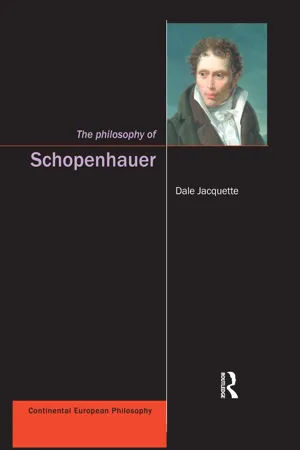
The Philosophy of Schopenhauer
About this book
Dale Jacquette charts the development of Schopenhauer's ideas from the time of his early dissertation on The Fourfold Root of the Principle of Sufficient Reason through the two editions of his magnum opus The World as Will and Representation to his later collections of philosophical aphorisms and competition essays. Jacquette explores the central topics in Schopenhauer's philosophy including his metaphysics of the world as representation and Will, his so-called pessimistic philosophical appraisal of the human condition, his examination of the concept of death, his dualistic analysis of free will, and his simplified non-Kantian theory of morality. Jacquette shows how these many complex themes fit together in a unified portrait of Schopenhauer's philosophy. The synthesis of Plato, Kant and Buddhist and Hindu ideas is given particular attention as is his influence on Nietzsche, first a follower and then arch opponent of Schopenhauer's thought, and the early Wittgenstein. The book provides a comprehensive and in-depth historical and philosophical introduction to Schopenhauer's distinctive contribution to philosophy.
Information
Chapter One
Schopenhauer's idealism
Accordingly, true philosophy must at all costs be idealistic; indeed, it must be so merely to be honest... It is quite appropriate to the empirical standpoint of all the other sciences to assume the objective world as positively and actually existing; it is not appropriate to the standpoint of philosophy, which has to go back to what is primary and original. Consciousness alone is immediately given, hence the basis of philosophy is limited to the facts of consciousness; in other words, philosophy is essentially idealistic.
(WWR2: 4-5)
A world in thought
To open the first pages of Schopenhauer's treatise The World as Will and Representation is to encounter an outrageous view of reality. We may easily be stunned into a sense of incredulity. Can Schopenhauer really be saying such things? Does he literally mean that the world of physical objects exists only in the mind?
Schopenhauer tells us in no uncertain terms that the world we experience in sensation exists entirely in thought, that everyone on reflection already knows this and that the world begins with the awakening to consciousness of each individual mind and ends with each thinking being's death. The implications of this radical commitment to the physical world's mind-dependence are as astonishing as they are intriguing. To understand Schopenhauer's metaphysics and epistemology with all their implications requires that we first try to make sense of his extreme idealism.
Introducing his philosophical system, Schopenhauer begins the book with the startling pronouncement:
The world is my representation: this is a truth valid with reference to every living and knowing being, although man alone can bring it into reflective, abstract consciousness. If he really does so, philosophical discernment has dawned on him. It then becomes clear and certain to him that he does not know a sun and an earth, but only an eye that sees a sun, a hand that feels an earth; that the world around him is there only as representation, in other words, only in reference to another thing, namely that which represents, and this is himself.
(WWR 1:3)
With admirable if disconcerting aplomb, Schopenhauer calls attention to a proposition that he insists we all already know at some level. He claims that even non-rational animals and all living perceivers possess such knowledge, even if they are incapable of becoming aware of its truth or reasoning about it abstractly. He asserts that the world is my representation, a thesis he significantly puts in first-person formulation. What I am supposed to know without further proof is that the world is my representation, meaning that it is something that belongs to me and resides within my mind as a feature of my personal subjectivity.
Remarkably, Schopenhauer claims that the same knowledge is available to every thinking subject. How can this be? If the world is not only my personal representation, but is identical to each thinking subject's distinct representation, existing in each individual's thoughts, then it appears that the physical world cannot be one single and unitary thing. Instead, there must then be as many different distinct physical worlds as there are thinking subjects that represent the world, in each of whose thoughts the world is somewhat differently represented. Idealism is the thesis that the world consists of ideas, and thus exists within the mind as dependent on thought. Schopenhauer embraces idealism in this sense, while still insisting that the subjectivity implied by the world as representation is not philosophically objectionable. But how can it not be? The problem of multiplying the existence of as many worlds as there are perceivers is only one of the difficulties facing idealism. It is notably a problem, moreover, that does not arise for opposing theories of metaphysical realism. The standard view concerning the nature of reality (sometimes patronizingly designated "naive"), realism, is that there is a unitary external physical world consisting of diverse objects and states of affairs existing objectively outside the mind. In metaphysical realism, the world exists independently of thought as something about which different perceiving subjects can have different ideas that are represented subjectively in their thoughts in different ways. This Schopenhauer flatly denies. His commitment to idealism is unequivocal:
Therefore no truth is more certain, more independent of all others, and less in need of proof than this, namely that everything that exists for knowledge, and hence the whole of this world, is only object in relation to the subject, perception of the perceiver, in a word, representation. Naturally this holds good of the present as well as of the past and future, of what is remotest as well as of what is nearest; for it holds good of time and space themselves, in which alone all these distinctions arise. Everything that in any way belongs and can belong to the world is inevitably associated with this being-conditioned by the subject, and it exists only for the subject. The world is representation.
(WWR 1: 3)
In the second edition, he says much the same. He qualifies the assertion that all thinkers recognize the truth of first-person idealism once they understand it, but remarks that not everyone immediately understands what it means to say that the world is their personal subjective representation. We, too, might not yet fully understand exactly what Schopenhauer means when he states:
"The world is my representation" is, like the axioms of Euclid, a proposition which everyone must recognize as true as soon as he understands it, although it is not a proposition that everyone understands as soon as he hears it. To have brought this proposition to consciousness and to have connected it with the problem of the relation of the ideal to the real, in other words, of the world in the head to the world outside the head, constitutes, together with the problem of moral freedom, the distinctive characteristic of the philosophy of the moderns.
(WWR 2: 3)
It is unclear at first what could possibly entitle Schopenhauer to speak in the singular of "the" world or "this" world. If the world is representation and more particularly "my" representation, and if there are many representing subjects, then it would appear that there must be as many different worlds as there are perceivers. The fragmentation of the world into many distinct subjectively existing worlds is nevertheless at odds with common sense and Schopenhauer's own pronouncements.
The trouble is that Schopenhauer is no mad solipsist. He is not so deluded as to imagine that he is personally the only representing subject. If that were his position then his idealism would at worst be implausible, but not logically inconsistent. He affirms the existence of many living knowing thinkers, including but not limited to what are ordinarily taken to be the other minds of numerous other human beings. He holds that if each thinking subject could express thoughts in language, then each could equally say, and justifiably admit as a certain truth, that, in his first-person way of putting things, "The world is my representation". Since there appears at least superficially within our representations of the world to be more than one "I", more than one thinking subject, there is presumably more than one representation. How, then, if the world is identical to each subject's representation, can there be only one world?
We are consequently deep in philosophical difficultities before we have even completed the first paragraph of Schopenhauer's treatise. There are two main problems to be addressed in understanding Schopenhauer's idealism. Each concerns a different direction in time, backward to the past or forward to the future, and the existence of the world before or after the existence of a representing subject. We must try to make sense of Schopenhauer's contentions that the world as representation:
- begins to exist only when a first representing subject has a first representing experience, even though there is good reason to believe that there must have existed a past and prior physical world in order to produce and sustain the first representing subject
- ceases to exist when any individual representing subject dies or in another way becomes totally cognitively inactive, even though there is good reason to believe that in the normal course of things other representing subjects for whom the world as representation continues to exist survive the death of any individual representing subject.
We shall need to clarify several aspects of Schopenhauer's theory and its background in Kant's metaphysics before we can return to answer these problems.
We know that representing subjects are born at different times, that they become conscious at different times and that some die while others remain alive. Moreover, we believe that the world existed at a time before there were any conscious beings. Schopenhauer acknowledges that there were planets and stars and such non-thinking entities as rocks and trees before there were even the simplest thinking subjects. We can equally project a future time when all consciousness might be extinguished, in which no thinking world-representing subjects survive. In such a scenario, we naturally expect there still to exist a non-thinking world of planets and stars, rocks and trees, that by hypothesis are not represented by any existent thinking subject, but in which living things and representing subjects might later again eventually evolve.
Are these convictions simply mistaken? Is it Schopenhauer's mission to disabuse us of a comforting but ultimately incorrect naive realism? The answer is complex. Schopenhauer makes conciliatory concessions to our common-sense conception of the world as one and as existing in some sense before and after the birth and death of any individual perceiver. He likewise hopes to do justice to generally accepted beliefs about the historical emergence and possible future annihilation of all perceiving subjects. He considers no inconsistency to hold between these assumptions and the principles of radical idealism. He believes in spite of these intuitive truths that the physical world is mind-dependent representation, that it exists subjectively in each thinking subject's first-person thoughts, and that it originates and perishes respectively with each thinking subject's first and last moments of consciousness.1
Idealism and Kant's thing-in-itself
What appears to save Schopenhauer's idealism from outright logical inconsistency is his dual-aspect metaphysics. The world for Schopenhauer is not only representation, but Kantian thing-in-itself. The mind-independence of thing-in-itself makes it possible for Schopenhauer to argue that thing-in-itself, existing outside the mind, is a single unified world that is differently represented to different minds. The world itself as thing-in-itself is not fragmented into as many different worlds as there are representing subjects in a plurality of mind-dependent subjective realities. Thing-in-itself, according to Schopenhauer, is not subject to a principle of individuation or principium individuationis. The world as thing-in-itself cannot be differentiated into individual parts or moments existing in different minds as different thought sequences. It exists outside the mind as just one thing.
Schopenhauer accepts a version of Kant's distinction between the world as it is represented in thought, which he refers to as appearance (Erscheinung) or representation (Vorstellung), much as Kant speaks of phenomena (Phänomene), and as it exists independently of thought, which, like Kant, he speaks of as thing-in-itself or as it is in itself (Ding an sich). Schopenhauer argues that we cannot describe what the world is like as thing-in-itself outside all thinking, but only as it is represented to or within our thoughts. Whatever we may try to say about the world as we know it in experience will necessarily involve our thinking and hence our way of thinking about reality, thus bringing the world under the concepts and categories of mind. If we think that there must be something more to the world than the way in which it appears to particular minds, then we may consider the world as thing-in-itself. There is next to nothing we can say about thing-in-itself, according to Kant, except that it exists and transcends the world of sense appearance. This is the significance of Kant's referring to thing-in-itself as noumenal. By this he means that it is intelligible only to mind as something thinkable or conceivable, and is otherwise representationally unknowable. Schopenhauer avoids the terms "noumenon", "noumena", and "noumenal" in his own neo-Kantian metaphysics, although he retains Kant's other terminology by referring to mind-independent reality as thing-in-itself (WWR 1: 474-7). The importance of Schopenhauer's refusal to employ Kant's word "noumenon" and its cognates is that Schopenhauer, who regards Kant's distinction between phenomena and thing-in-itself as one of the most important discoveries ever to have been made in the history of philosophy, believes that he has achieved a groundbreaking advance over Kant's metaphysics by penetrating into the hidden nature of thing-in-itself as Will.
Unwavering in his challenges to other prevailing forms of idealism in the philosophy of Hegel, Fichte and Schelling, Schopenhauer is a thinker of an entirely different stamp. As unwilling as he is to be associated with the other representatives of the nineteenth century's greatest philosophical lights, Schopenhauer is nevertheless not only a post-Kantian but, in his own estimation, the only genuine post-Kantian. He believes that he is the only philosopher who has remained faithful to the true spirit of Kant's most valuable metaphysical discovery in the Critique of Pure Reason. He argues that he alone has properly understood Kant's essential distinction between the phenomenal world of appearance and thing-in-itself as the mind-independent world existing outside all representation. He further believes that, having better grasped Kant's fundamental metaphysical and epistemological division, separating the world within and outside the mind, he has further extended and improved upon Kant's principles. He offers insight into the true nature of thing-in-itself, which Kant despaired of explaining, but about which Kant, according to Schopenhauer, managed in unguarded moments to say a great deal more than he was logically entitled to say.
Unlike Kant, Schopenhauer does not consider thing-in-itself to be merely conceivable and otherwise absolutely inscrutable. He agrees that thing-in-itself is representationally unknowable, but he maintains that it is possible to uncover its nature in an unconventional way, by properly analysing the content of ordinary episodes of willing. He argues that the world in reality or as thing-in-itself is a blind urging or directionless, unmotivated and uncaused, subjectless and objectless desire, which he refers to as "Will". The world as thing-in-itself for Schopenhauer is in essential self-conflict. Thing-in-itself as Will is a kind of disembodied hidden force or energy, one that is not physical, measurable or describable, however, and that has no causal efficacy. The world as Will transcends the world of experience for Schopenhauer, and hence is not subject to explanation under the fourfold root of the principle of sufficient reason. We cannot even correctly say whether there is a distinct thing-in-itself in a plurality of things-in-themselves corresponding to each represented object. The reason is that the principium individuationis does not apply to thing-in-itself or world as Will, but only to aspects of the world as it is represented within thought in its phenomenal aspect. Despite these limitations, Schopenhauer holds that world as Will manifests itself to representing subjects in innumerable objectifications in the world of sense experience. Thing-in-itself expresses its character through its phenomenal objectifications, which we can come to know by learning to recognize the signs of its hidden inner nature.
If the world were only representation, then the existence of many different subjects would have the immediate paradoxical conclusion that there are as many worlds as there are representing subjects. The world in reality and in the only sense in which it could be discussed would then be purely subjective. The fact that thing-in-itself, unlike the world as representation, cannot be divided into multiple worlds existing only subjectively in each perceiving subject's thoughts, seems to be all that Schopenhauer needs to avoid the unwanted conclusion that there are as many different worlds as perceivers representing the world (WWR 1: 7-8).
Kant's refutation of idealism
By its very nature, Kant's Ding an sich is descriptively unknowable. In distinguishing the world as representation from thing-in-itself, Schopenhauer makes thing-in-itself representationally unknowable, as a matter of definition. Knowledge of the world is limited to the phenomena of appearance in the mind's conception.
For Kant, unlike Schopenhauer, there exists a physical reality as well as thing-in-itself outside of consciousness. We get a sense of the differences in Kant's and Schopenhauer's metaphysics, and of how radical Schopenhauer's idealism is, by comparing it with Kant's more moderate form. In the section of the Critique of Pure Reason on "The Refutation of Idealism", Kant distinguishes his critical idealism from George Berkeley's "dogmatic" idealism. The argument appears in the Transcendental Doctrine of Elements, as part of the Transcendental Logic, in the First Division on Transcendental Analytic. Kant does not propose to prove the existence of thing-in-itself, but only at this stage to establish that there must exist something in the physical world outside of consciousness. Although Schopenhauer accepts Kant's distinction between appearance and thing-in-itself, he rejects Kant's proof for the existence of thing-in-itself. Schopenhauer's division of the world as representation and the world as thing-in-itself is logically incompatible with Kant's critical idealism in so far as Kant's refutation of (Berkeleyan) idealism is committed to the existence of a physical reality outside of thought. Kant's "refutation of idealism" provides a useful segue to Schopenhauer's objections to Kant's proof for the existence of thing-in-itself, calling attention to what Schopenhauer considers to be deep confusions in Kant's metaphysics.
Kant defends the following thesis: "The mere, but empirically determined, consciousness of my own existence proves the existence of objects in space outside me" (CPR: B275). The importance of proving the external existence of spatial objects in the overall plan of Kant's Critique is that it provides the basis for distinguishing critical idealism from problematic dogmatic or material idealism. By showing, if the argument is successful, that space and spatial entities exist outside of consciousness, Kant effectively refut...
Table of contents
- Cover
- Half Title
- Title
- Copyright
- Contents
- Dedication
- Preface
- Acknowledgements
- A note on texts and terminology
- Abbreviations
- Introduction: Schopenhauer's life and times
- 1 Schopenhauer's idealism
- 2 Empirical knowledge of the world as representation: from natural science to transcendental metaphysics
- 3 Willing and the world as Will
- 4 Suffering, salvation, death, and renunciation of the will to life
- 5 Art and aesthetics of the beautiful and sublime
- 6 Transcendental freedom of Will
- 7 Compassion as the philosophical foundation of morality
- 8 Schopenhauer's legacy in the philosophy of Nietzsche, Heidegger and the early Wittgenstein
- Notes
- Bibliography and recommended reading
- Index
Trusted by 375,005 students
Access to over 1.5 million titles for a fair monthly price.
Study more efficiently using our study tools.
Frequently asked questions
Yes, you can cancel anytime from the Subscription tab in your account settings on the Perlego website. Your subscription will stay active until the end of your current billing period. Learn how to cancel your subscription
No, books cannot be downloaded as external files, such as PDFs, for use outside of Perlego. However, you can download books within the Perlego app for offline reading on mobile or tablet. Learn how to download books offline
Perlego offers two plans: Essential and Complete
- Essential is ideal for learners and professionals who enjoy exploring a wide range of subjects. Access the Essential Library with 800,000+ trusted titles and best-sellers across business, personal growth, and the humanities. Includes unlimited reading time and Standard Read Aloud voice.
- Complete: Perfect for advanced learners and researchers needing full, unrestricted access. Unlock 1.5M+ books across hundreds of subjects, including academic and specialized titles. The Complete Plan also includes advanced features like Premium Read Aloud and Research Assistant.
We are an online textbook subscription service, where you can get access to an entire online library for less than the price of a single book per month. With over 1.5 million books across 990+ topics, we’ve got you covered! Learn about our mission
Look out for the read-aloud symbol on your next book to see if you can listen to it. The read-aloud tool reads text aloud for you, highlighting the text as it is being read. You can pause it, speed it up and slow it down. Learn more about Read Aloud
Yes! You can use the Perlego app on both iOS and Android devices to read anytime, anywhere — even offline. Perfect for commutes or when you’re on the go.
Please note we cannot support devices running on iOS 13 and Android 7 or earlier. Learn more about using the app
Please note we cannot support devices running on iOS 13 and Android 7 or earlier. Learn more about using the app
Yes, you can access The Philosophy of Schopenhauer by Dale Jacquette in PDF and/or ePUB format, as well as other popular books in Philosophy & Ethics & Moral Philosophy. We have over 1.5 million books available in our catalogue for you to explore.