eBook - ePub
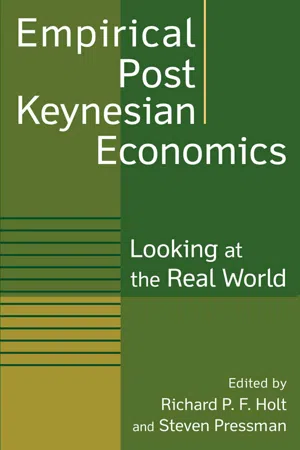
Empirical Post Keynesian Economics
Looking at the Real World
- 352 pages
- English
- ePUB (mobile friendly)
- Available on iOS & Android
eBook - ePub
About this book
This text highlights the major empirical questions and issues facing Post Keynesian economics today. Featuring contributions by leading Post Keynesian economists, it focuses on public policy and real-life analysis of this vibrant and dynamic economic theory. In language that is accessible to upper-level undergraduate and graduate students, professional economists, and public policy makers, each of the chapters takes on a specific issue of concern to all professional economists, provides empirical analysis of the issue, and then discusses the Post Keynesian view on the topic and contrasts it with the orthodox perspective. The topics covered are grouped into three main categories: empirical studies of consumption; empirical studies of business investment; and empirical studies of international economic relations.
1
RICHARD P.F. HOLT AND PRESSMAN STEVEN
Empirical Analysis and Post Keynesian Economics
Introduction
Post Keynesian economist Alfred Eichner (1976, 1983) argued that developing a complete economic paradigm must follow a certain historical trajectory. It must first provide a theoretical explanation of how real economies work, then it must supply a considerable amount of empirical evidence to support its theoretical analysis.
Eichner believed that the neoclassical model of economics failed both theoretically and empirically; in essence, it was not a complete paradigm.
Eichner found it particularly ironic that while neoclassical economics wanted to be seen as a “hard” social science, it did not focus on developing scientific propositions about the “nature of the observable world.” Instead, neoclassical economics worked at developing individual and social-optimization models, and then proving theorems that followed from its initial axioms, all the while holding to the assumption that the real world works according to the axioms of its theory.
Moreover, Eichner believed neoclassical theory had not held up well when empirically tested. Eichner (1985, 181) argued that many of the key ideas at the core of neoclassical theory had failed to meet the test of experience. This included the notions of indifference curves, isoquants, and positively sloped supply curves in the industrial sector of the economy; the marginal physical product of capital; and the Phillips Curve. While some of these concepts have been modified, serious problems remain with the neoclassical approach. It has been impossible to derive indifference curves from empirical data (Mishan 1961), for example. Even worse, the psychological literature on framing effects (Tversky and Kahneman 1981, 1986) and the literature on preference reversal (Tversky and Thaler 1990, Tversky et al. 1990) seem to falsify the economic notion of indifference curves and neoclassical views about human preferences. Eichner (1976) himself tested the notion of positively sloped supply curves, and found that most industrial firms operate under conditions of increasing returns rather than diminishing returns.
For Eichner, a clear difference between neoclassical and Post Keynesian economics is that Post Keynesians desire to “explain the real world as observed empirically.” But, to do this, Post Keynesians need to empirically test their theoretical model. This was a point that Eichner stressed numerous times (1978, 1983, 1985). It is also a general argument about economics that has been made many times, probably most persuasively by Wassily Leontief (1971) in his presidential address to the American Economic Association in 1970.
As Post Keynesian economists, we are interested in developing a complete Post Keynesian model, one that provides an alternative to the neoclassical model, and then testing that model. In a previous work (Holt and Pressman 2001), we argued that the Post Keynesian paradigm has progressed substantially since the writings of Eichner. Post Keynesian economics now has a distinct methodological approach (see Dow 2001) along with a well-developed theoretical base. There is a good deal of scholarly literature that summarizes the key Post Keynesian theoretical contributions in greater detail and contrasts them with neoclassical theory (Arestis 1992, 1996; Davidson 1972, 1994; Eichner and Kregel 1975; Lavoie 1992); there are examples of Post Keynesian literature geared toward students (Eichner 1978, Holt and Pressman 2001), and John King (2002) has provided a good summary of the history of Post Keynesian economics, including an excellent summary of its main theoretical and methodological foundations.
None of this denies that theoretical, methodological, and pedagogical issues are still being debated and discussed among Post Keynesians, but this is what you would expect to see from a vibrant and dynamic economic theory. This sort of discussion goes on within every economic paradigm or perspective, including in the dominant neoclassical paradigm. These internal debates—which revolve around refining the paradigm and solving its inherent puzzles—do not detract from the more important point that most of the key methodological and theoretical work has been done, and that the foundation of Post Keynesian economics is well established. For this reason, it is time for Post Keynesians to take their work beyond methodology and theory, which dominated much of the discussion of the past fifty years or so, and enter a new stage, one that focuses on public policy and empirical analysis.
Although we believe that both these areas are important for the next stage of Post Keynesian thought, this book is concerned with empirical analysis. Empirical analysis is important because it is only through empirical work and testing that one is able to evaluate the accuracy of economic theory, and it is only through empirical work that one may test the policy implications that derive from the theory. In this introductory chapter, we first briefly discuss the different stages through which Post Keynesian economics has already gone. Then we identify a new stage that still needs to be developed, one that focuses on the empirical implications of Post Keynesian economics. Next we summarize the empirical work and findings in the main chapters that comprise this book. Finally, we conclude with some thoughts about future empirical work that needs to be done.
Different Stages of Post Keynesian Thought
Eichner (1985) identified two overlapping stages in the development of Post Keynesian economics. A first stage, stretching from the late nineteenth century to the 1960s, mainly involved a theoretical critique of neoclassical economics. This critique begins with Marx and Veblen, both of whom Eichner classifies as Post Keynesians of sorts. Veblen, with great wit, demolished the neoclassical idea of rational and autonomous economic agents. For Veblen ([1899] 1908), consumption behavior was social in nature. Spending was determined by the desire to keep up with one’s neighbors, and even surpass their levels of consumption. Cars were not bought because they provided the individual with the greatest possible utility, but because (given budget constraints) they were more lavish and more expensive than the cars driven by one’s friends and neighbors. The same thing was true of homes, of clothing, and of most consumer items. Marx, like Veblen, saw behavior as determined in large part by social factors—in particular by one’s economic class—and, like Veblen, saw economic power as a main factor driving capitalist economies.
Many years after Veblen and Marx, there were the incisive critiques of Piero Sraffa and Joan Robinson. Sraffa’s (1926) Economic Journal article on increasing returns showed that supply and demand analysis could not apply in a world of increasing returns. His Production of Commodities by Means of Commodities (1960) made the more general criticism that the neoclassical theory of value and distribution was circular in its reasoning. He then sought to develop a theory of value and distribution that went back to the classical notion of an economic surplus and the importance of economic power in determining the distribution of that surplus, and, as a result, of economic growth. Robinson (1953–54) raised the question of how it is possible to measure capital and thus its return. Since there was no way to measure aggregate capital (outside of having the rate of return on capital and using this to measure capital), neoclassical theory could not explain either value or distribution. This led to the famous “Cambridge controversy,” which Harcourt (1972) documented so ably and with great wit. Robinson (1974, 1980) also stressed the importance of historical time in economic analysis rather than equilibrium analysis, and criticized the use of equilibrium analysis by mainstream economists.
A second stage in Post Keynesian economics, according to Eichner, stretches from the 1930s (but mainly the 1960s) to the present (or at least to 1985, when Eichner was writing). During this stage, Post Keynesians were primarily concerned with developing a theoretical alternative to neoclassical economics. John Maynard Keynes, Michal Kalecki, and Nicholas Kaldor were among the key actors in this stage of the development of Post Keynesian economics.
Keynes ([1936] 1964) developed a monetary theory of production in The General Theory. He explained how a money-using economy could easily fall into prolonged bouts of high unemployment. He also explained the economic policies that were needed to remedy that problem. Kalecki (1990–97) explained the importance of markup pricing, and what determined the markup. He also explained how the markup affected income distribution, investment, and the business cycle (see Sawyer 1985).
Kaldor (1956) set forth a nonmarginalist, Post Keynesian theory of distribution. He explained how aggregate spending propensities lead to a division of output between capital and labor. This explanation for distribution did not depend on the marginal returns to aggregate capital and labor, and so did not depend on the suspect notion of aggregate capital. More recently, the work of Luigi Pasinetti (1962) has built on the work of Kaldor to develop the mathematical structure of a theory of distribution that was not neoclassical in nature. At a broader and more abstract level, Vivian Walsh and Harvey Gram (1980) highlighted the differences between the classical and neoclassical theories of general equilibrium.
Eichner (1985, 177) noted that this theoretical perspective stands in sharp contrast to neoclassical theory. It focuses on “production rather than just distribution, income effects rather than just substitution effects, [and] a monetarized rather than just a barter economy.” Post Keynesian models were also more concerned with how economies move through time and recognized that this process may change the ultimate economic outcome. In these models, investment or capital accumulation determines prices (because the markup is determined, in part, by the need for internal funds for investment), income distribution, and the rate of economic growth.
The consequences of this approach to economics are fundamentally different from the consequences of neoclassical economics on a number of important issues. For example, while neoclassical economists see income distribution as the outcome of the marginal productivities of individuals, Post Keynesians see income distribution as the outcome of power relationships in the economy. And while rational expectations and real business-cycle macroeconomics see government policy as ineffective in changing macroeconomic outcomes, Post Keynesians see macroeconomic policy as necessary for economic stability and full employment. For Post Keynesians, there is no presumption that market outcomes are always optimal, and no presumption that macroeconomic policy is at best ineffective and at worst harmful, as viewed by many neoclassical economists (Holt and Pressman 2001).
Eichner, however, argued that these developments and advances did not go far enough. For Eichner (1983,10), a third stage is needed in Post Keynesian economics. At this important stage, the Post Keynesian theoretical paradigm must be tested and validated. As the historian of science Thomas Kuhn (1962) noted, in any mature science most of the theoretical issues have been addressed. Certainly there are anomalies and puzzles that need to be explained, and some people will work on these issues, but most practitioners need to engage in empirical work to articulate and confirm the paradigm by establishing its scope and precision (Kuhn 1962, 36). This empirical work informs the doctoral dissertations and the refereed publications needed to advance professional careers and to sustain the paradigm. Until this stage is reached, Post Keynesian theory is inadequate, according to Eichner. Only at this stage will economics in general, and Post Keynesian economics in specific, become scientific. At the empirical stage, Post Keynesians must focus on several things.
First, Post Keynesians need to compare the conclusions of their theory with reality and see if there is correspondence. In addition, Post Keynesian theory needs to be tested against other theories to determine which is closer to accurately describing the real world. Similarly, other (i.e., neoclassical) theories must be tested against Post Keynesian theory rather than against a null hypothesis. Theories have consequences, and, at some point, those consequences have to be examined. While it is certainly true that observations are often “theory-laden” (Hanson 1958), and that what you see is determined, to some extent, by how you see the world, still, it is possible to see things from different perspectives when contrasting views are clearly elucidated. This is most obvious in the famous duck/rabbit analogy—an optical illusion which can appear as either a duck or a rabbit—originally presented by Wittgenstein in the Philosophical Investigations and then used by Hanson to argue for theory-laden perceptions. As Hanson himself points out, the duck/rabbit can be seen sometimes as a duck and sometimes as a rabbit, and people can be led to see both perspectives. Thus, theory-laden perception does not invalidate empirical work.
The ability to compare and contrast things from two different theoretical perspectives is made easier in a discipline like economics, where many key, theoretical terms are quite well defined. Thus, Post Keynesians and neoclassicists can pretty much agree on definitions of saving and investment, for example. They can also agree that in a simple economy with no government and no foreign trade, savings must equal investment. This is, in fact, a basic national income accounting identity. Where these two schools differ is not here, but in how they see the causal nexus between the two. For neoclassicists, savings causes investment; it provides the funds needed to build new capital equipment. In contrast, Post Keynesians hold that investment determines savings. Investment can be financed by borrowing from banks, which does not require savings because banks create money by lending. Investment, in turn, generates jobs and incomes. Some of this income will be spent, and the rest will be saved; thus, at the end of the process, savings come to equal investment.
Given perspectives that are similar in some respects, but different in a number of crucial areas, it should be possible to test for the causal nexus in a number of different ways. There are Granger causality tests. It should also be possible to look at historical episodes, where either savings incentives were increased or investment incentives were increased, and to trace the rise (or fall) of savings and investment in the economy over time. On the Post Keynesian view, savings incentives, by lowering spending, should lower investment demand. Investment incentives, however, should expand the economy and increase savings. In the neoclassical perspective, the reverse is true. What we have here is a testable proposition and an alternative hypothesis. Despite different ways of looking at the world, these diff...
Table of contents
- Cover
- Half Title
- Title Page
- Copyright Page
- Dedication
- Table of Contents
- List of Tables and Figures
- 1. Empirical Analysis and Post Keynesian Economics
- Part I. Empirical Studies of Distribution, Inequality, and Consumption
- Part II. Empirical Studies of Business Investment
- Part III. Empirical Studies of International Economic Relations
- About the Editors and Contributors
- Index
Trusted by 375,005 students
Access to over 1.5 million titles for a fair monthly price.
Study more efficiently using our study tools.
Frequently asked questions
Yes, you can cancel anytime from the Subscription tab in your account settings on the Perlego website. Your subscription will stay active until the end of your current billing period. Learn how to cancel your subscription
No, books cannot be downloaded as external files, such as PDFs, for use outside of Perlego. However, you can download books within the Perlego app for offline reading on mobile or tablet. Learn how to download books offline
Perlego offers two plans: Essential and Complete
- Essential is ideal for learners and professionals who enjoy exploring a wide range of subjects. Access the Essential Library with 800,000+ trusted titles and best-sellers across business, personal growth, and the humanities. Includes unlimited reading time and Standard Read Aloud voice.
- Complete: Perfect for advanced learners and researchers needing full, unrestricted access. Unlock 1.5M+ books across hundreds of subjects, including academic and specialized titles. The Complete Plan also includes advanced features like Premium Read Aloud and Research Assistant.
We are an online textbook subscription service, where you can get access to an entire online library for less than the price of a single book per month. With over 1.5 million books across 990+ topics, we’ve got you covered! Learn about our mission
Look out for the read-aloud symbol on your next book to see if you can listen to it. The read-aloud tool reads text aloud for you, highlighting the text as it is being read. You can pause it, speed it up and slow it down. Learn more about Read Aloud
Yes! You can use the Perlego app on both iOS and Android devices to read anytime, anywhere — even offline. Perfect for commutes or when you’re on the go.
Please note we cannot support devices running on iOS 13 and Android 7 or earlier. Learn more about using the app
Please note we cannot support devices running on iOS 13 and Android 7 or earlier. Learn more about using the app
Yes, you can access Empirical Post Keynesian Economics by Richard P F Holt,Steven Pressman in PDF and/or ePUB format, as well as other popular books in Economics & Business General. We have over 1.5 million books available in our catalogue for you to explore.