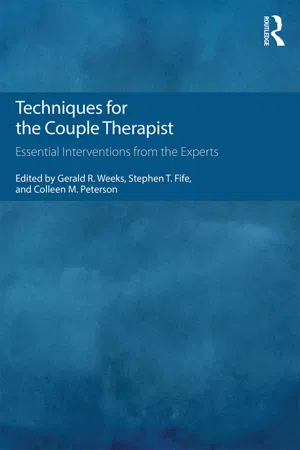
Techniques for the Couple Therapist features many of the most prominent psychotherapists today, presenting their most effective couple therapy interventions. This book provides clinicians with a user-friendly quick reference with an array of techniques that can be quickly read and immediately used in session. The book includes over 50 chapters by experts in the field on the fundamental principles and techniques for effective couple therapy. Many of the techniques focus on common couple therapy processes such as enactments, communication, and reframing. Others focus on specific presenting problems, such as trauma, sexual issues, infidelity, intimate partner violence, and high conflict. Students, beginning therapists, and seasoned clinicians will find this pragmatic resource invaluable in their work with couples.
eBook - ePub
Techniques for the Couple Therapist
Essential Interventions from the Experts
- 260 pages
- English
- ePUB (mobile friendly)
- Available on iOS & Android
eBook - ePub
Techniques for the Couple Therapist
Essential Interventions from the Experts
About this book
Information
SECTION IITechniques And Interventions
PART AEnactments
6ENACTMENTFrom the Perspective of the Use of Self
10.4324/9781315747330-6
Purpose: To allow the therapist immediate access to the couple’s dysfunctional relationship
Introduction
When couples and families relate to us their perceptions and interpretations of what goes on at home, we seldom find concurrence between any two parties in their depictions of what takes place between them. We then resort to our therapeutic detective work to develop our own hypotheses about their relationships. If our strategy is based on our interpretation of what they say, we act on the hearsay garnered from their narrations.
And, of course, that interpretation of ours is drawn from data strained through the filters of our personal life experiences and world views. The more removed we are from actually witnessing and experiencing the action people are describing, the more influence our own personal filters will have on what we understand. To be able to trust the behavior that we are exploring and weighing, we need to be closer to the action, so we can not only see it directly, but also so that we can feel the heat of it. The question to consider is this: How can we as therapists bring the living drama of people’s lives into our space so we can directly see and act on it?
The Purpose of Enactments
The enactment is meant to bring the story of our clients’ pathology into our presence for us not only to witness it as it happens, but also to experience it. People cannot convey the fullness of their experience through narration. People cannot fully see themselves, nor can they see others, except through the filters of our own biases. We fill in the blanks with our imagination. We can reason about it, feel it in our emotional receptors, and even track its effect on traces of our personal and professional histories—that is, what we have lived through in our personal lives and seen in our clinical practice. That data still lacks the body that can only be supplied by experiencing clients’ live interactions.
Moreover, as therapists we are trying to make a difference in people’s lives. This means reaching them at a depth that prompts them to approach their problems in novel and different ways, making possible change that may not have seemed possible. People are accessible to our interventions through different gates, depending on where they are in their relationships with us and what they bring of themselves—emotionally, culturally, and experientially—to the encounter with us. The more of themselves that is present with us, the more gates are accessible to our interventions. However, they cannot open their pain and vulnerability to us through words alone.
Description and Implementation
The therapist constructs an interpersonal scenario in the session in which dysfunctional transactions among family members are played out. This transaction occurs in the context of the session, in the present, and in relation to the therapist.(Minuchin & Fishman, 1981, p. 79)
Therapists from various schools have always attempted to make therapy more than just a conversation, and more of an experience. Psychoanalysts did it through the techniques that fostered transference. Structural family therapists, as noted above, did so through what they labeled the enactment. Bringing the action into the session can happen in several ways, but what is common to all methods is setting up a situation where clients feel free to or compelled to interact with each other around the focal issue in the session itself. The opportunity may present itself spontaneously when a client triggers another’s reaction by a comment or action touching on his or her issue, and the therapist refrains from drawing attention to him/herself. If the enactment is not fully spontaneous, the therapist may help it along by signaling a client to respond directly to the other family member and what was said instead of responding to the therapist, thus prompting them to continue the interaction between them as they would normally do at home. More actively, the therapist may explicitly invite clients to address the issue between them at a given moment, with the therapist involved as an observer. Even more actively, the therapist can read/sense what a family member wants to convey to another and then say it for him or her, looking to instigate an interaction between the family members.
This facilitation of interaction between family members will serve as an opportunity to observe and to understand what goes on between them. It also serves as a chance to intervene for change, a potentially powerful occasion to alter the couple’s interaction in a way that is therapeutically helpful to them. When partners are thus engaged with each other, the therapist, by how he or she connects with the couple, can promote a change in their words or behavior with one another. In such a reenactment, clients are emotionally open, and consequently more amenable to changing their patterns of interaction. This kind of engagement is more likely to stick than advice offered when they are less emotionally engaged. When a therapist actively joins family interactions to alter their dynamics, an intervention gains power through the therapist’s own emotional presence in what is interchanging among family members. The therapist’s live presence in family interactions takes on color, energy, and dimension through the therapist’s conscious and purposeful use of “all of self” that may facilitate the process—whether it is through gender, age, race, religious affiliation, or anything else that may make for a more immediate connection with the family.
Contraindications
There is a caution that relates to how directly and intensely partners engage with each other around an issue. Therapists need to be so personally present and connected to the interactions that they can sense and anticipate what could be harmful and even dangerous if not guided by them. Therapists’ emotional connection to the process will influence boundaries, patterns, and affective tones among members of the family during the enactment. Therapists also need to be self-aware of how they are influencing what is taking place among family members. Just as they can and should be positive influences in the interactions, they can unwittingly provoke harmful interactions. Therapists must view themselves as personally part of the system that is activated in the enactment.
Case Example
In this case example (see also Aponte, 1994), a Latino family with five children, two boys and three girls, presents an 11-year-old boy, Aldo, who was acting childishly at home and was inattentive in school. The mother was actively engaged with the female therapists in the therapy. The father was peripheral in the family and in the therapy. He hardly spoke in sessions. A consultant to the therapists and the family was also Latino, but as a male, his instinct was to engage the father. He moved chairs and sat right next to the father, taking time to talk with him and get to know him a little until the father relaxed with him. When the therapist felt himself connected to the man, he asked the father to get Aldo to talk with him about what was troubling him. The boy responded with one-word answers, obviously intimidated by his father, who was blunt when addressing Aldo. Finally, the father gave up and turned to the 16-year-old, Esteban, and asked him to help engage the 11-year-old. Esteban could read his brother, and confirmed with him that he was afraid of their father. Esteban himself became emotional and acknowledged to his father that he, too, feared him, and that what he needed from his father was to feel his father’s respect. This moved the father, and with encouragement from the consultant, the father said he understood his sons and spoke of how tough it had been for him with his own father. The father ended by owning up to his sons how he failed them and resolving to change.
The peripheral father became central in that therapeutic encounter; he was able to show his personal vulnerability and communicate his caring for his boys, something he was able to do in relationship with the consultant who had connected with him. The consultant had consciously used his Latino background and male identity to join with the father in a way that allowed the man to come out from hiding his fatherly understanding.
References
- Aponte, H. J. (1994). Bread & spirit: Therapy with the new poor. New York: W.W. Norton.
- Minuchin, S., & Fishman, H. C. (1981). Family therapy techniques. Cambridge, MA: Harvard University Press.
7ENACTMENTS IN FIVE DEVELOPMENTAL STAGES
10.4324/9781315747330-7
Purpose: To help emotionally reactive couples communicate effectively
Introduction
Broadly speaking, an enactment occurs in couple therapy when both partners are speaking with each other. Couples therapists use enactments as a tool for both assessment and intervention. Enactments are used in assessment when a therapist observes the couple interacting naturally, and usually provides a more accurate picture of communication patterns than if a couple merely describes their communication. Enactments are used as an intervention to shape interaction as it is occurring rather than didactically teaching the couple communication skills and then sending them home to practice without the safety provided by a therapist’s structure and guidance. Such an experiential approach is thought to produce better outcomes, as change is more likely to stick if a couple’s efforts are coached to success in-vivo by a therapist.
Even though enactments are traditionally associated with structural therapy, Butler and colleagues (Butler & Gardner, 2003; Davis & Butler, 2004) claim that enactments can be a logically consistent component of any dyadic approach. Butler and Gardner (2003) provide a framework in which a couple’s emotional reactivity determines through which of five developmental stages of an enactment a therapist should guide a couple. Davis and Butler (2004), on the other hand, focus on the specific operational skills that comprise an enactment. In other words, Butler and Gardner (2003) focus on when and to what purpose to use an enactment, whereas Davis and Butler (2004) focus on how to use an enactment. The purpose of this chapter is to outline Butler and Gardner’s (2003) five-stage model of enactments.
Purpose of the Five Developmental Stages
The main purpose of an enactment is to gradually foster self-reliant, healthy couple interaction. More specifically, enactments help couples lower their emotional reactivity, learn to be attentive to their partner’s needs, and effectively communicate their own needs. Enactments provide a vehicle through which a therapist can foster the skills necessary to achieve these goals.
Description and Implementation
Highly emotionally reactive couples begin in stage 1 and graduate to higher stages as emotional reactivity decreases and self-reliant, healthy interaction increases. Less-reactive couples will start therapy at later stages. Furthermore, some stages may take months, whereas others may take one session. It is also normal for couples to return to earlier stages if the transition happens prematurely. Regardless of the stage, the therapist intervenes through coaching interaction rather than extensive didactic teaching or advice giving (Butler & Gardner, 2003).
In stage 1, shielded enactments, the seating is arranged so both partners are facing the therapist. All interaction is channeled through the therapist. The couple is told that each will get half of the session to speak uninterrupted. While one speaks, the other is to listen without interrupting and to try to have empathy for their partner’s experience. The therapist explains that while the listener will likely not agree with everything their partner says, it is nevertheless important for the listener to set aside his or her agenda for the moment and try to see the situation through their partner’s eyes. They are also instructed to practice monitoring their physiological responses as they listen, and practice self-soothing (i.e., deep breathing) if their anxiety rises to the point that they are not listening. The therapist reassures the listener that they will get the same amount of time to talk; this serves the purpose of helping them relax enough to listen to their partner. This is still difficult for many couples in stage 1, and the therapist will likely have to briefly remind the listener to remain quiet until their turn to speak. The therapist asks the speaking partner to discuss their experience using principles of healthy communication, such as “I-statements,” complaining without blaming, and so forth. As the therapist listens to the speaker, the therapist helps the spouse or partner say things in ways that are easier to be heard. This coaching can be either didactic (e.g., “It may be easier for him/her to hear you if you used an I-statement rather than a you-statement there”) or through reflecting back what was said in a way that is easier for their partner to hear, such as by focusing on soft, primary emotions rather than harsh, secondary emotions (e.g., “I hear you that you feel angry when she doesn’t come home as planned, though I’m wondering if there’s some hurt underneath that anger, like you’re afraid that she doesn’t want to be around you. Is that right?”). Didactic coaching should be brief and kept to a minimum so as to allow time to practice within the enactment. Most instruction in stage 1 occurs indirectly through therapist modeling.
The goals of stage 1 are to help the clients reduce their emotional reactivity by slowing down their process and adopting healthier...
Table of contents
- Cover
- Halftitle Page
- Title Page
- Copyright Page
- Dedication
- Contents
- Preface
- Acknowledgments
- About the Editors
- Contributors
- SECTION I Fundamental Principles for Effective Couple Therapy
- SECTION II Techniques and Interventions
Trusted by 375,005 students
Access to over 1.5 million titles for a fair monthly price.
Study more efficiently using our study tools.
Frequently asked questions
Yes, you can cancel anytime from the Subscription tab in your account settings on the Perlego website. Your subscription will stay active until the end of your current billing period. Learn how to cancel your subscription
No, books cannot be downloaded as external files, such as PDFs, for use outside of Perlego. However, you can download books within the Perlego app for offline reading on mobile or tablet. Learn how to download books offline
Perlego offers two plans: Essential and Complete
- Essential is ideal for learners and professionals who enjoy exploring a wide range of subjects. Access the Essential Library with 800,000+ trusted titles and best-sellers across business, personal growth, and the humanities. Includes unlimited reading time and Standard Read Aloud voice.
- Complete: Perfect for advanced learners and researchers needing full, unrestricted access. Unlock 1.5M+ books across hundreds of subjects, including academic and specialized titles. The Complete Plan also includes advanced features like Premium Read Aloud and Research Assistant.
We are an online textbook subscription service, where you can get access to an entire online library for less than the price of a single book per month. With over 1.5 million books across 990+ topics, we’ve got you covered! Learn about our mission
Look out for the read-aloud symbol on your next book to see if you can listen to it. The read-aloud tool reads text aloud for you, highlighting the text as it is being read. You can pause it, speed it up and slow it down. Learn more about Read Aloud
Yes! You can use the Perlego app on both iOS and Android devices to read anytime, anywhere — even offline. Perfect for commutes or when you’re on the go.
Please note we cannot support devices running on iOS 13 and Android 7 or earlier. Learn more about using the app
Please note we cannot support devices running on iOS 13 and Android 7 or earlier. Learn more about using the app
Yes, you can access Techniques for the Couple Therapist by Gerald R. Weeks, Stephen T. Fife, Colleen M. Peterson, Gerald R. Weeks,Stephen T. Fife,Colleen M. Peterson in PDF and/or ePUB format, as well as other popular books in Psychology & History & Theory in Psychology. We have over 1.5 million books available in our catalogue for you to explore.