This book offers key tools and tactics that help school leaders navigate the complex and busy work of improving a school, allowing them to maintain success during the full calendar year. Through practical guidance and "Have to Do" strategies, School Leadership through the Seasons breaks down the challenges of leading a school into manageable steps that align with the seasons of the year. After reading this book, you'll be able to: implement school improvement processes at high levels, build a culture and climate that promotes safety and learning, and respond to student and staff needs.
eBook - ePub
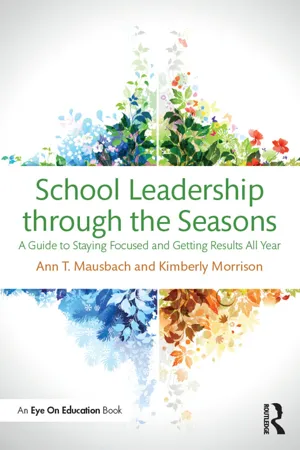
School Leadership through the Seasons
A Guide to Staying Focused and Getting Results All Year
- 212 pages
- English
- ePUB (mobile friendly)
- Available on iOS & Android
eBook - ePub
School Leadership through the Seasons
A Guide to Staying Focused and Getting Results All Year
About this book
Information
Topic
EducationSubtopic
Education General1 | Introduction |
You have to get up and plant the seed and see if it grows, but you can’t just wait around, you have to water it and take care of it.
Bootsy Collins
Gardening requires lots of water—most of it in the form of perspiration.
Lou Erickson
Did you know that peonies won’t grow if you move them or that adding sugar to the soil makes tomatoes sweeter?
If you are a gardener you will realize that these are old wives’ tales that aren’t true and have been circulating for generations. What does this have to do with leadership, specifically school leadership? Gardens and schools or districts are complex systems and as such require a lot of care. And like gardening myths, myths about leadership continue to circulate, such as the notion that leaders must possess the skills of a superhero, being able to swoop in and solve any problem at any time. Or that leadership is instinctual, you are either born to lead or not. Gardening and leadership are hard enough without falling prey to these falsehoods. The job of the leader, like that of the gardener, is to develop supports and structures that help everyone in the system grow and develop. This requires knowing not only what to do, but when to do it. The complexity of leading a school and a school system filled with adults and students with diverse needs is analogous to tending to the variety of plants that line garden beds. Gardens and school systems prosper when control is balanced by equal measures of commitment and skill (knowing what to do, how to do it, and when to do it). The purpose of this book is to share critical commitments and identify specific practices that operationalize these commitments so they can be skillfully implemented in the context of a school year.
Understanding and making a commitment is far easier than upholding one. Like the well-intentioned gardener who fails to water and weed on a regular basis, school leaders can also get sidetracked from their main job of leading teaching and learning. Commitments get broken when specific practices and processes aren’t in place. And even when these practices are in place, without a leader’s continual analysis of what is working and what isn’t and then adjusting practices, a breakdown will happen. The challenge for school leaders is not in committing to the work, but in making the work happen and continuously thinking about how to improve or refine practices. Figure 1.1 provides a framework to help both principals and central office administrators conceptualize the leadership mindset required to improve a system. The practices that support the commitments are titled “have to dos” and serve to hold up the commitments.
The work of improving a school or system is not a linear process. The gardening analogy is used throughout the book because it helps illustrate the cyclical nature of the work. This book is designed to help show the integrative nature of all three commitments through a series of moves that are connected. Section I outlines the commitments that need to be made, while Section II is designed to explain the moves that need to happen to uphold commitments.

Figure 1.1 Leadership Framework

One of the compelling findings of Fullan’s (2011) research on change is that behaviors change before shifts in beliefs occur. Changing behavior helps to change thinking (Sinek, 2015). Commitment happens when new experiences are provided that allow individuals to practice and build on the learning. It is in the “doing” that sincere changes in beliefs occur. It’s a bit like the Nike ads, “Just do it.” Do the work, and the belief and dedication to the change will follow. Leaders wanting to have an impact on an entire school or system need to understand that this finding is a call to action not only for how to approach work with staff, but how to approach their daily work. Commit to the work by engaging in behaviors that will transform beliefs and ultimately the system. Committing to the work requires a high degree of persistence. A dedicated gardener sticks with it even when the plants don’t sprout up right away, or the rabbits eat their lettuce. Leadership is also a practice that requires a high degree of commitment in order to get results. Consistency is more important than intensity (Sinek, 2015).
But what should school leaders be committing to? Commitments stem from knowing what is valued. Value defines purpose. The purpose of a garden is growth so gardeners value the land and the weather. The purpose of schooling is student learning, so school leaders need to value the people and processes that make this happen. School leaders need to commit to:

These commitments stem from the three components that make up the professional capital equation; human, social, and decisional capital (Hargreaves & Fullan, 2012). Professional capital is a framework for leading learning that involves equal measure and interaction of the three types of capital in order to develop the entire organization. Human capital, which has for too long been the focus in schools and school systems, pertains to individual talent. Are there skilled teachers and principals in the system? Social capital refers to the quality and quantity of social interactions in schools. How often and how well do teachers and principals collaborate?
Decisional capital refers to the ability to make good decisions and judgments based on experience and learning. How are decisions made when the answers aren’t clear-cut? Improving, using, and connecting all three capitals creates a balanced system and promotes school reform. In a balanced system groups work together in such a way that it improves the performance of the individual. The group changes both the group and the individual for the better. Decisions are made based on professional judgment that has been honed through working together through a variety of situations. Gardening is a symbiotic process that relies on the interaction of various conditions such as plants, soil, and weather. Each condition interplays with the others in the same sense that professional capital does. All three capitals interact with each other to develop healthy professional capital.
Commitment is defined as the state or quality of being that is dedicated to a cause, activity, etc. The cause for leaders in schools must be developing professional capital. Committing to implementing school improvement processes dedicates the leader’s actions to improving decisional capital, development of a school culture that promotes learning improves social capital, and using a growth mindset to develop and enhance professional capital helps increase human capital.
Section I of this book outlines the three commitments that leaders must make to improve schools. The relationship between each commitment and one aspect of professional capital is outlined. Critical concepts that underpin each commitment are discussed. Specific actions that a leader should and shouldn’t do when thinking through these concepts are included and titled “do this,” “not that.” Each chapter ends with a story from both the building and district level to help illustrate the commitment in action. Look for the school house icon which indicates the “Commitment to Action”.
A master gardener is both committed and skilled. The gardener’s skill is in knowing what must be done when and using the right tools to make the work happen. Gardeners understand that each season of the year is a distinct period of time marked by specific weather conditions, temperatures, and length of day. These variables define the growing season. Although each season represents a unique period that requires specific behaviors and actions, the cycles are recursive and interdependent. For example, the harvest in the fall is a result of the planting in the spring and the weather conditions in the summer. Skilled gardeners also understand the inter connected ness between soil, seeds, and maintenance. The garden can be well designed with straight rows that have seeds planted at exact distances but there will be little harvest if it isn’t watered, weeded, and fertilized.
And so it goes for school leaders. Leaders must understand the seasons of the school year and engage in specific behaviors at critical points in the year, using the right tools at the righ...
Table of contents
- Cover Page
- Half Title page
- Other Eye On Education Books
- Title Page
- Copyright Page
- Contents
- eResources
- Acknowledgements
- Meet the Authors
- 1 Introduction
- SECTION I Sowing the Field Commitments
- 2 Implementation of School Improvement Processes at High Levels
- 3 Development of a Safe Culture that Promotes Learning
- 4 Use of a Growth Mindset to Develop and Enhance Professional Capital
- SECTION II Seasons Working the Field to Get Higher Results
- 5 Fall Starting the Year with Clarity and Focus
- 6 Winter Making the Work Happen through Implementation and Monitoring
- 7 Spring Staying the Course While Looking Forward
- 8 Summer Reflecting, Refining, and Planning
- Appendix A Collaborative Learning Team Agenda
- Appendix B Backward Planner Template
- Appendix C SIP Template
- Appendix D SIP Feedback
- Appendix E Feedback Examples from Monitoring SIP
- Appendix F Thought for the Week Examples
- Appendix G Data Analysis Guide
Trusted by 375,005 students
Access to over 1.5 million titles for a fair monthly price.
Study more efficiently using our study tools.
Frequently asked questions
Yes, you can cancel anytime from the Subscription tab in your account settings on the Perlego website. Your subscription will stay active until the end of your current billing period. Learn how to cancel your subscription
No, books cannot be downloaded as external files, such as PDFs, for use outside of Perlego. However, you can download books within the Perlego app for offline reading on mobile or tablet. Learn how to download books offline
Perlego offers two plans: Essential and Complete
- Essential is ideal for learners and professionals who enjoy exploring a wide range of subjects. Access the Essential Library with 800,000+ trusted titles and best-sellers across business, personal growth, and the humanities. Includes unlimited reading time and Standard Read Aloud voice.
- Complete: Perfect for advanced learners and researchers needing full, unrestricted access. Unlock 1.5M+ books across hundreds of subjects, including academic and specialized titles. The Complete Plan also includes advanced features like Premium Read Aloud and Research Assistant.
We are an online textbook subscription service, where you can get access to an entire online library for less than the price of a single book per month. With over 1.5 million books across 990+ topics, we’ve got you covered! Learn about our mission
Look out for the read-aloud symbol on your next book to see if you can listen to it. The read-aloud tool reads text aloud for you, highlighting the text as it is being read. You can pause it, speed it up and slow it down. Learn more about Read Aloud
Yes! You can use the Perlego app on both iOS and Android devices to read anytime, anywhere — even offline. Perfect for commutes or when you’re on the go.
Please note we cannot support devices running on iOS 13 and Android 7 or earlier. Learn more about using the app
Please note we cannot support devices running on iOS 13 and Android 7 or earlier. Learn more about using the app
Yes, you can access School Leadership through the Seasons by Ann Mausbach,Kimberly Morrison in PDF and/or ePUB format, as well as other popular books in Education & Education General. We have over 1.5 million books available in our catalogue for you to explore.