- 370 pages
- English
- ePUB (mobile friendly)
- Available on iOS & Android
eBook - ePub
About this book
This edition brings the story of 20th-century Southern politics up to the present day and the virtual triumph of Southern Republicanism. It considers the changes in party politics, leadership, civil rights and black participation in Southern politics.
Trusted by 375,005 students
Access to over 1.5 million titles for a fair monthly price.
Study more efficiently using our study tools.
Information
1
There is no way to tell the story of the curious life that happened to me without dealing with the fact that I was for many years what that old brute Senator Joseph McCarthy delighted in calling “a card-carrying member of the Communist Party.” He had a way of saying it as if it were a spell to evoke Old Nick himself, and he shrouded each evocation of the devil in such nasty delight that you could fairly smell the smoke.
In my single encounter with the old monster, I tried vainly to instruct him in some of the more obvious truths of American history, in response to which McCarthy, in a towering rage, roared at me to go write a book. I wrote more than he asked for, but of that, later. At this point, I am trying to describe the circumstances that led me into the Communist movement, where I remained for twelve years, with a profound effect on all my life.
Pearl Harbor had happened, and the world was at war, and the United States joined the forces that faced Adolf Hitler and his fascist allies. It was 1942, and in the desperate rush by America to turn a peaceful nation into a war machine, many things were quickly if loosely put together. One of these was a propaganda and information center, something that the country had done well enough without in the past but was now a necessity in this era of radio. This propaganda and information center, so hastily thrown together, was called the Office of War Information, or OWI; and feeling that the only available pool of talent to man it was in New York City, the government took over the General Motors Building at Fifty-seventh Street and Broadway. In the first few months after Pearl Harbor, the government set to in a sort of frenzy to remake the building according to its needs, staff it, and somehow learn the art — if such it was — of war propaganda.
Howard Fast, meanwhile, was living the ultimate fulfillment of a poor boy’s dream. Raised in bitter and unrelenting poverty, I had now plunged right into the American dream. Of the poverty, of the awful and painful years that I spent in what people call childhood, I will have more to say; at this point, 1942, I was sitting right on top of eighteen pots of honey. My third novel, The Last Frontier, published a year earlier, had been greeted as a “masterpiece,” praised to the skies by Alexander Woollcott and Rex Stout, and chosen as a selection by the esteemed Readers Club, and my new novel, just published, called The Unvanquished, a story of the Continental Army’s most desperate moment, had been called, by Time magazine who found in it a parallel for the grim present, “the best book about World War Two.” I was twenty-seven years old, about to turn twenty-eight, and five years earlier I had married a wonderful blue-eyed, flaxen-haired girl, an artist by name of Bette, an artist by every right, and still my wife and companion, fifty-three years later. We had survived the first hard years nicely enough, and we had just put down $500 for an acre of land on the Old Sleepy Hollow Road near Tarrytown.
At Sears, Roebuck we purchased for twelve dollars a set of blueprints, and with a mortgage of $8000 and $1000 in cash, we built a small, lovely two-bedroom cottage. Bette became pregnant, we acquired a wonderful mongrel named Ginger, and I finished writing a book I would call Citizen Tom Paine. I cleared the land myself, Bette learned to bake and cook and sew small clothes, and I saw a rewarding, gentle future, in which we would have many children and Bette would paint and I would write my books and earn fame and fortune. And then the war came, and it all turned to dust.
In quick succession, my father died (my mother had died when I was eight and a half, and my father never remarried), my younger brother, close to me and my dearest friend, enlisted in the army, I drew a low draft number, and Bette miscarried our first child and sank into gloom. The future that we had planned so carefully was cast aside; Ginger was given to my older brother and promptly ran away and disappeared; the house was put up for sale; we moved into a one-room studio in New York; and Bette, convinced that my orders would be cut in a matter of weeks at the most, leaving her to face the possibility of years alone, joined the Signal Corps as a civilian artist, making animated training films.
Well, there it was, a pile of ashes but certainly not the worst such pile in those strange times. We were young, in good health, and I was successful and was looking forward to being in uniform. It is hard for us today, living with the horror of the atom bomb, remembering Korea and Vietnam, sick of war, and aware that the next war may finish the human race — hard indeed to think about a time when this country was knit together in a hatred of Nazism, wholly united in a conviction that we could not live in the same world as Adolf Hitler. But it was that way, and we knew that we would have to fight, and we accepted it — at least the great majority of us.
When I argued with my wife that it made more sense for me to enlist, as my brother had, than to wait around for a summons by the draft board, she objected strenuously and angrily, guided by the sensible feminine hope that the board would somehow miss me. I was bored and frustrated, and for two weeks I wandered the streets of New York, watched daytime movies, and looked with envy at every one of the thousands of uniformed men and women whom I passed. Then one midday, on West Fifty-seventh Street, I met Louis Untermeyer, and my life changed and nothing would ever again be what we had dreamed our lives might be. Whether it works that way, where a chance meeting can turn existence upside down, or whether what happened to me would have happened in any case, I don’t know.
Louis Untermeyer, at that time in his middle fifties, had a national reputation as a poet and anthologist. His knowledge of poetry was encyclopedic, his critical sense wise and balanced, and his wit delightful. He would become a major figure in my life, a beloved friend as well as a surrogate father, but at that time I knew him only slightly, having met him once, a year before this chance meeting on Fifty-seventh Street. The previous meeting had been in Philadelphia, at the Academy of Music, where I was invited to make the first public speech of my life. In front of an audience of twelve hundred literary-minded people, I read an address I had spent days preparing. I read it from beginning to end, a matter of at least twenty minutes, but since I was in a state of stark terror, no sound emerged from my lips. It was at this moment of cold anguish and hopeless despair that Louis came to my aid and saved me from some form of self-destruction by telling me that the same thing had once happened to him, and that the audience would not hold it against me but would cherish my platform terror as the stuff of an anecdote to tell their friends. (Let me note that in due time I became an excellent speaker, one of the best in the Communist movement.)
On this day in 1942 I greeted Louis Untermeyer as my savior and eagerly accepted his invitation to lunch. Any meal with Louis was a delight. He would bring a gourmet’s appreciation to a boiled egg, and his wit was so much a part of him that he had no existence without it. During lunch I poured out my tale of boredom and frustration, and once again he offered a solution. The solution was the Office of War Information, and it was located down the street, two blocks from where we were eating.
Louis had shared my present feeling of impotence and frustration, and he had offered his services to the OWI for whatever use it might have for him. So he had been given a desk and was now writing a propaganda pamphlet. Since at his age he could not bear arms, a propaganda pamphlet was meaningful. He asked me to come back with him, positive that the OWI would offer me the same thing.
To what end, I wondered. What on earth was the use of writing propaganda pamphlets? Who would read them? What difference would it make? What do you say — that Nazism is evil? Be of good cheer, someday American troops will land on the European continent and destroy Adolf Hitler?
Louis calmly replied that since this was something the government decided should be done, he was willing to do it. Possibly the pamphlets would be translated into the languages of occupied Europe; possibly they would be dropped from planes. He did not convince me that such a plan was other than useless, nor have I ever changed my mind about that; at the time I was convinced that nothing I could say would have the slightest meaning in occupied Europe. But I was bored and discontented, and it was only a matter of weeks before I’d be drafted, so I went along with Louis’s suggestion and walked with him back to the OWI, where I was welcomed with open arms, hired two days later, given a desk and a typewriter, and instructed to do a pamphlet on the American Revolution. Since my novel The Unvanquished was about the American Revolution, that was my thing. It made absolutely no sense to me. I had no notion of what use the pamphlet might be; I considered it a boondoggle. When I told Bette about it, I also informed her that I was ready to give the job back.
She thought otherwise, arguing that even if my pamphlet was some sort of boondoggle, the OWI needed time to give itself a direction. I had to agree with her. The desk where I did my writing was on the top floor of the building; on the floors below, Elmer Davis, newly appointed head of the Office of War Information, was trying to whip a massive short-wave radio operation into shape, setting up speaking and translation units for every country of occupied Europe — as well as for Spain, Portugal, and Sweden, still unoccupied by Nazi forces. Of this, at the time I was writing my pamphlet, I knew nothing. I took the elevator to my floor. Nobody had bothered to enlighten me about the problems of the floors below.
And they had their problems. Setting up the short-wave operation itself presented few difficulties, and though there were some hitches in putting together the translation desks — such as finding someone to man the Hungarian Desk other than cultural fascists — those were solved. Where the operation bogged down, curiously enough, was in setting up an operation called the American BBC. This had come into being because none of our medium-wave broadcasting units could reach the European continent. Medium wave was the normal radio transmission in the United States as well as in Europe, and though radio hams might have short-wave sets, ordinary households had the widely manufactured commercial medium-wave sets. There was only a sprinkling of the short-wave sets on the continent, and the Nazi SS worked assidiously to destroy them.
The feeling at the State Department and the War Department was that we must somehow reach the medium-wave receivers in European households, and since the only part of the European community that was both free and allied to us was Great Britain, our people cast their covetous eyes on the British Broadcasting Company. The British were none too happy at the thought of the Yanks putting their grubby fingers on the precious BBC, but their dependence on these same Yanks was enormous, so there was no way they could shunt off our demands. Elmer Davis, a one-time correspondent for The New York Times and later a radio news commentator, was at that time the most respected man in the field of radio news transmission. Joseph Barnes, a veteran newspaperman, talented and respected, was brought in by Davis to work with him. Both of them understood the importance of medium wave as opposed to short wave, and they persuaded our government to lean on the British; the result was that the British agreed to turn over their BBC medium-wave transmitters to us for four hours a day, from two a.m. to six a.m. our time, which was seven a.m. to eleven a.m. London time. A T & T set up a triple transatlantic telephone transmission to London; it would take our voices across the ocean with practically no loss in quality.
So now we had it, a transmitting facility that would cover Europe with our propaganda and could be tuned in by every home on the continent. Now it remained only to find someone to prepare the basic fifteen-minute program that would be translated into eleven languages and repeated several times in French and German. My knowledge of what happened in this search came from John Houseman, who headed up part of the short-wave operation — dramatic radio propaganda — and whom I later came to know and like enormously. John — or Jack, as we called him — had given up his work as a successful producer to come to the OWI, and according to Houseman, three men were hired in succession to be the BBC anchor writer, and each of the three had served from a week to two weeks and was then fired. One was the head of the second largest ad agency in New York; the other two were newspapermen.
During a meeting with Houseman on another subject, Davis and Barnes raised the question of whom to hire for the BBC and where to find him. They told Houseman how desperate they were and what a letdown the three candidates had been, all of them highly recommended and men of experience. There were other men — it was before the time when they might have turned to women — whom they wanted, men in good positions who would not give up their careers even for the OWI. Houseman asked them exactly what they wanted, to which they answered someone who could write clean, straightforward prose, someone who was literate yet simple and direct.
To this, Houseman answered that he had just read the proofs of a book called Citizen Tom Paine, clean, colorful political writing by a kid name of Howard Fast. And how old was this kid? Twenty-seven or twenty-eight. And how do they get in touch with him? He’s right here in this building, top floor, writing a pamphlet about the American Revolution. And what in hell was he or anyone else doing sitting up there and writing a pamphlet about the American Revolution? Didn’t anyone up there understand that this was World War Two, and not the American Revolution? A few minutes after this discussion, the head of the pamphlet department came to my desk and told me that Elmer Davis, chief of the operation, wanted me downstairs in the radio section.
I will never forget walking through the corridors where the shortwave power packs were stacked floor to ceiling, seeing them for the first time with a sense of awe, and realizing for the first time that this building housed no boondoggle but rather was the heart of the Voice of America. Suddenly, I felt that I was going to be fired, and for the first time, I did not want to be fired; I wanted to be a part of this, the tickers everywhere, the men in uniform, both army and navy, the cubbyhole offices with their placards: french desk, german desk, danish desk, croatian desk — Croatians, where had I heard of them, and who were they? — and inside each cubbyhole, different people, some bearded, some old, some of them young, exotic women, scribbling, typing, all of them animated by fierce energy. Were they refugees? I wondered. Refugees from Hitler were romantic figures then. A dozen different tongues were competing with the chatter of ticker tape machines and orders barked over a loudspeaker system — and all of this going on in a building where I had spent two quiet weeks working on a pamphlet about the Revolution.
In Elmer Davis’s office, Davis and Barnes and Houseman awaited me. I walked into the room, and the three cold-eyed, hard-faced men stared at me as if I were an insect on a pin, and then Elmer Davis said, “Are you Fast?”
Of course, they were not hard-faced or cold-eyed, but I was scared and unsure of myself and convinced that I was to be fired for some awful foul-up in my pamphlet, which must have been brought to them as proof of my culpability. I can recall the conversation that followed fairly well, by no means exactly after all these years. Jack Houseman, my entry angel into this strange new world, began by spelling out the nature of what would be called from then on simply the BBC, how the deal with the British had come about, and what it was intended to do. Then Elmer Davis picked up and said to me, “That’s why you’re here, Fast. Jack says you can write.”
They were all standing. Suddenly, they all sat down. No one asked me to sit down, so I remained standing. They kept looking at me as if I were distinctive in some way. I wasn’t. I was five feet ten and a half inches, I still had plenty of hair, and I had round cheeks that embarrassed the hell out of me because they turned pink at my slightest unease. Brown eyes and heavy horn-rimmed glasses completed the picture.
“Do you follow me?” David asked.
I shook my head.
“What he means,” Houseman said kindly, “is that he wants you to take over the BBC and write the fifteen-minute blueprint every day.”
I shook my head again. If I had unclas...
Table of contents
- Cover
- Half Title
- Title Page
- Copyright Page
- Dedication
- 1
- 2
- 3
- 4
- 5
- 6
- 7
- 8
- 9
- 10
- 11
- 12
- 13
- 14
- 15
- 16
- 17
- 18
- Index
Frequently asked questions
Yes, you can cancel anytime from the Subscription tab in your account settings on the Perlego website. Your subscription will stay active until the end of your current billing period. Learn how to cancel your subscription
No, books cannot be downloaded as external files, such as PDFs, for use outside of Perlego. However, you can download books within the Perlego app for offline reading on mobile or tablet. Learn how to download books offline
Perlego offers two plans: Essential and Complete
- Essential is ideal for learners and professionals who enjoy exploring a wide range of subjects. Access the Essential Library with 800,000+ trusted titles and best-sellers across business, personal growth, and the humanities. Includes unlimited reading time and Standard Read Aloud voice.
- Complete: Perfect for advanced learners and researchers needing full, unrestricted access. Unlock 1.5M+ books across hundreds of subjects, including academic and specialized titles. The Complete Plan also includes advanced features like Premium Read Aloud and Research Assistant.
We are an online textbook subscription service, where you can get access to an entire online library for less than the price of a single book per month. With over 1.5 million books across 990+ topics, we’ve got you covered! Learn about our mission
Look out for the read-aloud symbol on your next book to see if you can listen to it. The read-aloud tool reads text aloud for you, highlighting the text as it is being read. You can pause it, speed it up and slow it down. Learn more about Read Aloud
Yes! You can use the Perlego app on both iOS and Android devices to read anytime, anywhere — even offline. Perfect for commutes or when you’re on the go.
Please note we cannot support devices running on iOS 13 and Android 7 or earlier. Learn more about using the app
Please note we cannot support devices running on iOS 13 and Android 7 or earlier. Learn more about using the app
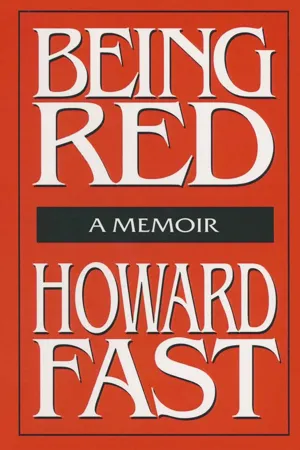
Yes, you can access Being Red: A Memoir by Howard Fast in PDF and/or ePUB format, as well as other popular books in Politics & International Relations & Civil Rights in Politics. We have over 1.5 million books available in our catalogue for you to explore.