Introduction
In 2012 I was asked by Dr Hui Yew-Foong, an anthropologist working in Singapore to assist in the visual documentation of Bukit Brown Cemetery, commonly called Bukit Brown for short. Long forgotten as a municipal cemetery in the 1970s, Bukit Brown is now symbolic of the tensions between conservation and progress in the nation-state of Singapore. Sited on prime land near ultra-expensive landed properties, it was announced in 2008 that the cemetery would first be cut in half by a four-lane road connecting the North of Singapore to its central motorway, and then in another 20 years be terraformed into more housing with more property. The state, realising a surge in demand for heritage and notions of the past, commissioned a three-year study to document and record not only the affected graves, but also the social and cultural life of the cemetery.
It was during the latter in which I first realised a need for this book. As a photographer trained in Sociology (and not the other way around), I focussed on visually engaging with the rituals, individuals and artefacts of Bukit Brown, whilst Yew-Foong both spoke to our informants and photographed when he could. I carried the equipment I would normally use on professional shoots, whilst Yew-Foong and other research assistants used smaller all-in-one cameras. In perfect lighting conditions, our images had similar levels of sharpness and detail – good samples of visual data documenting everyday objects in a cemetery. The problems began to occur when we started photographing in different and often difficult conditions. Grave exhumations were often carried out at night, with little artificial light. Covered in primary tropical rainforest, we were layered in a blanket of darkness – and the only photographs (and some videos) that we could use as data became mine.
As much as the anecdote sounds like a call for larger budgets for equipment (and admittedly good, professional-grade gear does make a research project easier), it is not. With 20 years of experience first as a commercial photographer, then as a social researcher who employs visual methods, I knew how to use my camera to its maximum potential. Even while trying to ensure that I had developed a nuanced understanding of the rituals I was observing, my mind was constantly assessing the situation and deciding on aperture and metering modes, while monitoring shutter speeds to prevent blurriness from camera shake. I observed and composed, then observed again through my camera’s lens, using it as a fulcrum of interaction between me and my informants. In other words, I was, as Edward Weston (1965) puts it, “seeing photographically.”
Although a number of social researchers work regularly and successfully with photographers (Knowles 2006; Knowles and Harper 2009), we are more likely to see scholars taking up a camera to record their own observations, especially certain social science disciplines, such as Anthropology (Banks 2001; Pinney 1997; Pink 2008), Sociology (Harper 2012), Human Geography (Comaroff 2007) and Education (Prosser and Schwartz 1998).
In recent years there has been a marked increase in interest in visual methods, but often the response to this interest has been to consider the post-photographed photograph, rather than the photograph that has yet to be photographed. In her very excellent book Visual Methodologies (2006), Gillian Rose sets out the aim of the book, which is to “provide a basic introduction to a range of methods that can be used to interpret visual images, and (the book) . . . provides enough references for (the reader) to develop more detailed methods if (the reader) need(s) to.” (Rose 2006:xiv). Rose, drawing from Hall (1997), points out that there is no one true meaning or interpretation of an image, and therefore, in order to have one’s meaning deemed acceptable, one must be able to justify that meaning, hence the need for a robust and rigorous visual methodology, a way to develop theories of the visual.
Rose’s book is exemplary of the texts available to social researchers interested in the broad topic of “visual methods.” Most students will also have read Sarah Pink’s Doing Visual Ethnography (2007), which introduced me and many of my peers to the idea that one could use a camera in the field. Other useful books in this genre include those by Banks (2001), Collier and Collier (1986), Mitchell (2011) and Spencer (2011). Whilst such volumes were and still are invaluable to theorising, understanding and using visual images as part of one’s research, many fail to recognise, or minimise, the aspect of creating the photographs that are to be read.
For example, in Visual Methodologies, Rose does devote an entire chapter to the act of making photographs as part of one’s research project (Rose 2006:237). Creating two broad categories, the use of photographs to support and supplement social science research, Rose explores the various ways in which photographs are used and created by researchers. However, little attention is paid to the “creation” aspect. She discusses the act of photo-documentation, in particular Suchar’s (2004) project on documenting gentrifying neighbourhoods and how he chooses to use a “shooting script” – a series of sub-questions about his chosen space – to link the kinds of photographs taken with his research question. But in doing so she only addresses the “how-to” from a non-technical, social science perspective (i.e. a shooting script might tell a researcher how to focus his or her attention on particular spaces, objects or people, but does not say how such photographs should be created, or what the challenges of creating these photos are). Likewise, in Douglas Harper’s also-excellent guide to Visual Sociology, entitled Visual Sociology (2012), Harper takes the reader on a journey of documenting the social using visual means, particularly photography. However, Harper’s focus is also on the sociological techniques of research, i.e. what should be included in a photograph. Harper does include a small section towards the end of the book that discusses the technical aspects of the methods he introduces, including aperture, shutter speed and so on, but this is fleeting compared to the much more in-depth discussions of photography-related subjects.
In other words, although there are a number of very well-written guides in the social science literature on what to photo-document and how to read, interpret and use the created photograph, there is a lack of information and guidance on how the photographs should be created from a technical point of view. Although some will argue that this niche is filled by technical manuals or photography classes, I propose that such approaches ignore the needs of social science researchers and the fields in which we do our work. Through this book, I will argue for the need for an awareness and fluency in “photographic grammar,” that while all photographs are useful and hold ethnographic value (Pink 2008), there is much potential for social researchers to “add ethnographic value” by creating more impactful, detailed or expressive images that support their arguments, inspire social change or simply make social research look better or, as Barthes (1981) would put it, for us to code studium into our images. In the rest of this chapter I will first map out what I mean by photographic grammar, framing it within well-known thought-pieces by Sontag (1977), Barthes (1981), Weston (1965) and others – I will show through examples how, all things being equal, a strong photograph helps communicate data more powerfully than a weak one. I will then introduce the rest of the book chapters, showing how, through case studies in the field, one can develop one’s own version of photographic grammar.
Developing a photographic grammar
In an increasingly globalised academic landscape, albeit one that is still prejudiced towards works in English, command of the English language is a valuable scholarly trait. However, with widening participation in publishing and submissions, publishers often encounter writers whose first language is not English submitting their work. This is evidenced, for example, in Taylor & Francis’s website for author services,1 where various videos have been posted in Mandarin, Arabic, Japanese and Korean offering advice to potential authors, along with suggestions and links to external, third-party companies who can assist with writing style and grammar. Such services suggest that a well-written, clearly argued and fluent book or journal article appears more likely to be well-received than one that is not.
The Oxford dictionary2 defines grammar as “The whole system and structure of a language or of languages in general, usually taken as consisting of syntax and morphology (including inflections) and sometimes also phonology and semantics.” It also considers the term “grammar” to imply “the basic elements of an area of knowledge or skill,” as well as “a set of actual or presumed prescriptive notions about (the) correct use of a language.” Good grammar, therefore, implies the ability to follow a prescribed set of rules regarding a language or skill in order to demonstrate mastery of said language or skill. To have good grammar, especially in the case of language, may not necessarily mean the user is an effective communicator, but it does suggest that the user has some ability pertaining to the medium. While it is not in the purview of this book to discuss the theories of effective communication (or the skills necessary to be an effective communicator), I want to propose that, for the purpose of this analogy, we accept that good grammar is an important contributor to the development of skills and eventual mastery in a particular area of knowledge.
From a photographic point of view, mastery is a crucial aspect of a photographer’s toolkit. Whilst many social researchers approximate adequate competency with a camera to be similar to that of a voice recorder (i.e. if you can use it and turn it on, that’s good enough), photographers have more exacting expectations. In her book The Photography Reader (2003), Liz Wells included a short but exceptional essay by Edward Weston (1886–1958), a twentieth-century American photographer best known for his work on nudes, still life and landscapes. Weston was also the first photographer to be awarded a Guggenheim Fellowship, and his work remains archived at the University of California: Santa Cruz and the Smithsonian Museum. Weston’s essay, Seeing Photographically (1965), was written in 1943, when photography was becoming increasingly popular, but significantly before the explosion of personal imaging devices that we see in mobile technology today. However, what Weston wrote about the act of photography remains as pertinent now as it was in 1943.
It is learning to see photographically – that is, learning to see his subject matter in terms of the capacities of his tools and processes, so that he can instantaneously translate the elements and values in a scene before him into the photograph he wants to make.
(Weston 1965:173)
One of Weston’s main arguments in his essay was that photographers of his age had not yet achieved a level of technical mastery that allowed them to photograph instinctively, to express their intention or tell their story with the camera as an extension of themselves. Instead, Weston points out that “. . . few photographers master their medium. Instead they allow the medium to master them and go on an endless squirrel cage chase from new lens to new paper to new developer to new gadget . . . becoming lost in a maze of technical information” (1965:173). Whilst Weston seemed to advocate a minimalist approach to equipment, he was also telling photographers to master their “tools” and “processes” (1965:174).
How does one achieve that mastery in the context of social science research? The majority of us are, after all, not professionally trained photographers who have spent many years honing their craft in the same way we hone our theoretical and methodological minds in graduate school. But in the same way we practise and refine (hopefully) our grammar of language when performing academic writing, I argue that we need to do the same when creating visual images. If we hold ourselves to high standards of grammar and language when writing, so too should we apply those same standards to the creation of data – quantitative, qualitative, visual or otherwise. We are often quick to determine and judge the quality of both quantitative data – p-values, R2, chi-squared and so on – and qualitative data, from the number of individuals one might have interviewed to the length of time one is involved in a participant observation study. Such standards have taken much time and effort to construct, and this introduction is only the beginning of the development of photographic grammar. But for the purpose of this book, I will propose a few things that will frame the rest of the chapters in creating “good” (however subjective) photographic data.
What might constitute good photographic grammar? Again, from a technical perspective, many photographers would point to various rules that are taught as basics to beginners – “correct” exposure, the rules of thirds, framing, leading lines and so on (Cross (2014) calls it a technical-aesthetic). Whilst these rules are useful and indeed should not be ignored, they are not the only aspect we should be concerned with. As social researchers, we are in the business of communicating the social conditions, relationships, values, opinions and circumstances of our informants, collaborators or interlocutors. Although many photographers (especially documentary photographers) seek to do the same, our photographs, especially those we choose to present as important data, need to be encoded to be as, if not more, useful than textual descriptions, quotes from our informants, or bar graphs from survey results.
In other words, our photographs need to invite readers to study them so as to inform their understanding of our argument. I propose that Barthes’s (1981) concept of studium is useful here. As Houlihan (2004) notes, “the studium speaks of the interest which we show in a photograph, the desire to study and understand what the meanings are in a photograph, to explore the relationship between the meanings and our own subjectivities.” La Grange (2005) further elaborates on this by outlining the five functions of studium – “to inform, to represent, to surprise, to cause to signify, to provoke desire” (Barthes 1981:28). For the purpose of developing a photographic grammar in social research, I propose that three of these functions are the most relevant – to inform, to surprise and to provoke desire. I will deal with each of these in turn.
To inform
In Barthes’s framework, the photograph is the subject of three things – the operator (the photographer who photographs), the spectum (the referent or the thing that is photographed) and the spectator (the individual who views and consumes the photograph). The act of informing, according to Barthes, lies in the detailed definition of a photograph, the same kind of mechanical fidelity that Weston (1965) writes about in his article on seeing photographically. Barthes’s vision of the photograph is that it shows details – and through these details the photograph transmits knowledge of the referent to the spectator. For a mundane photograph that is taken “as is” (straight-on angle, 50mm lens mimicking the human eye’s field of vision, perfectly flat lighting conditions), this function tends to be accurate – the photograph is a source of information and knowledge. For social researchers looking to develop cultural inventories of their informants’ lives, photographs can potentially tell a more nuanced story than a textual description. But this idea of information is simplistic and needs to be extended – information about details, about mundane elements, only reveals part of the social data that we strive to capture and present. Instead, a photograph can “inform” us of a great number of other things (Banks 2001) – emotion, ambience, and other sensorial aspects of the referent.
In my own visual research (Heng 2014), I often use a sensorial approach (Pink 2008) in my fieldwork, taking on the role of a wandering ghost during the 7th Chinese lunar calendar month, also known as the Hungry Ghost Festival. As part of this approach I wandered the urban neighbourhood late at night, photographing makeshift altars and offerings that were part of rituals for the festival. The photographs I chose to curate and eventually publish (Heng 2014, 2015) did more than just show evidence of altars during a particular period of time, they demonstrated the way altars influenced the spaces they were placed in, creating a secondspace (Soja 1996) of spirituality that overlaid carefully planned and arranged firstspaces set out by the state.
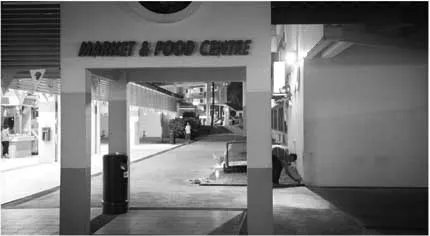
Figure 1.1 Hawker planting makeshift altar in Singapore.
In Figure 1.1, a Singapore hawker (colloquial term for a small business owner often selling food, groceries or sundries) from the adjacent market and food centre gingerly places an offering on a well-manicured grass patch. Here, there were two ways of p...