eBook - ePub
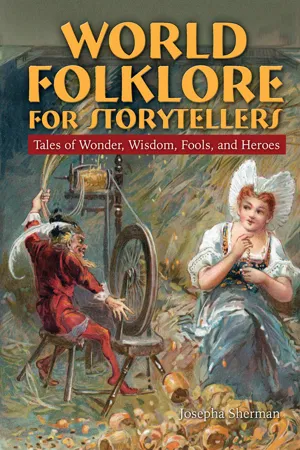
World Folklore for Storytellers: Tales of Wonder, Wisdom, Fools, and Heroes
Tales of Wonder, Wisdom, Fools, and Heroes
- 400 pages
- English
- ePUB (mobile friendly)
- Available on iOS & Android
eBook - ePub
World Folklore for Storytellers: Tales of Wonder, Wisdom, Fools, and Heroes
Tales of Wonder, Wisdom, Fools, and Heroes
About this book
Here is a treasury of favorite and little known tales from Africa, Asia, Europe, the Americas, Australia, and Oceania, gracefully retold and accompanied by fascinating, detailed information of their historic and cultural backgrounds. The introduction provides an informative overview of folklore, its purpose in world cultures and in contemporary society and popular culture. Following this, the main sections of the book are arranged by tale type, covering wonder tales, hero tales, tales of kindness repaid and hope and redemption, and finally tales of fools and wise people. Each section begins by comparing the tales cross-culturally, explaining similarities and differences in the folkloric narratives. Tales from diverse cultures are then presented, introduced, and retold in a highly readable fashion.
Information
Wonder Tales
Wonder tales are what people usually imagine when they hear the word folktale. These are the most familiar folktales, including tales of magic, strange beings, and enchanted transformations. “Cinderella” is a wonder tale, as is “Beauty and the Beast,” as are tales of dragonslayers and lands that lie “east o’ the sun and west o’ the moon.”
In wonder tales, there are magical beasts and fairy folk, witches good or bad, and incredible magicians. There are swords with wills of their own and quests that last for magical lengths—three days, seven months, even seven years. There are marvelous places with evocative names, such as the above-mentioned East o’ the Sun and West o’ the Moon, and realms above the sky or beneath the sea.
The natural laws do not apply in wonder tales, in which rocks may talk or heroes turn into animals without explanation, but some constants exist. The third son or daughter often is the one to succeed. While scholars argue the reasons (some claim ancient laws of inheritance, now forgotten), the idea of the third child succeeding is ingrained in wonder stories from around the world.
In these stories, a good heart, kindness, loyalty, and courage often are keys to happiness. Perhaps the most important constant in a wonder tale is the triumph of good over evil.
BEAUTY AND THE BEAST
“Beauty and the Beast” is one of the most popular of archetype folktales—that is, a folktale that appears in every culture in some form or another, and is always greeted with delight. Variants on the tale include monster husbands, snake husbands, crocodile husbands, dog husbands, and indeed almost every animal imaginable—all under a spell, all ultimately transformed by the love and steadfastness of the heroine. Sometimes, her love is enough. Sometimes, she must undergo an ordeal or a quest to win her love. In some versions, the animal man is a supernatural being who can take either shape. He may be human, or he may be a nature spirit, such as in North American tribal tales of women marrying fish deities or bear spirits.
Another popular worldwide variant on the major folktale type is the animal bride, the theme of the transformed female and the human male. The forms the female “animal” takes vary widely. She may be a fox, a swan, a frog, even a snake. She may be a human under a spell, a nonhuman being such as a kitsune, a Japanese fox being, changing to human on a whim or for love of a human man, a seal-being whose skin has been captured by the man, or a spirit such as the Chinese White Snake, who falls so deeply in love with her husband that she goes on a quest to save his life.
Falling into this latter category are fairy brides, who sometimes are won by a human groom without disguise but who often are captured. The human hero often will catch his bride when she is in human form and steal her magic skin or other object so that she must remain human. In such cases, the marriage ends with her recovering her magic and returning to animal form. In other stories, the marriage may be happy so long as the human husband does not criticize his nonhuman bride. Once he does, the marriage is over, and she returns to her own kind.
In still other animal bride stories, the hero is forced to marry an animal, only to learn that she really is an enchanted human. These stories tend to end happily for bride and groom. However, other animal bride tales do not end happily for the human man. His wife may return to her people, or she may abandon him. But some of these tales do show a nice compromise: In a Japanese fox bride tale, the fox wife returns every night to her human husband as his wife.
Because the transformed beast can be male or female, this section has been divided into two main categories: “The Transformed Female” and “The Transformed Male.”
The Transformed Female
The transformed female, unlike the transformed male, usually is a free shapeshifter, often a magical animal who can transform into a human female. Sometimes, this is a voluntary shift on her part, although in certain cases, such as the tales of swan maidens, it is the theft by a human man of her magical garb that holds her in human form.
Fox Brides
The idea of a fox being able to turn into a woman or, more rarely, a man, turns up mostly in Asia, although the folk motif also can be found in other cultures, such as the Inuit tale told below. The basic story line tends to follow that of all animal-human matings, with the animal wife being unintentionally (or intentionally) insulted by her human husband and fleeing back to the wild. For similar endings, see the section on seal people.
The Fox Wife: A Folktale from Japan
Stories of fox spirits, known in Japanese as kitsune, have been popular throughout Japan for literally centuries. This tale, which may date as far back as the eighth century C.E., claims to give the origin of kitsune, the word for fox spirit, since the word can mean kitsune (“come and sleep”) or kitsune (“always comes”).
There was a female fox who fell in love with a human man. To be with him, she turned herself into a woman and wooed him. They fell in love, and even though she admitted to him that she actually was a fox, they married and were very happy together. Years passed, and they had several children together.
But, sadly, the fox wife’s secret could not stay hidden forever. Even as a woman, she remained terrified of dogs. And when a dog threatened her in front of everyone in the village, she instinctively returned to her fox shape.
Now that her secret was known, she knew that she must leave her happy home. But her loving husband begged her to stay with him at least part of the time.
“We have spent so many happy years together,” he told her. “We have had several children together. My dear wife, I cannot simply forget you. Please come to me every night.”
The fox could not deny her love for him. So she agreed. From that night on, she returned to her husband in the shape of a woman, leaving again each morning in the shape of a fox.
Sources
Mayer, Fanny Hagin, trans. Ancient Tales in Modern Japan: An Anthology of Japanese Folk Tales. Bloomington: Indiana University Press, 1984.
Nozaki, Kiyoshi. Kitsune: Japan’s Fox of Mystery, Romance and Humor. Tokyo, Japan: Hokuseido, 1961.
The Fox Woman: A Folktale from the Inuit of Labrador, Canada
This folktale has an element common to many tales of nonhuman brides, the taboo against complaining about any aspect of the bride. Here, the husband’s complaint is about the fox bride’s foxy scent.
Once, there was a hunter who lived by himself. But one day when he came home, he saw that someone had taken care of everything, just as a nice wife would do. There was even a hot meal waiting for him.
Who could this mysterious person be?
The hunter left the next day as though going on a hunt, but instead he hid and watched and waited. He saw a fox slip into the house. Aha, it must be looking for food! The hunter followed it inside—and found himself facing the most beautiful woman he had ever seen. A fox skin hung on a peg on one wall of the house.
“Are you the one who has been keeping my house?” the hunter asked.
“I have become your wife,” the woman said demurely. “I trust that you are satisfied?”
Oh, he was very satisfied! They lived together happily for a time.
But one day, the hunter noticed a musky smell, a wild-thing smell. Once he had noticed it, the smell seemed to grow stronger and wilder. At last, he asked his wife what it was.
“That is my fox smell,” she said. “Don’t you like it?”
“It is not the smell of a normal woman.”
“If you are going to find fault with me, then I am gone!” the fox woman cried. She snatched up her fox skin, changed back into a fox, and raced away.
The hunter was left alone.
Sources
Thompson, Stith. Folk Tales of the North American Indians. 1929. North Dighton, MA: J.G., 1995.
Turner, Lucien M. “Ethnology of the Ungava District, Hudson Bay Territory.” In Report of the Bureau of American Ethnology. Vol. 11. Washington, DC: Smithsonian Institution, 1894.
The Fox Wife: A Folktale from Korea
Folktales often are attached to historic figures. This fox-wife tale is the only one to give such a figure a fox for a mother. Whether or not Kang Kamch’an (948–1031 C.E.), a famous general of the early Koryo period, was aware of this story or whether it started up after his death is unknown.
Once, when a man was walking alone along a lonely mountain road, the storm winds began to blow. Looking for shelter, he saw the lights of a house, and ran to it. He was made welcome by a beautiful young woman, the only resident there. For three days the storm raged, and for three days, the man and woman stayed together and became lovers.
When the storm ended, the man set out for his home, promising to return to his lover. But when he tried to find her house again, he never could.
Years passed. Then one day, the woman appeared at his home, leading a boy child by the hand. She said to the man, “The house you entered that stormy night was not a human’s home. It was the shelter of a fox. I am that fox, and I was in woman form when we loved. This is your child. I have foreseen great things for him, so I wish him to be raised as a human, as your son.”
As soon as the man took the child in his arms, the woman vanished. She had, indeed, been a fox.
She also was right about her prophesy for their son. He grew up to be Kang Kamch’an, who became a great general for Korea’s ...
Table of contents
- Cover
- Half Title
- Title Page
- Copyright Page
- Table of Contents
- Introduction
- Wonder Tales
- Hero Tales
- Tales of Kindness Repaid and Hope and Redemption
- Tales of Fools and Wise People
- Bibliography
- Index
Trusted by 375,005 students
Access to over 1.5 million titles for a fair monthly price.
Study more efficiently using our study tools.
Frequently asked questions
Yes, you can cancel anytime from the Subscription tab in your account settings on the Perlego website. Your subscription will stay active until the end of your current billing period. Learn how to cancel your subscription
No, books cannot be downloaded as external files, such as PDFs, for use outside of Perlego. However, you can download books within the Perlego app for offline reading on mobile or tablet. Learn how to download books offline
Perlego offers two plans: Essential and Complete
- Essential is ideal for learners and professionals who enjoy exploring a wide range of subjects. Access the Essential Library with 800,000+ trusted titles and best-sellers across business, personal growth, and the humanities. Includes unlimited reading time and Standard Read Aloud voice.
- Complete: Perfect for advanced learners and researchers needing full, unrestricted access. Unlock 1.5M+ books across hundreds of subjects, including academic and specialized titles. The Complete Plan also includes advanced features like Premium Read Aloud and Research Assistant.
We are an online textbook subscription service, where you can get access to an entire online library for less than the price of a single book per month. With over 1.5 million books across 990+ topics, we’ve got you covered! Learn about our mission
Look out for the read-aloud symbol on your next book to see if you can listen to it. The read-aloud tool reads text aloud for you, highlighting the text as it is being read. You can pause it, speed it up and slow it down. Learn more about Read Aloud
Yes! You can use the Perlego app on both iOS and Android devices to read anytime, anywhere — even offline. Perfect for commutes or when you’re on the go.
Please note we cannot support devices running on iOS 13 and Android 7 or earlier. Learn more about using the app
Please note we cannot support devices running on iOS 13 and Android 7 or earlier. Learn more about using the app
Yes, you can access World Folklore for Storytellers: Tales of Wonder, Wisdom, Fools, and Heroes by Howard J Sherman in PDF and/or ePUB format, as well as other popular books in Social Sciences & Economic Theory. We have over 1.5 million books available in our catalogue for you to explore.