- 256 pages
- English
- ePUB (mobile friendly)
- Available on iOS & Android
eBook - ePub
About this book
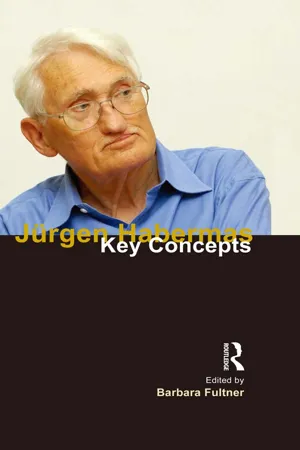
A rare systematic thinker, Habermas has furthered our understanding of modernity, social interaction and linguistic practice, societal institutions, rationality, morality, the law, globalization, and the role of religion in multicultural societies. He has helped shape discussions of truth, objectivity, normativity, and the relationship between the human and the natural sciences. This volume provides an accessible and comprehensive conceptual map of Habermas' theoretical framework and its key concepts, including the theory of communicative action, discourse ethics, his social-political philosophy and their applications to contemporary issues. It will be an invaluable resource for both novice readers of Habermas and those interested in a more refined understanding of particular aspects of his work.
Information
ONE
Historical and intellectual contexts
Max Pensky
It is not unusual, when reading about the lives and works of influential philosophers, to encounter the view that their work transcends the times that the authors live in; that the most influential philosophers think and write about highly abstract metaphysical or universal ideas and problems that are not specific to any particular historical or social context, and that for this reason they and their texts are “in conversation”, not with their own contemporaries but with their philosophical predecessors, however historically remote they may be. One implication of this view is that there are other philosophers, perhaps those who have less of an interest in abstract, metaphysical, or “timeless” questions, who therefore have a correspondingly thicker and more influential relationship with their own historical context; they’re “in conversation” with those among whom they live, rather than with the great figures of the history of philosophy.
If this view is correct, then the first set of context-t ranscending philosophers may sacrifice their relevance for their own contemporaries, but they are rewarded by the timeless and universal significance of what they think and write about. Conversely, the context-immanent philosophers may not age especially well, since they think and write about problems that may be specific to their own times, but they are rewarded by the relevance and influence they can assert within their own society. It is easy to see how this view implies a conclusion about the difference between these two types of thinkers: timeless philosophy is serious or important philosophy, the real work of the perennial search for transcendent truth. And if one cannot or will not manage this kind of achievement, there is always the time-bound, useful but forgettable kind of philosophy as a kind of consolation prize.
But this view and its implications have a lot of serious problems. For one thing, it is simply analytically true that philosophers always write fully enmeshed in their own times and their own societies, and unless they remain entirely obscure, they are therefore always formed by, and in turn influence, their own social contexts. The very notion of transcendence presupposes this embeddedness. Moreover, philosophy is very much a public, social activity itself. Even the most apparently context-transcending, metaphysical philosophical problems of truth, reason or being are not the sole property of aloof philosophers, but are published, sent out to mingle in a shared intellectual environment where they are, and are meant to be, accepted or rejected, debated and argued over, transformed and refashioned.
When it comes to philosophical concepts, then, there is no “either/or” between context-transcending universals and context-immanent particulars, but rather a “both/and”, a give-and-take or a dialectic.
Claims of universality are claims made to others with whom one lives in particular circumstances, with an eye towards transforming those circumstances. Even Plato and Descartes, the very models of the metaphysical thinker, wrote what they wrote in some significant degree in order to criticize and transform crucial elements of their own societies, which for them had fallen into forms of moral and epistemic relativism crying out for philosophy to intervene. Conversely, even the most socially and politically committed philosophers are precisely philosophers, rather than, say, social activists or politicians, just because they understand their work not just as offering opinions, suggestions or insights about their own times, but indeed because their relationship with those times is one that can produce a claim to truth, or justifiability, which in turn contains a moment of context-transcendence as well.
Therefore the key distinction is not, ultimately, between context-transcendent and context-immanent philosophers, and certainly not between the seriousness and rigour of context-transcendence and the more casual or unambitious nature of context-immanence. Rather, philosophers differ greatly on the attitude they assume towards the relationship between philosophical truth and social influence; some take this relationship as an evident but ultimately surmountable aspect of their work, while others see it as an essential, indeed the primary focus of their energies as thinkers.
Habermas’s historical and intellectual influences
Any discussion of the influences upon and impact of the philosophical writings of Jürgen Habermas must proceed on the basis of this corrected view of the philosopher’s work, since Habermas’s half-century of philosophizing so strongly exemplifies the second, engaged paradigm I discussed above. For Habermas, the dialectical relationship between the philosopher’s preoccupation with the context-transcending truth or universal justifiability of our claims and norms, and the context-immanence of the social world in which such claims and norms are offered and received, indeed lies at the very core of his conception of the philosopher’s task. And this means that when we begin to catalogue the many and varied intellectual influences and sources that Habermas quite consciously gathered and refashioned in his own work, we must bear in mind his conviction that a new, up-to-date vision of the proper tasks and scope of philosophizing arises only from an overarching, one might say metaphilosophical, view of the philosopher’s own times, intellectual landscape, historical situation and social demands.
Habermas is, arguably, the most diversely influenced of all contemporary philosophers, in the sense that the sources he brought together in his work, both philosophical and non-philosophical, are remarkably broad; indeed some might complain that they are too broad, too various and diverse. But this breadth of influences makes sense once we bear in mind the deliberate task of making the philosopher’s influential relationship with his or her own times the centre, rather than the byproduct, of the activity of philosophy itself.
All biographical discussion of Habermas must begin at what in German is sometimes still referred to as “Stunde null”: “zero hour”, the moment of war’s end in 1945, with German culture and society in ruins both physically and spiritually. Born in 1929, Habermas grew up in the small provincial town of Gummersbach, in the “everyday life” of National Socialism. He was enrolled in the Hitler Youth and briefly served in an anti-aircraft artillery unit in the closing months of the Second World War. As a sixteen-year-old at war’s end, Habermas was deeply affected by the revelations of the nature and extent of the Holocaust and the moral depravity of the leadership of the Nazi regime as he followed the Nuremberg Trials on radio.1
Moreover, his birth year of 1929 marked Habermas as a member of a very specific generational cohort that has played a distinctive and crucial role in post-war German culture and politics. On one side, Habermas and his generational peers were too young to have any memories of the Weimar Republic or to have taken any active part in the National Socialist regime that would incur adult responsibility. But on the other hand they were old enough to have direct, personal experiences of the horrible and fatal collapse of German society, to have participated in the final stages of the war effort, and to see firsthand the enormous task of rebuilding a physically and morally shattered society.2
For this generation in particular, the question of Germany’s political and indeed spiritual future was paramount. How could Germany build a stable, peaceful democratic society from the ruins of fascism? How could the elements of German culture worth saving – the elements of political and moral modernity, and above all the tradition of Enlightenment, of Kant and Goethe, Schiller and Bach – be picked from this rubble and included in the foundation of a new social order? There are very few modern examples of a generation that so self-consciously recognized itself challenged with such an enormous task of social rebuilding and reinvention. For a culture that had so valued the activity of philosophy, and had embraced its own philosophical tradition as a primary source of collective identity and self-understanding, it is not surprising that this generation also regarded the task of social rebirth as implying a collective reorientation to its philosophical heritage.
As a young university and graduate student in philosophy, in the early 1950s, and especially one deeply influenced by Martin Heidegger, Habermas was shocked to discover that this generational task, re-envisioning Germany’s relationship with its own philosophical heritage, was not in fact taking place. Instead, as he bitterly noted at the time, the ingrained conservatism of the German academy in the post-war years helped sponsor a head-in-the-sand culture of denial and evasion, one that mirrored the broader post-war trend towards suppressing and silencing, rather than openly debating, Germany’s immediate past. Prominent philosophers, including some of Habermas’s own professors, had affiliations with National Socialism that were pointedly not discussed or even divulged.
Perhaps more tellingly, the very idea that philosophy must transform itself in response to the German disaster met with deep resistance. As a university student Habermas was far from alone in his dismay and frustration with the idea that philosophy in post-war Germany could carry on business as usual, as though the period between 1933 and 1945 could simply be bracketed out of consideration. German philosophy had produced not just Kant and Hegel, but (indirectly, surely) Marx as well. It was a tradition not only of deep insularity, of conservative academic self-sufficiency, but of its own internal radical critique as well. Moreover, the heritage of Enlightenment itself contained at its core the very dialectic between philosophical insight and calls for progressive social reform that I discussed earlier: Kant was not just the author of the Critique of Pure Reason but of essays such as “An Answer to the Question: What is Enlightenment?” (1996: 11–22), which demand the general social encounter with a conception of public reasoning, enquiry and tolerance that Kant’s philosophy had discovered in the universal features of human cognitive faculties.
The question facing Habermas and his like-minded philosophical colleagues in the early years of the Federal Republic was how the pertinent dimensions of this eighteenth-century tradition of intellectual and political Enlightenment could be rendered serviceable for a society with such unprecedented damages and needs. How could the Enlightenment’s commitment to core human values such as secularism, rationality, tolerance, representative republican governance, universal and equal moral and legal rights, and broad social inclusion be reappropriated in a way that would resonate with the needs of the times?
The answer to this question is highly complex, but in one sense it can be summarized reasonably well with three linked claims. First, recovering and promoting the values of Enlightenment modernity for the post-war world required that philosophy be gently but firmly knocked off its pedestal as a discipline with a special claim to transcendent, foun-dational truth, and assigned a more humble but more socially significant role, one that was tailored specifically to the values and challenges of a secular, “postmetaphysical”, democratic society. Second, in order to fulfil this role, philosophy, above all the notoriously insular philosophy as it developed in the German universities, must engage in substantive and productive reciprocal dialogue with the newer, adjacent disciplines that it had traditionally held at arm’s length. In his earliest work Habermas had already pointed to the primary candidate for this kind of partnership: social science, above all those branches of political sociology that he later termed “reconstructive”, that is, sciences that aim at explaining those dimensions of human interaction that have a putative claim to universality. Third, Habermas understood that specifically German (or perhaps better, European) philosophy in the post-war era had to open itself up to the influence of parallel philosophical traditions, above all the tradition of American pragmatism, which had taken the productive relationship between philosophy and democracy as one of its most basic problems. In doing so, Habermas saw himself as bringing in the kind of fresh material and problems that would compel European philosophy to move decisively away from theoretical models that had become exhausted: the model of the solitary, autonomous ego as the “basic unit” of philosophical analysis, and the model of consciousness as the mode in which this ego relates both to itself and to its external world. In the following, I will first offer some brief comments on Habermas’s commitment to a new, humble and interactive mode of philosophy. A longer discussion of Habermas’s project of opening dialogue between philosophy and the reconstructive and critical social sciences recalls Habermas’s early and fraught collaboration with the post-war Frankfurt School of critical theory and its prominent figures, Max Horkheimer and Theodor Adorno. Finally, I will turn to Habermas’s development of a theory of linguistic competence and communicative rationality in the 1970s and 1980s that meets the requirements of a philosophy that has definitively broken both with the philosophy of the subject and the philosophy of consciousness.
The reconception of philosophy and its role
In an essay entitled “Philosophy as Stand-In and Interpreter” from the early 1980s, Habermas declared that philosophy, above all the magisterial style of academic philosophy so familiar in the German tradition culminating in Kant and Hegel, could no longer plausibly claim a role as a judge, determining once and for all what the natural sciences may and may not legitimately know, and how the sciences may and may not legitimately take their place within a broader canopy of cultural learning (MCCA: 1–21).
Given the conditions of modernity, Habermas insisted, philosophy must take on humbler but still crucial ambitions: to “stand in” for the reconstructive social sciences. By this he meant that philosophy ought to explain and analyse, and thereby hold open a space for, the contributions of empirically grounded theories of human action that have strong universalistic claims. It is precisely here, Habermas believed, that a humble but still viable version of the older Enlightenment account of rationality still had a sharp relevance. Such theories – for instance, theories of linguistic competence – do not simply conjecture ex cathedra about the sovereign power of reason in the world, à la Kant and Hegel, but begin with basic human competencies that already present strong empirical grounds for universality, that is, competencies lacking any identifiable alternative if we are to consider ourselves and one another as responsible subjects.
Language and communication, of course, are the chief candidates for such competencies, and Habermas suggests that the reconstructive sciences that explore them ought to turn to philosophy as a helper and adjunct in expressing and disseminating the full significance of their universalistic claims. And a philosophy that seeks to fulfil this helper role will have to drop its self-understanding as offering those sciences their “permit” and their space for legitimacy, and learn them in order to make their own claims of rationality (for that in the end is precisely what such universal competencies are) intelligible.
The legacy and transformation of critical theory
This brings Habermas to the second revision in philosophy’s self-understanding. Rather than appoint itself as the sovereign judge that will decree how scientific knowledge will find its proper relationship to the sum of human cultural understanding, Habermas instead suggests that philosophy serves as an interpreter, communicating and transmitting insights from the specialized and technical language of the reconstructive sciences to the “normal” discourse of the everyday lived world of adult citizens, that is, the democratic public sphere where the normative and political implications of scientific progress find their proper forum for debate.
The implications of Habermas’s argument in “Philosophy as Stand-In and Interpreter” are that philosophy’s disciplinary core consists in a specific ongoing relationship with parallel disciplines in the natural and above all in the social sciences. Philosophy’s purpose is therefore impossible without an ongoing conversation with social theory. It is a position that has guided Habermas’s own intellectual trajectory as early as the 1950s.3
This argument for a supple, curious and self-l imiting philosophy certainly does not originate with Habermas. But it does help to explain why the young Habermas, following his PhD in philosophy and some years as a journalist, found a home (although as we will see an uneasy one) at the Institute for Social Research in Frankfur...
Table of contents
- Cover
- Half Title
- Key Concepts
- Title Page
- Copyright Page
- Table of Contents
- Contributors
- Acknowledgements
- Abbreviations
- Introduction
- 1 Historical and intellectual contexts
- Part I: Communicative Rationality
- Part II: Moral and Political Theory
- Part III: Politics and Social Change
- Chronology of life and works
- Bibliography
- Index
Trusted by 375,005 students
Access to over 1.5 million titles for a fair monthly price.
Study more efficiently using our study tools.
Frequently asked questions
Yes, you can cancel anytime from the Subscription tab in your account settings on the Perlego website. Your subscription will stay active until the end of your current billing period. Learn how to cancel your subscription
No, books cannot be downloaded as external files, such as PDFs, for use outside of Perlego. However, you can download books within the Perlego app for offline reading on mobile or tablet. Learn how to download books offline
We are an online textbook subscription service, where you can get access to an entire online library for less than the price of a single book per month. With over 1.5 million books across 990+ topics, we’ve got you covered! Learn about our mission
Look out for the read-aloud symbol on your next book to see if you can listen to it. The read-aloud tool reads text aloud for you, highlighting the text as it is being read. You can pause it, speed it up and slow it down. Learn more about Read Aloud
Yes! You can use the Perlego app on both iOS and Android devices to read anytime, anywhere — even offline. Perfect for commutes or when you’re on the go.
Please note we cannot support devices running on iOS 13 and Android 7 or earlier. Learn more about using the app
Please note we cannot support devices running on iOS 13 and Android 7 or earlier. Learn more about using the app
Yes, you can access Jurgen Habermas by Barbara Fultner in PDF and/or ePUB format, as well as other popular books in Philosophy & Critical Theory. We have over 1.5 million books available in our catalogue for you to explore.