eBook - ePub
The Danwei
Changing Chinese Workplace in Historical and Comparative Perspective
- 270 pages
- English
- ePUB (mobile friendly)
- Available on iOS & Android
eBook - ePub
The Danwei
Changing Chinese Workplace in Historical and Comparative Perspective
About this book
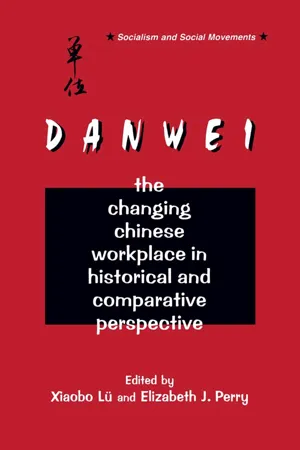
The danwei, or work unit, occupies a central place in Chinese society. To understand Chinese politics demands a better understanding of this system. This volume provides a systematic study of the danwei system and addresses a variety of questions from historical and comparative perspectives.
Information
Part I
Danwei in Historical Perspective
1
Minor Public Economy: The Revolutionary Origins of the Danwei
Xiaobo Lü
The danwei, an enclosed, multifunctional, and self-sufficient entity, is the most basic collective unit in the Chinese political and social order. It plays both political (statist) and economic (societal) roles. As a basic unit in the Communist political order, the danwei is a mechanism with which the state controls members of the cadre corps, monitors ordinary citizens, and carries out its policies. As an economic and communal group, the danwei fulfills the social and other needs of its members. Many urban units have become “small societies” themselves, providing entitlements and maintaining basic services ranging from housing, car fleets, dining services, barbers, kindergartens, guesthouses, and clinics to, in some large state-owned enterprises, cremation services. Indeed, the work unit has taken over many welfare and service responsibilities the state would otherwise have to provide. Many public goods and entitlements are not provided directly by the state but by individual danwei. Instead of developing a social security system, for example, work units have taken on all the necessary service and welfare responsibilities even for retirees. Many of these services have been provided either free or at very low cost.
The control function exerted at the grass-roots level of a Leninist society is unique to China. In the Soviet Union and other Communist countries, similar types of “functional cells” existed through which the party-state monitored and controlled the working population.1 Existing studies and anecdotes about the danwei have focused mainly on this seemingly powerful tool of an authoritarian party/state in controlling society.2 However, it is the other dimension of the danwei—its comprehensive welfare and social functions—that, I contend, makes it somewhat unique and bears a more profound impact on the broader political and socioeconomic systems. As chapters 8 and 9, respectively, by Solinger and Bian and his coauthors in this volume show, some of these functions not only remain intact but have been further enhanced in some sectors even after more than a decade of reforms.
In order to understand fully the institution of the danwei in China, we need to trace its origins and development over the years. Surprisingly, however, not only has little been written on the danwei system but almost no study has been done about its origins. People generally assume that it emerged in the 1950s along with the establishment of the household registration system and other measures for the socialist transformation of urban society. Some scholars have speculated, without much data and analysis, that it originated in the revolutionary war period.3 This chapter explores one of the most important origins of the danwei— the free supply system (gongjizhi) and related self-reliance economic activities in which Communist army and government units in the wartime base areas were involved, called at the time “agency production” (jiguan shengchan) or “minor public economy” (xiaogong jingji).4 It was during the wartime revolutionary period that the earliest danwei took shape as a functional entity in the Communist political and social systems.
Guerrilla War and Free Supply System
During the long period of armed struggle, Communist forces adopted, instead of salaries, a free supply system under which essential supplies were provided at almost no cost to the members of the revolutionary rank and file, including noncombat personnel and administrative staff. To a large degree, it was as much a product of economic necessity—a salary system would have required a much stronger financial revenue base than the Communists had—as a reflection of Communist egalitarian principles. As part of the revered revolutionary tradition, this free supply system lasted well beyond the war years and was not totally replaced by a salary system until 1955.
Although the items on the supply list varied from time to time and place to place, some key items remained on it throughout the whole period. Besides regular operational funds, living allowances usually covered everything from food and miscellaneous daily allowances to a woman’s health allowance, child-care subsidies, and children’s clothing. All service and nonmilitary personnel also received uniforms or other clothing and other daily necessities in kind. One basic tenet of the free supply system was relatively equal treatment of officers, soldiers, officials, and staff in the Communist army and government.
In the early years, the Communists’ revenue and food supply sources largely consisted of confiscations from rich landlords, apportioned funds, and donations. Later, when some base areas were established, Communist authorities also relied upon taxation and revenues from a limited number of small-scale industries run by the authorities in base the areas. When the Communists formed a united front with the Nationalists, they also received funding and some regular supplies from the Nationalist government.5 Eventually, once all these sources became problematic—especially when the Nationalist government stopped its supplies to the Communists in 1940—revenues and supplies also came from production and commercial entities run by individual units with the aim of self-sufficiency.
One of the fundamental characteristics of the Chinese Communist revolution was its profound experience of guerrilla war fought in the country’s vast hinterlands. From the late 1920s until the final takeover in 1949, Communist forces operated in “base areas” in various regions of China. Large and small contingents alike, these forces often functioned in a highly dispersed fashion. Until the late 1930s, the Communists basically operated with a decentralized supply system; their essential supplies and revenues came from local economies through the raising of revenues and their disposal by individual army units themselves (zichou zizhi). Revenues and supplies were raised in such an irregular fashion that local people often felt unfairly burdened. In some areas, rich peasants were squeezed; in others, poor peasants had to offer more than landlords.6 Both politically and financially, such arrangements had negative effects on the Communist central authorities. In order to raise and dispense supplies efficiently for army units, the Chinese Communist Party’s (CCP’s) Central Military Commission decided to unify budgets and appropriations in 1932.7 All the supplies and funds were to be provided by the centralized authorities of each base area with a unified supply system. The principle of “unified supply, revenue-raising, and expenditure” (tongyi gongji, tongchou, tongzhi) was adopted. Under such a system, individual units would not have to raise revenue to obtain the necessary supplies they required. If they did have revenue, it had to be turned over to higher-level authorities.
Economic and political conditions, however, often rendered the system less than totally effective, especially in newly established bases, where Communist governments remained highly unstable and irregular. As late as 1940, a party leader in the Shandong base area reported to the CCP Central Committee that “unified budgeting, appropriation, and supply systems have not been well established. Local forces have been raising and spending funds at will. There is no way to audit and control their finances. Squandering is shockingly high.”8
Local economic conditions also made the centralized supply system much more difficult to implement than a fragmented one. Before the Long March in 1935–36, Communist forces operated mainly in areas such as Jiangxi and Fujian, where economic conditions were relatively good. When the Red Army moved to Yan’an and a few other, more remote base areas, things were quite different—in these poverty-stricken regions of the north, peasants were already terribly exploited by the landlords. The extra burden of sustaining a large military and administrative presence became increasingly unbearable for the local economy. In Yan’an, the number of personnel in the central party and administrative organs alone once peaked at 16,000.9 In the most difficult year, 1941, there were some 70,000 people receiving free supplies in the base area of Shaan-Gan-Ning border region.10 In the Jizhong (central Hebei) base area, the number of administrative personnel reached 65,000 in 1945.11 To rely solely on extracting revenue from the local population was obviously not a good option for the Communists, who depended greatly upon peasant support. Lack of sufficient supplies also caused hardship in the daily life in the army. The supply shortage affected the army’s morale and resulted in some desertions.12 The Communist leadership found that the only sensible way to solve this problem was to produce things themselves and to let units find ways to supplement provided supplies. Thus new policies of “expanding the economy in order to guarantee supplies” and “unifying management and dispersing (economic) operation” were adopted.
Self-Reliance and the Economic Role of Units
These new policies were an attempt to remedy the economic difficulties caused by both the Japanese blockade of the Communist base regions and a lack of material supplies from the Nationalist government in the late 1930s. In 1938, some army units began experimenting with production activities such as planting vegetables, raising pigs, and making shoes, mainly to improve the soldiers’ daily lives.13 By 1939, the Communists’ financial situation had worsened, due both to decreasing supplies from the Nationalists and to the increased number of government agencies and other public units and their staffs. In January 1939, Mao formally advocated the idea of “letting the army produce for itself.”14 A large-scale production movement (da shengchan yundong) was launched in early 1940 by the Central Military Committee, which, in a directive, called on all military units to participate in production of all kinds, including commercial businesses. The slogans at that time were to “feed and dress ourselves through self-reliance” and to “develop the economy in order to guarantee supplies.”15 Soon, it was not only army units that were mobilized to engage in production activities in order to be self-sufficient; other nonmilitary units such as government agencies, public schools, and hospitals all participated in production activities in Yan’an and the surrounding Shaan-Gan-Ning border region. Hence, such activities were called “agency production.” Similar production movements were also launched in other Communist-controlled base areas in 1942–43. Although set in motion in mass campaign style, the “production movement” took on a permanent character. With encouragement from the CCP leadership, economic activities of military and administrative units not only lasted throughout the anti-Japanese resistance and civil war periods, but also after 1949. In fact, it can be argued that the contemporary commercial frenzy of ...
Table of contents
- Cover
- Half Title
- Title Page
- Copyright Page
- Table of Contents
- Acknowledgments
- Contributors
- Introduction: The Changing Chinese Workplace in Historical and Comparative Perspective
- Part I. Danwei in Historical Perspective
- Part II. Danwei in Comparative Perspective
- Part III. Danwei Under Reform
- Index
Trusted by 375,005 students
Access to over 1.5 million titles for a fair monthly price.
Study more efficiently using our study tools.
Frequently asked questions
Yes, you can cancel anytime from the Subscription tab in your account settings on the Perlego website. Your subscription will stay active until the end of your current billing period. Learn how to cancel your subscription
No, books cannot be downloaded as external files, such as PDFs, for use outside of Perlego. However, you can download books within the Perlego app for offline reading on mobile or tablet. Learn how to download books offline
Perlego offers two plans: Essential and Complete
- Essential is ideal for learners and professionals who enjoy exploring a wide range of subjects. Access the Essential Library with 800,000+ trusted titles and best-sellers across business, personal growth, and the humanities. Includes unlimited reading time and Standard Read Aloud voice.
- Complete: Perfect for advanced learners and researchers needing full, unrestricted access. Unlock 1.5M+ books across hundreds of subjects, including academic and specialized titles. The Complete Plan also includes advanced features like Premium Read Aloud and Research Assistant.
We are an online textbook subscription service, where you can get access to an entire online library for less than the price of a single book per month. With over 1.5 million books across 990+ topics, we’ve got you covered! Learn about our mission
Look out for the read-aloud symbol on your next book to see if you can listen to it. The read-aloud tool reads text aloud for you, highlighting the text as it is being read. You can pause it, speed it up and slow it down. Learn more about Read Aloud
Yes! You can use the Perlego app on both iOS and Android devices to read anytime, anywhere — even offline. Perfect for commutes or when you’re on the go.
Please note we cannot support devices running on iOS 13 and Android 7 or earlier. Learn more about using the app
Please note we cannot support devices running on iOS 13 and Android 7 or earlier. Learn more about using the app
Yes, you can access The Danwei by Xiaobo Lü,Elizabeth J. Perry in PDF and/or ePUB format, as well as other popular books in Social Sciences & Business General. We have over 1.5 million books available in our catalogue for you to explore.