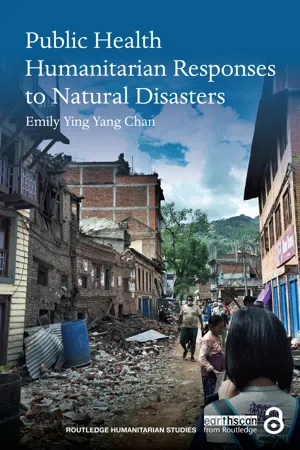
The pressure of climate change, environmental degradation, and urbanisation, as well as the widening of socio- economic disparities have rendered the global population increasingly vulnerable to the impact of natural disasters. With a primary focus on medical and public health humanitarian response to disasters, Public Health Humanitarian Responses to Natural Disasters provides a timely critical analysis of public health responses to natural disasters.
Using a number of case studies and examples of innovative disaster response measures developed by international agencies and stakeholders, this book illustrates how theoretical understanding of public health issues can be practically applied in the context of humanitarian relief response. Starting with an introduction to public health principles within the context of medical and public health disaster and humanitarian response, the book goes on to explore key trends, threats and challenges in contemporary disaster medical response.
This book provides a comprehensive overview of an emergent discipline and offers a unique multidisciplinary perspective across a range of relevant topics including the concepts of disaster preparedness and resilience, and key challenges in human health needs for the twenty-first century. This book will be of interest to students of public health, disaster and emergency medicine and development studies, as well as to development and medical practitioners working within NGOs, development agencies, health authorities and public administration.
1 KEY PUBLIC HEALTH CONCEPTS OF DISASTER PREPAREDNESS AND RESPONSE
DOI: 10.4324/9781315667218-2
Public health is a multidisciplinary subject that concerns the health of a population. Its practitioners, composed of doctors, nurses, pharmacists, lawyers, educators, policymakers and researchers, aim to prevent diseases, promote health and prolong life through the organised efforts of society. This subject draws on a wide variety of disciplines and has developed tools which can allow practitioners to describe, analyse, manage and respond to problems that threaten the health and well-being of a society and community group. This chapter will introduce fundamental principles of public health and their applications to the study and understanding of disasters and medical humanitarian assistance. Basic terminology definitions and theories of public health will also be covered in this chapter.
Historical background of how public health is involved in disaster response
A brief review of the history of this field of study demonstrates the rapid development of the public health approach to medical disaster and humanitarian response. Although most disasters are natural phenomena, their impact is often defined by human consequences. Historically, major disasters were documented from the perspectives of how human communities might be affected and how systems were destroyed and subsequently improved after these natural calamities.
The application of public health principles in studying disasters and their public health and medical humanitarian responses can be useful in mitigating and understanding the human impact of these disasters. Early papers published about the public health impact on disaster management can be dated back to the early 1970s. Results of health surveys related to a tropical cyclone hitting the coast of Bangladesh in 1970 with over 250,000 deaths demonstrated the complicated matrix of needs and risks faced by different stakeholders in disaster situations. The publication highlighted the “value of early on-the-spot assessments” in providing valid and timely data for disaster relief (Sommer & Mosley, 1972, p. 7759). Publications following the Guatemala earthquake that caused an estimated 23,000 deaths in Guatemala illustrated how significant logistical challenges and deficiencies in the international relief system might affect human toll and health outcomes of a natural disaster (de Ville de Goyet, del Cid, Romero, Jeannee, & Lechat, 1976; Spencer et al., 1977). These early examples illustrated the plausible use of disaster research methodology in identifying risk factors associated with specific negative health outcomes linked to the disaster, and hence the possible implementation of effective and targeted interventions as a means of health protection (Glass et al., 1980) (see Case Box 1.1).
CASE BOX 1.1TSUNAMI WARNING AND MITIGATION FOR THE INDIAN OCEAN REGION
The Indian Ocean Tsunami in 2004 caused major human losses and rampant destruction. The root causes for such massive damage are not only the rapid expansion of coastal communities but also the hampered translation of knowledge of tsunami science into practice.
Soon after the Indian Ocean Tsunami, scientists and policy makers teamed up to form an international commitment – the Indian Ocean Tsunami Warning and Mitigation System (IOTWS). The IOTWS is dedicated to issuing tsunami advisories to all National Tsunami Warning Centres of the Indian Ocean rim countries. With the establishment of IOTWS, all the country members in the Indian Ocean could receive early warnings. Warnings can thus now reach the millions of people who did not receive any warning prior to 2004 and the system also enables tsunami hazard mapping and evacuation planning for coastal communities.
In April 2012, an offshore earthquake of magnitude 8.5 struck Sumatra, Indonesia. Specifically, in Banda Aceh, one of the hardest hit regions in the Indian Ocean Tsunami 2004, over 75% of the population managed to evacuate soon after the strike of the earthquake. This example demonstrates clearly the significance of an early warning system together with physical defence and evacuation procedures in enhancing disaster preparedness and preventing the loss of life.
Concepts of health and public health
The World Health Organization has defined health as “a state of complete physical, mental and social well-being and not merely the absence of disease or infirmity” (Constitution of the World Health Organization, 1946, p. 1). It is important to point out that this definition encompasses a wide range of outcomes from physical, mental and social well-being. It includes both negative and positive aspects of health. It implies that action should aim not only to minimise diseases but also to maximise attainment of potential health. Although this definition has been criticised for over 60 years since its enforcement in 1948, and alternative proposals have been published, it remains the working definition of health internationally.
CASE BOX 1.2SCHOOL-IN-A-BOX BY UNICEF
Psychosocial interventions in the post-impact phase of disasters and crises are useful for creating a supportive environment and restoring a sense of normalcy for the affected people. For example, for the child population, being able to return to school is very important for their psychosocial health. In the 1990s, the United Nations Children’s Fund (UNICEF) developed the “School-in-a-Box” programme for children in disaster-affected situations. It is literally a box containing supplies and basic materials that can be used to support the teaching of 40 students for approximately three months; temporary classrooms can be set up within 72 hours after a disaster. Further information can be found in this video: http://www.unicef.org/supply/kits_flash/schoolinabox.
Public health has been defined as “the science and art of preventing disease, prolonging life and promoting health through organised efforts of society” (Acheson, 1988, p. 1; World Health Organization [WHO], 2004, p. 32). Unlike clinical medicine, where physicians and allied health professionals focus on treating diseases and managing the health of individuals, public health professionals focus on optimising the health of populations. The field of public health comprises evidence-based methods, decision-making and the application of theories in society. Effective public health practice is a multidisciplinary effort to make health a priority for all by understanding the determinants of health, addressing health disparities, identifying disease risk factors and implementing preventive strategies.
In the context of disaster preparedness, response and management, the definition of health implies the importance of addressing all three fundamental components of health: the physical, social and mental well-being of a population. Although health and medical disaster response programmes tend to focus heavily on safeguarding physical health (e.g. injury management, communicable disease control, food access), an effective health response should consider the mental and social health aspects as well as activities which lead to health improvements instead of focusing only on physical dimensions (see Case Box 1.2).
Scope of the field of public health: three domains of public health
Public health is a multidisciplinary field in medicine that utilises epidemiology, clinical trials, biostatistics, laws and ethics to protect health, improve health and secure the provision of health services. The various components of public health practice can be grouped into three widely accepted domains of public health: health protection, health improvement and health services (Griffiths, Jewell, & Donnelly, 2005). The three domains of public health illustrate the multidisciplinary nature of this field and its potential applications in the development of evidence-based medical and humanitarian response in disasters.
FIGURE 1.1 Three domains of public health
Figure 1.1 shows the anatomy of public health. The three domains include health protection, health improvement and health services, with global health encompassing, and some common tools supporting, all the domains.
Health protection involves the prevention, control and response to outbreak of infectious diseases, the regulation of occupational hazards, the monitoring of environmental health hazards, such as air, water and food quality, and response to chemical or technological emergencies (e.g. bioterrorism and radiation disasters). Health improvement involves actions to improve outcomes and health determinants and to reduce health inequalities in a population. This area of work combines different sectors (e.g. housing and education) to ensure that policies and health promotion and education activities at the population level will empower and support individuals to make informed lifestyle choices. Health service and management focuses on the policies and delivery of health services. It promotes evidence-based clinical practices, governance and resource allocation. Of note, the three domains of public health are not mutually exclusive to each other; these subjects overlap and are often interdependent. These domains are commonly applied in general public health practice.
Epidemiology, biostatistics, clinical trials, and law and ethics are overlapping public health skill sets that serve as foundation tools for public health practice. They provide common technical approaches to support the knowledge-based domains, as illustrated at the centre of the Venn diagram (Figure 1.1). Epidemiology is the branch of medicine studying the distribution and determinants of health-related states. Biostatistics is the application of statistical techniques to research related to the health field. Clinical trials are a specific type of clinical research that conducts comparisons between treatments/intervention options and serves three major purposes: confirming the safety of treatment, identifying side effects and comparing the effect of a new treatment with the existing standard procedure. This type of research produces evidence-based interventions in disaster response. Law and ethics provide frameworks for decision making. Specifically, public health law is the study of the legal power and hence the duties of the state in providing conditions where people remain healthy. Ethics provides a guiding principle for deciding what is right and wrong. In health care, it is also related to how professionals behave, based on professional bodies’ definition of what is right, fair and just when serving the general community (Griffiths, Jewell, & Donnelly, 2005).
In public health-and medical-related disaster studies, epidemiology and biostatistics can provide the technical tools to assess and evaluate the impact and outcomes of disasters. Health policy and service analysis can support service emergency preparedness and training planning, and disaster response management. Health protection actions, such as outbreak and infection control, environmental health assessment and protection, and psychological first aid to support the mental health of responders and affected community, are important activities to protect the community from the secondary impact of a disaster. Health promotion, nutritional programmes, health risk communication, resource mobilisation and technical capacity building (e.g. human resources development and disaster response team building) might not only support a disaster-affected community but also improve its underlying resilience in its health systems and technical capacity and, ultimately, safeguard the health and well-being of the community.
Measuring health
There are four major ways to measure health. Firstly, it can be measured by consequences, such as mortality, morbidity, economic implications and so forth. Secondly, it can be assessed by targeting population subgroups. The health impact of an incident toward children, women, older people or those with chronic diseases may vary within the same context. Health outcomes may thus be categorised according to the specific characteristics and needs of each of these subgroups. Thirdly, health might be measured by frequency. Incidence, prevalence, mortality rates and ratios are examples of metrics by which one can quantify health outcomes. Last but not least, disease severity might differentiates a person’s experiences in health. For example, someone who has early asymptomatic stage of diabetes mellitus might experience a different quality of life when compared with someone who has a severe diabetic condition which requires dialysis or diabetic foot-related amputation.
In a disaster, the actual health impact may be difficult to quantify. Available information (e.g. mortality data and hospitalisation information) might allow only a partial overview of the actual health implication of a situation. Figure 1.2 shows that unless specific effort is dedicated to examine the overall real impact of an incident or disaster, most reports provide only a specific and partial perspective toward the true impact.
FIGURE 1.2 An iceberg of health outcomes
In order to build responsible and evidence-based disaster preparedness and response programmes, it is importan...
Table of contents
Cover
Half Title
Series Page
Title Page
Copyright Page
Dedication Page
Contents
List of illustrations
List of boxes
List of contributors
Foreword
Foreword
Foreword
Acknowledgements
List of abbreviations
Introduction
1 Key public health concepts of disaster preparedness and response
2 Disaster concepts and trends
3 General public health impacts of natural disasters
4 The specific human health impacts of natural disasters
5 When public health and disaster collide: responding to health needs in natural disasters
6 Current and likely medical and public health threats and challenges for disaster response in the twenty first century
7 Resources for disaster response and beyond
8 From public health emergency preparedness to resilience
9 Conclusion
Index
Trusted by 375,005 students
Access to over 1.5 million titles for a fair monthly price.
Study more efficiently using our study tools.
Frequently asked questions
Yes, you can cancel anytime from the Subscription tab in your account settings on the Perlego website. Your subscription will stay active until the end of your current billing period. Learn how to cancel your subscription
No, books cannot be downloaded as external files, such as PDFs, for use outside of Perlego. However, you can download books within the Perlego app for offline reading on mobile or tablet. Learn how to download books offline
Perlego offers two plans: Essential and Complete
Essential is ideal for learners and professionals who enjoy exploring a wide range of subjects. Access the Essential Library with 800,000+ trusted titles and best-sellers across business, personal growth, and the humanities. Includes unlimited reading time and Standard Read Aloud voice.
Complete: Perfect for advanced learners and researchers needing full, unrestricted access. Unlock 1.5M+ books across hundreds of subjects, including academic and specialized titles. The Complete Plan also includes advanced features like Premium Read Aloud and Research Assistant.
Both plans are available with monthly, semester, or annual billing cycles.
We are an online textbook subscription service, where you can get access to an entire online library for less than the price of a single book per month. With over 1.5 million books across 990+ topics, we’ve got you covered! Learn about our mission
Look out for the read-aloud symbol on your next book to see if you can listen to it. The read-aloud tool reads text aloud for you, highlighting the text as it is being read. You can pause it, speed it up and slow it down. Learn more about Read Aloud
Yes! You can use the Perlego app on both iOS and Android devices to read anytime, anywhere — even offline. Perfect for commutes or when you’re on the go. Please note we cannot support devices running on iOS 13 and Android 7 or earlier. Learn more about using the app
Yes, you can access Public Health Humanitarian Responses to Natural Disasters by Emily Chan in PDF and/or ePUB format, as well as other popular books in Medicine & Emergency Medicine & Critical Care. We have over 1.5 million books available in our catalogue for you to explore.