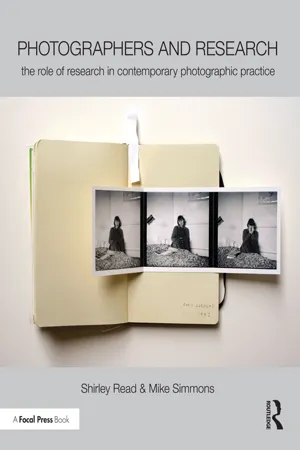
This ground-breaking book situates research at the heart of photographic practice, asking the key question: What does research mean for photographers? Illuminating the nature and scope of research and its practical application to photography, the book explores how research provides a critical framework to help develop awareness, extend subject knowledge, and inform the development of photographic work. The authors consider research as integral to the creative process and, through interviews with leading photographers, explore how photographers have embedded research strategies into their creative practice.
eBook - ePub
Photographers and Research
The role of research in contemporary photographic practice
- 274 pages
- English
- ePUB (mobile friendly)
- Available on iOS & Android
eBook - ePub
Photographers and Research
The role of research in contemporary photographic practice
About this book
Information
Case Study
Edmund Clark
Edmund Clark is a photographer working on issues raised by the war on terror.

From the series Guantanamo: If the Light Goes Out. Camp 4, arrow to Mecca and ring for ankle shackles
© Edmund Clark
© Edmund Clark
FOR ME RESEARCH WORKS on many different levels and functions in many ways. It can be reading something specific about the background of a subject, an event or an issue. It can be talking to people who have been involved with that situation. It can be absorbing information, almost subconsciously, from the news or the radio. It can be anything from thinking about what kind of camera I am going to use to how I access a site or who I have to know to get access to a site. It’s everything.
My unconscious plays a part, there’s always something going on at the back of my mind about the questions I’m involved with, how they might be visualised and for whom. I’ve been reading a lot of Kafka recently and that’s directly related to the subjects I’ve been working on about processes of control. Looking for other cultural references, expressions and forms that relate to the ideas and subjects I’m dealing with is definitely a part of what I do.
The films I go to see are all related to my work. In looking at media narratives about things like extraordinary rendition, control orders and the way people who have been in Guantanamo Bay are perceived and represented the role of popular culture in helping to facilitate a changing common perception of standards of legality and morality is really interesting and important. Films like Zero Dark Thirty and TV series like 24 and Homeland are in some ways an expression of changing perceptions of standards of behaviour by our government agencies. But they also raise the question of whether they constitute justification or tacit agreement for some of the measures that these agencies have carried out. So understanding all that is definitely part of a wide research context.
The nature of the work I do in looking at the war on terror, the use of control and incarceration in that war and the expression of those controls through legal forms, whether it be memos justifying enhanced interrogation techniques by the American government or the formulation of control orders by the British government, means I have to really understand the legal implications. So, on Control Order House I worked incredibly closely with the lawyers at Gareth Peirce’s practice, Birnberg Peirce.1 They read every word I wrote. I had to know that what I was saying was watertight because I’d be an easy target if it wasn’t. And also I was producing material that could, in theory, be used as evidence in the case of the man I was working with, who was a terrorism suspect. In a sense what I was producing was also research in itself. I do think lawyers have both positive and negative attitudes to photography and are incredibly aware of what media exposure can bring to their work in terms of both public debate and possible damage.
There are certain starting points, such as access, with my projects. I think there’s a basic amount of research you have to do in order to know whether something is going to be practicable or what you have to do to find a way around the obstructions to accessing, representing or visualising something.
My work is actually about trying to visualise experiences that are unseen and the involvement of agencies in that—which is not something that photographers get to see. Yet I can use images in a way that will re-represent these subjects and through that try to engage people to think about them in a new way.
There are projects I’ve given up on because I thought they couldn’t be done. I was trying to do some work in Saudi Arabia, in a rehabilitation centre for ex-Jihadis and people who had been sent back from Guantanamo Bay. There’s a centre there where they use a mixture of western therapy techniques blended with what I think is basic intimidation and reward—if you do what you are supposed to do and you’re reformed you get a job, a car, a house and, I believe, a wife as well in some cases. I spent about a year trying to get access but eventually realised that, no matter what people said, it wasn’t going to happen.

From Guantanamo: If the Light Goes Out. Camp 1, exercise cage
© Edmund Clark
© Edmund Clark
For me, contextual research is more important than practical. I rarely have full control over the practical elements of my work because I am so dependent on getting access, dealing with censorship and with people allowing me to photograph or not photograph things or deleting my pictures or simply not being able to photograph something important. So my practical choices tend to be quite straightforward and a lot of what I do is shaped by the agencies I’ve got to deal with. I’ve just done a series of trips to sites around Europe, for example, including the former CIA black site in Bucharest.2 When photographing a Romanian government building, which I know they don’t want photographed, I’m unlikely to take a large format camera on a big tripod because I know I will get stopped. So in that kind of situation I will use a camera I know I can work with quickly but will still give me the quality I want.

From Guantanamo If the Light Goes Out. Camp 6
© Edmund Clark
© Edmund Clark
So, practical research is shaped by the situation but that comes after I’ve developed my ideas about the project conceptually and considered how the form may allow me to explore other ideas about representation. These come out of the contextual research I do in reading and looking for documentation. I use a lot of documents in my work. How the bureaucracy of control looks is really interesting. The documents are the interface between power and the individual so how they look, how they’ve been presented or how they may have been redacted says so much.

From Guantanamo: If the Light Goes Out. US Naval Base, McDonalds
© Edmund Clark
© Edmund Clark
My research process is a constant process of absorption. I do a lot of primary research looking at documents produced by these situations and by the subjects and individuals involved and secondary research looking at how academics, journalists and lawyers have written about them. A lot of my research is down to personal contacts. Talking to people who have been the subject of extraordinary rendition or have been held in Guantanamo Bay or living with a man who is a terrorist suspect is a key part of what I do. There may be no people in my pictures but I have directly related to the individuals who are involved. I don’t interview people like a journalist would; I just spend time with them and let those relationships develop. So that aspect of personal contact, which I would define as being part of my research, is incredibly important.


From Guantanamo: If the Light Goes Out. (top) Ex-detainee’s home (bottom) Ex-detainee’s home, rose suspended in solution
© Edmund Clark
© Edmund Clark
The decision to re-read Kafka came out of an essay in book of literary critique, On Art and War and Terror by Professor Alex Danchev.3 I’d read Kafka a long time ago and with a different understanding. I’ve also looked at WG Sebald who uses photography, documents, direct memory and experience combined with a more fictional narrative. There’s a relationship between the way Sebald writes and uses images and documents and putting together photographs and documents about extraordinary rendition. Extraordinary rendition is all about obfuscation, cover-up and denial being in plain sight and this geo-political, moral event, which was the extra-legal abduction, detention and torture of people by the west. So, looking at the way a novelist like Sebald is using a range of different forms is really interesting in terms of how I think about how I am going to formulate my work.
My research is both random and comprehensive because it’s just implicit to the way I’m thinking. But, when I analyse what I’m doing, there’s actually something quite logical going on and, having worked as a researcher, I can recognise that I am accessing different forms of material from different sources. What’s so interesting about this, and perhaps why it’s so particularly relevant to photography, is that tension between the creative act and the informed decision. The form of my creative act is deeply informed by the research I have done. For a previous project I had, for instance, researched sixteenth-century Dutch Vanitas painting in which everyday objects were imbued with symbolism representing the ephemeral nature of temporal life. Because I had looked at that type of iconography, I could then see the rose and its petrification in a vase in the UK home of an ex-detainee as an image of confinement and abuse.
The obvious definition of the creative act for a photographer is when they’re looking through the viewfinder deciding what to put in the frame and when to push the shutter button. You can be working it out formally but you also kind of just know when the balance is there, when something is going to make an image that works. But the decision is related to all that research I’ve done before. Because you are having to work quickly you are so completely focused on what you are doing that you trust yourself to make the aesthetic judgement but also to make decisions based on what your brain is telling you is interesting. Sometimes you don’t know at that moment why that is interesting but you just know it is. So, for example, I walked into the McDonald’s on the US Naval Base at Guantanamo Bay, looked out of the window and saw a statue of Ronald McDonald in what looked like a cage. Everything about it spoke of a sense of confinement and complicity; even this smiling and waving symbol of the American way of life was confined. Perhaps I wouldn’t have seen this scene and recorded this image in this way if I hadn’t researched the history of the US naval base at Guantanamo since 1898. This meant I understood it represented a small town microcosm of America and a place of confinement in its own right since, after the Cuban Revolution in 1959, it has been cut off behind a razor wire fence and, for a while, an extensive minefield.
The other aspect of a creative act is that curatorial thing when my research takes me to a primary source who has put together a paper trail of evidence. That is an act that is in some way similar to the act of taking a photograph in as much as I’m looking for something which is, in terms of its evidential purpose, interesting and important and also has a visuality to it.
The Letters to Omar series, which are part of the Guantanamo work, were incredibly interesting documents.4 These are photocopies and scans of letters and messages sent to a man in Guantanamo. They’ve been produced by a number of different stages of intervention, redacted, stamped, archived and are images that have been created by the administrative process of Guantanamo Bay—they literally bear witness to degradation, they’ve been used in the control of the man they’ve been sent to, they’ve added to his paranoia and disorientation. I had researched the Camp Delta Standard Operating Procedures, which I found through Wikileaks, which described the Behaviour Management Plan: ‘The purpose of the Behaviour Management Plan is to enhance and exploit the disorientation and disorganization felt by a newly arrived detainee in the interrogation process. It concentrates on isolating the detainee and fostering dependence on his interrogator.’ In the same document I came across a matrix that listed what detainees could have and how they were treated according to five levels of compliance. Omar was at the ‘Intel’ level, the highest level, so everything was controlled by his interrogators, including whether, and in what form, he got any posted materials. This research directly enriched how I saw the significance of the letters and how they reflected the exercise of control and the experience of abuse at Guantanamo.

From Guantanamo: If the Light Goes Out. Fellowship Room, US Naval Base
© Edmund Clark
© Edmund Clark
Lastly, I think it’s the form. I no longer do conventional photography books, the books I do are about form. Whether it’s Control Order House, the Mountains of Majeed or the rendition work Negative Publicity: Artefacts of Extraordinary Rendition, the form is important.5 The object, the way in which you envisage something is shaped by censorship and control and other forces. I can never know what I’m going to have by the end of the day so that process of reflection, refining and deciding the form is all part of the creative act.
In ...
Table of contents
- Cover
- Title
- Copyright
- Contents
- Foreword
- Introduction
- Case Studies
- Photographers and Research in Higher Education
- Essays
- Contributor Biographies
- Acknowledgements
- Index
Trusted by 375,005 students
Access to over 1.5 million titles for a fair monthly price.
Study more efficiently using our study tools.
Frequently asked questions
Yes, you can cancel anytime from the Subscription tab in your account settings on the Perlego website. Your subscription will stay active until the end of your current billing period. Learn how to cancel your subscription
No, books cannot be downloaded as external files, such as PDFs, for use outside of Perlego. However, you can download books within the Perlego app for offline reading on mobile or tablet. Learn how to download books offline
Perlego offers two plans: Essential and Complete
- Essential is ideal for learners and professionals who enjoy exploring a wide range of subjects. Access the Essential Library with 800,000+ trusted titles and best-sellers across business, personal growth, and the humanities. Includes unlimited reading time and Standard Read Aloud voice.
- Complete: Perfect for advanced learners and researchers needing full, unrestricted access. Unlock 1.5M+ books across hundreds of subjects, including academic and specialized titles. The Complete Plan also includes advanced features like Premium Read Aloud and Research Assistant.
We are an online textbook subscription service, where you can get access to an entire online library for less than the price of a single book per month. With over 1.5 million books across 990+ topics, we’ve got you covered! Learn about our mission
Look out for the read-aloud symbol on your next book to see if you can listen to it. The read-aloud tool reads text aloud for you, highlighting the text as it is being read. You can pause it, speed it up and slow it down. Learn more about Read Aloud
Yes! You can use the Perlego app on both iOS and Android devices to read anytime, anywhere — even offline. Perfect for commutes or when you’re on the go.
Please note we cannot support devices running on iOS 13 and Android 7 or earlier. Learn more about using the app
Please note we cannot support devices running on iOS 13 and Android 7 or earlier. Learn more about using the app
Yes, you can access Photographers and Research by Shirley Read,Mike Simmons in PDF and/or ePUB format, as well as other popular books in Art & Photography. We have over 1.5 million books available in our catalogue for you to explore.