eBook - ePub
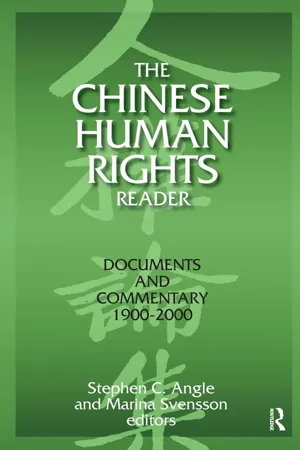
The Chinese Human Rights Reader
Documents and Commentary, 1900-2000
- 350 pages
- English
- ePUB (mobile friendly)
- Available on iOS & Android
eBook - ePub
About this book
Representative selections from China's twentieth-century human rights discourse, rendered into fluid and non-technical English. The documents are arranged chronologically, and each is preceded by a brief introduction dealing with the author and the immediate context. The book also includes a glossary in which translations of key terms are linked to their Chinese equivalents.
Information
Part I
Last Years of the Qing Dynasty: 1900–1911
1
On Citizens (1901)
Anonymous
“Shuo guomin” [On citizens]. Guomin bao 2 (1901). Reprinted in Zhang Nan and Wang Renzhi, eds., Xinhai geming qian shi nian jian shi lun xuanji [A Selection of Materials from the Ten-Year Period Before the Xinhai Revolution] (Beijing: Sanlian shudian, 1963), vol. 1:1, pp. 72–77.
The anonymous article “On Citizens” was published in the magazine Guomin bao in 1901. This interesting but very short-lived magazine came out with only four issues in 1901 before publication ceased. The magazine was published under the auspices of the Chinese National Society in Tokyo. Its goal was to inaugurate a national movement in China; it advocated liberal methods to achieve this end. As the editors wrote in English in the first issue: “We are liberal, unprejudiced, and impartial reformers. We promise to tolerate all sorts of religions and we also promise to protect the life and property of all people living within our jurisdiction. What we are trying to do is to defend our inalienable rights, the rights of independence and of humanity. Self-defense is our justification; ‘China for the Chinese’ is our motto.” The magazine discussed politics and China’s dismal state of affairs. It also published articles on Western philosophy, including the first translation of the American Declaration of Independence.
… What is meant by rights (quanli)? Nature (tian) gives birth to humans and endows them with the rights of personal freedom and political participation. We are, therefore, justified to concern ourselves with the executive power of the nation, to intervene in its legislative power, and to supervise its judicial power. When our nation receives benefits, we each personally benefit, and so we must use our collective strength to pursue [national benefit]. When our nation receives harm, we each are personally harmed, and so we have to pledge our lives to eliminate [national harm]. Hence, the genuine rights of citizens (guomin) cannot be suppressed by tyrants, cannot be infringed upon by oppressive officials, cannot be taken away by one’s parents, and cannot be overstepped by one’s friends. But if we hand over our individual rights on a silver platter to someone else; or if a monarch has monopolized all our rights and we do not dare to challenge him; or if a few aristocrats have privately (si) possessed all our rights and we still do not dare to challenge them; or if even foreigners have stolen and cheated us of our rights, and we still do not dare to challenge them; that is what is called forsaking one’s rights Those who have no rights are not citizens.
What is meant by responsibility (zeren)? Slaves are concerned only with their own affairs and those of their families, whereas citizens are concerned with the affairs of the nation and the race. When slaves are confronted with something they are timid and resigned. At home, they shift the responsibility onto their fathers and elder brothers; at court, onto their monarch and ministers. When all the people in a nation are like this, then no one takes responsibility (ren shi). When citizens are confronted by something, on the other hand, they are brave and bold. They understand that national affairs are also their own, and that their own affairs are also the nation’s. When all the people in a nation are like this, then everyone takes responsibility. However, those who do not know order from chaos, are indifferent to demotion and promotion, and are unconcerned about the gain and loss, weal and woe of the nation, and only diligently and avidly seek to protect themselves and their families—such people live ignoble and degrading lives in this world and have forsaken their responsibilities. Those who do not take responsibility are not citizens.
What is meant by freedom (ziyou)? Freedom is, roughly speaking, not to be subject to suppression. There are only two forms of suppression: suppression by monarchical power and suppression by foreign powers. France, for example, broke away from monarchical suppression and achieved freedom, whereas America broke away from the suppression of a foreign power and achieved freedom. Those who are suppressed by monarchical power and not able to do what the French did are not citizens, and those who are suppressed by foreign powers and not able to do what the Americans did are not citizens either. In order to free ourselves from the suppression of monarchical and foreign powers, though, we first have to free ourselves from suppression by our thousands of years of indestructible customs, thoughts, education, and learning. Breaking out from the suppression of monarchical and foreign powers is the manifestation of freedom; leaping out from [beneath] thousands of years of indestructible customs, thoughts, education, and learning is the spirit of freedom. Those without the spirit of freedom are not citizens.
What is meant by equality (pingdeng)? Nature gave birth to humans, and originally there was no distinction between noble and base, superior and inferior. Because the strong tyrannized the weak and the many violated the few, however, distinctions between noble and base, master and slave were formed. Consequently, the rulers become masters and the ruled, slaves; the aristocrats become masters and the common people, slaves; free people become masters and unfree people, slaves; men become masters and women, slaves. This is called a nation of slavery. The situation for citizens is not the same. When one tears apart the web that binds the ruler and the ruled, then everyone becomes both ruler and ruled. When one tears apart the web that binds aristocrats and common people, then everyone becomes both a prince and a functionary. When one tears apart the web that binds free people and unfree people, then there is no such word as slave in the law, and Chinese workers overseas are no longer called “coolies.” When one tears apart the web that binds men and women, both men and women have the right to political participation. Afterwards everyone is equal in the nation and each receives his or her due. When the people are equal, then one has a nation of equality. Those who are not equal are not citizens. …
Further Reading
Chinese concepts of citizenship are discussed from various perspectives in Joshua A. Fogel and Peter G. Zarrow, eds., Imagining the People: Chinese Intellectuals and the Concept of Citizenship, 1890–1920 (Armonk, NY: M.E. Sharpe, 1997). For a general view of the goals and experiences of Chinese students in Japan at the turn of the twentieth century, see Paula Harrell, Sowing the Seeds of Change: Chinese Students, Japanese Teachers, 1895–1905 (Stanford, CA: Stanford University Press, 1992).
2
On Rights Consciousness (1902)
Liang Qichao
“Lun quanli sixiang” [On Rights Consciousness]. Part 4 of Xin min shuo [On the New People], originally published in Xinmin congbao, 1902–3. Reprinted in Yinbingshi quanji [Complete Works from an Ice-Drinker’s Studio] (Shanghai: Zhonghua shuju, 1989).
Liang Qichao (1873–1929) was a leading political thinker and publicist. His manifesto, On the New People, was published serially in Japan, where Liang—like many other progressive intellectuals in the late Qing—lived and worked for a decade in order to avoid governmental suppression. The present essay was published in 1902 as part of On the New People. Liang began writing about rights as early as 1896; they came to occupy a prominent place in his theorizing after he arrived in Japan in 1898. He was influenced by the Social Darwinist ideas of Kato Hiroyuki, which can be seen most clearly in Liang’s 1899 essay “The Right of the Strongest.” Although some of these ideas are still present in the current essay, Liang had by this time developed a more complex position, partly through reading and interpreting the ideas of Rudolph von Jhering (1818–1892), a pioneering German legal theorist whose influence on Liang was significant, as Liang himself declares early in this essay.
All people have responsibilities toward others that they ought to fulfill, and all people have responsibilities to themselves that they ought to fulfill. Not fulfilling one’s responsibility to others is to indirectly harm the group, while not fulfilling one’s responsibility to oneself is to directly harm the group. How is this? Not fulfilling one’s responsibilities to others is like killing another; not fulfilling one’s responsibilities to oneself is like killing oneself. If someone kills himself, then the group is decreased by one person. If there were a group all of whose members killed themselves, this would mean no less than the entire group’s suicide.
What are one’s responsibilities to oneself? In giving birth to things, nature (tian) endowed them with the innate abilities to defend and preserve themselves; all living things are examples of this. The reason humans are greater than the other myriad things is that they have not only a physical existence but also a metaphysical existence. There are numerous aspects to metaphysical existence, but the most important among them are rights (quanli). Animals have no responsibilities toward themselves other than preserving their lives, while in order for us who are called “human” to completely fulfill our self-responsibilities, we must preserve both our lives and our rights, which mutually rely on one another. If we do not do this, we will immediately lose our qualifications to be human and stand in the same position as the animals. Thus, the Roman Law’s view of slaves as equivalent to animals was, according to logical theory, truly appropriate. (If we used a logical syllogism to make the reasoning explicit, it would look like this: [1] those without rights are animals; [2] slaves have no rights; [3] thus, slaves are animals.) Therefore, while in aphysical suicide, only one person is killed, in the case of a metaphysical suicide, a whole society is turned into animals. Furthermore, the descendants of animals will continue on endlessly. This is why I say that not fulfilling one’s responsibility to oneself is to directly harm the group. Alas! I do not know how many times my fellow Chinese have willingly killed themselves!?
From where are rights born? They are born from strength. Lions and tigers always have first-class, absolute rights with respect to the myriad animals, as do chieftains and kings with respect to the common people, aristocrats with respect to commoners, men with respect to women, large groups with respect to small, and aggressive states with respect to weak ones. This is not due to the violent evil of the lions, tigers, chieftains, and so on! It is natural that all humans desire to extend their own rights and are never satisfied with what they have attained. Thus it is the nature of rights that A must first give them up before B can invade and gain them. For a human to be committed to strengthening himself or herself through preserving his or her own rights (quart)1 is an unparalleled method for firmly establishing and doing well by his or her group. In ancient Greece there were those who made offerings to the god[dess] of justice. The statue of this god[dess] held a scale in her left hand and a sword in her right. The scale was for weighing the rights, and the sword was for protecting the manifestations of rights. To have a sword but no scale would be mean and wicked; but to have a scale without a sword is to make talk of rights empty and ultimately without effect. The German philosopher Jhering wrote The Struggle for Law (Der Kampf ums Recht). Jhering was a great philosopher of private jurisprudence who lived from 1818 to 1892. He wrote this book while he was a professor at Vienna University. In his own country, it was reprinted nine times, and it has been translated into twenty-one languages; [from these facts,] the value of this book can be ascertained. Last year the [magazine] Yishu huibian began to translate it into our nation’s language.2 Only the first chapter has been completed. I very much desire that they continue with it, so that this book can be used as a medicine to cure the Chinese people’s extremely urgent disease. It is because the essential points of my current essay are mostly taken from Jhering’s book that I have provided an outline in this fashion. Jhering writes: “The goal of rights is peace, but the means to this end is none other than war and struggle. When there are mutual invasions, there is mutual resistance, and so long as the invasions do not cease, the resistance will also not end. The essence is simply that rights are born from competition.” He also says: “Rights [require] unending effort. If effort is stopped even for a moment, the rights will be annihilated.” From this it can be seen that attaining and maintaining rights is in no way easy.
If one wants to attain [rights], if one wants to preserve [rights], then the place to begin is truly with rights consciousness (quanli sixiang).3 The body provides the essential condition for a person’s physical existence. Consider an internal organ like one’s liver or one’s lungs, or an external digit like one’s finger or toe: If one of these were not to be right, who would not feel pain and rapidly think about how to heal it? Now bodily pain is evidence that one’s inner organs have lost their harmony. It is a sign that the organ has been invaded. Healing involves warding off the invasion in order to preserve oneself. At the metaphysical level there are also invasions like this, and for one possessed of rights consciousness, as soon as one has been invaded and oppressed, th...
Table of contents
- Cover
- Half Title
- Title Page
- Copyright Page
- Table of Contents
- Acknowledgments
- General Introduction
- Notes on Further Readings and Selected General Bibliography
- Alternative Thematic Table of Contents
- Romanization, Pronunciation, and Abbreviations
- Permissions
- Part I. Last Years of the Qing Dynasty: 1900–1911
- Part II. The New Culture Movement, May Fourth, and the Twenties: 1914–1926
- Part III. The Nanjing Decade: 1927–1937
- Part IV. War with Japan and Civil War: 1937–1949
- Part V. 1949–1975
- Part VI. 1976–1986, Including the Democracy Wall Movement
- Part VII. The Late 1980s: Before and After Tiananmen
- Part VIII. The 1990s
- Glossary and Index
Trusted by 375,005 students
Access to over 1.5 million titles for a fair monthly price.
Study more efficiently using our study tools.
Frequently asked questions
Yes, you can cancel anytime from the Subscription tab in your account settings on the Perlego website. Your subscription will stay active until the end of your current billing period. Learn how to cancel your subscription
No, books cannot be downloaded as external files, such as PDFs, for use outside of Perlego. However, you can download books within the Perlego app for offline reading on mobile or tablet. Learn how to download books offline
Perlego offers two plans: Essential and Complete
- Essential is ideal for learners and professionals who enjoy exploring a wide range of subjects. Access the Essential Library with 800,000+ trusted titles and best-sellers across business, personal growth, and the humanities. Includes unlimited reading time and Standard Read Aloud voice.
- Complete: Perfect for advanced learners and researchers needing full, unrestricted access. Unlock 1.5M+ books across hundreds of subjects, including academic and specialized titles. The Complete Plan also includes advanced features like Premium Read Aloud and Research Assistant.
We are an online textbook subscription service, where you can get access to an entire online library for less than the price of a single book per month. With over 1.5 million books across 990+ topics, we’ve got you covered! Learn about our mission
Look out for the read-aloud symbol on your next book to see if you can listen to it. The read-aloud tool reads text aloud for you, highlighting the text as it is being read. You can pause it, speed it up and slow it down. Learn more about Read Aloud
Yes! You can use the Perlego app on both iOS and Android devices to read anytime, anywhere — even offline. Perfect for commutes or when you’re on the go.
Please note we cannot support devices running on iOS 13 and Android 7 or earlier. Learn more about using the app
Please note we cannot support devices running on iOS 13 and Android 7 or earlier. Learn more about using the app
Yes, you can access The Chinese Human Rights Reader by Stephen C. Angle,Marina Svensson in PDF and/or ePUB format, as well as other popular books in Politics & International Relations & Asian History. We have over 1.5 million books available in our catalogue for you to explore.