eBook - ePub
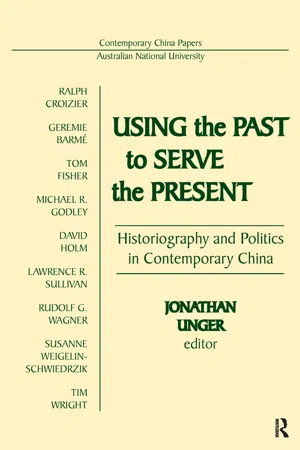
Using the Past to Serve the Present
Historiography and Politics in Contemporary China
- 304 pages
- English
- ePUB (mobile friendly)
- Available on iOS & Android
eBook - ePub
About this book
An historiographical examination of the political debates of the 1980s over despotism in Chinese history and over Party history. The extent of popular culture and its reinterpretation of history is also assessed, as governmental control of the media has decreased.
‘IN GUISE OF A CONGRATULATION’: POLITICAL SYMBOLISM IN ZHOU XINFANG’S PLAY HAI RUI SUBMITS HIS MEMORIAL
When rehabilitation of the intellectual victims of the Cultural Revolution began in 1978, the leadership had to decide on what basis they should now be praised. Some of the most prominent had been attacked by Red Guards and Kang Sheng’s machine for disagreeing with Mao Zedong or even openly criticizing the Chairman. Should the historian Wu Han, the dramatists Meng Chao and Tian Han, the essayist Deng Tuo, or the actor Zhou Xinfang be rehabilitated as people who dared to speak up when the common people were in distress during the Great Leap years, as people who stood up to the strong and mighty, as courageous defenders of civil liberties whose emulation would be the best defense against a recurrence of a Cultural Revolution?
A great chance for setting new political standards was to be missed and the new leadership lived up to its reputation. Speeches, books, and articles praised the Wu Hans and Tian Hans in unison for their utter obedience to orders from the Party leadership. Why then, had they become victims of the Cultural Revolution? Because, according to the new dispensation, this social conflagration had arisen exactly through reckless criticism directed at Party leaders. The rehabilitated intellectuals were presented as victims of their obedience, not of their daring outspokenness.1
Of course, there was some double talk involved. These intellectuals had been linked to now-rehabilitated political leaders. In their outspoken criticism of certain Party leaders and their policies before the Cultural Revolution, they had all too often obediently followed directives given to them by their elders. As these leaders were now back in power and as their opponents were dead or jailed, there was no further need for daring and outspoken critics, and the now praiseworthy virtue of these intellectuals was their continuous obedience to orders from the right people.
In actuality, their obedience had not been restricted to the now restored leaders, nor their criticism to Mao Zedong and his associates. They had had their own reasons to do each other in, their own trivial squabbles; the media and genres they used had their own laws and restrictions, and the actual record of their lives would probably rather land them in Dante’s messy Limbo than in the neatly defined realms of Paradise or Hell.
Background
The Anti-Rightist Campaign which began in June 1957 eliminated from the literary scene the bulk of the prose writers affiliated with the Communist Youth League, such as Liu Binyan, Wang Meng, Liu Shaotang and Gao Xiaosheng.2 Their criticism of bureaucratic abuse was termed ‘anti-socialist’, and their advocacy of greater leeway for intellectuals ‘decadent’. Prose lost its critical potential as well as its promoters. The role models of these young authors, the engagé journalistic writers from the Soviet Thaw like Ovechkin, Nikolayeva, Ehrenburg, and Dudintsev, became unlivable and unquotable.
The acceleration of rural collectivization in early 1958, which resulted in the establishment of People’s Communes as well as the attempts to achieve a Great Leap Forward in production through a militarily organized production campaign, exacerbated the inherent problems of one-Party leadership. The abrogation of individual economic prerogatives together with the political Anti-Rightist Campaign combined to increase the powers of the cadres and to close the avenues of [open] talk (yanlu). The ensuing marked increase in cadre abuses of power was accompanied by an equally marked decrease in the options available to ward them off. Lower level cadres ceded to higher level pressure to come up with inflated ‘Great Leap Forward’ production targets, and squeezed the amounts of grain required for sale to the state from the defenseless peasants. This resulted in the by far largest man-made famine in this century.3
The ‘new historical drama’ of the period 1958 through 1963 provided the principal medium to depict the Great Leap, to analyse who was responsible for its failings or achievements, and to suggest remedies to overcome the crisis or to bring the slanderers to order. The authors were not young men from the Youth League but older cultural leaders like Tian Han, Zhou Xinfang, Meng Chao, Guo Moruo or Wu Han. Their public were not the traditional Peking Opera aficionados from the lower orders. The plays were new or radically rewritten, and comprehension of their message required a substantial knowledge of wenyan, of history, and of top-level contention within the Party’s leadership. Their intended audience comprised the senior members of the political class.
The historical drama traditionally deals with the Centre, the court, and not with the common folk, the laobaixing, as had the reform prose of the preceding years. It was thus able to portray indirectly the struggles at the very centre of power, which had been removed from the corpus of legitimate literary topics at the very moment when these internal political debates assumed an unprecedented importance for the fate of the country.
The new historical drama inherited elements from the rewritten historical drama of the early Fifties. At that time, scores of popular operas had been rewritten to conform to new educative purposes. Qin Xianglian now appeared on stage as a public warning to the cadres not to change their wives as their social status rose. The Monkey King now ends his Great Uproar in Heaven in victory, because the revolution with which this uproar had been equated had been victorious. There was a shared understanding that these restaged old works directly referred to contemporary things. Works where no such echo with the present was found were not performed.4
The new historical drama also inherited a rich tradition dating from its use in the battle against the Guomindang. Most of the senior figures in drama, including Wu Han, Guo Moruo, Tian Han and Meng Chao, had experience in using historical drama for indirect criticism of contemporary politics from pre-1949 times.5 This was true, too, for the author of the play studied in this paper, Zhou Xinfang. He had reacted to every one of the major political developments since the May 4th period by selecting and reworking historical pieces in a fashion that joined the contemporary fray.6 The implication of the renewed use of historical drama since 1958 was that times were again such as to leave no other avenue of discourse open.
The Hai Rui Model
A small number of qingguan, pure officials, had been waiting for their time in the wings of the opera houses during the first half of the Fifties, especially Bao Cheng, the Song Dynasty judge. During the Hundred Flowers period, some quite critical Judge Bao plays had been performed. He was eventually joined by the Ming official Hai Rui, who became his ‘southern’ counterpart.
Jiang Xingyu, a member of the Shanghai Cultural Office, began work on his biography Hai Rui in 1955.7 The biography eventually came out in September 19578 after two substantial revisions, and nearly landed the author in the position of a ‘Rightist’ during the ‘Anti-Rightist Campaign’ that had just begun.9 The book ran through five printings until 1962 and remained the main source for public information on Hai Rui during these years. Jiang Xingyu greatly praised Hai Rui for his defense of the ‘interests of the peasants and small landowners’, and for his outspoken criticism of corruption and misrule in the Centre. He rejected as being ‘all too one-sided’ the argument proffered by ‘some people’ that Hai Rui’s ‘progressive measures’ only softened the class contradictions and deferred revolution.10 In this way Hai Rui became a possible behavioural model for the present. The key terms used later for Hai Rui, i.e., his ‘daring to act’, (ganzuo ganwei), were not now in political fashion when Jiang Xingyu wrote the book. Jiang Xingyu’s Hai Rui, with his popular and upright stand and brave battle against bureaucratic abuses of power, was very much a hero of the Hundred Flowers period.
A few months later, in mid-1958, Hai Rui was joined by Guan Hanqing, the Yuan Dynasty playwright. A decision at that time by the World Peace Council to elevate Guan to the level of a world cultural giant provided Tian Han with the opportunity to write a play ostensibly about Guan Hanqing.11
Tian Han’s Guan Hanqing operated as a guide for the reading and appreciation of the new historical drama, written by none ...
Table of contents
- Cover
- Half Title
- Title Page
- Copyright Page
- Table of Contents
- Acknowledgements
- Contributors
- Introduction
- ‘The Play’s the Thing’: Wu Han and Hai Rui Revisited
- ‘In Guise of a Congratulation’: Political Symbolism in Zhou Xinfang’s Play Hai Submits His Memorial
- The Strange Case of Liu Zhidan
- Qu Yuan and the Artists: Ancient Symbols and Modern Politics in the Post-Mao Era
- Party Historiography
- The Controversy Over ‘Feudal Despotism’: Politics and Historiography in China, 1978–82
- ‘The Spiritual Heritage of Chinese Capitalism’: Recent Trends in the Historiography of Chinese Enterprise Management
- Socialism with Chinese Characteristics: Sun Yatsen and the International Development of China
- History for the Masses
- Index
Trusted by 375,005 students
Access to over 1.5 million titles for a fair monthly price.
Study more efficiently using our study tools.
Frequently asked questions
Yes, you can cancel anytime from the Subscription tab in your account settings on the Perlego website. Your subscription will stay active until the end of your current billing period. Learn how to cancel your subscription
No, books cannot be downloaded as external files, such as PDFs, for use outside of Perlego. However, you can download books within the Perlego app for offline reading on mobile or tablet. Learn how to download books offline
Perlego offers two plans: Essential and Complete
- Essential is ideal for learners and professionals who enjoy exploring a wide range of subjects. Access the Essential Library with 800,000+ trusted titles and best-sellers across business, personal growth, and the humanities. Includes unlimited reading time and Standard Read Aloud voice.
- Complete: Perfect for advanced learners and researchers needing full, unrestricted access. Unlock 1.5M+ books across hundreds of subjects, including academic and specialized titles. The Complete Plan also includes advanced features like Premium Read Aloud and Research Assistant.
We are an online textbook subscription service, where you can get access to an entire online library for less than the price of a single book per month. With over 1.5 million books across 990+ topics, we’ve got you covered! Learn about our mission
Look out for the read-aloud symbol on your next book to see if you can listen to it. The read-aloud tool reads text aloud for you, highlighting the text as it is being read. You can pause it, speed it up and slow it down. Learn more about Read Aloud
Yes! You can use the Perlego app on both iOS and Android devices to read anytime, anywhere — even offline. Perfect for commutes or when you’re on the go.
Please note we cannot support devices running on iOS 13 and Android 7 or earlier. Learn more about using the app
Please note we cannot support devices running on iOS 13 and Android 7 or earlier. Learn more about using the app
Yes, you can access Using the Past to Serve the Present by Jonathan Unger in PDF and/or ePUB format, as well as other popular books in History & Chinese History. We have over 1.5 million books available in our catalogue for you to explore.