eBook - ePub
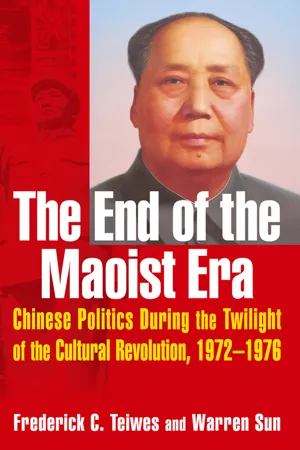
The End of the Maoist Era: Chinese Politics During the Twilight of the Cultural Revolution, 1972-1976
Chinese Politics During the Twilight of the Cultural Revolution, 1972-1976
- 729 pages
- English
- ePUB (mobile friendly)
- Available on iOS & Android
eBook - ePub
The End of the Maoist Era: Chinese Politics During the Twilight of the Cultural Revolution, 1972-1976
Chinese Politics During the Twilight of the Cultural Revolution, 1972-1976
About this book
This book launches an ambitious reexamination of the elite politics behind one of the most remarkable transformations in the late twentieth century. As the first part of a new interpretation of the evolution of Chinese politics during the years 1972-82, it provides a detailed study of the end of the Maoist era, demonstrating Mao's continuing dominance even as his ability to control events ebbed away. The tensions within the "gang of four," the different treatment of Zhou Enlai and Deng Xiaoping, and the largely unexamined role of younger radicals are analyzed to reveal a view of the dynamic of elite politics that is at odds with accepted scholarship. The authors draw upon newly available documentary sources and extensive interviews with Chinese participants and historians to develop their challenging interpretation of one of the most poorly understood periods in the history of the People's Republic of China.
Chapter 1
COMING TO TERMS WITH LIN BIAO: “ULTRA-LEFT” AND “ULTRA-RIGHT” ON THE ROAD TO THE TENTH PARTY CONGRESS, 1972–73
In our country there are people who curse us, saying we are completely leftist. Which people are our “leftist faction”? They are those who wanted to knock down the Premier today, Chen Yi tomorrow, Ye Jianying the next day. This so-called “left” faction is now in jail. For several years there was chaos under heaven, fighting in various places throughout the nation, widespread civil war. The two sides fired guns, all together one million guns. This army faction supported this faction, that army faction supported that faction, [all] fighting. Power was seized by that “left” faction…. The chief backstage backer [of the “left” faction] is now no longer with us, [he is] Lin Biao.
—Mao Zedong on Lin Biao as the Cultural Revolution’s “leftist” chieftain during a meeting with the Sri Lankan Prime Minister, June 28, 19721
In July 1967 Mao Zedong had a private talk with me alone in Wuhan. I reported to the Chairman, “You’ve said many times that Liu and Deng must be distinguished, but now the slogan is ‘Down with Liu, Deng, [and] Tao [Zhu]’.” Mao Zedong immediately answered: “Liu Shaoqi and Deng Xiaoping are different. Xiaoping can administratively (wen) match Shaoqi and Zhou Enlai, and militarily (wu) he can match Lin Biao and Peng Dehuai. If Lin Biao’s health doesn’t hold out, then it will be Deng Xiaoping who comes forward.”
—Wang Li, a younger radical from the Central Cultural Revolution Group, recalling in 1991 a conversation with Mao at the height of the Cultural Revolution2
[At the time of the Tenth Party Congress], Chairman Mao placed his hopes on the comrades of the Politburo, especially Wang Hongwen, Zhang Chunqiao, Jiang Qing and Yao Wenyuan. I remember that not long after the Tenth Congress, Chairman Mao summoned us to [his] swimming pool residence [in Zhongnanhai] for a talk. He called on the Politburo to assist them. At that time, Chairman Mao pointed out the window to some green vegetables in the vegetable patch: “[Cultivate them] just like [those vegetables] are growing.”
—Wu De’s recollection of Mao at the time of the Tenth Congress3
Lin Biao’s attempt to flee the country and his resulting death on September 13, 1971, came as a shock to the people of China, to Party officials from the basic levels to the Politburo, and to Mao Zedong. For the people and cadres of China, as they gradually became aware of the “incident,, over the following months,4 the affair raised doubts not only about “Chairman Mao’s best student and successor,“ but also concerning the Cultural Revolution which saw Lin’s elevation, and the Chairman himself. If the Cultural Revolution had been hard to understand, the great majority seemingly accepted its premise, or at least the legitimacy of the regime which had inflicted it upon them. The Lin Biao incident shattered that illusion for many, leading people to at least question Mao’s judgment, or to conclude bitterly that it was all a power struggle among the highest rulers.5 Politburo members and other high-ranking officials were equally shocked, even those who had been aware of Mao’s mounting displeasure with Lin since the Lushan Central Committee plenum in summer 1970. As for Mao, a senior Party historian is undoubtedly on the mark in concluding that despite his developing distrust of Lin, the Chairman would not have expected an act of betrayal as when Lin boarded the fatal flight that crashed in the Mongolian desert.6
In the following section we examine the devastating physical and emotional impact of Lin’s perceived betrayal on Mao, as well as his and the leadership’s immediate responses. Here the broader political impact of the incident deserves initial comment. Since the Ninth Congress, Mao had placed the CCP on a road of winding down the Cultural Revolution and correcting its excesses. This was, to be sure, a limited course correction, but the direction was clear. While we doubt the speculation of a Party historian that without the Lin Biao incident the Cultural Revolution might simply have faded away, his observation that the affair introduced new complexities into the situation is valid. Mao, wrongly and disingenuously attributing the excesses of the Cultural Revolution to Lin, but rightly recognizing the threat of those excesses to his larger objective, now initiated or endorsed more flexible policies and more far-reaching attacks on “left” deviations than those carried out earlier after the Ninth Congress and particularly after he first criticized Lin at the Lushan plenum. On the other hand, as his biographers observe, Mao was aware that “after the Lin Biao incident many people developed basic doubts about the ‘Cultural Revolution’,” not to mention the Chairman’s own credibility, and as a result he became “very concerned with how the [movement] would be viewed in the future” and determined to defend its essential validity. These two considerations, while theoretically compatible, resulted in increased tension as both aspects took on new salience, each backed by forces with a history of conflict within the Politburo.7
In this chapter, after reviewing the initial reaction to Lin’s demise, we address the key developments of the early post-Lin Biao period beginning with the more far-reaching attack on “left” deviations—i.e., on a so-called “ultra-left ideological trend” (jizuo sichao), an attack that dominated throughout most of 1972, and still had significant influence in the first half of 1973. Key aspects of this effort were rectifying problems in economic construction and cadre policy, in the latter case by accelerating the rehabilitation of veteran revolutionaries ousted in 1966–68. In December 1972, however, Mao redefined Lin’s essential deviations as “ultra-rightist” (jiyou) in nature, leading to a revival of praise of the “new born things” of the Cultural Revolution and criticism of revisionism as the main task. After examining the politics of the shift from the “ultra-left” to “ultra-right” definitions of Lin’s essence, we discuss the most significant rehabilitation of an old revolutionary, that of Deng Xiaoping. This is followed by an analysis of the major organizational developments of the period—the effort to restore the Party and reassert its role as the key coordinating organization of the regime, the further revival of state bureaucratic organs, the reappearance of official mass organizations, and the linked gradual withdrawal of the PLA from civilian affairs. Particularly notable was the creation of an urban militia under civilian Party control, a force that would play a significant if usually exaggerated role in elite politics. We next turn to the crucial, largely overlooked, role of foreign affairs in leadership politics preceding the August 1973 Tenth Party Congress. Finally, we examine the process leading to the Congress and its outcomes, notably a strong reaffirmation of the Cultural Revolution, a continuation of the mixed personnel policy of rehabilitating veteran cadres and promoting youth, and the confirmation of Wang Hongwen as the presumptive future successor.
These events have been analyzed elsewhere, although usually in condensed form and seldom addressing the significance of the foreign affairs question. How does our interpretation of developments up to the Tenth Congress differ from what has been generally accepted? While there is enough diversity in the limited existing literature to warn against characterizing any particular view as conventional wisdom, there nevertheless are two generally accepted propositions. First, that Zhou was the driving force of the attack on “ultra-leftism,” making 1972 ““Zhou Enlai’s year.”8 Second, that the Premier’s brief dominance was a new stage in an ongoing struggle with the Politburo radicals that allowed him to damage their cause, but also led to their counterattack and a new political balance in 1973.9 What of Mao in all this? Most accounts paint the Chairman as relatively passive in the attack on “ultra-leftism,” endorsing rather than initiating Zhou’s efforts, a view stated forcefully by senior Party historian Liao Gailong in 1980: ‘: “Following Lin Biao’s death … [Mao] allowed [Zhou to restore the Party’s traditions, liberate cadres, rehabilitate and revive the national economy].”10 As for the shift in emphasis from criticizing the ““ultra-left” to opposing the “ultra-right,” Mao is given a much more central, albeit reactive, role in responding to the urgings of Jiang Qing and Zhang Chunqiao, and concluding that the anti-leftist tide had gone too far.11 As our subsequent analysis will demonstrate, while there is something in these accepted understandings, they underestimate Mao’s impact, and do not adequately capture the elite politics of the period.
Before examining specific events, some general observations concerning the preceding issues are in order. First, it is undeniable that in 1972 Zhou Enlai played a more critical role in CCP elite politics than ever before. Apart from his driving role in various policies, for the first time since 1949 Mao placed Zhou in charge of the Party Center, and together with his close relationship to Ye Jianying, who was simultaneously given responsibility for the PLA, Zhou now had enormous influence over all three traditional pillars of regime authority—the Party, State Council and army. Indeed, if Mao’s doctor is to be believed, during his health crisis of early 1972, a despairing Chairman commented to Zhou that if he could not make it, “everything [will] depend on you.12 ” Yet Mao, not Zhou, determined CCP policy concerning leftist practices: criticism of such practices predated the Premier’s enhanced role, and attacks on left phenomena continued after the diminution of Zhou’s power at the end of 1972. Zhou remained utterly dependent on Mao while the Chairman lived. As Party historian An Jianshe observed, the Premier’s efforts in the struggle against “ultra-leftism,” “cannot be separated from Mao Zedong’s understandings at the time.”13 Zhou’s dependence on Mao can be seen in two striking developments in 1972. One concerned something all too familiar in Zhou’s career—several sessions of self-criticisms in May and June 1972. In contrast to various past and several future cases, these were not offered when the Premier was under attack. In fact, his typically excessive self-criticisms allowed him to rebut long-standing rumors that, under the alias of Wu Hao, he had deserted the Party in the early 1930s. Party leaders—as was also the case with Jiang Qing and Zhang Chunqiao—were deeply vulnerable to suspicions of betrayal during the revolutionary struggle, the type of charge that was used falsely, with Zhou’s complicity, to expel Liu Shaoqi from the Party in 1968. In this case, by authorizing Zhou’s self-criticism, Mao allowed the Premier to clarify the circumstances of this threatening issue, and then banned further discussion of it. But the larger lesson was clear: it was Mao, and Mao alone, who could provide such an opportunity, but in a context where self-examination of one’s faults was mandatory—something carried out to excess by the Premier even at the time of his greatest clout.14
An even more remarkable example of Zhou’s own perception of his utter dependence on Mao was a virtually unknown incident during Nixon’s groundbreaking visit to China in February 1972. Again, this was not only a time when Zhou exercised great authority, but it also concerned a sphere where Zhou’s value to Mao was at an all-time high. The matter in question was Nixon’s arrival in Beijing and the famous handshake between the President and Premier. The point at issue is that the photograph of the handshake which appeared in the People ‘s Daily the next day was, in one significant respect, faked. In that photo the trailing interpreter, who in fact was Ji Chaozhu, was replaced by the image of Wang Hairong, Mao’s niece and one of the “two ladies.” This substitution puzzled people in the Ministry of Foreign Affairs, and remained a source of speculation and contention over the following three decades. The enemies of the “two ladies” concluded that they had somehow brought about the switch, but it is virtually certain that this was the work of Zhou Enlai. Not only would it have taken someone of Zhou’s status to bring about such a switch, but it was the Premier’s practice to vet all photos and film of such occasions. The interpretation of this strange event, we believe, is inescapable: in highlighting a member of the Chairman’s family, Zhou was trying to send a message that Mao was the architect of this momentous development. How widely that message was understood is another matter, but the Premier undoubtedly hoped it would be read that way by Mao. That Zhou would be concerned with such a detail at a time of both his greatest powers and one of the pivotal events in PRC foreign policy speaks volume...
Table of contents
- Cover
- Half Title
- Title Page
- Copyright Page
- Dedication
- Table of Contents
- Tables and Abbreviations
- Preface
- Introduction
- Chapter 1 Coming to Terms with Lin Biao: "Ultra-Left" and "Ultra-Right" on the Road to the Tenth Party Congress, 1972-73
- Chapter 2 "The Second Cultural Revolution," Fall 1973-Summer 1974
- Chapter 3 Toward the Fourth National People's Congress, August 1974-January 1975
- Chapter 4 Mao, Deng and the Politics of Consolidation: From the Fourth NPC to Summer 1975
- Chapter 5 Deng's Period "In Charge": Comprehensive Consolidation, July-October 1975
- Chapter 6 The Unfolding of a New Leadership Equation: The Turn against Deng and the Ascent of Hua, November 1975-March 1976
- Chapter 7 The Tiananmen Incident and Mao's Last Days, April-September 1976
- Chapter 8 The Purge of the "Gang of Four," September-October 1976
- Conclusion
- Bibliography
- Index
- About the Authors
Trusted by 375,005 students
Access to over 1.5 million titles for a fair monthly price.
Study more efficiently using our study tools.
Frequently asked questions
Yes, you can cancel anytime from the Subscription tab in your account settings on the Perlego website. Your subscription will stay active until the end of your current billing period. Learn how to cancel your subscription
No, books cannot be downloaded as external files, such as PDFs, for use outside of Perlego. However, you can download books within the Perlego app for offline reading on mobile or tablet. Learn how to download books offline
Perlego offers two plans: Essential and Complete
- Essential is ideal for learners and professionals who enjoy exploring a wide range of subjects. Access the Essential Library with 800,000+ trusted titles and best-sellers across business, personal growth, and the humanities. Includes unlimited reading time and Standard Read Aloud voice.
- Complete: Perfect for advanced learners and researchers needing full, unrestricted access. Unlock 1.5M+ books across hundreds of subjects, including academic and specialized titles. The Complete Plan also includes advanced features like Premium Read Aloud and Research Assistant.
We are an online textbook subscription service, where you can get access to an entire online library for less than the price of a single book per month. With over 1.5 million books across 990+ topics, we’ve got you covered! Learn about our mission
Look out for the read-aloud symbol on your next book to see if you can listen to it. The read-aloud tool reads text aloud for you, highlighting the text as it is being read. You can pause it, speed it up and slow it down. Learn more about Read Aloud
Yes! You can use the Perlego app on both iOS and Android devices to read anytime, anywhere — even offline. Perfect for commutes or when you’re on the go.
Please note we cannot support devices running on iOS 13 and Android 7 or earlier. Learn more about using the app
Please note we cannot support devices running on iOS 13 and Android 7 or earlier. Learn more about using the app
Yes, you can access The End of the Maoist Era: Chinese Politics During the Twilight of the Cultural Revolution, 1972-1976 by Frederick C Teiwes,Warren Sun in PDF and/or ePUB format, as well as other popular books in History & Development Economics. We have over 1.5 million books available in our catalogue for you to explore.