eBook - ePub
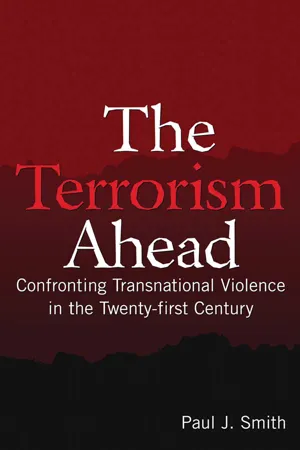
The Terrorism Ahead
Confronting Transnational Violence in the Twenty-First Century
- 258 pages
- English
- ePUB (mobile friendly)
- Available on iOS & Android
eBook - ePub
About this book
This book examines the evolving threat of terrorism and draws on the latest research to assess future trends. The author assumes that terrorism will remain a potent threat to the international system throughout the twenty-first century, primarily because of the convergence of two negative trends: the availability of Chemical, Biological, Radiological, and Nuclear Weapons (CBRN) - also known as Weapons of Mass Destruction - and the proliferation of terrorist organizations seeking to achieve mass casualties. Even without the CBRN element, however, Smith maintains that terrorism will remain an ongoing threat. The book also explores specific aspects of contemporary terrorism, including political, social, economic, religious, and ideological factors, globalization as a stimulation to contemporary terrorism, the role of organized crime in terrorist movements, and more. Written with students in college and professional programs in mind, the book includes case studies interspersed throughout the chapters that provide clarifying examples.
Information
1
The Nature and Definition of Terrorism
The Nature and Definition of Terrorism
On April 20, 2004, Jordanian counterterrorism officials disrupted a plot involving the use of chemical weapons that was organized and financed by Abu-Mus’ab al-Zarqawi, who at the time was alive and living in Iraq. The goal of the plot was to bomb the Jordanian Prime Minister’s Office, the U.S. Embassy, and the General Intelligence Department (GID) in Amman.
The attack plan, which would employ suicide terrorists, envisaged a convoy of vehicles that would enter the compound, where all three targets were located. The first vehicle, a conventional sedan, would attack the guard post and destroy it. The trucks in the back of the convoy would proceed into the compound and position themselves near their targets, and then detonate. The planners hoped that in addition to the conventional explosives, the use of toxic chemicals would enhance the effects of the blast and create “a cloud of toxins that would disperse around the GID compound and out in the city, inducing mass casualties.”1 In addition, the emission of chemical gases was expected to “cause physical deformities and direct damage to the lungs and the eyes.”2
Preparations for the attack were extensive and were led by Azmi al-Jayyusi, who took direct orders from al-Zarqawi. Al-Jayyusi actually began planning for the attack while in Iraq, following his transfer from Afghanistan, under the direct orders of al-Zarqawi. Subsequently, he moved to Jordan to oversee logistical planning for the attack. In Jordan, the attack planners—including al-Jayyusi—purchased more than twenty tons of chemicals from local companies, which were intended to be part one of a two-part explosion design, one chemical and the other conventional.3 Funding for the plot exceeded US$170,000, most of which was supplied by Al-Zarqawi in smaller payments ranging from US$10,000 to US$15,000.4
The plot designers calculated that the two explosions would have had an impact within a two-kilometer radius. Overall, it was anticipated that 80,000 people would die and 160,000 would be wounded.5 According to Husayn Sharif, one of the co-conspirators in the plot, the Jordan attack was intended to be the “first suicide chemical attack by al-Qaeda.”6 Fortunately, it was disrupted prior to its execution.
The attempted attack in Jordan was followed three months later by the issuance of a final report by the National Commission on Terrorist Attacks on the United States (The 9/11 Commission Report) on July 22, 2004. The report was the product of a multiyear effort by current and former U.S. officials to understand the background and motivations underlying the September 11, 2001, terrorist attacks in the United States. The report described how nineteen young men, mostly citizens of Saudi Arabia, boarded four planes within the United States and flew three of them into the World Trade Center in New York City and the Pentagon, in Washington, DC, with the fourth crashing in Pennsylvania. The individuals who perpetrated this incident acted as part of, or on behalf of, a conservative and militant Salafist terrorist organization known as al-Qaeda, which at the time was based in Afghanistan.
Although 9/11 and the disrupted chemical attack in Jordan were separate and unrelated plots, they shared a common characteristic in that each exhibited varying degrees of what might be called progressive tactical evolution. In other words, specific terrorist plots are often a single node in a long line of progressive learning, including attempts, failures, and then redeployment of the same or similar tactics. The 9/11 attack, for instance, was the culmination of conceptual thinking and planning by Khalid Sheikh Mohammed (“KSM”) beginning in 1993. KSM had already been tied to the first attempt to bomb the World Trade Center in 1993.7 According to The 9/11 Commission Report, by the year 1995, KSM and others “speculated about striking the World Trade Center and CIA headquarters.”8
Moreover, a Joint Intelligence Inquiry conducted by the U.S. Congress revealed numerous planned, attempted, or aborted suicide plots involving airplanes that were being planned against the United States or other Western countries in the mid- to late 1990s. Among the plots catalogued by investigators was the hijacking in December 1994 of an Air France flight in Algiers by members of the Algerian Armed Islamic Group.9 The terrorists had threatened to crash the plane, in a suicide operation, into the Eiffel Tower. A year later, in 1995, Philippine authorities uncovered the Bojinka plot—partly engineered by KSM—which featured a plan to bomb eleven U.S. airliners as they crossed the Pacific Ocean. Another stage of Bojinka, as described earlier, involved the crashing of an airplane into CIA headquarters and other targets.10
In January 1996, another plot surfaced involving a planned airplane suicide plot targeting the White House.11 Later, in October 1996, intelligence agencies learned of an Iranian plot “to hijack a Japanese plane over Israel and crash it into Tel Aviv.”12 Roughly two years later, in August 1998, the intelligence community learned that an al-Qaeda-linked group “planned to fly an explosive-laden plane from a foreign country into the World Trade Center.”13 In September 1998, intelligence officials learned of a bin Laden-directed operation that “might involve flying an explosives-laden aircraft into a U.S. airport and detonating it.”14
In November 1998, intelligence officials in Turkey uncovered a possible plot by an Islamic extremist group to conduct “a suicide attack [involving an airplane packed with explosives] to coincide with celebrations marking the death of Ataturk, the founder of modern Turkey.”15 In April 2000, the U.S. intelligence community was told by a “walk-in” source to the Federal Bureau of Investigation’s Newark, New Jersey, office that he had learned hijacking techniques and “was to meet five or six persons in the United States” for the purpose of taking over a plane and flying it to Afghanistan.16 Finally, in August 2001, U.S. intelligence officials learned of a plot to “bomb the U.S. embassy in Nairobi from an airplane or crash the airplane into it.”17
Similarly, the Jordan chemical plot could also be viewed as a single node in a long line of tactical evolution. Since the 1980s, al-Qaeda has been fascinated by the prospect of deploying chemical weapons in a mass casualty attack (often in conjunction with a conventional attack). In the 1990s, al-Qaeda had constructed chemical laboratories in Afghanistan and was actively conducting experiments to determine the efficacy of certain chemical weapons. Moreover, recent evidence suggests that al-Qaeda and affiliated groups have been very interested in conducting a chemical weapons attack. In Iraq, for instance, insurgents operating in Al Anbar province and elsewhere—many of whom are believed to be linked to al-Qaeda—have conducted a number of suicide attacks involving trucks loaded with chemicals such as chlorine. In addition, in April 2007, a truck loaded with nitric acid overturned before it could hit a joint security station manned by American and Iraqi troops.18 These attacks suggest a new form of progressive tactical evolution, consistent with al-Qaeda’s past practices. Some U.S. officials have downplayed the significance of these attacks, asserting that they cause mere “psychological effects” instead of “killing effects.”19 Nevertheless, these attacks imply that al-Qaeda and affiliated groups or individuals are learning and evolving. These groups have noted, for instance, the powerful psychological effects generated by the 1995 Sarin gas attack in the Tokyo subway system. As a Jane’s Terrorism and Security Monitor report noted, “such [a chemical] attack would finally cement al-Qaeda’s reputation as a force that is capable of fielding weapons of mass destruction.”20
Moreover, it would probably not matter for terrorists that such an attack might actually result in fewer casualties than an attack using conventional explosives (an observation that is often made regarding the 1995 Tokyo subway attacks). The successful execution of a chemical attack—which would be deemed a weapons of mass destruction (WMD) event by the target state and international media—“would be a propaganda victory for the global jihad movement.”21
“Massive Intelligence Failure”
Terrorism incidents often provoke deep introspection by governments, which are under pressure from their publics to explain why they were unable to prevent the attacks. Not surprisingly, in the days, weeks, and months following the September 11, 2001, attacks in the United States, many pundits, analysts, and scholars began to question how such an attack could have occurred; U.S. Senator Richard Shelby described the events surrounding September 11, 2001, as a “massive intelligence failure.”22 The 9/11 Commission Report would later observe that “the road to 9/11 again illustrates how the large, unwieldy U.S. government tended to underestimate a threat that grew ever greater.”23
It is perhaps understandable that such underestimation was allowed to flourish; after all, the U.S. intelligence and security establishment had been geared for decades to focus on state-based threats, and particularly those threats emanating from the Soviet Union. What 9/11 demonstrated was a willingness on the part of nonstate actors to execute a mass casualty attack on an unprecedented scale. Similarly, the planned chemical attacks in Jordan demonstrated a “specific intent”—despite its disruption by the Jordanian government—to bring about even greater casualties, on a level that would far exceed the death toll of 9/11. Moreover, both attacks, one inchoate while the other completed, demonstrated the power of religion—however distorted and manipulated—to motivate and justify such massive harm. When asked about why he joined the Jordan operation, for instance, Husayn Sharif stated: “I agreed to carry out this operation because I believe it serves Islam.”24
Perhaps most important, both events demonstrated a fundamental transformation of terrorism and its role in international politics. No longer could terrorism simply be viewed as a “nuisance” on the world stage, nor could it be handled exclusively as a law enforcement matter.
On the point of nuisance, former U.S. presidential candidate John Kerry was quoted in an article in the New York Times Magazine (just weeks before the November 2, 2004, election) as saying “we have to get back to the place we were, where terrorists are not the focus of our lives, but they’re a nuisance.”25 President Bush subsequently criticized Senator Kerry’s remark by stating that it reflected a fundamental misunderstanding of the terrorist threat the United States was now facing. Directly referencing Senator Kerry’s “nuisance” standard, President Bush was quoted as saying “Our goal is not to reduce terror to some acceptable level of nuisance. Our goal is to defeat terror by staying on the offensive, destroying terrorists, and spreading freedom and liberty around the world.”26
Despite the political rhetoric associated with discussion of the “nuisance” standard, one can find validity on both sides of the argument. In Senator Kerry’s defense, the “nuisance” standard was presented as an alternative to perpetual war that is implied by an open-ended campaign designated the “global war on terrorism” (or GWOT, as it is known within government circles). Senator Kerry stated that terrorism, like prostitution, could never be eliminated, but it could, with the appropriate measures, be managed so that it does not disrupt society or exact too heavy a price in terms of its destructive capacity. However, President Bush was also correct in asserting, in essence, that terrorism could no longer be viewed through the lens that it had been understood in previous eras, such as during the cold war, or earlier periods, when terrorism was indeed seen as a nuisance. The convergence of chemical, biological, radiological, and nuclear (CBRN) technology and unrestrained desires on the part of modern terrorists to bring about catastrophic destruction—whether through conventional or nonconventional weapons—meant that terrorism could never again be viewed through the nuisance paradigm.
Indeed, terrorism now reflects—and is arguably a product of—powerful forces of globalization both functionally and ideationally (i.e., the competition and power of ideas). Wea...
Table of contents
- Cover
- Half Title
- Title Page
- Copyright Page
- Dedication
- Table of Contents
- Preface
- Acknowledgments
- 1. The Nature and Definition of Terrorism
- 2. The Historical Evolution of Modern Terrorism
- 3. Terrorism in the Context of Global Politics
- 4. Globalization and the Information Revolution: The Impact on Terrorism
- 5. Religious Foundations for Terrorism
- 6. Terrorism and Weapons of Mass Destruction: The Ultimate Fear
- 7. Suicide Bombers: The New Face of Terrorism
- 8. Money and Violence: The Financial Foundations of Modern Terrorism
- 9. The Terrorism Ahead: Root Causes and Future Prospects
- Notes
- Index
- About the Author
Trusted by 375,005 students
Access to over 1.5 million titles for a fair monthly price.
Study more efficiently using our study tools.
Frequently asked questions
Yes, you can cancel anytime from the Subscription tab in your account settings on the Perlego website. Your subscription will stay active until the end of your current billing period. Learn how to cancel your subscription
No, books cannot be downloaded as external files, such as PDFs, for use outside of Perlego. However, you can download books within the Perlego app for offline reading on mobile or tablet. Learn how to download books offline
Perlego offers two plans: Essential and Complete
- Essential is ideal for learners and professionals who enjoy exploring a wide range of subjects. Access the Essential Library with 800,000+ trusted titles and best-sellers across business, personal growth, and the humanities. Includes unlimited reading time and Standard Read Aloud voice.
- Complete: Perfect for advanced learners and researchers needing full, unrestricted access. Unlock 1.5M+ books across hundreds of subjects, including academic and specialized titles. The Complete Plan also includes advanced features like Premium Read Aloud and Research Assistant.
We are an online textbook subscription service, where you can get access to an entire online library for less than the price of a single book per month. With over 1.5 million books across 990+ topics, we’ve got you covered! Learn about our mission
Look out for the read-aloud symbol on your next book to see if you can listen to it. The read-aloud tool reads text aloud for you, highlighting the text as it is being read. You can pause it, speed it up and slow it down. Learn more about Read Aloud
Yes! You can use the Perlego app on both iOS and Android devices to read anytime, anywhere — even offline. Perfect for commutes or when you’re on the go.
Please note we cannot support devices running on iOS 13 and Android 7 or earlier. Learn more about using the app
Please note we cannot support devices running on iOS 13 and Android 7 or earlier. Learn more about using the app
Yes, you can access The Terrorism Ahead by Paul J. Smith in PDF and/or ePUB format, as well as other popular books in Politics & International Relations & International Relations. We have over 1.5 million books available in our catalogue for you to explore.