- 192 pages
- English
- ePUB (mobile friendly)
- Available on iOS & Android
eBook - ePub
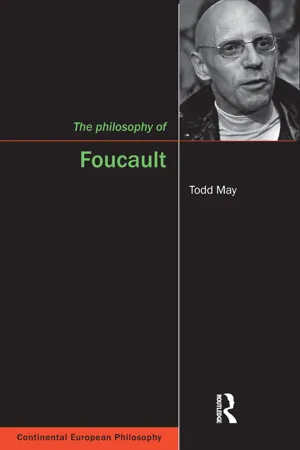
The Philosophy of Foucault
About this book
Michel Foucault's historical and philosophical investigations have gone through many phases: the archaeological, the genealogical, and the ethical among them. What remains constant, however, is the question that motivates them: who are we? Todd May follows Foucault's itinerary from his early history of madness to his posthumously published College de France lectures and shows how the question of who we are shifts and changes but remains constantly at or just below the surface of his writings. By approaching Foucault's work in this way, May is able to offer readers an engaging and illuminating way to understand Foucault. Each of Foucault's key works - "Madness and Civilization," "The Archaeology of Knowledge," "The Order of Things," "Discipline and Punish" and the multi-volume "History of Sexuality" - are examined in detail and situated in an historical context that makes effective use of comparisons with other thinkers such as Freud, Nietzsche and Sartre. Throughout this book May strikes a balance between sympathetic presentation and criticism of Foucault's ideas and in so doing exposes Foucault's contributions of lasting value. "The Philosophy of Foucault" is an accessible and stimulating introduction to one of the most popular and influential thinkers of recent years and will be welcomed by students studying Foucault as part of politics, sociology, history and philosophy courses.
Information
CHAPTER ONE
Introduction: who are we?
Why study a philosopher, a philosophically oriented historian, a thinker? Why grapple with a body of thought that is difficult, often elusive? Why forsake the pleasures of sport, the company of friends, a novel or a videogame for the slow, patient activity of coming to understand a set of texts that, far from inviting one in, seem often designed to keep one at bay?
These are not idle questions. One might be told, in response to them, that the rigours of thought are good for the mind, that grappling with difficult concepts is bracing, or strengthening, or a sign of good character. These are, it seems to me, bad answers. Not that a person should not have a good mind or a good character. But why study philosophy in order to achieve these? Would mathematics, or physics, or the law not do just as well? There is nothing less rigorous about these disciplines than there is about philosophy. They offer challenges to the mind, and in addition training in something that might come in handy down the road.
If one is to study a philosophical figure, if one is, to paraphrase James Joyce, to forge one's own soul in the smithy of their mind, there must be a better reason on offer than simply being told that conceptual difficulty is good for you. There must be something about the thinker's being philosophical, or, in the case of Michel Foucault, at least philosophically oriented, that is itself compelling. That reason need not be practical, in the traditional sense of the term. It need not lead to a job, or a social position, or recognition by a broader public. Ideology aside, there is no reason to believe that these are all that people seek. The reason one might study a philosopher can be less goal-oriented, or more subtle. But, given the alternative ways of spending one's time, the reason ought to be a good one.
The philosopher Gilles Deleuze tells us that:
a philosophical theory is an elaborately developed question, and nothing else; by itself and in itself, it is not the resolution to a problem, but the elaboration, to the very end, of the necessary implications of a formulated question. It shows us what things are, or what things should be, on the assumption that the question is good and rigorous.1
Deleuze suggests that a philosophical theory is not to be defined by the answer it gives but by the question it asks. The point of reading philosophy, to him, is not one of seeking solutions but of elaborating the implications of a question.
We must be clear here. Deleuze is not arguing that philosophy is about questions rather than about answers. Or at least he is not arguing it in any simple way. He is not saying only that it is the questions that matter rather than the answers. There is something empty, after all, in being told that if one asks the right question, then what comes after does not matter. What would the point of asking a question be, if the response did not somehow matter? When he talks about the elaboration of the necessary implications of a formulated question, he is talking not only about questions, but also about responses. Those responses, those elaborations, however, need not be as straightforward as answers to traditional questions. They need not be as narrow as answers to questions such as "Where do you live?" or "What is the GNP of Sierra Leone?" They can be difficult, or shifting, or open-ended. If they are to be worthwhile, however, they need to respond to a question that is good and rigorous. And that is where the riches of philosophy lie.
The point of reading philosophers is to follow their elaboration of the implications of a good and rigorous question. If the question is worthwhile, if it is a matter of what Deleuze elsewhere calls "the Interesting, Remarkable, or Important"2, then there is a reason to engage in studying it. If we are to ask ourselves whether a philosophical work or a body of philosophical thought is worth pausing over, then we must, sooner or later, know the question that is being elaborated.
For Foucault there is, throughout the body of his work, a single question that receives elaboration. It is the question "Who are we?" This is not the only question he elaborates. Yet it is the one he asks most doggedly, the one that is never far from the surface of any of his works. In his hands, the question of who we are becomes a rigorous one, elaborated, if not to the very end, then very far along the way.
The question of who we are, or at least that of who each among us is, will be foreign to no one. Who has not, at least once or twice, asked this question? And, when asked seriously, rigorously, its answer - or its response - is not obvious. There are, of course, many institutions in our society that seem to provide easy answers. Our churches tell us: you are a child of God. Our politicians tell us: you are an American (or an Australian, or an Indian, or . . . ). Our televisions tell us: you are a consumer. We are told who we are, and as a result we rarely ask. But if we do not ask often, we do ask sometimes, at moments when the obvious answers seem to fall away in the wake of a tragedy, or when boredom overcomes us and the easy answers lose their grip, or, more rarely, when a philosopher puts the question to us in a new way.
There are many ways to ask the question of who I am or of who we are. Foucault turns the question, reformulates it, asks it in a new way. To understand how he does so, to grasp the particular rigour he brings to the question, we must contrast it with other, more traditional ways of asking and elaborating.
We could do worse than to start with Rene Descartes. Although he is concerned more with the question of what we could know than of who we are, his legacy is perhaps greater in regard to the second question. The response he gives to the question of who we are is still with us; it still defines the framework within which most of us ask the question. The legacy of Descartes - one of the legacies Foucault will seek to undermine - remains our inheritance. How, then, does he answer the question of who we are?
For Descartes, the central question is one of what we could know. And the problem is that he wants to be able to give our knowledge a more solid foundation than merely a reliance on faith. He himself probably puts the issue best, at the beginning of his Meditations, in an ironic passage that at once challenges and denies that he is challenging the church authorities.
It is absolutely true, both that we must believe that there is a God because it is so taught in the Holy Scriptures, and, on the other hand, that we must believe the Holy Scriptures because they come from God. . . . Nevertheless, we could hardly offer this argument to those without faith, for they might suppose that we were committing the fallacy that logicians call circular reasoning.3
Suppose, indeed. Descartes learns from the church's censure of Galileo to be circumspect in his deviations from church orthodoxy.
The foundation he offers is well known. It occurs in two steps: first, a proof of the existence of God and, secondly, a proof that God cannot be a deceiver. It is in the first step that he begins to answer the question of who we are. The first move in the first step is to doubt everything that he cannot be absolutely certain of. What remains after such doubt? Only the existence of a doubter, of a substance that thinks, perceives, imagines, etc. That, as it will turn out, is one of the two substances that comprise a human being. The other substance is physical matter. (There is a third substance in the universe as well, that of the divine.) But it is mental substance that is the key. That is what allows him to construct his proof of God and what seems most important about who we are. The other substance - physical matter does not make its appearance until the sixth and last of his meditations. There the existence of physical matter in general, and Descartes's own body in particular, is a conclusion he arrives at on the basis of earlier proofs: namely, if God exists and is not a deceiver, then so much of what I experience as corporeal matter must be correlated with my actually having a body. "I also recognize in myself some other faculties, such as the power of changing location, of assuming various postures, and other similar ones; which cannot be conceived without some substance in which they inhere ...".4
So who are we? We are beings made up of two substances, a mental substance and a physical substance. These substances are intimately related. Indeed, Descartes thinks they actually meet at a particular point, the pineal gland.5 But the fact that they meet does not mean that they are the same kind of substance. He writes of the body's characteristics that:
if it is true that they exist, [they] must inhere in some corporeal or extended substance, and not in an intelligent substance, since their clear and distinct concept does actually involve some sort of extension, but no sort of intelligence whatsoever.6
Of these two substances, it is the mind that is the most important in several respects. First, the body cannot be conceived without it. Second, it is the seat of our highest capacities, those of thinking, judging and free choice. Finally, it is the mind, the mental substance, that gives the body the particular animation it has. It is not that the body would not have any animation without the mind. Descartes argues that the body could, at least in principle, operate on its own. "[T]he human body", he tells us:
may be considered as a machine, so built and composed of bones, nerves, muscles, veins, blood, and skin that even if there were no mind in it, it would not cease to move in all the ways that it does at present when it is not moved under the direction of the will, nor consequently with the aid of the mind, but only by the condition of its organs.7
But to do the particular things that a particular body does in the way that it does them requires a mind to be attached to it.
This way of thinking of ourselves remains with us. It has been passed down to us through our Judeo-Christian legacy, which in many ways both influenced and then followed Descartes. The main stream of this tradition holds the body to be a substance characterized by fault or sin or weakness and the mind to be a substance capable, if it so chooses, of departing from that corporeal inheritance. Think of such phrases as "mind over matter", or "you can do anything you put your mind to" or "it's all in your mind". These cliches, and so many like them, reveal a particular cultural inheritance committed to two ideas. First, there is an important separation between mind and body, a separation that Descartes characterizes by saying that they are different substances. Secondly, in this separation, the mental is privileged with respect to the physical.
Many current scientists would dispute Descartes's claim that there is a mental substance distinct from the physical one. They believe that what is called mental substance is nothing more than the working of the brain, or more broadly of the body. (Foucault's writings, by the way, are not contrary to such a viewpoint.) However, the weight of tradition lies heavily on most of us, and it remains difficult to think of ourselves otherwise than as beings that are defined as a particular combination of mind and body. Even when we seek to escape this inheritance, it finds it way back through our speech and into our conception of ourselves. Foucault is cognizant of this, and uses it, as we shall see in detail later, to invert our Judeo-Christian legacy when he declares in his book on the prisons that "the soul is the prison of the body" (DP: 30).
If we set Descartes aside for a moment to turn to a more nearly contemporary thinker, we shall see, beyond surface differences, important similarities that run through the philosophical tradition. At first it may be hard to imagine a thinker more different from Descartes than Sigmund Freud. Whereas Descartes privileges consciousness, Freud privileges the unconscious. Where Descartes sees a large measure of free will, Freud sees a long and often unsuccessful struggle to attain any freedom. Where Descartes allows reason to rid us of the burden of false conceptions, Freud sees us as being burdened by a history whose legacy one can never entirely escape.
So who are we, in Freud's view? This is a difficult question to answer, and not only because his writings can be elusive. Freud seems to present us with two distinct topographies of the mind: one that dominates his earlier writings and another that appears later on. The first one, in which the distinction between the conscious and the unconscious dominates, will be our focus. The second one, with its tripartite division into id, ego and superego, can be interpreted in light of the earlier one, and we shall leave it aside.
To think of human beings as having an unconscious, and furthermore to think of who they are as being largely a matter of what happens in that unconscious and how it expresses itself, is a revolutionary idea at the time of Freud's writings in the early twentieth century. He thinks of the idea as the third great blow to humanity's view of itself as a privileged being in the universe, after Copernicus's discovery that the earth revolves around the sun and Darwin's discovery of the evolution of species.
[H]uman megalomania will have suffered its third and most wounding blow from the psychological research of the present time which seeks to prove to the ego that it is not even the master of its own house, but must content itself with scanty information of what is going on unconsciously in its mind.8
To say that we are largely a matter of our unconscious is to remove us from what the philosophical tradition has taught us to consider as our special relation to reason and self-awareness, a special relation that is central to Descartes, among others.
For Freud, who each of us is concerns how we live the historical conflicts that characterize our early life. Although the particular character of those conflicts is unique to each of us, there is a general pattern that all of them follow. First, those conflicts are centred around oral issues, then anal ones. Next, and most important, they concern the Oedipal complex (or, for girls, the Electra complex). Taking the boys' development as exemplary - which is Freud's approach - the boy falls in love with his mother. He would like to be rid of his father, who, after all, is the competition for his love. However, he fears the consequences of his father's wrath; as Freud has it, castration is the imagined consequence. Therefore the boy must suppress his feelings for his mother. This suppression creates an unconscious, which in turn swallows much of the boy's pre-Oedipal history and sets the stage for the resolution of later conflicts.
As Freud conceives the unconscious, it is not merely a container for conflicts or a safe haven for unacceptable feelings or thoughts. The unconscious does not merely receive; it also expresses. Just as it incorporates situations in later life, repressing the elements of those situations that remind us of earlier difficulties, so it emerges in indirect ways in our behaviour. For Freud, jokes, symptoms and slips of the tongue are ways the unconscious can express itself in our behaviour without those expressions being recognized for what they are.
One way to describe who we are, then, is as a certain type of engagement with the world, an engagement that operates largely on an unconscious economy of repression and expression. This economy is one that, with the help of a psychoanalyst, we can come to understand, at least to a certain extent. We need the aid of an analyst because the unconscious has no motivation to reveal itself; moreover, the project of self-understanding is, in Freud's view, a never-ending one. Therefore, each of us can, through a long and often painful process and with the assistance of another, come to some recognition of who we are, and perhaps can do something to overcome those aspects of ourselves that we would rather be rid of. But this ability is limited and is gained at a high price.
The other way to describe who we are is as a set of more or less successfully resolved conflicts. This way of describing us is not in conflict with the first. Rather, it focuses on a different aspect of Freud's view, on the history rather than the topography. If we are, on the one hand, largely an unconscious relation with the world, it is because we are, on the other, a determined set of conflicts that each of us faces. Those conflicts, again, are at once universal and individual. They are universal in that they unfold according to a pattern that holds for all human beings. They are individual in that that pattern is inflected in particular ways depending on a person's particular history.
The contrast between Freud's focus on the unconscious and Descartes's primacy of the conscious mind could not be sharper. Although the possibility of the unconscious does not occur to Descartes, it would be safe to say that, if it did, he would reject it. It runs against the entire grain of his philosophy, with its focus on conscious rationality. Moreover, one might well say that the idea of an unconscious violates the claim that God is not a deceiver, since the point of the unconscious is to engage in a systematic deception of consciousness. If, for instance, the little boy recognizes that he is suppressing his hatred and fear of his father, and later comes to understand that some of his actions express that hatred and that fear, the unconscious would not be performing its function.
Although these differences are crucial, there are important similarities between the approaches of Descartes and Freud. Two of them are fundamental for understanding Foucault's approach to the question of who we are: their individualized approach and, although it may seem to be the opposite, their universal character.
When Descartes and Freud ask who we are, they approach the question by asking who each of us is in his or her nature. The "we" of who we are is not a collective we. It is an individual I. For Descartes, the answer to the question of who we are is, in its most important elements, the same as the answer to the question of who each of us is. Each of us is a mind-substance and a body-substance engaged with each other, in which the mind - the conscious, rational mind - is the dominant aspect. That we could be who we are as a result of a collective experience is irrelevant for him. This is not to say that he denies that people have a collective experience. It is rather to say that, in undertaking to answer the question of who we are, he does not consider it. It is neglected rather than rejected.
With Freud the situation is more complicated. On the one hand, he does al...
Table of contents
- Cover
- Half Title
- Title
- Copyright
- Dedication
- Contents
- Abbreviations
- Acknowledgements
- 1 Introduction: who are we?
- 2 Archaeological histories of who we are
- 3 Genealogical histories of who we are
- 4 Who we are and who we might be
- 5 Coda: Foucault's own straying afield
- 6 Are we still who Foucault says we are?
- Notes
- Further reading
- References
- Index
Trusted by 375,005 students
Access to over 1.5 million titles for a fair monthly price.
Study more efficiently using our study tools.
Frequently asked questions
Yes, you can cancel anytime from the Subscription tab in your account settings on the Perlego website. Your subscription will stay active until the end of your current billing period. Learn how to cancel your subscription
No, books cannot be downloaded as external files, such as PDFs, for use outside of Perlego. However, you can download books within the Perlego app for offline reading on mobile or tablet. Learn how to download books offline
Perlego offers two plans: Essential and Complete
- Essential is ideal for learners and professionals who enjoy exploring a wide range of subjects. Access the Essential Library with 800,000+ trusted titles and best-sellers across business, personal growth, and the humanities. Includes unlimited reading time and Standard Read Aloud voice.
- Complete: Perfect for advanced learners and researchers needing full, unrestricted access. Unlock 1.5M+ books across hundreds of subjects, including academic and specialized titles. The Complete Plan also includes advanced features like Premium Read Aloud and Research Assistant.
We are an online textbook subscription service, where you can get access to an entire online library for less than the price of a single book per month. With over 1.5 million books across 990+ topics, we’ve got you covered! Learn about our mission
Look out for the read-aloud symbol on your next book to see if you can listen to it. The read-aloud tool reads text aloud for you, highlighting the text as it is being read. You can pause it, speed it up and slow it down. Learn more about Read Aloud
Yes! You can use the Perlego app on both iOS and Android devices to read anytime, anywhere — even offline. Perfect for commutes or when you’re on the go.
Please note we cannot support devices running on iOS 13 and Android 7 or earlier. Learn more about using the app
Please note we cannot support devices running on iOS 13 and Android 7 or earlier. Learn more about using the app
Yes, you can access The Philosophy of Foucault by Todd May in PDF and/or ePUB format, as well as other popular books in Philosophy & Ethics & Moral Philosophy. We have over 1.5 million books available in our catalogue for you to explore.