- 192 pages
- English
- ePUB (mobile friendly)
- Available on iOS & Android
eBook - ePub
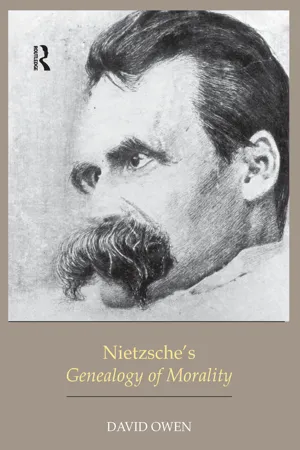
Nietzsche's Genealogy of Morality
About this book
A landmark work of western philosophy, "On the Genealogy of Morality" is a dazzling and brilliantly incisive attack on European "morality". Combining philosophical acuity with psychological insight in prose of remarkable rhetorical power, Nietzsche takes up the task of offering us reasons to engage in a re-evaluation of our values. In this book, David Owen offers a reflective and insightful analysis of Nietzsche's text. He provides an account of how Nietzsche comes to the project of the re-evaluation of values; he shows how the development of Nietzsche's understanding of the requirements of this project lead him to acknowledge the need for the kind of investigation of "morality" that he terms "genealogy"; he elucidates the general structure and substantive arguments of Nietzsche's text, accounting for the rhetorical form of these arguments, and he debates the character of genealogy (as exemplified by Nietzsche's "Genealogy") as a form of critical enquiry. Owen argues that there is a specific development of Nietzsche's work from his earlier "Daybreak" (1881) and that in "Genealogy of Morality", Nietzsche is developing a critique of modes of agency and that this constitutes the most fundamental aspect of his demand for a revaluation of values. The book is a distinctive and significant contribution to our understanding of Nietzsche's great text.
Information
On the Genealogy of Morality
Introduction
Nietzsche does not claim to be the first philosopher to attempt a genealogy of morals; he does, however, claim to be the first to take up this task properly, that is with due consideration to the intrinsic requirements of this mode of enquiry.1 Thus, commenting on Paul Rée’s The Origin of Moral Sensations, Nietzsche writes:
There for the first time I clearly encountered an inverted and perverted kind of genealogical hypothesis, the genuinely English kind, and found myself drawn to it – as opposites attract one another. … It is possible that I have never read anything which I rejected so thoroughly, proposition by proposition, conclusion by conclusion, as this book: but without the least ill humour and impatience.
(GM Preface §4)2
This claim is, to put it mildly, rather self-serving in the light of Nietzsche’s earlier endorsement of much of Rée’s argument; however, it is true that Nietzsche has come to reject the “English” kind of genealogical argument. As he put this point in Book V of The Gay Science:
These historians of morality (particularly, the Englishmen) do not amount to much: usually they themselves unsuspectingly stand under the command of a particular morality and, without knowing it, serve as its shield-bearers and followers, for example, by sharing that popular superstition of Christian Europe which people keep repeating so naively to this day, that what is characteristic of morality is selflessness, self-denial, self-sacrifice, or sympathy and compassion. Their usual mistaken premise is that they affirm some consensus among peoples, at least among tame peoples, concerning certain moral principles, and then conclude that these principles must be unconditionally binding also for you and me – or, conversely, they see that among different peoples moral valuations are necessarily different and infer from this that no morality is binding – both of which are equally childish. The mistake of the more subtle among them is that they uncover and criticize the possibly foolish opinions of a people about their morality, or of humanity about all human morality – opinions about its origin, its religious sanction, the myth of free will and such things – and then think they have criticized the morality itself. But the value of the injunction “Thou Shalt” is still fundamentally different from and independent of such opinions about it and the weeds of error that may have overgrown it – just as surely as the value of a medication for someone sick is totally independent of whether he thinks about medicine scientifically or the way an old woman thinks about it. A morality could even have grown out of an error, and the realization of this fact would not so much as touch the problem of its value. Thus no one until now has examined the value of that most famous of all medicines called morality; and for that, one must begin by questioning it for once. Well then! Precisely that is our task.
(GS §345)
In this specific instance, what makes the hypothesis advanced in Rée’s book a genealogical hypothesis, even if of “an inverted and perverted kind”, is that it attempts to provide a naturalistic account of the emergence of morality, an account that seeks to account for the origin of moral sensations in non-moral terms. What makes it “an inverted and perverted kind” of genealogical hypothesis is that Rée’s account is methodologically inept with respect to the historical dimension of genealogy in that Rée seeks to account for the origin of morality in terms of the present purpose that it plays (GM I §§2–3, II §12), when it is precisely one of the achievements of Darwinian evolutionary theory to show that there need be no necessary connection between the origin of a phenomenon and its current purpose or value, a point that Nietzsche demonstrates compellingly in sections 12–14 of the second essay in respect of the phenomenon of punishment.3 Nietzsche’s criticisms of “the genuinely English kind” of genealogy practised by Rée indicate that his own development of genealogy – “decisive preliminary studies by a psychologist for a re-evaluation of values” (EH “Why I Write Such Good Books”, on GM) directed towards “the real history of morality” (GM Preface §7) – will acknowledge the distinction between the conditions of emergence of the various threads that come together to compose “morality” (in the Christian perspective) and the current value of morality. Such an acknowledgement, however, raises the question of the role that Nietzsche’s account of the complex and disparate conditions of emergence of the strands that compose “morality” is intended to play. Some preliminary observations on this issue will be proposed in Chapter 4, which focuses on the Genealogy.
The account of Nietzsche’s path to genealogy in Part I claimed that the development of his philosophy between Daybreak and Book V of The Gay Science can be seen in terms of the refinement of his understanding of the demands of the project of re-evaluation with respect to the kind of argument required in both its analytical and rhetorical dimensions. Nietzsche’s development of genealogy in On the Genealogy of Morality is, I shall suggest, precisely designed to address what Nietzsche, by the conclusion of Book V of The Gay Science, understands to be his target in the light of what he, at this time, understands to be the demands of the project of re-evaluation. The complex character of this task is, as the arguments of Part I indicate, composed of three demands: the need to loosen the grip on his audience of the moral perspective to which they are subject so that they can take it as an object of reflection and assessment; the need to provide arguments whose reasons can be acknowledged as such by those subject to this moral perspective (i.e. reasons that express values held to be intrinsic within this perspective); and the need to mobilize the existing affective dispositions of his audience in the service of his goal. These claims will be supported by the detailed account of the three essays composing On the Genealogy of Morality developed in Chapters 5–7. I conclude Part II by focusing on current debates concerning the nature of genealogical argument and addressing competing interpretations to my own.
Chapter Four
Reading the Genealogy
On the Genealogy of Morality is composed of a preface in which Nietzsche recounts his path to this project and three essays that take up different aspects of “morality”. Mathias Risse has helpfully drawn attention to a postcard from Nietzsche to Franz Overbeck in which Nietzsche offers some elucidation with respect to the structure of this work:
Nietzsche says that, “for the sake of clarity, it was necessary artificially to isolate the different roots of that complex structure that is called morality. Each of these three treatises expresses a single primum mobile; a fourth and fifth are missing, as is even the most essential (‘the herd instinct’) – for the time being, the latter had to be ignored, as too comprehensive, and the same holds for the ultimate summation of all those different elements and thus a final account of morality.” Nietzsche also points out that each treatise makes a contribution to the genesis of Christianity and rejects an explanation of Christianity in terms of only one psychological category. The topics of the treatises are “good” and “evil” (first treatise), the “bad conscience” (second), and the “ascetic ideal” (third). The postcard suggests that Nietzsche discusses these topics separately because a joint treatment is too complicated, but that in reality, these ideas are inextricably intertwined, both with each other and with others that Nietzsche omits. Therefore, the three treatises should be regarded as parts of a unified theory and critique of morality.
(Risse 2001: 55)
The postcard to which Risse refers suggests why Nietzsche regarded the Genealogy as “decisive preliminary studies by a psychologist for a reevaluation of values” (EH “Why I Write Such Good Books”, on GM) and, more significantly, indicates that we should approach the three essays as “foregrounding” different aspects of a single complex phenomenon: “morality”. (This does not, however, license the view also advanced by Risse that there is no implicit narrative in the Genealogy – “no single historical background story in place yet” (Risse 2001: 60) – that relates the formation of the elements of “morality” treated in the three essays.) Further support for this view of the Genealogy is provided by Nietzsche’s gloss on the three essays in Ecce Homo:
Every time a beginning that is calculated to mislead: cool, scientific, even ironic, deliberately foreground, deliberately holding off. Gradually more unrest; sporadic lightning; very disagreeable truths are heard rumbling in the distance – until eventually a tempo feroce is attained in which everything rushes ahead in a tremendous tension. In the end, in the midst of perfectly gruesome detonations, a new truth becomes visible every time among thick clouds.
The truth of the first inquiry is the birth of Christianity: the birth of Christianity out of the spirit of ressentiment, not, as people may believe, out of the “spirit” – a countermovement by its very nature, the great rebellion against the domination of noble values.
The second inquiry offers the psychology of the conscience – which is not, as people may believe, “the voice of God in man”: it is the instinct for cruelty that turns back after it can no longer discharge itself externally. Cruelty is here exposed for the first time as one of the most ancient and basic substrata of culture that simply cannot be imagined away.
The third inquiry offers the answer to the question whence the ascetic ideal, the priests’ ideal, derives its tremendous power although it is the harmful ideal par excellence, a will to the end, an ideal of decadence. Answer: not, as people may believe, because God is at work behind the priests but faute de mieux – because it was the only ideal so far, because it had no rival.
(EH “Why I Write Such Good Books”, on GM )
We shall have reason to return to consideration of the opening paragraph of this gloss shortly but for the moment let us note merely that Nietzsche here affirms that each essay is directed at a specific aspect of “morality” and at beliefs that people may have concerning “morality”.
We can introduce some more precision into this initial characterization of the structure of the Genealogy by considering the target of Nietzsche’s project of re-evaluation. By the time Nietzsche comes to compose this work, he identifies “morality” in terms of the following features:
- An identification of moral action as unegoistic, that is, in terms of “selflessness, self-denial, self-sacrifice, or sympathy and compassion” (GS §345; see also D §§79, 145–8, 215; GS §21; BGE §§33 and 55).
- An interpretation of suffering as punishment and, hence, the centrality of the mechanism of guilt to moral reflection (D §§29, 77–8, 89, 321; GS §135).
- A view of moral agency as composed of, and hence to be judged in terms of, the intentional choices of actors characterized by freedom of will (GS §127; BGE §32).
- The valuation of “slave” values (e.g. obedience and humility) as intrinsic values and the devaluation of “noble” values (e.g. commanding and boldness) (BGE §§195 and 260).
- A conception of intrinsic values as unconditioned and, hence, of moral obligations as unconditional (GS §5; BGE §§31, 46, 199, 202; GS §§344 and 347).
- A conception of morality as universally applicable (BGE §§198– 202, 259; GS §345).
These features of “morality”1 are all taken up in arguments in the Genealogy; each essay focusing on a subset of these features. The opening essay, “‘Good and Evil,’ ‘Good and Bad’”, taking as its primum mobile the re-evaluation of noble values out of the spirit of ressentiment, focuses on (c) and (d); the second essay, “Guilt, Bad Conscience and the Like”, taking as its primum mobile the psychology of conscience, is directed at (a) and (b); the third essay, “What is the Meaning of Ascetic Ideals?”, taking as its primum mobile the ascetic ideal, concerns (e) and (f). I say “broadly speaking” since issues relating to features other than those they foreground also appear in each essay and this is perhaps to be expected in so far as Nietzsche’s strategy of focusing on specific aspects of “morality” in each essay means that other features that are saliently related to the aspects under scrutiny will also tend to make supporting appearances (this is especially the case with the identification of morality as unegoistic, which appears in each essay). Moreover, to the extent that the three essays also comprise, albeit implicitly, a narrative concerning the formation of “morality” in which Nietzsche tracks the emergence of bad conscience (second essay), the slave revolt in morality (first essay) and the construction of the ascetic ideal (third essay) as, roughly, successive stages in the formation of “morality”, this feature of his text should not surprise us.2
In the light of these remarks on the distinctive focus of each essay, we can return to the opening paragraph of the passage from Ecce Homo cited above in order to elucidate two further features of the structure of the Genealogy that relate to our earlier discussion of Nietzsche’s elaboration of the demands of the project of re-evaluating morality. The first feature concerns Nietzsche’s announcement that each essay is oriented to letting “a new truth” appear; an announcement that suggests – in the context of our claim that the project of re-evaluation requires that Nietzsche supply an argument that appeals to an intrinsic value within the perspective of “morality” that is also an intrinsic value within his own perspective – that it is truthfulness that plays this role. Nietzsche stresses this commitment on his part throughout the preface to the Genealogy and the centrality of this commitment to “morality” and its self-overcoming in the third essay (see GM III §27). Moreover, Nietzsche’s references to his essays as opposing what people may believe indicate that his general strategy in the Genealogy depends on the commitment to truthfulness of his audience. It might be objected here that the critical function of Nietzsche’s genealogy of morality requires only that his audience is committed to the intrinsic value of truth and not that Nietzsche is so committed, but such an objection runs up against both the textual evidence of the preface to, and third essay of, the Genealogy, in which Nietzsche makes it plain that it is this commitment to truthfulness that drives his turn to the project of re-evaluation, and the philosophical problem that unless truthfulness is an intrinsic value for Nietzsche, his project of re- evaluation will not possess the right kind of reflective stability.
The second feature to which the remarks from Ecce Homo...
Table of contents
- Cover Page
- Half Title page
- Title Page
- Copyright Page
- Dedication
- Contents
- Acknowledgements
- Abbreviations and note on translations used in the text
- Introduction
- I The project of re-evaluation and the turn to genealogy
- II On the Genealogy of Morality
- Conclusion
- An annotated guide to further reading
- Notes
- Bibliography
- Index
Trusted by 375,005 students
Access to over 1.5 million titles for a fair monthly price.
Study more efficiently using our study tools.
Frequently asked questions
Yes, you can cancel anytime from the Subscription tab in your account settings on the Perlego website. Your subscription will stay active until the end of your current billing period. Learn how to cancel your subscription
No, books cannot be downloaded as external files, such as PDFs, for use outside of Perlego. However, you can download books within the Perlego app for offline reading on mobile or tablet. Learn how to download books offline
Perlego offers two plans: Essential and Complete
- Essential is ideal for learners and professionals who enjoy exploring a wide range of subjects. Access the Essential Library with 800,000+ trusted titles and best-sellers across business, personal growth, and the humanities. Includes unlimited reading time and Standard Read Aloud voice.
- Complete: Perfect for advanced learners and researchers needing full, unrestricted access. Unlock 1.5M+ books across hundreds of subjects, including academic and specialized titles. The Complete Plan also includes advanced features like Premium Read Aloud and Research Assistant.
We are an online textbook subscription service, where you can get access to an entire online library for less than the price of a single book per month. With over 1.5 million books across 990+ topics, we’ve got you covered! Learn about our mission
Look out for the read-aloud symbol on your next book to see if you can listen to it. The read-aloud tool reads text aloud for you, highlighting the text as it is being read. You can pause it, speed it up and slow it down. Learn more about Read Aloud
Yes! You can use the Perlego app on both iOS and Android devices to read anytime, anywhere — even offline. Perfect for commutes or when you’re on the go.
Please note we cannot support devices running on iOS 13 and Android 7 or earlier. Learn more about using the app
Please note we cannot support devices running on iOS 13 and Android 7 or earlier. Learn more about using the app
Yes, you can access Nietzsche's Genealogy of Morality by David Owen in PDF and/or ePUB format, as well as other popular books in Philosophy & Ethics & Moral Philosophy. We have over 1.5 million books available in our catalogue for you to explore.