![]()
Stories
These Stories about participatory placemaking projects and those behind them, as listed on the right, discuss a wide range of recoding activities responding to needs across all continents around the world, in formal and informal contexts. Our 43 essays, based on fresh research, explore ways in which to regenerate, develop or repair places cost-effectively and sensitively, applying more dynamic and user-centred urban design approaches.
| Architecture for Humanity |
| atelier d'architecture autogérée |
| Canning Town Caravanserai |
| Center for Urban Pedagogy |
| Clear Village |
| Collectif Etc |
| Alejandro Echeverri, Sergio Fajardo, Municipio de Medellín |
| Estudio Teddy Cruz |
| Dreaming New México |
| Dudley Street Neighbourhood Initiative |
| Ecosistema Urbano |
| Elemental |
| Friends of the High Line |
| Gap Filler |
| Herkes için Mimarlik |
| Anna Heringer |
| Home for All |
| Kéré Architecture |
| 1to1 Agency of Engagement |
| Operation Resilient Long island |
| Marcos L. Rosa |
| Marko and Placemakers |
| MASS Design Group |
| SENSEable City Laboratory, MIT |
| Muf Architecture/Art, J&L Gibbons |
| Neighborland |
| Partizaning |
| PITCHAfrica |
| Project for Public Spaces |
| Project H Design |
| Rural Urban Framework |
| SERA Architects |
| snark space making |
| Soundings |
| Strategic Design Scenarios and La 27e Région |
| Studio Mumbai |
| TYIN tegnestue Architects |
| Urban-Think Tank |
| URBZ |
| Vancouver Public Space Network |
| WikiHouse |
| WORKSHOP architecture |
| WXY Studio |
![]()
Architecture for Humanity
‘My focus isn’t the heart of the city, I’m interested in where the city meets nature’, says the architect Nathaniel Corum, who until 2015 was the long-standing head of Educational Outreach at Architecture for Humanity (AfH), the American non-profit organisation established by London-born architect Cameron Sinclair and writer/producer Kate Stohr in 1999.1 For Corum, asset-based design, conducted through a locally specific approach to the use of land, brings resilience to communities’ dwelling places.
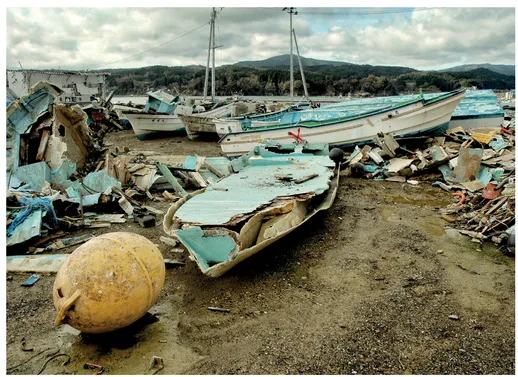
Tsunami-impacted coastal conditions near Shizugawa, Japan, showing storm-damaged boats and other jetsam. A group of fishermen who lost everything asked AfH for help in 2011.
Sinclair and Stohr were also cofounders of the Open Architecture Network for open source humanitarian design (2006). Honoured by multiple awards for AfH, notably its work in disaster relief housing after Hurricane Katrina in August 2005, they stepped down from their executive positions in 2013, with Sinclair becoming the executive director of the Jolie-Pitt Foundation and Stohr founding 99 Antennas, a digital design and curating firm.
In spite of AfH’s immense track record in pro bono design and construction in 48 countries – particularly in the US, Haiti, the Philippines, South Africa and Japan – involving 90,000 design professionals at its height and with 70 independent, city-based chapters, in January 2015 the organisation announced it was filing for bankruptcy. By way of explanation it cited a spate of serious funding challenges from both budget overruns and decreasing donations, challenges faced by many charitable bodies.
However, as part of what is seen as a foremost asset of AfH’s legacy, many of the international chapters sharing the AfH name have continued their work as separate legal entities. The contemporary era is marked by extensive practical knowledge of high-level humanitarian design – not the case in the late 1990s when the organisation was set up – and a wider informed awareness of AfH’s activities and strategies globally.
From very early on in its operations, AfH’s reach was larger than any other comparable entity’s. ‘Where we had the ability to do so, we not only moved there, but set up shop’, says Corum. Besides its base in San Francisco, it also had five offices including in Biloxi, Mississippi, and in Haiti (led by a team of 10 fulltime workers). The overall staff of 30 was complemented by design fellows and consultants, as well as international students on internships, some of whom went on to become staff.
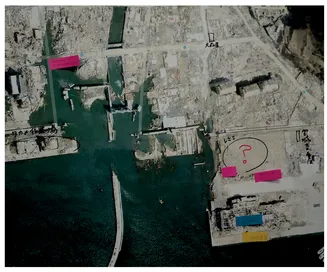
Site plan by students at Kyoto University of Art and Design of Shizugawa, where they designed and constructed a new workplace and warehouse for local fishermen as part of an AfH post-tsunami workshop.
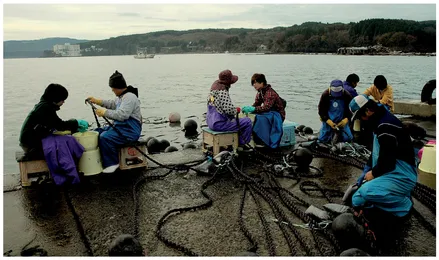
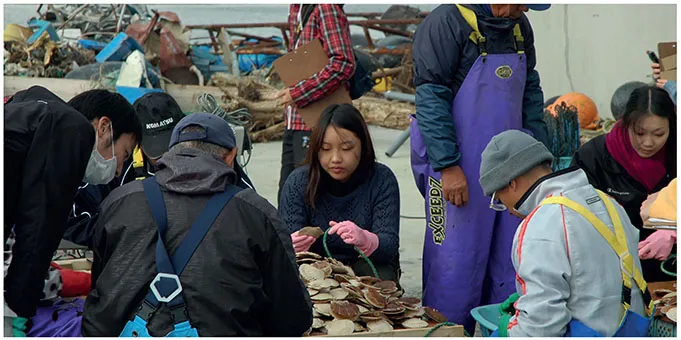
Shizugawa, Miyagi, Japan, 2011. Students from Kyoto University of Art and Design working with local fishermen, attaching kelp fronds (seaweed) to ropes to be floated in the sea.
We use the word ‘acupuncture’ a lot. Building community facilities shows a way to a more resilient future, not an ephemeral one.
Corum led AfH’s Native American community initiatives, which did not get as much exposure in the media as its work in New Orleans and Haiti. He worked alongside tribal members to research and develop culturally and climatically appropriate building prototypes and materials. However he was also an instrumental part of AfH’s wide ‘exchange across cultures’, and remains engaged in humanitarian design projects in Japan, Haiti, and the Galápagos Islands, where AfH was invited by various partners to be part of long-established networks, for example, a nation’s indigenous groups. For each endeavour he has connected university design programmes to humanitarian design projects, involving research, design and hands-on assistance, and creating design teams. Students frequently join projects, contributing their goodwill and skills, and Corum has worked hard over the years to get more architectural schools involved.
Rather than bringing a generic methodology or system to projects, Corum comes with questions, first listening to the replies and then working with what is there, to make an asset-based response: what can be built on with local place forms and the community’s skills and latent ideas – including tribal intelligence and indigenous technologies. The process relies on ‘inperts’ – local people who are ‘experts about things that we’ll never know’, who will understand a Navajo elder living in an off-grid location, for example, or someone whose family members have just died in a natural disaster – to express what they might need. ‘We get them to draw, show us a place they like.’
‘We’re not doing charity’, Corum asserts, ‘we’re going for a mutually supportive and productive exchange across cultures – mutual understanding that builds things beyond the facilities themselves, and actually helps people to better sustain themselves in the world. We use the word “acupuncture” a lot.2 We’ve gravitated away from housing to community facilities, which affect more people. A building that is very useable by many people shows a way to a more resilient future, not an ephemeral one.’
AfH’s first really big project was one of rehabilitation after the deadly Hurricane Katrina hit the US coast of the Gulf of Mexico in 2005. Here in Biloxi, Mississippi, AfH collaboratively designed over 300 new-build and renovated homes, and partnered with long-standing local groups to create a public-access design centre in a disused building, where people could talk extensively about problems in their devastated community. With all the road signs destroyed in the storm, the group also mapped the area to redesign an orientation system.
After the 2011 Tohoku earthquake and tsunami AfH also assisted in Japan’s reconstruction efforts. Japan, Corum says, is ‘essentially a megalopolis, so densely settled, and every inch of land is spoken for by someone’s family. Tsunami stones exist on the hills, etched with the year of the tsunamis in the 17th and 18th centuries, saying, “don’t build beyond this point”’, but people have done. Fishermen worked competitively before the tsunami, but after the disaster boats were scarce so the men formed a collective, which was more fun. ‘It was the only way for them to survive, but it resulted in a lot more community.’ In assembling the team for Japan AfH gathered as many Asian architects as it could, especially suitable personnel able to provide technical rehabilitation support. Beyond the problems of nuclear contamination and ongoing threats of earthquake and tsunami, the team had a lot to learn, ‘because the Japanese have been at the forefront of “base isolation” and of a different kind of seismic approach in their codes’ to that taken in the USA.
‘I’m really learning a lot from these folks working [in Japan] about seismically resilient design. In America we tend to build things strong so they’ll break, but in Japan it’s much more about flexibility, being able to roll with it. Like taekwondo versus aikido. Both approaches are right, but I feel theirs is the more elegant.’ AfH’s project in the devastated coastal town of Shizugawa saw students working alongside community members in workshops held to clarify needs and refine designs. Together they built tables, chairs, platforms and furnishings for work, cooking, eating and resting, all made from local wood.
Showing up with ample time, actually getting to know people and walking in their shoes, is a really amazing ice-breaker
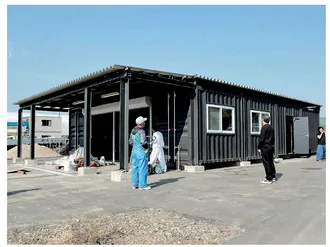
The completed Banya building, Shizugawa, a new workplace for the fishermen, to help develop a collective acquafarming business. Its furnishings were designed and built through the AfH workshop with Kyoto University of Art and Design.
Fishermen in Shizugawa and students from Kyoto University of Art and Design working together as part of the AfH workshop in 2011.
To achieve consensus, a wishlist was compiled. In this ravaged environment, temporary buildings were needed – places to store fishermen’s nets, prepare lunch, and potentially to sell some things from. The project was therefore more of an acupuncture scheme for ‘a shelter in a place inside the red line where they will never build again’. A demountable prefabricated building was made of shipping containers, kitted it out with shelving, bookcases, tables, chairs for relaxation and meetings. The team went out on the boats and worked with the fishermen, while asking them questions about their life and their needs. For Corum this is ‘a really important process. Actually getting to know people, and walking in their shoes a bit, is a really amazing icebreaker. Some of the best ideas come out of that.’
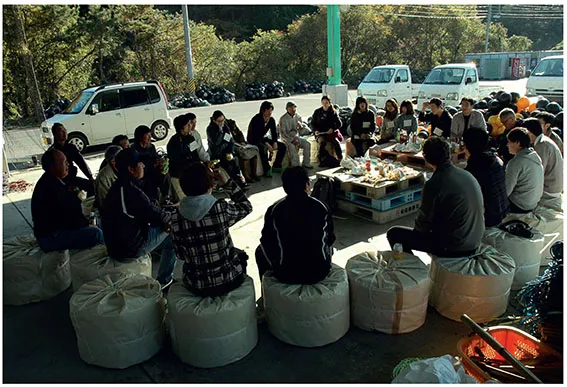
A community meeting to discuss the Banya building for the local fishermen, attended by ocean farmers, local stakeholders, AfH representatives and students from Kyoto University of Art and Design.
In the USA, AfH collaborated with the organisation Make It Right (through the Ford Peck Foundation) on a community project in Montana for highly insulated tribal housing, involving the staging of design charrettes. Held over several days with AfH team members and local citizens, these intense meetings served to jointly formulate solutions and options responding to declared needs. ‘We need to make beyond-LEED village expansions with the full collaboration of the community and respecting the ecology at large,’ said Corum, ‘helping them expand through improved systems for agriculture, permaculture and habitat, and new, regenerative community buildings, rather than through solely LEED criteria.’3
AfH design team members frequently become embedded in the physical contexts of projects. When he started, Corum lived for nine months in the Navajo Nation, which extends into the states of Arizona, Utah and New Mexico. ‘I’m not a tribal member but I got immersed in it. I learned some words, how people spend their days. Developing trust allows you to understand what people need and to apply design knowledge to that challenge.’ Native communities ‘have only recently regained control over their finances, through a Native American self-determination act. There were always government handouts before. You got certain things but couldn’t decide what the money was spent on. Now tribal governments have a budget, and are able to hire technical assistance, or decide to build a community centre.’
Corum is excited by the fact that many tribal members who grew in the Crow Tribe of Montana up went on to Cornell University’s architecture school, and are now returning to their homes with professional expertise. Working on a study of 20 exemplary tribal architecture projects sponsored by the US Department of Housing and Urban Development (HUD), he has found not historical artefacts or reconstructions, but LEED platinum buildings with culturally appropriate features.
Architecture is ideally a profession...