eBook - ePub
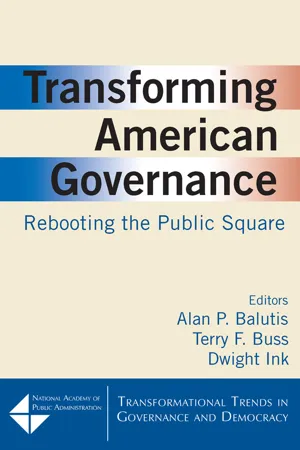
Transforming American Governance: Rebooting the Public Square
Rebooting the Public Square
- 384 pages
- English
- ePUB (mobile friendly)
- Available on iOS & Android
eBook - ePub
Transforming American Governance: Rebooting the Public Square
Rebooting the Public Square
About this book
Government and governance will be very different in the future than anticipated by the literature in the field.
Information
1
American Governance 3.0
Issues and Prospects
Governance in America is undergoing a great transformation. For some, this is a crisis. For others, it’s a welcome evolution. No one knows for certain how all this will end up: better, worse, or perhaps just different from the past. The transformation is driven by events, movements, information technology, national public policy, and institutional change, all interacting and all taking governance in different, often contradictory, directions, and into unknown territory (see Figure 1.1). Some are calling for a new “social contract” to govern America. Others see no need for change. Others believe this is all business as usual.
Consider these competing drivers of change in governance over the past two decades:
1. Events. The Republican Party takeover of Congress in 1994, the Clinton scandal in 1998, and the George W. Bush/Al Gore election controversy in 2000; the dot.com bust and recession of 2001; terrorist attacks on New York and Washington in 2001; ongoing prosecution of wars beginning in Afghanistan in 2001 and Iraq in 2003; the response to the Katrina hurricane disaster of 2005; the global financial crisis of 2008; the election of President Barack Obama in 2008, along with the Republican loss of control of Congress; and in 2010 the Republican takeover of the House of Representatives and the narrowing of the Democratic Party control of the Senate.
2. New Public Management movement. The pervasiveness of performance management and budgeting and the ascendency of the New Public Management (NPM) movement, a movement based on business management principles, market approaches, efficiency, and effectiveness; and the backlash to NPM from its critics and opponents.
3. Information technology. The ascendency of information technology (IT), fostering e-government, open government, social media, collaboration, and knowledge management.
4. Public policy. Out-of-control budget deficits and debt under Presidents Bush and Obama; economic recovery and management of the economy and monetary policy; government intervention in and management of private business in the form of public ownership, bailouts, subsidies, and regulation; reemergence of regulatory policy generally; and upheavals in health care, carbon emissions, energy, immigration, and foreign policy.

Figure 1.1 Determinants of American governance
5. Institutions. Congress and executive relations and balance of power; intergovernmental relations and federalism; new organizational models in international affairs; networked government, both formal and informal; new forms of collaboration; expansion and contraction of authority in international organizations; and the rise of nongovernmental organizations (NGOs)—the so-called third sector.
How these factors influence governance—or are influenced by it—is now a matter for debate. Causality may go in either direction: public policies are developed in response to events and public policies produce events. Factors are not mutually exclusive: a public policy, for example, creating the Department of Homeland Security, can be viewed as a policy initiative and also as an event. There are many more critical factors influencing government than can be adequately dealt with here. Our treatment is by necessity selective.
Now is a propitious time to look at governance anew. We need to describe how governance is different now from the way it was in the past. We need to understand how governance will likely evolve and transform in the future. We should immediately begin a national dialogue concerning whether our democracy will be improved or diminished as governance changes. H. George Frederickson, in Chapter 2, lays out a possible role for the National Academy of Public Administration (the Academy)—the sponsor of this volume—in working on a national governance agenda for public administration. And we need to put into place mechanisms to keep government on the right course, whatever that turns out to be. This chapter lays out the issues.
Whether American governance is hopelessly broken or simply needs reengineering remains an open question. But few would disagree with our assessment about what ought to be addressed, stated in the form of questions:
• Is attempting to radically transform governance following every presidential election necessary for the renewal of the country? Or is it unnecessarily disruptive and divisive? What is the role of consensus building and compromise?
• Has partisanship become exponentially worse, further reducing effective governance? Or has this always been characteristic of the political system? How has this partisanship played out in Congress and the executive branch? Is basic civility a casualty?
• How has the balance of power between the executive, legislative, and judicial branches changed governance? Is the balance intended by the Founding Fathers out of wack?
• Is our Federalist model transforming? Or is the model in place since the Reagan administration alive and well?
• Has government lost its ability to tackle big problems (Eggers and O’Leary 2010)? Or has it always been ineffective and inefficient in the design and implementation of policies and programs?
• Has the United States given up too much of its national sovereignty to international organizations? Or should it play an even greater part in a global governance system?
• Has performance-based management and budgeting and civil service reform improved governance? Or have they been largely irrelevant?
• Will social media and collaboration with Internet-based technologies transform governance? Or will they turn out to be just another fad in the public arena? Could these technologies actually make governance worse?
• Has networked government—both formal and informal—improved governance or impeded it? Has it transformed governance in significant ways?
A number of books have appeared over the past decade calling for new institutions, models, or approaches to inform or improve governance (e.g., Cooper 2003; Denhardt and Denhardt 2007; Goldsmith and Eggers 2004; Kamarck 2007; Kettl 2008; Morse, Buss, and Kinghorn 2007; Newbold and Terry 2008; Noveck 2009; Stanton 2006). Most of these books suggest the need for a smaller, more nimble government, oriented toward efficient and effective service provision through performance- and evidence-based policy and management. They call for increased use of partnerships, collaboration and networking, and reliance on IT, especially social networking and knowledge management—in short, American Governance 2.0. As we began putting this volume together, we accepted as a premise this view of governance in transformation. But with the unfolding of patterns in the past two years, governance may be different from anything anyone could possibly have imagined. Perhaps the nation has skipped to Governance version 3.0.
Before addressing these issues, it might be useful to define what we mean by governance and why it is always evolving.
The Essence of Governance
Governance Defined
Governance is a pivotal concept in public management; yet, surprisingly, there is little consensus among researchers, practitioners, and educators about its meaning (Frederickson and Smith 2003). By governance we mean:
A system of values, laws, policies, processes, and institutions through which society articulates and aggregates competing interests; compromises and reaches consensus; manages resources; exercises power and authority; and resolves conflict to promote fairness, human rights, and growth and development for the public good.
Governance also applies at the organizational level in government. According to the Australian Public Service Commission, governance is “the set of responsibilities and practices, policies and procedures, exercised by an agency’s executive, to provide strategic direction, ensure objectives are achieved, manage risks and use resources responsibly and with accountability” (Australian Government 2008).
A Clash of Values and Ideologies
Governance structures reflect a society’s competing values, political ideologies, philosophies, and theories. America is a society deeply divided along political, social, cultural, ethnic, racial, class, religious, generational, and economic lines. The past two decades have become a battleground where factions clash or unite around alternative visions, self-interest, and expectations. Factions disagree about the causes, appearance, and resolution of governance issues. Because no single faction prevails for long in the political system, governance at times becomes curiously transient, fragmented, incongruent, and inconsistent. In short, it’s very messy. Nevertheless, it mirrors society. Although this is the essence of democracy, many believe that governance is getting exponentially more dysfunctional, threatening the very foundations of the nation. Of course, some might argue, every period in history reflects this sense of impending doom. Then, over time, people forget and worry about something else. Durant, in Chapter 3, places these factional divisions in historical context.
Two Competing Factions
In the United States there are two major factions and a myriad of minor ones, occupying countervailing positions. Frederickson reviews both in the context of public administration in Chapter 2. One espouses social welfare values, which hold that the state is responsible for protecting individuals from economic distress, guaranteeing an acceptable standard of living, and compensating individuals when they are harmed. The other believes in a market-based society where individuals are responsible for their own lives. Thus, the government exists to enforce laws, referee disputes, and create an equal playing field, but not to guarantee successful or egalitarian outcomes. When these extremes clash in the political system, neither side overwhelms the other. Each side gets something, but not everything. These factions are unstable: people, groups, and political parties shift sides on many issues. The result is that governance becomes a hybrid, with elements from both extremes, as well as inputs from factions at the center.
Consider the financial crisis of 2008. The social welfare faction blamed the financial crisis on business—excess, greed, corruption. Social welfare proponents push for more government regulation of the private sector, business bailouts to protect jobs, and social programs such as unemployment insurance, public health insurance, job retraining, and the like. They favor corporatism—that business exists to serve the interests of the people (workers and state), not management (owners and shareholders). Free-market proponents blame financial crises on government intervention, especially in the form of stultifying regulation, excessive taxation, and invasive public policy. Free marketers favor laissez-faire policies and individual responsibility. Hybridization occurs in governance when free-market advocates approach government for favors that limit competition or protect private interests. So, for example, according to many economists, the Federal Reserve System was created by private financiers to protect their interests, when economies threaten them, by spreading or sharing risk with taxpayers. Hybridization also occurs when government creates government-sponsored enterprises (GSEs) to influence public policy through market manipulation: for example, creating Fannie Mae and Freddie Mac to securitize home mortgages to promote homeownership. Ink, in Chapter 15, calls for cooperation across party lines as the only way to resolve the nation’s factional differences.
Often policymakers attempt to find common ground on factious issues by creating a bipartisan or nonpartisan task force to build consensus. Redburn, in Chapter 4, provides insights into the role of experts on task forces working on the federal deficit and debt in the aftermath of the financial crisis.
Renegotiating the Social Contract
For several decades many have been calling for a new social contract between government, business, and the American public. “During and after the Great Depression, workers, employers and the government entered into an implied social contract that afforded Americans a basic level of economic security if they worked hard and took responsibility for their families” (Rodin 2008, p.1; see also Brooks 2007 and Kochan and Shulman 2007). This movement had little traction until the financial crisis of 2008 (Sunstein 2007). Low unemployment rates, rising housing values, easy credit, unprecedented returns on investment, and “unquenchable exuberance” created massive wealth over several decades, causing many to believe economic good times woul...
Table of contents
- Cover
- Title Page
- Copyright Page
- Table of Contents
- Preface
- 1. American Governance 3.0: Issues and Prospects
- 2. Administration in the Coming Public Era
- 3. Crises, Governance, and the Administrative State in a Post-Neoliberal World
- Part I. Challenges for a 21st-Century Government
- Part II. Whither American Federalism?
- Part III. How Will Government Respond?
- Part IV. Is the Force Already with Us?
- Part V. What Does the Future Hold?
- Index
- About the Editors and Contributors
Trusted by 375,005 students
Access to over 1.5 million titles for a fair monthly price.
Study more efficiently using our study tools.
Frequently asked questions
Yes, you can cancel anytime from the Subscription tab in your account settings on the Perlego website. Your subscription will stay active until the end of your current billing period. Learn how to cancel your subscription
No, books cannot be downloaded as external files, such as PDFs, for use outside of Perlego. However, you can download books within the Perlego app for offline reading on mobile or tablet. Learn how to download books offline
Perlego offers two plans: Essential and Complete
- Essential is ideal for learners and professionals who enjoy exploring a wide range of subjects. Access the Essential Library with 800,000+ trusted titles and best-sellers across business, personal growth, and the humanities. Includes unlimited reading time and Standard Read Aloud voice.
- Complete: Perfect for advanced learners and researchers needing full, unrestricted access. Unlock 1.5M+ books across hundreds of subjects, including academic and specialized titles. The Complete Plan also includes advanced features like Premium Read Aloud and Research Assistant.
We are an online textbook subscription service, where you can get access to an entire online library for less than the price of a single book per month. With over 1.5 million books across 990+ topics, we’ve got you covered! Learn about our mission
Look out for the read-aloud symbol on your next book to see if you can listen to it. The read-aloud tool reads text aloud for you, highlighting the text as it is being read. You can pause it, speed it up and slow it down. Learn more about Read Aloud
Yes! You can use the Perlego app on both iOS and Android devices to read anytime, anywhere — even offline. Perfect for commutes or when you’re on the go.
Please note we cannot support devices running on iOS 13 and Android 7 or earlier. Learn more about using the app
Please note we cannot support devices running on iOS 13 and Android 7 or earlier. Learn more about using the app
Yes, you can access Transforming American Governance: Rebooting the Public Square by Alan P. Balutis,Dwight Ink in PDF and/or ePUB format, as well as other popular books in Politics & International Relations & Human Resource Management. We have over 1.5 million books available in our catalogue for you to explore.