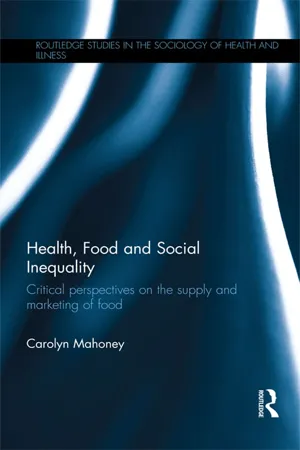
Health, Food and Social Inequality investigates how vast amounts of consumer data are used by the food industry to enable the social ranking of products, food outlets and consumers themselves, and how this influences food consumption patterns.
This book supplies a fresh social scientific perspective on the health consequences of poor diet. Shifting the focus from individual behaviour to the food supply and the way it is developed and marketed, it discusses what is known about the shaping of food behaviours by both social theory and psychology. Exploring how knowledge of social identities and health beliefs and behaviours are used by the food industry, Health, Food and Social Inequality outlines, for example, how commercial marketing firms supply food companies with information on where to locate snack and fast foods whilst also advising governments on where to site health services for those consuming such foods disproportionately. Giving a sociological underpinning to Nudge theory while simultaneously critiquing it in the context of diet and health, this book explores how social class is an often overlooked factor mediating both individual dietary practice and food marketing strategies.
This innovative volume provides a detailed critique of marketing and food industry practices and places class at the centre of diet and health. It is suitable for scholars in the social sciences, public health and marketing.
While much concern continues to be expressed by healthcare professionals, researchers and governments about high levels of obesity and diet-related ill health in Britain, there is insufficient acknowledgement of the long established social gradient in both these public health issues by policymakers. Lower status people are more likely to experience poor diet, large bodyweights, diet-related ill health, and a shorter life expectancy, even though all the way up the social gradient there is evidence of problematic patterns of food consumption.
Much research energy is devoted to asking why people eat the way they do and how they can be encouraged to change their food choices. Less attention has been focused on the role of the food industry – from agriculture to marketing – in shaping the food supply, processing it, developing an array of food products for consumer groups of varying social status, targeting these groups effectively and thereby influencing consumption and health. This book proposes that these forces shape class-differentiated patterns of food consumption and influence diet-related health over the long term, and traces how this process unfolds. Specifically, it examines both public and industry discourses which have constructed and reinforced an understanding of the health effects of food consumption as essentially behavioural issues; it then looks behind what is said publicly to what is acknowledged in texts written by and for industry members, and to a range of academic research which probes the contradictions of both industry practices and public narratives and policies regarding food and health. It asks the following questions:
What are the discourses which both describe and shape food consumption and its health consequences?
What health and social phenomena and questions of power and influence do these discourses conceal, whether intentionally or unintentionally? What contradictions do they contain?
What is the role of both government rhetoric and actual public policy in sustaining these discourses and why might it be in governments’ interest to do so?
What is the food industry’s role and interest in sustaining these discourses?
What is the relationship between government and the food industry in developing approaches to improving dietary quality and health and what are the weaknesses of these approaches?
How can social theory illuminate our understanding of food-related health trends in recent decades and links between social class and diet-related illness? More broadly, how has the sociological tension between agency and structure been negotiated on the subject of diet and health?
How does the food industry understand the health effects of diet?
How do food scientists, food product developers, food retailers and food marketers interact with notions of social class when developing and targeting food products and concepts? What techniques do they use for doing so?
What can texts by food/marketing industry professionals reveal about industry’s role in shaping diet?
What is the evidence for a diet–class–health link according to epidemiology?
To what degree does academic research influence the dominant discourses surrounding food consumption, social class and health? In particular, how have the insights of psychology been mobilised in developing and marketing food products?
What is the larger agricultural, historical, ideological and economic/financial context within which food production and food marketing operate?
What is the relationship between market research, food retailing, and public health?
My point of entry1 to the research as a whole is the discourse of healthy eating and the assumption of personal responsibility for healthy diets, as long urged by governments through health policy and health promotion campaigns. For example, the government’s obesity announcement of October 2011, calling on individuals to reduce their calorie intake, built on a longstanding yet ineffective strategy. As a press release phrased it, the Coalition government had ‘called time on obesity’ (Department of Health (DoH) 2011a). In an approach described as novel, people would be urged ‘to be more honest with themselves about their eating and drinking habits’ (ibid.). Britain was an increasingly overweight nation, and the then secretary of state for health Andrew Lansley concluded that ‘reducing the number of calories we consume is essential. It can happen if we continue action to reduce calories in everyday foods and drinks, and if all of us who are overweight take simple steps to reduce our calorie intake’ (ibid.). The chief medical officer added that ‘as individuals we all need to take responsibility. This means thinking about what we eat and thinking about the number of calories in our diets to maintain a healthy weight’ (ibid.).
The previous Labour government had shown an interest in revealing and addressing health inequalities with the Acheson Report in 1998, shortly after being elected to office. Six years later, it was still prepared to acknowledge the role of deprivation in food consumption and high bodyweights, though in veiled terms; the discourse of personal responsibility, perhaps with government-enabled support, is already evident. Its 2004 report, Choosing Health, notes that ‘it is easier for some people to make healthy choices than others’ (DoH 2004: 6). Yet people can be ‘enabled to make healthier choices’ even if they are coping with ‘more immediate priorities’ (ibid.: 13). Even so, making healthy choices is a matter of ‘motivation, opportunity and support’ (ibid.: 12). In a foreword to the report, the then prime minister Tony Blair speaks of ‘the responsibility that we each take for our own health’; in that context, the government will ‘work to provide more of the opportunities, support and information people want to enable them to choose health’ (ibid.: 3).
All this seems quite remote from the realities of class-differentiated growth in bodyweights which are discussed later in this chapter; and somewhat arm’s length from the findings and language of the 1998 Acheson Report, commissioned by the new Labour government to research structural, environmental ‘determinants’ of health inequalities and policies to redress them (Acheson cited in Exworthy et al. 2003: v). ‘Our report’, Acheson noted, ‘was based on a socio-economic explanation of health inequalities’ (ibid.). The subsequent Marmot Review of health inequalities was set up by the Labour government in 2008, and supported by two health secretaries (Marmot et al. 2010: 3, executive summary).
But arguably, neither of these research projects was able to bring about a decisive shift in the discourse away from the notion of personal responsibility for dietary health and bodyweight. If anything, this discourse has intensified since Britain’s Coalition government was elected in 2010. Social class and health inequalities are not central to the discussion regarding obesity.
This is also reflected in food industry discourse. In its submission to the 2007 Foresight investigation into obesity, the food industry representative who prepared the document cites factors influencing eating habits: the trend to having children later in life; an ageing society; longer working hours; working mothers; families not eating together as much; less ‘perceived’ time for fitness and cooking; less physical activity and therefore ‘calorie expenditure’ (Paterson 2007: 4). Industry-proposed solutions to problematic diets encompass better information and education for consumers alongside product reformulation, with ‘nanotechnology, biotechnology and neuroscience’ at their core (ibid.: 3). The Foresight report itself recommends addressing health inequalities more broadly in future efforts to tackle obesity (Foresight 2007: 3). In Chapter 6 of this book, industry scientists express concern about the health implications of diets centred on processed foods, the tendency for low income people to eat these types of foods, and acknowledge the powerful role of family background in determining diet.
Where the health effects of food consumption are concerned, there is a tendency for research to focus on ‘behaviour’ – what people eat, why they eat the way they do, and how they can be influenced to improve their diets. This is natural enough and can yield valuable insights. But there needs to be a greater focus now on the food supply itself, its transformation in the latter half of the twentieth century, and the dietary and health inequalities which are a feature of problems associated with food consumption. In this book I argue that personal responsibility discourse is incapable of explaining embedded, class-related dietary patterns and their health consequences, and that this is due at least in part to a lack of attention to the distorted nature of the food supply and its promotional strategies. The notion of an inadequate degree of individual responsibility for consumption as the underlying cause of the spread of overweight and obesity – and related health risks – cannot explain why bodyweights have increased at the rate they have in recent decades, given that diet is linked to health status and social class as well as the nature and extent of the food supply, and the way in which it affects different sections of the population differently. A decontextualised focus on poor eating habits and campaigns which urge healthy eating do not allow any of these factors to be effectively addressed.
Healthy eating discourse cites the locus of responsibility for food consumption patterns in the individual choices a person makes when selecting and preparing food; this notion underlies both public health and industry pronouncements on dietary health. This book sets out to show what this discourse conceals. But there has long been much valuable, publicly funded research into food consumption and health. At the outset, a review of bodyweight and diet-related health trends in recent decades will help to anchor this exploration in the data.
Diet, health and social class: an empirical introduction
Many studies have demonstrated an association between socio-economic status, diet, and health; this literature is discussed in detail in Chapter 5. But since this introductory chapter begins my investigation of the origins and power of discourse surrounding food consumption and health, it is useful to set out the nature of the problem under investigation. Obesity is one manifestation of the problem, though not the only possible indicator of diet-related illness.
Figure 1.1 illustrates the growth of obesity since 1993, for women and for men. There has been a notable increase in obesity throughout the period, though the rate of increase looks less steep in latter years. However, the trend of extremely high bodyweights (‘severe obesity’) continued to increase throughout most of that period, rising more dramatically among women before dipping after 2010, while continuing to rise for men, as Figure 1.2 shows.
Obesity statistics also show a social class gradient, revealing a much more nuanced picture than for the adult population overall. Prevalence rates are markedly higher among lower social classes, particularly for women, and have been steadily increasing. Among men, the gradient is somewhat less consistent (see Figure 1.3). One study speculates that male and female obesity patterns across occupational social class measures may not be comparable, since women often earn less than men; they may therefore experience much greater disadvantage (El-Sayed et al. 2012).
Figure1.1 Trend in obesity prevalence among adults (Health Survey for England 1993–2012; three-year average). Data source: Health and Social Care Information Centre. Chart by Public Health England.
Figure1.2 Trend in severe obesity prevalence among adults (Health Survey for England 1993–2012; three-year average). Data source: Health and Social Care Information Centre. Chart by Public Health England.
Figure1.3 Trend in adult obesity prevalence by social class (Health Survey for England 1994–2009; five-year moving average). Data source: Health and Social Care Information Centre. Chart by Public Health England.
Note: This chart has not been updated because the social class of respondents was not noted in subsequent HSE 2010 data (Public Health England 2014a).
Statistics for obesity among children also tell a more nuanced, class-differentiated story, with those who are most deprived twice as likely to be obese as those who are least deprived (see Figure 1.4).
These graphic representations of patterns of obesity make the discourse of individual responsibility (or the lack thereof) appear one-dimensional as an explanation of food consumption and bodyweight patterns, particularly where children are concerned. Overall obesity statistics do not reveal the underlying disproportionate distribution of obesity by social class or differences in prevalence rates between different categories of obesity.
Studies have long shown that those on lower incomes spend a larger proportion of their incomes on food. The Food Standards Agency’s Low Income Diet and Nutrition Survey (LIDNS), last done in 2007, and the government’s Family Food Survey, carried out annually, also observe social gradients in the nutritional quality of diets (FSA 2007a; Defra 2012). The LIDNS survey found that low income earners tend to eat less wholemeal bread and vegetables and more fats and oils, meat dishes and processed meats, non-diet soft drinks, pizza, whole milk and table sugar (FSA 2007a: 17).
Figure1.4 Obesity prevalence in children by deprivation decile (National Child Measurement Programme 2012/13). Data source: Health and Social Care Information Centre. Chart by Public Health England.
Note: Data for 2012/13 showed that overall child obesity rates were lower than the previous year for the first time; ‘further years’ data will be required to see if this is the start of a decline’ (NCMP 2013: 11). The strong relationship between obesity and deprivation remained for both age groups measured (ibid.: 10). Overall obesity rates in year 6 were double those in reception year (18.9 per cent and 9.3 per cent respective...
Table of contents
Cover Page
Half-Title Page
Series Page
Title Page
Copyright Page
Table of Contents
List of figures
Preface
Acknowledgements
1 Introduction: the politics of food consumption and health
2 Analytical framework and methodology: critical realism and critical discourse analysis in food and health research
3 Applying social theory to food production, food consumption and social class
4 Reflexivity, habitus and lifeworld: applying the theories of Giddens, Bourdieu and Habermas
5 The evidence for a diet–health–class link
6 How the agri-food industry shapes our diets and influences our health
7 Critical perspectives on marketing and market research
8 Social class in food retailing and marketing and reflections on marketing ethics
9 Conclusion
References
Index
Trusted by 375,005 students
Access to over 1.5 million titles for a fair monthly price.
Study more efficiently using our study tools.
Frequently asked questions
Yes, you can cancel anytime from the Subscription tab in your account settings on the Perlego website. Your subscription will stay active until the end of your current billing period. Learn how to cancel your subscription
No, books cannot be downloaded as external files, such as PDFs, for use outside of Perlego. However, you can download books within the Perlego app for offline reading on mobile or tablet. Learn how to download books offline
Perlego offers two plans: Essential and Complete
Essential is ideal for learners and professionals who enjoy exploring a wide range of subjects. Access the Essential Library with 800,000+ trusted titles and best-sellers across business, personal growth, and the humanities. Includes unlimited reading time and Standard Read Aloud voice.
Complete: Perfect for advanced learners and researchers needing full, unrestricted access. Unlock 1.5M+ books across hundreds of subjects, including academic and specialized titles. The Complete Plan also includes advanced features like Premium Read Aloud and Research Assistant.
Both plans are available with monthly, semester, or annual billing cycles.
We are an online textbook subscription service, where you can get access to an entire online library for less than the price of a single book per month. With over 1.5 million books across 990+ topics, we’ve got you covered! Learn about our mission
Look out for the read-aloud symbol on your next book to see if you can listen to it. The read-aloud tool reads text aloud for you, highlighting the text as it is being read. You can pause it, speed it up and slow it down. Learn more about Read Aloud
Yes! You can use the Perlego app on both iOS and Android devices to read anytime, anywhere — even offline. Perfect for commutes or when you’re on the go. Please note we cannot support devices running on iOS 13 and Android 7 or earlier. Learn more about using the app
Yes, you can access Health, Food and Social Inequality by Carolyn Mahoney in PDF and/or ePUB format, as well as other popular books in Social Sciences & Health Care Delivery. We have over 1.5 million books available in our catalogue for you to explore.