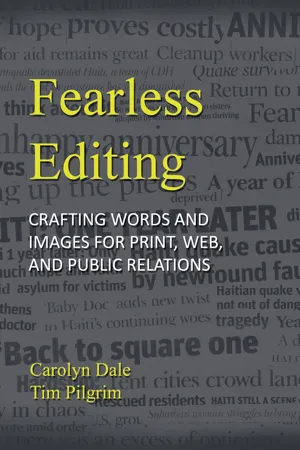
Fearless Editing clearly articulates the basic concepts underlying editing techniques and demonstrates their application for newspapers, public relations, magazines and Web pages. This text takes a conceptual approach that integrates verbal skills with visual elements. Unlike other texts that are clearly designed for print, this book includes multi-media applications in every chapter.
eBook - ePub
Fearless Editing:
Crafting Words and Images for Print, Web, and Public Relations
- 256 pages
- English
- ePUB (mobile friendly)
- Available on iOS & Android
eBook - ePub
Fearless Editing:
Crafting Words and Images for Print, Web, and Public Relations
About this book
Information
1
Concepts: A Time for Editing
Readers are drawn to a page for its information and because of its beauty. In the chaos of constant, competing stimuli, this is a space where order shows through priority, where clarity results from a fellow human having studied the elements, checked their accuracy and value and prioritized them.
The page shows an editor has asked:
- What makes this story different from all others like it?
- What does this really mean to you who will come to this page?
- Which elements—words and visuals—can be combined to tell the story in the best possible way?
We may agree or disagree with that editor’s ordering and emphasis but inwardly be grateful. A properly edited page provides us a standpoint in the enormous, rushing swirl of events and talk, a place to grab on to, a place to start our own interpretation, another human mind against which to test our knowledge and ideas so that we may nurture our understanding.
Good editing also lends a feeling of satisfaction from the time we spend with a page because of its physical beauty, the enjoyment of dense colors of ink balanced against white space, the movement of the eye as it is directed from item to item.
And, an element of trust is instilled in readers—a belief that the information will be accurate, true, and have been judged worthwhile on the merits of its ideas and information, and on its contribution to our understanding of the world, society, cosmos.
These feelings of interest, restfulness, trust and enjoyment are responses to good, consistent editing. The underlying concepts allowing readers to achieve such feelings are what should motivate us in our work as editors.
Six Concepts Guide Effective Editing
This book explains how editing is most effective when guided by six key concepts:
- Priority—with the readers in mind, the judging of importance of written and visual information, along with the ranking and displaying of that information.
- Community—knowing the public, or audience, to whom the publication is directed, and whose values and interests underpin the publication and the entire editing process.
- Clarity—providing content in a way that avoids any confusion and allows readers to understand the information quickly and accurately.
- Unity—being consistent or uniform in treatment of elements of design, writing, story approach and content so that clarity and reader trust in the publication are reinforced.
- Contrast—using skillful change in writing and design often enough to stir reader interest and direct attention.
- Beauty—presenting material that is pleasing to the intended audience and that appeals to the aesthetic senses.
(See BOX 1.1 for a full discussion of these concepts.)
Applying these concepts to stories and images, an editor can gain confidence and ease, and can connect the tasks of editing words or designing visuals to intellectual traditions in language and art. Editing in a conceptual way enables editors to communicate more clearly with writers and artists while allowing them to observe and enjoy their own growth as professionals.
A love of the language keeps an editor enjoying its changing nuances and seeking out word derivations and meanings; a love of fine art encourages an editor to develop aesthetics and a sense for visual trends and changing tastes.
Love and aesthetics are perhaps vague and even mysterious-sounding, like qualities one either has or doesn’t have. However, those who know and love language and art apply their knowledge through sets of ideas, or concepts, which are more specific.
Editing for Media
It may be that the best editing is the least apparent to the eye: What we notice as readers are the story that flows quickly and involves us in the telling, the photographs that invite us to stop, the typography and illustrations that enhance the meaning. Editors make the creative people they work with look good, and the nature of this process is not mechanical, but creative.
It also may seem like less competitive and individualistic work than writing. But, because editors must coordinate and elicit the best work from writers, artists
BOX 1.1 • Using Concepts in Editing
Priority—judgment of written and visual information and the subsequent process of ranking and displaying based on importance.
Editing expresses priority through:
- placement of a story on a page or within a publication; placement of information within a story;
- placement of an idea within a sentence;
- use of heading size, number of lines, width, and bold or italic typeface;
- use of color, photos or illustrations;
- use of textual design elements such as pullquotes or fact boxes;
- length of story and shape and size of the overall package;
- selection of certain issues for editorial comment or analysis.
Community—the public or audience (and its values and interests) to whom the publication is directed and the working relationship that develops between the two.
Editing for community involves:
- defining the audience for the publication, and how often to publish or update; defining the publication’s profile, cost, role and geographic reach;
- defining standards for content created outside: advertising, letters to the editor, op-ed pieces, guest columns, etc.;
- defining internal standards or local style for treating sensitive issues;
- editing for truthfulness to maintain integrity and readers’ trust;
- representing major voices in the community, including the unpopular ones;
- editing in the best interest of the audience and resisting self-interested pressures of advertisers or sponsors or even of editors exercising their personal values and tastes;
- avoiding unnecessarily harming others through libel, slander or invasion of privacy;
- giving credit to other writers and artists by respecting copyright practices;
- providing true information so that community members can function fully as citizens in a democracy;
- supporting freedom of speech within the United States and, as possible, abroad.
Clarity—presentation of content in a way that conveys the intended meaning, shows the publication’s purpose and allows quick navigation.
Editing a publication for clarity ensures:
- the purpose of a publication and identity of its publishers are stated;
- editorial content or news is differentiated from paid announcements;
- contents pages or navigation points provide ease of use;
- information most important to the audience is emphasized;
- each item appeals to some segment of the overall audience;
- content is ordered using news or feature writing values;
- information sought or obtained from readers is openly stated;
- irrelevancies, redundancies and inaccuracies are removed;
- missing information has been researched and gaps filled;
- a direct and informative style is used for stories, headings and captions;
- style is applied that prefers active voice, present or past tense, shorter paragraphs and sentences, but that varies these for effect or to preserve editorial voice;
- stories and packages show the relationship among elements;
- graphic elements are relevant and offer explanatory material.
Unity—consistent or uniform treatment of elements of design, writing, story approach and content. Unity shows the personality of the publication and builds the background or context against which variations will provide contrast. Over time, unity underscores reader recognition of the publication and trust in it.
Editing for unity ensures:
- elements building the look of the publication are applied throughout;
- style, grammar, punctuation, typefaces, type sizes, column widths, placement of photos, illustrations and graphics and lengths of items are applied consistently;
- visual hierarchies (such as large type sizes) serve the content’s meaning;
- an underlying template and a color palette are planned and used consistently;
- the same standards are used to evaluate visual and verbal items; the kinds of stories, the departments or sections and the voice used contribute to the publication’s identity and role in the community.
Contrast—use of change in writing and design often enough to stir readers’ interest and direct attention. Contrast is the exception to the rule; it must be used with restraint because it needs to stand out but not destroy the background it depends upon for effect.
Editing for contrast creates tension between two opposites:
- In sentence structures: passive voice/active voice; compound or complex sentences/short, declarative sentences;
- In voice: writer’s voice/institutional voice; humorous tone/serious tone; opinion pieces/objective-style reporting; expert sources/readers’ responses; following community tastes or sensitivities/challenging them;
- In page design: horizontal modules/vertical modules; rectilinear/round shapes; large image/small images; large headings/small headings; dominant or dark elements/white space;
- In use of color: black and white/color; white background/reversed or dark background; color complements/color contrasts; proportion/extension;
- In typography: plain type/bold, italic or cursive; serif/sans serif; capitals/lower case; justified type/ragged or centered type; standard column width/narrower or wider columns; small leading/large leading.
Beauty—presentation of material in a manner that appeals to the aesthetic senses of the intended audience.
Editing for beauty ensures:
- unity of form plus excitement through contrast;
- use of content attractive to the community;
- avoidance of writing and design fads and gimmicks.
It pleases the eye through:
- providing high quality physical reproduction (ink, paper, monitor);
- planning visual and verbal presentations to complement each other;
- selecting photos and art that are well composed and executed;
- using regular shapes, such as modules;
- planning the length of paragraphs and sentences for visual appeal;
- using color with consideration for complementarity, contrast and restraint.
It pleases the reader’s “ear” through:
- organizing the structure of each sentence;
- using a range of sentence structures to provide rhythm and variety;
- selecting precise words and creating phrases with cadence and flow;
- enhancing the voice of the writer or the publication;
- smoothing writing so it sounds great when read out loud.
and photographers, they often grow to seek and appreciate the skills of others as well as the management and organizational abilities needed to draw diverse people into a team and produce professional pieces on deadline.
As a process, editing begins with the thinking that lays the foundation, the decisions about what will be told in words or through visuals and about how parts will be reshaped for presentation in different media.
It goes on to apply specific concepts: Good writing is clear writing; an apt heading can be poetic; a page design balances dominant elements and guides the eye; an informed person has checked facts and decided what is important; the elements form a pleasurable whole that imparts value.
Editing Differs in Each of the Major Media
Editing means something different in each of our major media, which draw on differing combinations of skills:
- At a newspaper, it may refer to copy editing, headline writing and a final checking for errors, or it may encompass news editing, selecting from hundreds of foreign and national stories.
- At a magazine, it may mean guiding writers from story ideas through final drafts.
- In public relations, it may mean creating entire publications oneself, from research and writing to final design and layout.
- For World Wide Web pages, it may mean digesting large amounts of information for selective presentation or telling a single story in depth with audio and video in addition to text and photos.
To picture likely futures and careers in editing, it is helpful to understand where editing fits in different media now as well as the pressures in economics, shifting audiences and new technologies that are reshaping the nature of the work.
Newspapers
The imminent demise of newspapers has been often predicted, from Marshall McLuhan’s forecasts of 30 years ago to current electronic editors referring to them as “legacy media.” However, newspapers are persistent about surviving and still sell millions of copies daily.
Economic pressures come from competition by other media for advertising dollars, and from readers’ preferences for news delivery in the morning. Urban daily newspapers often publish half a dozen times in a 24-hour cycle and maintain Web pages as well. These Web pages vary extensively in their nature and purpose.
Historically, both a newspaper’s advertisers and readers have been in a defined geographic area. An editor may find it difficult to picture a typical reader of the newspaper where she works because it tries to reach everyone within that geographic area. Increasingly, newspapers reach the older members of their potential audience, and a Northwestern Media Management readership impact study in 2001 showed only a third of American adults to be heavy readers and a third to be non-...
Table of contents
- Cover
- Half Title
- Title
- Copyright
- Contents
- Acknowledgments
- Introduction
- 1 Concepts: A Time for Editing
- 2 Priority: Shaping Stories on the Page
- 3 Clarity: The Poetic Heading
- 4 Working with Words—and Their Writers
- 5 Shaping Beautiful Writing
- 6 Components of Story Packages
- 7 Editing Images
- 8 Color
- 9 Typography
- 10 Clarity with Data: Informational Graphics
- 11 Layout and Design
- 12 Balancing Community Interests: Ethics and Law
- Index
Trusted by 375,005 students
Access to over 1.5 million titles for a fair monthly price.
Study more efficiently using our study tools.
Frequently asked questions
Yes, you can cancel anytime from the Subscription tab in your account settings on the Perlego website. Your subscription will stay active until the end of your current billing period. Learn how to cancel your subscription
No, books cannot be downloaded as external files, such as PDFs, for use outside of Perlego. However, you can download books within the Perlego app for offline reading on mobile or tablet. Learn how to download books offline
Perlego offers two plans: Essential and Complete
- Essential is ideal for learners and professionals who enjoy exploring a wide range of subjects. Access the Essential Library with 800,000+ trusted titles and best-sellers across business, personal growth, and the humanities. Includes unlimited reading time and Standard Read Aloud voice.
- Complete: Perfect for advanced learners and researchers needing full, unrestricted access. Unlock 1.5M+ books across hundreds of subjects, including academic and specialized titles. The Complete Plan also includes advanced features like Premium Read Aloud and Research Assistant.
We are an online textbook subscription service, where you can get access to an entire online library for less than the price of a single book per month. With over 1.5 million books across 990+ topics, we’ve got you covered! Learn about our mission
Look out for the read-aloud symbol on your next book to see if you can listen to it. The read-aloud tool reads text aloud for you, highlighting the text as it is being read. You can pause it, speed it up and slow it down. Learn more about Read Aloud
Yes! You can use the Perlego app on both iOS and Android devices to read anytime, anywhere — even offline. Perfect for commutes or when you’re on the go.
Please note we cannot support devices running on iOS 13 and Android 7 or earlier. Learn more about using the app
Please note we cannot support devices running on iOS 13 and Android 7 or earlier. Learn more about using the app
Yes, you can access Fearless Editing: by Tim Pilgrim,Carolyn Dale in PDF and/or ePUB format, as well as other popular books in Personal Development & Typography. We have over 1.5 million books available in our catalogue for you to explore.