eBook - ePub
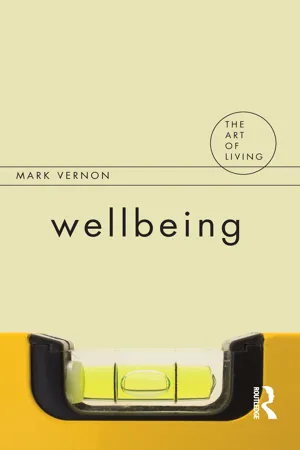
Wellbeing
About this book
The politics of wellbeing and the new science of happiness have shot up the agenda since Martin Seligman coined the phrase "positive psychology". After all, who does not want to live the good life? So ten years on, why is it that much of this otherwise welcome debate sounds like as much apple-pie - "work less", "earn enough", "keep fit", "find meaning", "enjoy freedoms"? The reason is not, ultimately, cynicism. Rather, it is because a central, tricky question is being glossed over: just what is wellbeing? Mark Vernon argues that positive psychology has overlooked and sidelined the ancient wisdom on wellbeing, notably from the Greek philosophers. Now is the time to pay it proper attention.Vernon shows, surprisingly, that wellbeing is not found in a focus on pleasure, or even the pursuit of happiness itself. Rather, it is a question of meaning and responding to the great challenge of our day: the search for transcendence. For at root, the life that is going well cultivates a way of life based upon love: it is that which draws you out of yourself - in friends, hopes and ultimately the contemplation of mystery - and orientates a life towards that which is good.
Information
1. Pleasure and pain
One half of the world cannot understand the pleasures of the other.
(Jane Austen, Emma)
Pleasure. It is so welcome, so immediate, so tangible, so motivating: it is its own reward. If you put sophisticated and refined pleasures on the menu of life, such as fulfilling relationships and stretching ambitions, as well as those small pleasures akin to eating chocolates, then it appears to be a no-brainer to conclude that the maximization of quality pleasure should be the central goal of wellbeing. At the very least, it just seems counterintuitive to suggest that a good life has little to do with good feeling. The assertion would seem so easy to knock down.
That is certainly what many have taken as gospel since the Enlightenment. Happiness finds its greatest delight and stimulation when enlivened by pleasure, explained Abbé Pestré, in his entry on the matter for Diderot and d’Alembert’s famous eighteenth-century Encyclopédie. Or to put it another way, he championed the notion that perfect happiness would be a state of perpetual, quality pleasure uninterrupted by pain. He continues:
If happiness is not enlivened from time to time by pleasure, it is not so much true happiness as a state of tranquillity, a very sorry kind of happiness indeed! If we are left in a state of lazy indolence that offers no stimulus to our activity, we cannot be happy; our desires can only be fulfilled by our being transported out of this listlessness in which we languish. Joy must flow into the innermost recesses of our hearts, it must be stimulated by pleasant feelings, kept in motion by gentle shocks, filled with delightful variety, it must intoxicate us with a pure pleasure that nothing can spoil.
Pestré shared these assumptions with the authors of many of the treatises that were published on happiness in the eighteenth century; in the early days of modernity it was quite as blossoming an industry as it is today. He knew, of course, that perfect happiness is not practically achievable, for the reason that in reality pleasure rises and falls like a flame. Also, if it burns too brightly it burns itself out. But then, as Lord Byron wrote in Don Juan a few years later:
Let us have wine and women, mirth and laughter, Sermons and soda-water the day after.
There is something profoundly compelling in the notion that a good life has much to do with physical joys and mental delights. We can be sophisticated about it, for sure. But is it not unanswerable that happiness in one way or another essentially boils down to increasing the amount of positive emotion you enjoy? Dissatisfaction and suffering are the opposite of wellbeing. We should do everything to reduce them, if not cut them out; they are so self-evidently horrid. So why might there be grounds for believing otherwise?
Oranges and apples
The cracks start to show if you turn to the individual who made the most robust case for such a sophisticated hedonism, the English philosopher Jeremy Bentham, the founding father of utilitarianism and, incidentally, the godfather of John Stuart Mill. Bentham was convinced that whatever might be the essence of a good life, it must be a straightforward matter, for only something that is straightforward could warrant the title of the greatest good for which any human being, in their right senses, would aspire. He was not a stupid man; he knew that great minds before him had thought that the key to happiness is as elusive as answers to the riddles of the Sphinx. But he thought that the pleasure principle was so powerful, so direct an idea of wellbeing, that it could sweep all the equivocation aside.
One immediate difficulty is that there are pleasures and pleasures. The joy of reading a book is not like the buzz of dancing until dawn. The contentment of loving your spouse after thirty years of marriage is not like the thrill of being swept off your feet on a date. The risk is that before you know what you are doing, the good life is reduced to a more or less silly series of calculations about what to choose: dancing and dates or reading and marriage? In general, there is a need to assess different pleasures for happiness-as-positive-emotion to work, and establish which are likely to lead to the greatest happiness, and therefore which are the best to cultivate.
Bentham developed a quasi-scientific means of doing so, called felicific calculus. He drew up tables of pleasures and graded them one against the other. Most contemporaries thought it untenable, not least Mill. It just seemed so crude. Mill pointed out that pleasures do not vary just in intensity but also in kind– as oranges differ from apples. Or there is the issue of how one person’s pleasure can be met with another’s disgust: marmite, Stockhausen, gay sex – some people’s stomachs turn at all three. Or take an extreme case. What about those pleasures that are evil: the torturer who delights in cruelty or the paedophile who finds comfort with children? Both might argue with conviction that acting in a way that brings them pleasure contributes to their wellbeing. That is the way they are made.
Bentham argued back that consequences count too. What people do should be assessed by their effects, not least in terms of the pleasure or pain they cause others. But this only works in a world where the consequences of actions can be seen in relative black and white. The extreme cases are the easy cases. Mostly, though, the world is a smudge of barely indistinguishable greys. What about the ordinary, frustrated individual who obtains some small satisfaction in everyday acts of humdrum vengeance? Is the offence they cause the call-centre operator worth the satisfaction they feel at venting their anger? Is the aggression they show others by pummelling the car-horn justified by the release they experience in their road-rage? Adding up the negatives and offsetting them against the positives in a ledger of utility, before settling on the best course of action, is in practice ham-fisted. Focusing so much on maximizing pleasure just seems a clumsy way to live. It is not that pleasure is bad; it is that making it the main gauge of the good life is flawed.
Put like that, there would seem to be no argument. However, pleasure is persuasive. We are sentient beings. We are also, today, consumers. That must have something to do with a good life! Sure enough, felicific calculus is making something of a comeback armed with twenty-first-century science, for there are now striking ways of making the pleasurable measurable that revive neo-Benthamite aspirations. Brain-scanners can be deployed to take direct readings of pleasure centres in the brain. Alternatively, questionnaires and experiments, along with algorithms to unravel the results, aim to distil simple but powerful truths from the complexities of what people say about the things that make them feel better or worse.
And yet is this really any more sophisticated than Bentham, for all that 4D CT scan images of grey matter responding to stimuli in real time are impressive? For example, there is a risk of circular reasoning: pleasure centres in the brain are only recognized as such because individuals have previously said they are experiencing pleasure as, say, the nucleus accumbens lights up. Alternatively, there is one of the Duc de la Rochefoucauld’s Maxims to consider: “One is never as unhappy as one thinks, nor as happy as one hopes”. What we feel about wellbeing is not always the best judge. And it depends on who’s asking: pollster, politician, psychologist or philosopher. It’s a bit like the concern opinion pollsters have when measuring religiosity in America and secularity in Europe: people tend to answer as they think they should, church-going being thought respectable in the US and as an activity only suitable for “nutters” in the UK. The implication is that people are alienated from what they actually believe. In the case of happiness, they may struggle to ascertain what they feel. Similarly, there is good reason to presume that some people will feel happier just because someone bothered to ask.
Researchers in this area are quite conscious of these experimental hurdles. Comparative studies that cross-reference results to ensure that human guinea-pigs are being consistent is one tactic for attempting to surmount them. The problem is that even enhanced felicific calculus treats life as simpler than it is. As a rule few things in life that really matter can be accurately measured. Love blows hot and cold but not in carefully calibrated degrees. Motivations are more or less pure but usually something of a muddle in the middle. The science of measuring happiness by measuring pleasure would be a great strength if it provided a firm basis for evidence and data. It becomes a weakness if, because of the need to measure something – anything – in order to derive tangible evidence, it measures the wrong things. This is not to be against science, any more than it is to be against pleasure. It is simply to be realistic about what the science can achieve. Great strides are being made in terms of understanding how the brain works. But to be frank the advice about wellbeing that is derived from it is often just trite: people feel better when they do such things as accept they are human, simplify their lives, exercise regularly and focus on the positive. It sounds like a lesson in the bleeding obvious because all it can do is state what is, more or less, immediately apparent.
Barley cakes and water
For all that, though, pleasure is a part of happiness. So what is a good attitude to have towards it? The ancient philosopher who understood its appeal more than anyone was Epicurus. He concurred that it was the crucial issue for human beings. However, he saw that there is an inexorable logic to pleasure-seeking that is likely to undo you if you set it as how you judge your life – directly or indirectly. What did he advise? In short, if you want to live well, keep pleasure in its place.
“No pleasure is a bad thing in itself,” he said, “but the things which produce certain pleasures bring troubles many times greater than the pleasures themselves” (Principal Doctrines, 8). He argued that if you take pleasure as your guide then, wittingly or not, you will be committed to a life pursuing its peaks. You will endorse all sorts of accumulative tendencies that turn out to be unwise. And then you will be condemned: condemned to fall repeatedly from the heights to the troughs that follow them. This will be true whether your pleasures are high- or low-minded: a melancholic dip comes after finishing a novel as surely as the “Tuesday blues” tags a weekend on Ecstasy. Down follows up like a shadow. That is true for anyone. But if the ups are more or less the only things that make life worth living for you, then you will become ensnared in a vicious cycle of increasingly intense, decreasingly satisfying hits.
This is the moody life of the teenager wedded to his or her kicks. It is that of the gourmand who bolts his food and then complains of indigestion, as the saying has it. Is that not a metaphor for our age? Coupled to that is a further point that resonates particularly powerfully today. If you live in a society in which everyone is striving for more – bigger houses, better holidays, larger pay-packets, swisher clothes – then an ethic of avarice and aggression will emerge. The competitive desire to outdo the neighbours becomes a defining characteristic of life. Keeping one step ahead of the Joneses is what you come to love because it secretly gives you more pleasure – maybe more than a rising standard of living does itself. Hence, in a marketplace of easy, pleasurable luxuries, unhappiness will spread. It sounds wrong: more pleasure for all turns out not to be correlated to more happiness for all – although anyone who has been elbowed in an Ikea on a crowded Sunday morning will know that already.
The danger was understood by Adam Smith, no enemy of capitalism. In his Theory of Moral Sentiments he recalled an inscription on the tombstone of a man who had been ruined by the ambition that can turn the blessings of our age into a curse. The epitaph read: “I was well, I wished to be better; here I am”.
The trick, Epicurus explained, is to uproot the wild pursuit of peaks and in its place allow to grow a cultivated attention that delights in whatever you happen to have. He called it ataraxia, or serenity, born he thought of an “obscure life”, which is to say, one with enough space in it to think. It will embrace refined or spiritual goods, such as friends and, if possible, a beautiful place to live. Epicurus set up his philosophy school in a location with the enchanting name the “Garden”. The Garden had the advantage of not being in the city and so away from those cutthroat, competitive compulsions that are so damaging. Epicurus explained it in his letter to his friend Menoeceus:
So when we say that pleasure is the goal we do not mean the pleasures of the profligate or the pleasures of consumption, as some believe, either from ignorance and disagreement or from deliberate misinterpretation, but rather the lack of pain in the body and disturbance in the soul.
An Epicurean “hedonist” will be happy to make do with modest means, such as barley cakes and water. He or she might positively seek to give things up, since “wealth, if limits are not set for it, is great poverty”. “Blessed are the meek” is the Christian version of this, the Greek for “blessed” here meaning happy as well as holy.
So, less is more when it comes to pleasure, lest the desire for more undermines your wellbeing. Epicurus would do away with the accumulation of things and positive emotion, and cultivate tranquillity of mind instead. In this, he was perhaps a bit like the Buddhist who practises mindfulness: the aim is not to be rid of thoughts, feelings and emotions but to notice them for what they are – mostly distractions. Something like that attention appears to have been the essence of human wellbeing for Epicurus and his followers.
The problem of pain
So Epicurus has a better way forward. But is it enough to make sense of life? The problem is that it still revolves around the matter of pleasure. He was no hedonist, as the word commonly means today. But his notion of wellbeing remained bound to its logic.
The issue can be put in this way. Might there not be cases in which pain contributes to wellbeing? For wellbeing, in real life, it is not just that the suffering that people face would always ideally be ameliorated, overcome or banished, although that is certainly the case in many situations; it is also possible, in fact likely, that some difficulties, even tragedies, are an important part of what makes us human, indeed they make us more human. In truth there is more to suffering and the life lived well than simply a desire to remove it or anaesthetize it: to push difficulties aside as if they were as much brushwood.
The imaginary pleasure machine, made famous in a thought experiment devised by the philosopher Robert Nozick (1974), is revealing in this respect. This utopian device delivers happiness by feeding you positive emotions so precisely that you cannot tell they are not real. The surprise is that, when asked, most people would not want to be plugged into it. That they are naturally resistant to this ticket to everlasting felicity has been interpreted in different ways. Some say it implies that happiness must be based on real not artificial life, others that happiness necessitates actually making a difference not merely simulating it. However, another answer would be that people also intuitively know that a life without pain would be no life. It might be hard to define exactly why that should be. And it would not imply the perverse conclusion that the deliberate infliction of pain is good, although as any parent will know, even that principle is true on occasion. What the pleasure machine implies is that heaven, for humans, is not unalloyed joy. Life requires grit, struggle, and perhaps sometimes a singe that may scar. “What man actually needs is not a tensionless state but rather the striving and struggling for some goal worthy of him”, Viktor Frankl (1959: 127) thought.
Further sense can be made of this by considering the results of research into parenting and children that shows that when parents are asked whether raising children brings them more pleasure or more pain, the answers typically hang in the balance. Parents are not sure. Now, without an understanding of struggle, the result seems somewhat quizzical. Might the message for your greater happiness be don’t have kids? Intuition would suggest that something is wrong with that assessment, since children would undoubtedly be part of many people’s idea of wellbeing. And indeed they are. I would say the problem is interpreting life in relation to pleasure, and therefore having trouble accommodating the necessity of pain. Asking parents about how they feel about their kids is probably simply the wrong question. Children are to do with fulfilment or love or hope, which are infinitely more complex and paradoxical aspects of life than mere pleasure, and invariably bring agonies too.
The issue of joys that come only in conjunction with sorrows can be generalized to embrace all sorts of valuable things such as struggling to read, or running a race, or suffering with a friend. And then there is love: “All other pleasures are not worth its pains”, it has been said. Such experiences are as much a trial as a treat. But since any kind of meaningful life requires us to deal with other people – and if not with others then certainly with ourselves – it seems highly likely that wellbeing is inseparable from what we might call meaningful suffering, or at least the potential for suffering, which, for the human animal, gifted with the capacity to ponder the future, is inevitably part of life.
Nietzsche highlighted a related matter. He noted that times of hardship can teach people certain things and deepen their emotional lives; that is, they can improve their overall wellbeing. He put this rather well when he pointed out that pain can be a great source of wisdom. “There is as much wisdom in pain as there is in pleasure”, he wrote (1974: § 318). Smarting can make you smarter.
Clearly there is such a thing as pointless suffering, such as the pain of chronic physical suffering, or the unnecessary agonies that the powerful can so easily inflict on the poor. And there is a cautionary note to sound when talking about suffering that Kierkegaard caught in a parable:
What is a poet? An unhappy man who in his heart harbours a deep anguish, but whose lips are so fashioned that the moans and cries which pass...
Table of contents
- Cover
- Half Title
- Title
- Copyright
- Dedication
- Contents
- Acknowledgements
- Introduction: happy yet?
- 1. Pleasure and pain
- 2. The meaning dimension
- 3. Turning to the transcendent
- 4. Discerning the mystery
- 5. The power of love
- Further reading
- References
- Index
Trusted by 375,005 students
Access to over 1.5 million titles for a fair monthly price.
Study more efficiently using our study tools.
Frequently asked questions
Yes, you can cancel anytime from the Subscription tab in your account settings on the Perlego website. Your subscription will stay active until the end of your current billing period. Learn how to cancel your subscription
No, books cannot be downloaded as external files, such as PDFs, for use outside of Perlego. However, you can download books within the Perlego app for offline reading on mobile or tablet. Learn how to download books offline
Perlego offers two plans: Essential and Complete
- Essential is ideal for learners and professionals who enjoy exploring a wide range of subjects. Access the Essential Library with 800,000+ trusted titles and best-sellers across business, personal growth, and the humanities. Includes unlimited reading time and Standard Read Aloud voice.
- Complete: Perfect for advanced learners and researchers needing full, unrestricted access. Unlock 1.5M+ books across hundreds of subjects, including academic and specialized titles. The Complete Plan also includes advanced features like Premium Read Aloud and Research Assistant.
We are an online textbook subscription service, where you can get access to an entire online library for less than the price of a single book per month. With over 1.5 million books across 990+ topics, we’ve got you covered! Learn about our mission
Look out for the read-aloud symbol on your next book to see if you can listen to it. The read-aloud tool reads text aloud for you, highlighting the text as it is being read. You can pause it, speed it up and slow it down. Learn more about Read Aloud
Yes! You can use the Perlego app on both iOS and Android devices to read anytime, anywhere — even offline. Perfect for commutes or when you’re on the go.
Please note we cannot support devices running on iOS 13 and Android 7 or earlier. Learn more about using the app
Please note we cannot support devices running on iOS 13 and Android 7 or earlier. Learn more about using the app
Yes, you can access Wellbeing by Mark Vernon in PDF and/or ePUB format, as well as other popular books in Philosophy & Ancient & Classical Philosophy. We have over 1.5 million books available in our catalogue for you to explore.