eBook - ePub
Emotional Labor and Crisis Response
Working on the Razor's Edge
- 192 pages
- English
- ePUB (mobile friendly)
- Available on iOS & Android
eBook - ePub
Emotional Labor and Crisis Response
Working on the Razor's Edge
About this book
The author's of the award-winning Emotional Labor now go inside the stressful world of suicide, rape, and domestic hotline workers, EMTs, triage nurses, and agency/deparment spokespersons, to provide powerful insights into how emotional labor is actually exerted by public servants who face the gravest challenges.
Information
Subtopic
Human Resource ManagementIndex
Business1
Emotional Labor as Public Good and the State as Harbor of Refuge
Illinois Interstate 294—the Tri State tollway—carves a long, flat arc around the city of Chicago, extending north to Wisconsin and east to the Indiana state line: seventy-eight miles in total. Unlike other products of the post-World War II surge in infrastructure development, the Tri State was not built anew but instead is a patchwork of new roads and old, with portions dating back to the 1920s. Nevertheless, the Tri State is one of the most heavily traveled highways in the United States, carrying more than 100,000 vehicles every day (IDOT 2009). The Mile-Long Bridge conveys eight lanes of the Tri State over the Des Plaines River, the Chicago Sanitary and Ship Canal, dozens of railroad tracks, and the United Parcel Service Midwest intermodal facility. At one end of the bridge, the northbound and southbound lanes split, leaving a gap of several feet.
In the wee hours of one cold February night, a truck driver—a husband, a father to three small children—was heading southbound on the Tri State and fell asleep as he approached the Mile-Long Bridge. He crashed through the median guardrail, through the gap between the lanes, and plunged to the ground. He was trapped inside his cab under the trailer. He was about ten miles from home. Emergency responders were dispatched to the site. A responding paramedic describes the scene:
Basically I’m inside the cab holding the guy’s hand … they’re trying everything they can, … [but] this guy’s pinned so bad and the problem was that the truck was kind of up on top of him here, so we were trying to figure out how we were going to make this work. But I’m looking at him, I see him going into shock and there’s no way. I just know we’re not going to get him out. I’m not telling him that.When I saw the way he was pinned in there and knowing the amount of weight we had on this truck, I knew it was going to be at least two, three hours before we could get him out of there…. I just knew it wasn’t going to happen. Again, I’m not telling him that…. I’m being positive: “We’ll get you, we’ll get you … we’re working on this, we’re working on that.” I said, “Tell me some more about your family,” and the whole time I’m holding his hand. I mean I’m not letting go of his hand. I’m holding his hand and just—cold to the touch. And then I can feel his hand getting colder and colder and he’s getting more pale …
Tragically and beautifully, this story illustrates emotional labor on two fronts: eliciting a particular emotional state in another person and emotion regulation within oneself. Emotional labor is “the management of feeling to create a publicly observable facial and bodily display” that is necessary for doing the job (Hochschild 1983, p. 7, emphasis supplied). It requires workers to suppress their private feelings in order to show desirable work-related emotions (Guy, Newman, & Mastracci 2008). Emotional labor is an indispensable skill in roughly one-quarter to one-third of all occupations and in all street-level occupations in the public sector (Guy, Newman, & Mastracci 2008; Hochschild 1983; McCloskey 2008). Public servants who cannot manage their own or another’s feelings fail to do their jobs, just as surely as the physical laborer who cannot lift or carry weight. Because emotional labor is fundamental to the job, it is also part of a worker’s salary: “emotional labor is sold for a wage and … has exchange value” (Hochschild 1983, p. 7).
As fundamental as it is to public service, emotional labor is all but absent from job descriptions and performance evaluations (Mastracci, Newman, & Guy 2006). So how did this paramedic know what to do? What’s more, how did he do it? How did he stay “positive” and keep himself from breaking down? How did he keep his face and voice from betraying what he knew—that rescue was impossible and that the truck driver would never see his wife, his children, again? The paramedic foresaw the outcome but focused on selected aspects of the truth. How did he do that? This paramedic was also a husband, a father; how did he resist thoughts of his own wife and child and employ the following emotion regulation strategies?
• Situation modification: efforts “to directly modify the situation so as to alter its emotional impact,” as shown by the paramedic’s commitment to stay positive and by his reassurances to the victim (We’ll get you, we’ll get you… we’re working on this, we’re working on that).
• Attention deployment: “How individuals direct their attention within a given situation in order to influence their emotions.” This effort includes distraction (Tell me some more about your family) and focused concentration (I’m inside the cab holding the guy’s hand… I’m not letting go of his hand).
• Response modulation: efforts to influence “physiological, experiential, or behavioral responding as directly as possible,” which again is demonstrated by the paramedic’s commitment to stay positive and hide what he knows (it was going to be at least two, three hours before we could get him out of there) from the victim (I’m not telling him that). (Gross & Thompson 2007, pp. 12, 13, 15)
The paramedic in this story also betrays his awareness that, in this situation, “telling” means not only speaking, but also communicating nonverbally via his tone of voice, facial expressions, and physical gestures. Where did this awareness come from? Are some people just born with it, or can it be learned? Hochschild suggests the latter when she observes that emotional labor is not “merely a facet of personality” (1979, p. 568, emphasis supplied). It is more than a personality trait; it is a skill that can be learned and honed. Studies in experimental psychology have demonstrated this repeatedly. We discuss them below as part of the “Why” of emotional labor.
Emotional Labor: What, How, and Why
The “What”
In our previous research on emotional labor, we sought to answer questions related to its definition, presence, and role in public service delivery (Guy & Newman 2004; Guy, Newman, & Mastracci 2008; Mastracci, Newman, & Guy 2006; Newman, Guy, & Mastracci 2009). We consulted linguistics in order to define it and consulted other professions in order to understand it in public service practice. In the process, we discovered several important dimensions of emotional labor. First, at varying levels of intensity, it plays a role in nearly all government jobs. Frontline workers deal with the day-to-day needs of an increasingly demanding public; management handles the inter- and intra-agency demands of subordinates and superiors on everything from budget and human resources to agency turf battles. Second, we found that the performance of emotional labor need not lead to burnout. Public servants are as energized by intense emotional labor demands as they are exhausted. The difference lies in how management and workers address the emotive labor demands of these jobs. This led us to a third conclusion: Emotional labor is part of an occupation, not simply something that a person brings to the job (or not). The characteristics of the job—its purpose androle in the organization, its demands and requirements—determine whether or not job holders will find themselves exerting emotional labor. This led to a fourth conclusion: Agencies can screen, train, retrain, and evaluate employees on the quality of emotional labor that they exercise on the job. But it is the rarest office that even recognizes the emotive demands on its workers, much less evaluates and compensates for them. Finally, we found public administration theory and scholarship to be woefully short in recognizing and examining this subject. It is undertheorized in public administration. Our earlier book was an effort to push the canon in that direction (Guy, Newman, & Mastracci 2008). We sought to define emotional labor and bring it to the fore in public administration practice and scholarship.
The “How”
Emotional labor requires workers to suppress, exaggerate, or otherwise manipulate their own and/or another’s private feelings in order to comply with work-related display rules. Private-sector jobs demand it because it contributes to the bottom line (Hochschild 1983). Public service jobs require emotional labor because they involve working directly with people and, more crucially, because they target vulnerable populations or people in vulnerable situations. This is due to the nature of the services provided by government and the role of government as harbor of refuge. Both of these are discussed later in this chapter.
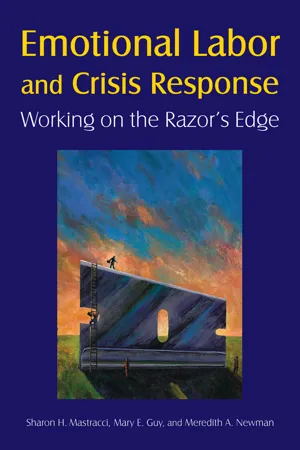
How public servants exerted emotional labor was beyond the scope of our earlier research. In this book, we take as given the presence of emotional labor in public service and investigate how it is done. How do public servants interpret unwritten “feeling rules,” and how are they integrated into the execution of one’s duties? We explore worker strategies and approaches to crisis situations. In an instant and faced with panicked and traumatized victims, how do workers size up a situation and decide how to proceed? How do they frame and define the situation? How do they establish trust and elicit cooperation? How do they perceive their roles as representatives of the state, yet also as fellow citizens working under extreme pressure? How do they use discretion in different situations? We further consider the ethical dimensions of exercising autonomy while also possessing the power of the state. In short, we seek a fuller understanding of emotional labor exerted by public servants as they face grave challenges. In the cover illustration of this book, men and women climb atop a towering razor blade and walk across its edge. We want to know how they walk across the razor’s edge and, in terms of “self-care,” how they keep their balance.
Crisis response is a uniquely fertile context within which to study the “how” of emotional labor. All crisis responders rely on their capacity to manage their own and/or others’ emotions almost all of the time as part of their jobs. Crisis response is unique to public service because it is a public good. Furthermore, crisis response is purposefully not representative of all public service; indeed, we chose crisis response because it is an extreme type of public service.1 Crisis responders exert emotional labor to a degree and intensity that few others do, and our respondents represent a range of occupations: domestic violence hotline workers, emergency medical staff, and department spokespersons who are the initial face of the organization and who address the public immediately after crises.
Our deliberate choice of high-intensity occupations is akin to the approach taken by Carol Gilligan in her pathbreaking book, In a Different Voice (1982). She studied the gendered nature of moral development by interviewing women considering abortion, which is obviously not “random” or “representative” of decisions a woman must make, but it is one that allowed her to capture the strategies and approaches that women take when making moral judgments. If there were any decision that would betray a woman’s moral calculus, Gilligan hypothesized, considering abortion would definitely be it. Likewise, if there were any type of public service that would reveal workers’ strategies and approaches to exercising emotional labor, crisis response is it. Both are time bound. A woman must act early in her pregnancy—after that, the decision is made for her by law and cannot be reversed. Similarly, in the case of sworn officers, crisis responders cannot choose not to act—to refuse to act is to violate their oath and fail to do their jobs.
A significant difference between ours and Gilligan’s respondents involves the ability to anticipate. Unlike women facing the abortion decision, which for many is a once-in-a-lifetime situation, first responders confront crises as a regular part of their occupations. Despite all their preparation, however, unanticipated events occur. We asked crisis responders about their worst experiences, those in which they felt underprepared or unprepared and those that took them by surprise (Troxell 2008). Our objective was to elicit responses about their use of emotional labor in crisis response. (See Appendix A for a detailed discussion of our assumptions about respondents ‘ abilities to articulate how they exert emotional labor.)
We interview public servants who work on the razor’s edge. Our goal is to learn their strategies for handling emotionally intense situations, how they exercise discretion, how they understand the roles that they are expected to play, and how they fulfill those expectations. Working in crisis situations as a fundamental part of their jobs requires public servants to flex their emotional muscles all at once. We can capture numerous, varied facets of on-the-job emotional labor in an instant or a series of instants. And an accumulation of crisis events allows us to tap into the evolution of workers’ strategies and approaches. We rely on respondents’ recollections and observations of crises, the demands of their jobs, and how or whether their actions and reactions have developed over time.
The “Why”: Emotion Regulation and Cognitive Performance
The premise that politics and administration are mutually exclusive set into motion decades of public administration research along two trajectories: good and bad, or rational/objective/scientific/good and illogical/subjective/ discursive/bad. To the extent that emotions were mentioned at all, they would certainly be in the second group. Much of mainstream public administration scholarship is founded in the so-called politics-administration dichotomy, an assumption that permits researchers to study administration in isolation from politics, ceteris paribus. This assumption silences emotional labor, which is a subtle but crucial aspect of the economy and a not-so-subtle and even more crucial component of public service (McCloskey 2008; Guy, Newman, & Mastracci 2008). What’s more, the politics-administration dichotomy sets emotion and cognition at cross purposes.
Our 2008 book challenged the assumption of orthodox public administration theory that cognition and reason are the best, the most appropriate, the only underpinnings of decision making and action. This is an assumption rooted deeply in the scientific management origins of the discipline. We challenged the primacy of cognitive skills and abilities—the reification of “objectivity”—in a discipline that requires its practitioners to work closely with people on relational matters. Now, however, we know more about the relationship between emotion and cognition. First, we have learned that, even among philosophers, the relationship between emotion and reason is not straightforward, as if emotions were, in Rietti’s words, “random inclinations distorting the clean operations of practical reason.” Even Enlightenment philosophers, including “the usual suspects, Hume, Descartes, and the emotiv-ists tend to turn out, on closer inspection, to have rather more sophisticated accounts [of the relationship between emotion and reason] than they are often credited with.” Philosophers of the twentieth and twenty-first centuries continue to deconstruct the “cognitivist paradigm” (Rietti 2009, pp. 68–69) and posit cognition in emotionality and emotion in cognition. Second, we have learned that not only are emotion and cognition linked, but emotion regulation affects cognitive function.
One of the earliest experiments on the relationship between emotion and cognition revealed the “cognitive consequences” of emotion regulation and concluded that “emotion suppression impaired memory for information encountered while individuals inhibited ongoing emotion-expressive behavior” (Richards & Gross 1999, p. 1042). The de rigueur method of eliciting emotion in experimental psychology is to show participants images—moving or still—that depict surgeries, traffic accidents, and other “disgust-inducing” and “gruesome” situations (Dunn, Billotti, Murphy, & Dalgleish 2009; Schartau, Dalgleish, & Dunn 2009; Scheibe & Blanchard-Fields 2009, p. 217; Schmeichel 2007; Schmeichel, Volokhov, & Demaree 2008). To gauge the effect of emotion regulation on cognitive function, participants are instructed to exaggerate or suppress felt emotions and complete various tests of cognitive function, usually something involving working memory (Dunn et al. 2009; Schartau et al. 2009; Scheibe & Blanchard-Fields 2009; Schmeichel 2007; Schmeichel et al. 2008). Test results from these participants are then compared to those of participants who also viewed emotion-eliciting images but received no emotion-regulation instructions.
Schmeichel (2007, p. 251, emphasis supplied) focuses onhow people ration a given amount of energy available to control emotion and perform cognitive tasks. The conclusion is that “although the executive control of memory and the executive control of emotion may emanate from distinct areas of the brain… performing one of these temporarily impaired the performance of the other.” Moreover, emotion control at one point in time impeded subsequent attempts at emotion control. Dunn et al. (2009, p. 772) conclude that “the longer-term consequences of emotion suppression are an ongoing dampening of reactivity, reduced emotional response to positive material [and] reduced memory of the material encoded.” While we speculated on the cumulative impact of emotional labor (see our process models in Guy, Newman, & Mastracci 2008, pp. 183–185), the corrosive effect of emotional labor on cognitive function has been demonstrated in the laboratory.
To...
Table of contents
- Cover
- Half Title
- Title Page
- Copyright Page
- Table of Contents
- Foreword
- Preface
- 1. Emotional Labor as Public Good and the State as Harbor of Refuge
- 2. A Blind Spot in Public Administration Theory . . . But Not in Practice (still)
- 3. Human Capital Issues
- 4. Communicating Competence and Cultivating Trust
- 5. Who Gets the Blame? Who Gets the Credit? Government Responsiveness and Accountability
- 6. Of the People: Legitimacy, Representativeness, and the Difference That Gender Makes
- 7. Professional Standards and Discretion in Crisis Response
- 8. Refections on the “Why,” “How,” and “What” of Emotional Labor
- Appendix A. Evidentiary Proceedings
- Appendix B. Interview Protocol
- References
- Index
- About the Authors
Trusted by 375,005 students
Access to over 1.5 million titles for a fair monthly price.
Study more efficiently using our study tools.
Frequently asked questions
Yes, you can cancel anytime from the Subscription tab in your account settings on the Perlego website. Your subscription will stay active until the end of your current billing period. Learn how to cancel your subscription
No, books cannot be downloaded as external files, such as PDFs, for use outside of Perlego. However, you can download books within the Perlego app for offline reading on mobile or tablet. Learn how to download books offline
Perlego offers two plans: Essential and Complete
- Essential is ideal for learners and professionals who enjoy exploring a wide range of subjects. Access the Essential Library with 800,000+ trusted titles and best-sellers across business, personal growth, and the humanities. Includes unlimited reading time and Standard Read Aloud voice.
- Complete: Perfect for advanced learners and researchers needing full, unrestricted access. Unlock 1.5M+ books across hundreds of subjects, including academic and specialized titles. The Complete Plan also includes advanced features like Premium Read Aloud and Research Assistant.
We are an online textbook subscription service, where you can get access to an entire online library for less than the price of a single book per month. With over 1.5 million books across 990+ topics, we’ve got you covered! Learn about our mission
Look out for the read-aloud symbol on your next book to see if you can listen to it. The read-aloud tool reads text aloud for you, highlighting the text as it is being read. You can pause it, speed it up and slow it down. Learn more about Read Aloud
Yes! You can use the Perlego app on both iOS and Android devices to read anytime, anywhere — even offline. Perfect for commutes or when you’re on the go.
Please note we cannot support devices running on iOS 13 and Android 7 or earlier. Learn more about using the app
Please note we cannot support devices running on iOS 13 and Android 7 or earlier. Learn more about using the app
Yes, you can access Emotional Labor and Crisis Response by Sharon H. Mastracci,Mary E. Guy,Meredith A. Newman in PDF and/or ePUB format, as well as other popular books in Business & Human Resource Management. We have over 1.5 million books available in our catalogue for you to explore.