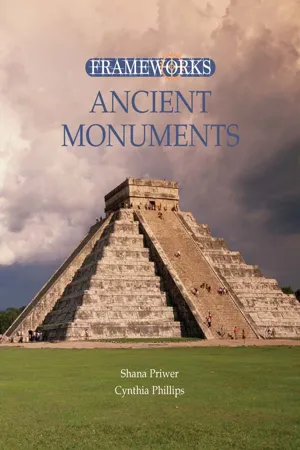
- 115 pages
- English
- ePUB (mobile friendly)
- Available on iOS & Android
eBook - ePub
Ancient Monuments
About this book
Discusses the Egyptian pyramids, Greek temples, Roman buildings, and megalithic monuments in Britain, the book includes chapters on architecture in Mesoamerica, the early Middle East, and ancient China and Japan.
Information
CHAPTER
1
EGYPTIAN PYRAMIDS
The pyramids of ancient Egypt are some of the earliest and most impressive examples of architectural ingenuity in the history of civilization. The city of Giza usually comes to mind first when considering ancient Egyptian architecture. The pyramids of Giza are some of the most familiar and best-preserved examples, but well over 100 pyramids were built in various cities around Egypt, such as Cairo. Viewing these awesome structures raises many questions. Why were the pyramids built? What functions did they serve? And how did an ancient civilization manage to build such inspiring monuments without the benefit of modern technology?
Religion was of major importance in ancient Egyptian society, and it inspired the construction of the pyramids. One of the major Egyptian deities was Ra, the sun god. He was believed to have been the first Egyptian king, and the pharaohs were considered his direct descendants.
There were strong connections between religious beliefs and the ancient peoples’ observation of the sky, so astronomy was an important area of knowledge for Egyptians. They took careful account of the sun’s rise and fall, and recorded data on the stars they observed. Study of the stars allowed the ancients to distinguish the four points on the compass (north, south, east, and west), and these directions were a major factor in the positioning of the pyramids. It has been suggested that the three Great Pyramids of Giza are aligned to replicate the three stars in the belt of the constellation now known as Orion.
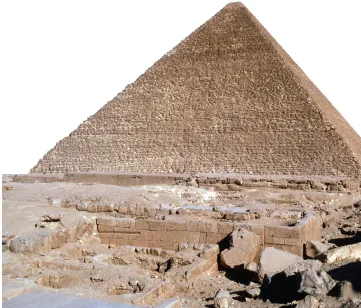
FUNCTION AND FORM
Egyptian pyramids had a distinct purpose. They were built as tombs, or funerary monuments, for the pharaohs. Pyramids were also associated with various cults relating to the sun, the moon, and other celestial bodies. Their construction involved extreme technical innovation, as well as enormous labor forces. Most of the large pyramids were constructed during the Old Kingdom (2575–2134 B.C.E.) and Middle Kingdom (2040–1640 B.C.E.) periods (see table).
THE STEP PYRAMID OF DJOSER
The first major pyramid to be studied by historians and archeologists was the Step Pyramid in Saqqara. It was built to honor the pharaoh Djoser over the course of several periods, reaching completion around 2611 B.C.E. Djoser’s pyramid was designed by the lead architect of the day, Imhotep.
Imhotep was a prolific designer and a remarkable man. In addition to designing tombs, he was an astronomer, high priest, doctor, and general consultant to the pharaohs. He is often referred to as the world’s first documented architect, and also is considered the father of Egyptian medicine. Historians became aware of Imhotep because he was strongly associated with the pharaohs and his name was included in the official writings of the period. Lesser-known architects and assistants probably contributed greatly to Imhotep’s success, but their accomplishments have not been preserved.
The pyramid of Djoser was the tallest structure at the time. It consisted of a series of mastabas, which were massive tombs shaped like rectangular benches. In the Step Pyramid, the tombs were arranged underground and stone tiers were added above, giving the pyramid its stepped appearance.
MAJOR EGYPTIAN DYNASTIC PERIODS, THE PHAROAHS, AND THEIR PYRAMIDS
PERIOD | DATE RANGE |
Early Dynastic Period | |
First Dynasty | 3050–2890 B.C.E. |
Second Dynasty | 2890–2686 B.C.E. |
| Third Dynasty Pharaoh: Djoser (2667–2648 B.C.E.) Major work: Step Pyramid in Saqqara | 2690–2575 B.C.E. |
Old Kingdom Period | |
| Fourth Dynasty Pharaoh: Sneferu (2575–2551 B.C.E.) Major work: Bent Pyramid, Red Pyramid in Dashur Pharaoh: Khufu, son of Sneferu (2551–2528 B.C.E.) Major work: Great Pyramid in Giza Pharaoh: Djedefra, son of Khufu (2528–2520 B.C.E.) Pharaoh: Khafre, son of Khufu (2520–2492 B.C.E.) Major work: Pyramid of Khafre, Sphinx in Giza Pharaoh: Menkaure, son of Khafre (2492–2472 B.C.E.) Major work: Pyramid of Menkaure Pharaoh: Shepseskaf (2472–2467 B.C.E.) | 2575–2467 B.C.E. |
Fifth Dynasty Pharaoh: Userkaf (2465–2458 B.C.E.) | 2467–2345 B.C.E. |
Sixth Dynasty | 2345–2134 B.C.E. |
First Intermediate Period (Dynasties 7–10) | 2125–2040 B.C.E. |
Middle Kingdom (Dynasties 11–14) | 2040–1640 B.C.E. |
Second Intermediate Period (Dynasties 15–17) | 1630–1540 B.C.E. |
New Kingdom Period (Dynasties 18–20) | 1540–1075 B.C.E. |
Third Intermediate Period (Dynasties 21–24) | 1075–715 B.C.E. |
Late Period (Dynasties 25–30) | 715–332 B.C.E. |
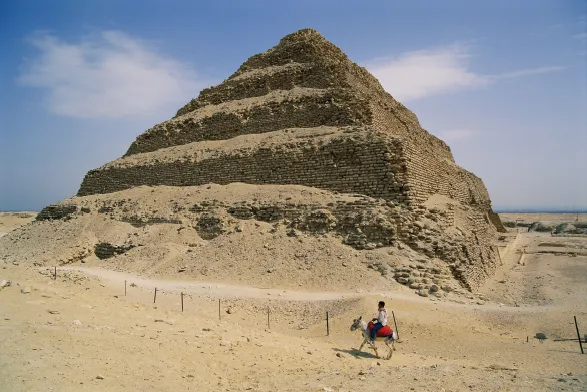
The Step Pyramid of Saqqara is one of the world’s oldest structures that is built of stone.
The faces of this pyramid are in various states of preservation. Some have deteriorated to the point where most of the stone is missing. This deterioration has had at least one advantage—it allows modern archaeologists to get a first-hand look at the interior, which contains a burial chamber.
Created in stone and finished with limestone, the burial chamber was enhanced with more limestone and made accessible by a maze of interior corridors. Multiple chambers were created and some of these were lined with colored tiles. Once the pyramid was complete, the entry was permanently blocked with granite. Some of the early pyramids and mastabas were built of mud brick, which tended to crumble and disintegrate over time. The Step Pyramid was constructed mainly of stone. As a result, it has survived through the years in much better condition than its predecessors.
Why do archaeologists think that the tomb belonged to Djoser? The main piece of evidence is a statue in his likeness that was found inside. Inscriptions on the walls confirm that this pyramid was intended to be his burial tomb.
Something else that sets the Step Pyramid apart is that it was not a single, isolated structure but was placed within a larger architectural setting. It was surrounded by a stone wall, within which courtyards and temples were constructed, making up the pyramid complex.
GREAT PYRAMID OF KHUFU
The Great Pyramids of Giza are the standout pyramids of ancient Egypt and were named one of the Seven Wonders of the Ancient World by observers around the second century B.C.E. This group of three pyramids, located in proximity to each other, is one of the finest remaining examples of Egyptian pyramid building. The smallest of the three was built to honor Menkaure. His father, Khafre, was responsible for the midsized pyramid. Pharaoh Khafre was also responsible for the construction of the Great Sphinx, a massive limestone structure with the head of a man and the body of a lion. Khafre’s father...
Table of contents
- Cover
- Title Page
- Copyright Page
- Table of Contents
- About Frameworks
- Chapter 1 Egyptian Pyramids
- Chapter 2 Megalithic Monuments
- Chapter 3 Greek Masterpieces
- Chapter 4 Roman Greatness
- Chapter 5 Mesoamerican Architecture
- Chapter 6 Early Middle Eastern Architecture
- Chapter 7 Ancient Asian Engineering
- Glossary
- Find Out More
- Index
Trusted by 375,005 students
Access to over 1.5 million titles for a fair monthly price.
Study more efficiently using our study tools.
Frequently asked questions
Yes, you can cancel anytime from the Subscription tab in your account settings on the Perlego website. Your subscription will stay active until the end of your current billing period. Learn how to cancel your subscription
No, books cannot be downloaded as external files, such as PDFs, for use outside of Perlego. However, you can download books within the Perlego app for offline reading on mobile or tablet. Learn how to download books offline
Perlego offers two plans: Essential and Complete
- Essential is ideal for learners and professionals who enjoy exploring a wide range of subjects. Access the Essential Library with 800,000+ trusted titles and best-sellers across business, personal growth, and the humanities. Includes unlimited reading time and Standard Read Aloud voice.
- Complete: Perfect for advanced learners and researchers needing full, unrestricted access. Unlock 1.5M+ books across hundreds of subjects, including academic and specialized titles. The Complete Plan also includes advanced features like Premium Read Aloud and Research Assistant.
We are an online textbook subscription service, where you can get access to an entire online library for less than the price of a single book per month. With over 1.5 million books across 990+ topics, we’ve got you covered! Learn about our mission
Look out for the read-aloud symbol on your next book to see if you can listen to it. The read-aloud tool reads text aloud for you, highlighting the text as it is being read. You can pause it, speed it up and slow it down. Learn more about Read Aloud
Yes! You can use the Perlego app on both iOS and Android devices to read anytime, anywhere — even offline. Perfect for commutes or when you’re on the go.
Please note we cannot support devices running on iOS 13 and Android 7 or earlier. Learn more about using the app
Please note we cannot support devices running on iOS 13 and Android 7 or earlier. Learn more about using the app
Yes, you can access Ancient Monuments by Cynthia Phillips,Shana Priwer in PDF and/or ePUB format, as well as other popular books in Architecture & Architecture General. We have over 1.5 million books available in our catalogue for you to explore.