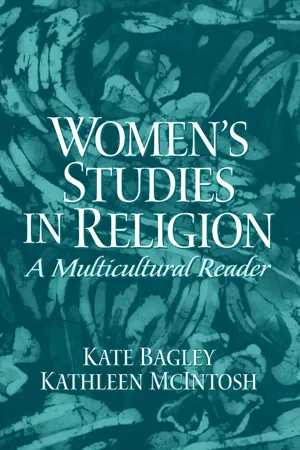
Women's Studies in Religion: A Multicultural Reader uses essays written by today's most respected feminist voices to examine the impact of contemporary feminism on the practice and study of religion. Many in the field have expressed the need for a reader that is both accessible to undergraduates who have little background in the study of religion and that shows the transforming impact of feminism on the religious lives of American womean. This book meets that need.
- 256 pages
- English
- ePUB (mobile friendly)
- Available on iOS & Android
eBook - ePub
Women's Studies in Religion
About this book
Information
PART I

STARTING FROM EXPERIENCE
It is an unforgettable, irreversible, and definitive fact of feminist experience that respect for women’s experience/voice/perception/knowledge, our own and others’, is the ground and foundation of our emancipation—of both the necessity and the possibility of rewriting, recreating, the world.—MARILYN FRYE, “The Possibility of Feminist Theory”
Marilyn Frye describes the feminist enterprise as the creation of an “encyclopedia” entitled The World, According to Women. Each woman’s experience, especially when shared with other women, serves to illuminate patterns within her own life and the lives of some other women, spiraling out to reflect the “world” to which Frye refers. These patterns become “an anthology, a collection of tales, unified, like any yarn, only by successively overlapping threads held together by friction, not riveted by logic” (Frye 1993, 111).
The “collection of tales” in this part illustrates in several ways the significance of experience for feminist religious thought. These authors recognize that biographical differences as well as differences in social location (culture, gender, social class, racial/ethnic status, and sexual orientation) create contexts that affect the nature of women’s experiences of religion. Experiencing discrimination as a member of an oppressed group can lead to a reexamination of religious doctrine and imagery that may have contributed to that oppression. The beliefs, practices, and symbols of one religion may be rejected as unredeemable, they may be changed to speak to a group’s experience, or they may be combined with different symbols to create “moods and motivations” (Geertz 1966: 4) that resonate with one’s way of life. In societies in which women and men live very different lives, in which, in a sense, they inhabit different “worlds,” it is fair to speak of women’s religion as distinct from men’s. Although “men’s religion” may be the dominant narrative in many societies and may define women and their roles as being of lower value than men’s, we should not assume that most women accept those definitions or that they agree with the ways in which men interpret religious doctrine and symbols.
Korean theologian Chung Hyun Kyung’s “Following Naked Dancing and Long Dreaming” illustrates through the author’s dramatic personal story the claim of feminist theology that women’s own experience should be the primary source and touchstone of that theology. The author credits a variety of religious traditions, including indigenous belief systems as well as Buddhism and Christianity, with helping to uphold and sustain women whose lives are demeaned by a patriarchal society. Chung argues that the fullness of women’s religious lives cannot be appreciated by focusing on their exclusion from formal roles or lack of systematic training in doctrine—a point that will receive further development, within a different cultural context, in the selection by Leila Ahmed. The garden imagery in this essay and the title of the volume in which it first appeared will be recognized by many as an allusion to Alice Walker’s feminist classic, In Search of Our Mothers’ Gardens (1983).
Leila Ahmed, who is Egyptian by birth, writes in the selection from A Border Passage: From Cairo to America of the life she shared with the women of her extended family in Alexandria, where her family summered, and at her grandmother’s house in Zatoun. It is in this context that she distinguishes between “men’s Islam,” which she calls an official, textual heritage, and “women’s Islam,” characterized as a moral ethos and “a way of being in the world.” She is keenly and painfully aware that it is “men’s Islam” that holds authoritative sway over the lives of women in the Islamic world. At the same time, her personal narrative reveals the way in which the “women’s Islam” of her own family and childhood continues to inform her life.
Ahmed’s approach contrasts sharply with that of Muslim scholar Riffat Hassan, whose selections appear in Part II. This contrast should serve to break down notions of Muslim belief as being monolithic, as well as to draw connections to the way in which Jewish and Christian scholars are engaging their respective traditions.
Ahmed comes to Western feminism as an outsider, having arrived in the United States in 1979 to teach in a women’s studies program. In this piece she also addresses the issue of the hostility she has experienced from within the community of feminist scholars to the study of women in Islam. This topic may well engender debate—among those who hold the view that Islam is unremittingly hostile to women’s interests, for example.
In excerpts from White Women’s Christ and Black Women’s Jesus, Jacquelyn Grant analyzes and expands Christian feminist theology by focusing on the triple oppressions of racism, sexism, and classism affecting Black women. Grant argues that feminist theology, which she labels white and racist, does not reflect the struggles of African American women. She outlines a womanist theology that grows out of Black women’s experiences in the world and in the church. Both the Bible and Jesus are central to womanist theology because both have been, and continue to be, important for Black women. Thus, a womanist theology is a “contextualized” theology, rooted in the world of African American women and in their experiences of racism, sexism, and classism. Grant’s assertion of the reality of a Black Jesus is bound to spark discussion and controversy. She also confronts the sexism embedded in Christianity and in the Black church, and celebrates women’s efforts to find new ways of reading scripture and creating symbols that are representative of their lives.
In “Mediations of the Spirit: Native American Religious Traditions and the Ethics of Representation,” Inés Hernández-Ávila, whose cultural heritage is Nez Perce and Mexican, raises troubling and challenging questions about how Native American religious traditions can be preserved without being misrepresented or commodified by non-Native scholars or by participants in New Age spirituality. Her emphasis on personal experience and social location as sources of authority and authenticity resonate with other voices in this collection. Noting that Native American women have not embraced feminism, Hernández-Ávila is critical of feminists who claim solidarity with all women, while ignoring Native women or trivializing their culture. She is particularly disturbed by the expropriation of Native American sacred beliefs and practices by non-Native women seeking an authentic, “feminist,” earth-centered spirituality.
Kwok Pui-lan, the author of “Mothers and Daughters, Writers and Fighters,” is a native of Hong Kong who came from a family in which the two sons were favored over the five daughters. She saw the contradiction between the low value placed on girls and women on the one hand, and the power and independence of her illiterate but creative mother on the other. Kwok’s mother and mother-in-law were strong women who refused to see themselves as victims of the oppressive patriarchal society in which they lived. They used Buddhism and folk religion as sources of power and managed to live with integrity under difficult conditions. Kwok’s Christianity became a similar source of strength and she found a role model in a female pastor who saw men and women as equals and who encouraged women to reach their potential.
The new theology Kwok proposes would include life stories and women’s wisdom along with scripture and tradition. She insists that the Western heritage Christianity represents need not exclude religious insights from other cultures. She hopes for a Christianity that can be integrated (“indigenized”) into Chinese culture, despite Christianity’s patriarchal bias and its problematic history in China.
Fran Leeper Buss’s Forged under the Sun is an oral history—a work in which an individual narrates her life story in an edited context. Buss’s role as editor is one of feminist advocacy, as well as providing historical background and a narrative framing the subject’s account. The voice that speaks in the text is that of Maria Elena Lucas, a Mexican American farm worker from south Texas. Her voice is distinctive in relation to the others represented here, and is particularly well suited to introduce questions of class as well as ethnicity in the context of feminism and religion. Lucas is an individual whose formal education was cut short in the sixth grade, and her theological speculations, though thematically similar to those of many feminist theologians, are entirely experience-based. They reflect the speaker’s confrontation, in both childhood and adulthood, with the reality of male violence, as well as her struggle for self-expression under highly constrained circumstances. In the excerpt presented here Lucas attempts to reappropriate the image of the Virgin of Guadalupe as a positive, empowering model for herself and other women. In language reflective of personal and collective struggle, she seeks to imagine how a powerful cultural symbol might be reinterpreted so as to support female empowerment and transformed gender relations within her community.
The final piece in Part I, “Challah for the Queen of Heaven,” is perhaps the best example of what might be called a postmodern perspective in this collection. Drawing on feminism, traditional Judaism, and Paganism, Ryiah Lilith constructs a kind of syncretic, highly personal spirituality that does not require an external entity to validate it. Her aim is to incorporate goddess spirituality, specifically witchcraft, with the Judaism that is an important part of her heritage.
This piece graphically illustrates the contemporary fragmentation of religious tradition as individuals select, from a variety of sources, those elements that speak to their personal experience. The tension between experience and tradition, as well as between individual and community, is palpable in Lilith’s account of her own spiritual search. Paradoxically, embracing Paganism, as she asserts, has enabled Lilith to confirm and express her Jewish identity. Paganism attracted Lilith, in part, because of its “lack of dogma and authority”; this selection by a twenty-something feminist raises questions about whether “religion” loses its definition in the absence of some form of institutional authority and shared beliefs.
References
Frye, Marilyn.1993. The possibility of feminist theory. In Alison M. Jaggar and Paula S. Rothenberg, eds., Feminist Frameworks, 3rd ed., 103–112. New York: McGraw-Hill
Geertz, Clifford. 1966. Religion as a cultural system. In M. Banton, ed., Anthropological Approaches to the Study of Religion, 1–46. London, UK: Tavistock.
Walker, Alice. 1983. In Search of Our Mothers’ Gardens: Womanist Prose. San Diego, CA: Harcourt Brace Jovanovich.
Following Naked Dancing and Long Dreaming*

“Mom, stop it!”
I screamed at her, but she did not look at me. She continued her dance, moving nearly naked in the forest. I felt ashamed of her; I wished she were not my mother. There was nothing to hide the scene before me. There was a deathly silence around us, except for Mother’s singing and the sound of the river.
Under the hot sun of August, the forest seemed to be taking a nap. There were no villagers moving about, only Mother and I. She looked like a person who did not belong to this world. I saw real happiness in her face while she was singing and dancing. I could see her breasts, the lines of her body—large, like a whale’s—through her wet underwear. I did not want anybody in the world to see that shape, my mother’s body that had worked and lived. I finally started to cry out of extreme embarrassment. I wanted to hide from her. She did not look anymore like the noble mother of whom I was always proud. But in spite of my crying, she continued singing and dancing, twirling in the forest as a child might, twirling and dancing in a space of her own.
This happened twenty-four years ago, when I was seven. My mother and I were traveling together to visit her older sister, who lived in a small, remote village in a southern province in Korea. My father was deeply involved with his business and had remained at home in Seoul. I had been raised in a big city, and traveling to a remote village was not easy for me. No bus or train service was available. We had to go over the mountain and cross the river. I was exhausted from walking so long on the dusty road under a hot summer sun. Mom had been telling me stories from her childhood as we were walking—how she had played in the river and climbed the mountain with her sisters. So when we came to the river, Mother’s memories came to life and she took off her clothes and started to bathe in the water. She encouraged me to bathe with her. I was shocked. How could she do this? I looked to see whether there were any other people around. No one was there. I did not approve of my mother’s behavior at all. I hoped she would finish her bathing as soon as possible. I sat on the riverbank and waited.
At last she got out of the water, but the situation only grew worse. She began singing a song I had never heard before. She danced while she was singing. I thought my mother had gone crazy; otherwise she would never have acted like that. Humiliation and confusion made me cry. “Mom, stop it, stop it!” I screamed, but she continued to dance and sing, her body flopping and straining against the dampened clothes. I could not stop the tears from coming, and we stayed like that—me crying and her dancing—for some time. After a while, because of my contin...
Table of contents
- Cover Page
- Half Title Page
- Title Page
- Copyright Page
- Table of Contents
- Preface
- Introduction
- Part I Starting from Experience
- Part II Confronting Tradition
- Part III Embodying Our Hope
- Index
Trusted by 375,005 students
Access to over 1.5 million titles for a fair monthly price.
Study more efficiently using our study tools.
Frequently asked questions
Yes, you can cancel anytime from the Subscription tab in your account settings on the Perlego website. Your subscription will stay active until the end of your current billing period. Learn how to cancel your subscription
No, books cannot be downloaded as external files, such as PDFs, for use outside of Perlego. However, you can download books within the Perlego app for offline reading on mobile or tablet. Learn how to download books offline
We are an online textbook subscription service, where you can get access to an entire online library for less than the price of a single book per month. With over 1.5 million books across 990+ topics, we’ve got you covered! Learn about our mission
Look out for the read-aloud symbol on your next book to see if you can listen to it. The read-aloud tool reads text aloud for you, highlighting the text as it is being read. You can pause it, speed it up and slow it down. Learn more about Read Aloud
Yes! You can use the Perlego app on both iOS and Android devices to read anytime, anywhere — even offline. Perfect for commutes or when you’re on the go.
Please note we cannot support devices running on iOS 13 and Android 7 or earlier. Learn more about using the app
Please note we cannot support devices running on iOS 13 and Android 7 or earlier. Learn more about using the app
Yes, you can access Women's Studies in Religion by Kathleen McIntosh,Kate Bagley in PDF and/or ePUB format, as well as other popular books in Politics & International Relations & Religion. We have over 1.5 million books available in our catalogue for you to explore.