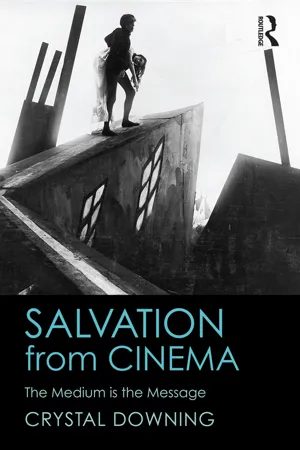
Salvation from Cinema offers something new to the burgeoning field of "religion and film": the religious significance of film technique. Discussing the history of both cinematic devices and film theory, Crystal Downing argues that attention to the material medium echoes Christian doctrine about the materiality of Christ's body as the medium of salvation. Downing cites Jewish, Muslim, Buddhist, and Hindu perspectives on film in order to compare and clarify the significance of medium within the frameworks of multiple traditions. This book will be useful to professors and students interested in the relationship between religion and film.
- 204 pages
- English
- ePUB (mobile friendly)
- Available on iOS & Android
eBook - ePub
About this book
Information
Theories of Film Salvation
1
Let There Be Enlightenment
Salvation from Religion and Film
In the beginning was cinema. Related to kinesis, Greek for movement, the word cinema resonates with the beginnings cited at the start of the Hebrew Bible. In the first chapter of Genesis we read, “And the Spirit of God moved upon the face of the waters. And God said, ‘Let there be light: and there was light.’”1 The moment of creation combines movement, light, image, and the spoken word: basic components of narrative cinema. But that is not all: “God saw the light, that it was good” (v. 4a). God’s act of seeing, repeated seven times in the first chapter of Genesis, is essential to the work of creation. Similarly, the act of seeing is essential to the creative work of cinema, to the recognition of what is good.
Ironically, the majority of books extracting salvation from cinema talk more about what movies tell us through well-crafted story lines than about the artistry one can see on screen. They discuss religious and philosophical implications of things people say and do in movies, while largely ignoring what cinematic techniques say and do. As a result, they miss much of what is good about cinema. This chapter therefore outlines the genesis of cinema in order to explain the importance of theological/religious responses to it.2 The chapter ends suggesting how attention to the cinematic medium might enrich the burgeoning field known as “religion and film.”
Let There Be the Lightbulb
As mentioned in the introduction, Marshall McLuhan singled out the lightbulb as a life-altering medium that changed the way people viewed reality. As well as inspiring McLuhan’s aphorism “the medium is the message,” the lightbulb made possible what McLuhan calls the “hot medium” of moving pictures.
In the nineteenth century, numerous inventors tinkered with primitive forms of an electric lamp, starting with British chemist Humphry Davy in 1802. In 1840 another British chemist, Warren de la Rue, actually created the first light-bulb, but it wasn’t until 1880 that the first incandescent lightbulbs, developed by Joseph Swan, lit up homes in England. Meanwhile, in America Thomas Edison was also perfecting a lightbulb, seeking his first patent in 1878, the same year that Swan unveiled his bulb at a British chemical society meeting. Though the Edison and Swan electric companies joined forces for several years, it was Edison who saw a future in moving images projected in front of a lightbulb.
Film history owes much to Edison’s visionary materialism. Edison realized that inventions needed structures of support to make them marketable. Hence, he is often credited with “the invention of the lightbulb” because he understood that electricity needed to be grounded not just physically, but also economically. Providing generators and distribution systems, Edison made the lightbulb a viable commodity for consumers. That was also his goal for moving pictures.
When Edison commissioned one of his lab assistants, William Dickson, to develop a moving picture camera, he did so in order to make money off an earlier invention: his 1877 phonograph. Intended to accompany phonographic sound, moving pictures would enable Edison to sell his device to a whole new generation. Dickson therefore developed a camera with a stop-motion device that exposed each frame in a roll of celluloid to light, pulling the roll through the camera via sprocket holes punched into the film. To enable viewing, the process went in reverse: light was projected through the film as it moved inside a viewing box. Unfortunately, Dickson and Edison failed to fully synchronize those moving images with phonographic sound.
Edison therefore conceptualized another way to make money, asking Dickson to perfect a device through which individuals might view the soundless moving pictures. While Dickson’s machine for recording reality was called a Kinetograph, the machine through which the recording could be watched was called a Kinetoscope: a contraption about four feet high into which an individual looked through a peep-hole at a continuously running film loop.
The words Kinetograph and Kinetoscope, of course, return us to the Greek word for movement that began this chapter: kinesis. What Edison saw as “good,” however, was not creation for its own sake. By 1894, he was successfully selling Kinetoscopes to viewing parlors all over the country. Convinced about the financial potential of moving images, Edison next sought to purchase competitors’ patents for new inventions, hoping to monopolize the cinematic marketplace as film viewing transitioned from Kinetoscope peep-boxes to screen projection.
It was a losing battle. By 1908, at least twenty filmmaking companies had been established, all motivated by profit. Most people who worked for film “manufacturers” therefore saw themselves not as contributors to a creative medium but as assembly-line workers in a tawdry commercial enterprise. As Lewis Jacobs puts it in The Rise of the American Film,
most of the directors, actors, and cameramen who had come to the movies were more or less ashamed of their connection with them; they stayed in their jobs because they needed work, and they gave little thought to the medium’s possibilities or opportunities. Nearly everyone still regarded movie making as a shabby occupation.3
Even after production companies moved from the East Coast to Hollywood (between 1907 and 1913), studio chiefs “saw their business as basically a retailing operation modeled on the practice of Woolworth’s and Sears.”4 It’s just that, rather than mass-producing clothing, they were stitching together off-the-rack movies, some studios at the rate of three to four per week.
The Studio System: Block Booking and Screen Idols
Considering movies to be more like amusement park rides than works of art, early production companies often did not list actor names in the credits. Even Mary Pickford (1892–1979), considered the most powerful female celebrity during the silent era, initially appeared in over fifty films without credit, known only to adoring fans as “Little Mary,” the name of a character she played. Lured to a new studio in 1911, she finally got screen credit, and when she switched to Paramount she became a superstar. After a 1918 popularity poll established her as one of Paramount’s top six actors, the studio allowed theaters to show a Pickford film only if they simultaneously contracted for multiple mediocre movies. Paramount thus established financial obligations on both ends of production: stars were contractually obligated to only appear in its films, and theaters were contractually obligated to show dozens of second-rate Paramount movies in order to get one star vehicle.
By the 1920s, most American production companies had followed suit, instituting a system called “block booking.” Studio heads told movie exhibitors that, in order to book one of the studio’s star-studded high-cost films, theaters had to “book” in advance a whole “block” of low-cost movies sight-unseen. Theater owners were thus forced to show hundreds of quickly made sub-par products in order to make money on several blockbusters.5 Money, not the medium, was their message.
Block booking also intensified what is known as the “star system.” Because the celebrity vehicles were few and far between, greater and greater value accrued to the stars themselves. As a result, the material conditions of those stars off-screen— whom they married, where they lived, how they partied—became as important to viewers as (if not more so than) the movies in which the stars appeared. When Pickford and her Paramount co-star Douglas Fairbanks married in 1920, they were mobbed by rioting fans in London and Paris during their honeymoon. The “star system” thus became materialistic both economically and philosophically: garnering money for studios, the material bodies of actors drew more attention than either the artistry of the medium or the profundity of the message.6
Significantly, the same year Paramount initiated block booking, it distributed a Mack Sennett comedy called Her Screen Idol. It was 1918, a mere seven years after Pickford got her first screen credit. The word idol, of course, is revealing. Something becomes an idol when its material presence predominates over its spiritual or intellectual significance. For example, in the book that follows Genesis in the Hebrew Scriptures, Israelites set up a golden calf after they were told not to look at God on Mount Sinai (Exodus 19:21). Hence, even though the Israelites saw Aaron artificially construct the calf (Exodus 32:4), they found its materiality more comforting than the unseen God who enlightened Moses on Sinai.7
Something similar could be said about “screen idols.” They are artificial constructions insofar as they became identified with the false fictions they portray on the screen. Indeed, fans sometimes address actors by their screen character names. And those same fans pay for the movies that cast their screen idols— just as the Israelites contributed their own gold so that Aaron might cast the golden calf (Exodus 32:3). Screen idols are false gods created by the worshippers themselves.8 To this day, many news and social media outlets celebrate films not according to their artistic quality and/or level of insight but by the screen idols starring in them and/or the money they amass during opening weekend. And studios still show movies to preview audiences, hoping to make changes that might generate greater viewer satisfaction and hence profitability.9
From Idolatry to Gnosticism
Considering how economic materialism has long been at the heart of Hollywood, it should amaze us that many filmmakers value cinematic art, seemingly for its own sake. Since later chapters discuss such artistry, the remainder of this chapter assesses scholarship that intelligently defies the idolatry of Hollywood. Renouncing golden calves, numerous theologians and religion scholars write books directing our attention toward spiritual and intellectual enlightenment.10 However, in the process, many end up reinforcing a controversial claim made by Harold Bloom in 1992: because religion in the USA is based upon right “knowing,” or enlightenment, it has overwhelming gnostic tendencies.11
Gnosticism, which shuns the material world in favor of spiritual enlightenment, has been aligned with multiple religions. Manichaeism, founded by the Iranian prophet Mani in the third century ce, asserted an opposition between the dark material world and the spiritual realm of goodness and light: a dualism that influenced early Christian sects, with which gnosticism is usually aligned. And in her famous book The Gnostic Gospels, religion scholar Elaine Pagels suggests similarities between Christian gnosticism and Buddhism.12
In film studies, some scholars have noted a “gnostic” opposition in film noir between light and dark, good and evil, and others have identified gnosticism in the “Jesus-film tradition,” wherein Jesus’s material body is downplayed in favor of his spirituality.13 I am more concerned, however, about gnosticism within the field of religion and film itself. My following assessment of scholarship in the field, however, should not be read as a dismissal of powerfully intelligent and insightful work. Instead, it justifies yet another book on religion and film. By focusing on religious implications of the material medium, Salvation from Cinema offers something that hasn’t already been published in scores upon scores of books, books that often focus on the same movies in order to extract theological/ religious insight.
I argue that, in their search for enlightenment, Anglo-American theologians and religion scholars often take one of three gnostic approaches to cinema.14 The first privileges transcendence, the second story, the third viewer response. To visualize these approaches I borrow a metaphor from Plato, whose work influenced Christian gnosticism. In his famous allegory of the cave, from Book VII of The Republic, Plato has Socrates present a parable in which prisoners sit inside a “den” watching images projected on the cave wall. As multiple film scholars have noted, this image uncannily anticipates viewers seated inside theaters watching movies on cinema walls.15 In both cases, the moving images are artificial, mere shadows of reality projected via a light-source above and behind the viewers’ heads. Plato even mentions a “screen” over which “marionette players” direct the movement of puppets that create these false pictures. Furthermore, some of the moving images, projected via the light behind them, are “talking, others silent.”16
As far as Plato is concerned, enthralled viewers must be encouraged to turn from artificial images of reality to seek the light of Truth. Such knowledge is painful at first, as when spectators chained to classic Hollywood entertainment are forced to watch an avant-garde or foreign film containing little story and less action. As Plato puts it,
At first, when any of them is liberated and compelled suddenly to stand up and turn his neck round and walk and look towards the light, he will suffer sharp pains; … and he will be unable to see the realities of which in his former state he had seen the shadows.17
Nevertheless, turning toward the light is necessary in order to attain True Ideas that transcend material realities. Significantly, by emphasizing a similar kind of transcendence, theologians in the 1970s and 1980s helped ignite scholarly discourse about religion and film.
The First Gnostic Approach: Cinematic Transcendence
Melanie Wright notes that “serious writing on the religion–film interfac...
Table of contents
- Cover Page
- Half Title page
- Title Page
- Copyright Page
- Dedication
- Contents
- Introduction: Toward a Union of Medium and Message
- Part I Theories of Film Salvation
- Part II Salvation from Film Theory
- Bibliography
- Index
Trusted by 375,005 students
Access to over 1.5 million titles for a fair monthly price.
Study more efficiently using our study tools.
Frequently asked questions
Yes, you can cancel anytime from the Subscription tab in your account settings on the Perlego website. Your subscription will stay active until the end of your current billing period. Learn how to cancel your subscription
No, books cannot be downloaded as external files, such as PDFs, for use outside of Perlego. However, you can download books within the Perlego app for offline reading on mobile or tablet. Learn how to download books offline
Perlego offers two plans: Essential and Complete
- Essential is ideal for learners and professionals who enjoy exploring a wide range of subjects. Access the Essential Library with 800,000+ trusted titles and best-sellers across business, personal growth, and the humanities. Includes unlimited reading time and Standard Read Aloud voice.
- Complete: Perfect for advanced learners and researchers needing full, unrestricted access. Unlock 1.5M+ books across hundreds of subjects, including academic and specialized titles. The Complete Plan also includes advanced features like Premium Read Aloud and Research Assistant.
We are an online textbook subscription service, where you can get access to an entire online library for less than the price of a single book per month. With over 1.5 million books across 990+ topics, we’ve got you covered! Learn about our mission
Look out for the read-aloud symbol on your next book to see if you can listen to it. The read-aloud tool reads text aloud for you, highlighting the text as it is being read. You can pause it, speed it up and slow it down. Learn more about Read Aloud
Yes! You can use the Perlego app on both iOS and Android devices to read anytime, anywhere — even offline. Perfect for commutes or when you’re on the go.
Please note we cannot support devices running on iOS 13 and Android 7 or earlier. Learn more about using the app
Please note we cannot support devices running on iOS 13 and Android 7 or earlier. Learn more about using the app
Yes, you can access Salvation from Cinema by Crystal Downing in PDF and/or ePUB format, as well as other popular books in Theology & Religion & Film History & Criticism. We have over 1.5 million books available in our catalogue for you to explore.