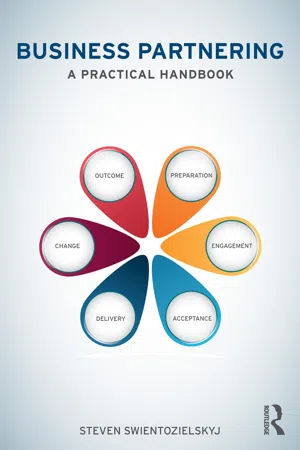
Business Partnering
eBook - ePub

Business Partnering

A Practical Handbook

  1. 208 pages
  2. English
  3. ePUB (mobile friendly)
  4. Available on iOS & Android
eBook - ePub

Business Partnering

A Practical Handbook

About this book

A Business Partner is a professional who supports and advises strategic and operational decision-making through insights that drive better business performance. Often as a result of external changes, business partners must respond quickly to map out the future strategic development, keep the firm competitive and ensure all objectives and legal requirements are met.

In this book, business partnering expert Steven Swientozielskyj introduces a framework that provides a set of practical tools and techniques via a simple six stage model that, when replicated, will take the practitioner from start to finish through strategic change; from the formation and agreement of the strategy to its delivery and sustainability.

Business Partnering is a one-stop shop for understanding this important phenomenon and as such will be vital reading for practitioners and academics in the business arena.
Trusted byĀ 375,005 students

Access to over 1 million titles for a fair monthly price.

Study more efficiently using our study tools.

Information

Publisher
Routledge
Year
2016
Print ISBN
9781138907997
eBook ISBN
9781317440734

1 Introduction to the six-stage generalmodel of business partnering

DOI: 10.4324/9781315694825-1
Introduction – the act of beginning something new.
The whole is greater than the sum of its parts.
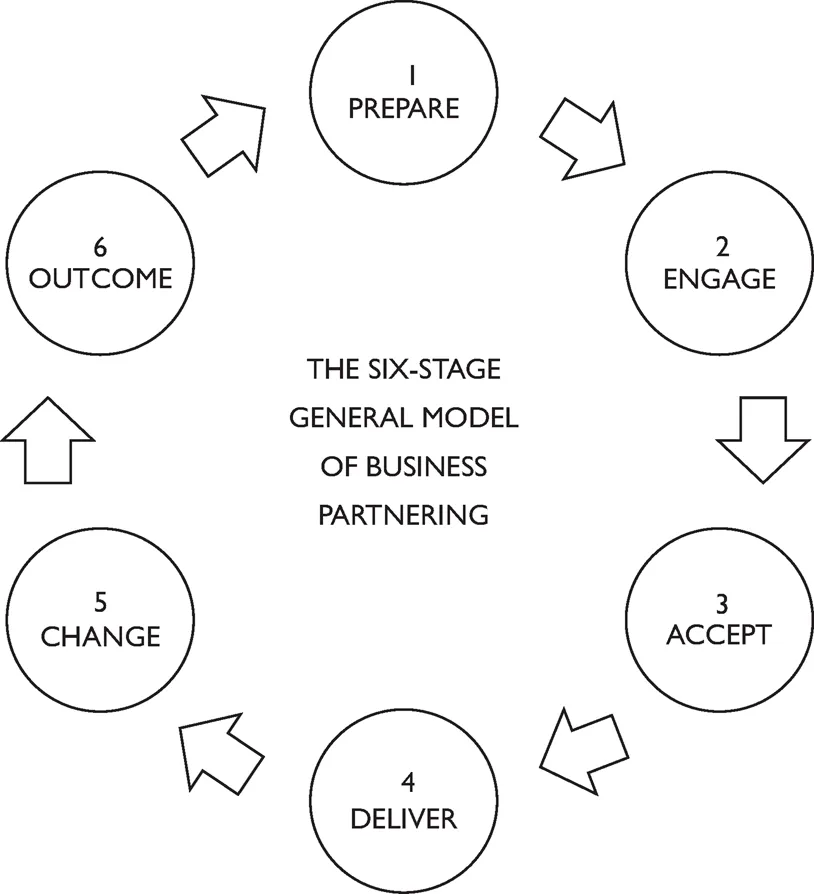
Figure 1.1 Introduction overview: the six-stage model
This chapter provides the context of business partnering and an explanationof the stages of the general model of business partnering.

Knowledge components consideredwithin this chapter

What is it?

  • introduction
  • context and scope
  • historical and current context
  • definitions of stakeholders and business partners.

Why do it?

  • why business partnering is important
  • the three key approaches: control, service, or advisory
  • the overview of the lifecycle stages of a businesspartner.

What is it?

Introduction

The key outcomes for this book will be to support:
  1. individuals who wish to gain a comprehensive understanding ofbusiness partnering;
  2. a new business partner who does not have the requisiteknowledge;
  3. an existing business partner who has identified potentialgaps in knowledge and skills which should be improved orapplied;
  4. the business partner’s line managers;
  5. stakeholders engaging with business partners;
  6. functional business leaders who wish to improve theirbusiness partnering outcomes;
  7. functional business leaders who are considering establishinga business partnering program.
In all of the these cases, increasing knowledge and skills will supportthe resulting outcome of increased applied competence.

Context and scope

The context of the general partnering model will apply to individuals whoare working in organizations, whether profitmaking ornot-for-profit.
The scope includes:
  • a general model for business partnering for theindividual;
  • the model applies to both for-profit and not-for-profitorganizations, the term business partnering can apply toboth;
  • a model based on six stages.
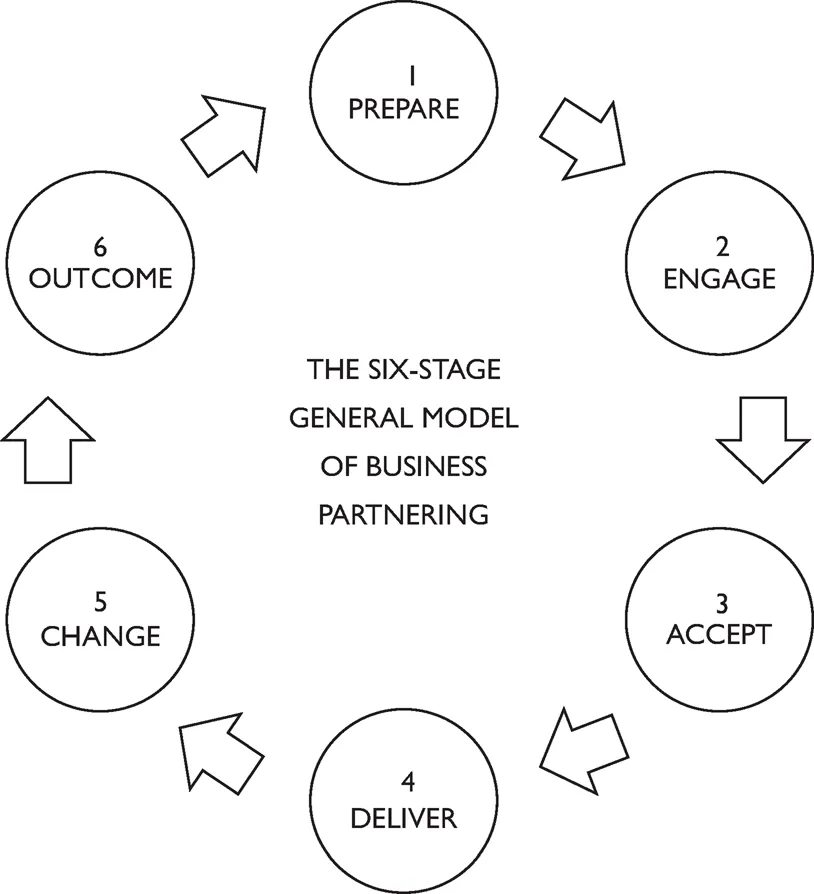
The six stages of the general modelare:

The preparation stage (Chapter 2)

Chapter 2 will outline the initial preparation required by thebusiness partner, the teams that they must engage with, andengagement with the organization as a whole.
The initial individual preparation process should support theself-review of the skills, knowledge and competences that may berequired. Self-review, or self-assessment is the process ofevaluation of one’s skills, capabilities, attitudes andperformance. This is the starting point of efficient preparation.This self-insight will help to support the initial assessment ofwhat the stakeholder power base might be, to assess thestakeholder’s team’s needs, and to assess the style thatmay be the most appropriate to adopt. The requirements of thebusiness partnership relationship can therefore be developed andthen established from an initial firm foundation of understandingthat will support a strong bonding or ā€˜contract’ withtheir stakeholders. This will support the organizationaloutcomes.

The engagement stage (Chapter 3)

The engagement stage establishes the engagement process, servicecontent and emotional contract with the stakeholders. The engagementprocess is a method, and should be on-going rather than a singleoccurrence; the initial engagement is critical to developing aneffective long-term relationship. The service content is framed bytwo simple boundaries. What are the technical demands required fromyour partner and what you can supply as a business partner. Theemotional contract includes the attitudes, beliefs, perceptions andtrust that both parties will share with each other. A significantoverlap of the concepts behind the context will support theestablishment of a contract based on trust. This tends to operate ata subconscious level between both parties.

The acceptance stage (Chapter 4)

This includes the management of conflict, acceptance and integrationissues that business partners face. Although there may be a firmagreement from the outset of the relationship, conflicts will occurdue to a variety of factors and these will be explored in moredetail within Chapter 4. Acceptance occurs when both parties sharecommon aims, objectives and goals that they wish to achievetogether. These are bound by a condition of mutual satisfaction byboth parties. Integration is the degree in which the aims,objectives and goals are unified and assimilated.

The delivery stage (Chapter5)

This includes the review of business, delivery and operating modelsthat can be applied. It defines the type of delivery that includesgoals, aims, targets, outcomes, outputs and objectives including theconstraints and enablers that may apply. Within these delivery typesa variety of potential delivery models are then considered. Thesevary from strategic goals to individual and team objectives. Thefundamental paradigm for the business partner is their valueproposition and contribution towards effective delivery oforganizational operations.

The change stage (Chapter 6)

This includes the review of strategic, tactical and operationaldrivers that dominate change. Strategies of dealing with resistanceand supporting positive engagement are explored. Change is poweredby strategic, tactical, and operational causes; these impact on theattainment of the change requirement being pursued. Applying theoptimum change model(s) will enhance success and mitigate the risksof failure. Change is to move from an old state to a new state. Whatcauses and drives changes, what resistance might be expected, andhow to overcome them are reviewed. More positively, the enablers ofpositive and successful change are defined and explored with therelevant methodologies that can be applied.

The outcome stage (Chapter 7)

The personal outcomes for the business partner are interrelated withthe stakeholder, their teams and the organizational outcomes. Theoutcomes of any operating model will impact the personal outcomesfor the business partner and these will include their own financialand non-financial rewards. Additionally the business partner’spersonal development, trust and their ethical standards will havebeen enhanced. The alignment of these to those of the stakeholderand their teams towards organizational alignment creates a powerfulline of sight for the outcomes being aimed for or targeted. Thereview of how the knowledge, skills and competences relate tocurrent and new operating models is considered. In addition theentity outcomes that relate to organizational, stakeholder and teamexpectations of the outcomes to be delivered are reviewed.
The general model, by definition, is not functionally ororganizationally based. However, the discussion will refer to casestudies and examples where they can provide deeperunderstanding.

Historical and current context

The emergence of added value for partnering

The business partner concept emphasizes a move towards added valueteamwork and specialization, rather than focusing on a range ofdiverse general skills and requirements of multiple interested parties. Yet, if we reach backin time where does the concept of specialization of activitiesoccur?
Figure 1.2 Explanation six-stage model overview
Aristotle lived in ancient Greece from 384–322 bce.His writings covered many different subjects and are the source ofmany well-known quotes, one of which is used in business ā€˜thewhole is greater than the sum of the parts’. Teamwork betweenpartners can deliver much greater outcomes than an individual can.This is an emerging argument for the concept of added value.

The emergence of specialization

Adam Smith in his book The Wealth of Nations (1776)defines the causes of improvement in the productive powers oflabour. This has been a driver for wealth creation for nations. Thegrowth of business partnering has been driven by many organizationsthat need to achieve improvements. There is still current relevancetoday from Smith’s historical work in relation to businesspartnering.
The key elements of how it relates to the growth of businesspartnering are:
The division of labour
Division of labour has been one of the great drivers ofincreasing productivity. This is based on:
  • improving the knowledge, skill, and experience ofstaff to increase the quantity of the work they canperform;
  • reducing staffactivities to core operations, and making theseoperations the sole focus will increaseproductivity;
  • creating a sensible balance of how much experiencedstaff is supported with by applying the properprocesses.
The specialization of labour
Specialization of labour will:
  • increase the competences and skills of theindividual;
  • improve co-operation by using the sum ofeveryone’s talent, which in turn will increaseproductivity.
The division of labour is limited by size
The context for business partne...

Table of contents

  1. Cover Page
  2. Half Title Page
  3. Series
  4. Title Page
  5. Copyright Page
  6. Dedication
  7. Contents
  8. Figures
  9. Tables
  10. Preface
  11. Acknowledgements
  12. Abbreviations
  13. 1 Introduction to the six-stage generalmodel of business partnering
  14. 2 Preparation – the first stage
  15. 3 The engagement stage
  16. 4 The acceptance stage
  17. 5 The delivery stage
  18. 6 The change stage
  19. 7 The outcomes stage
  20. 8 The final recap
  21. Glossary
  22. Index

Frequently asked questions

Yes, you can cancel anytime from the Subscription tab in your account settings on the Perlego website. Your subscription will stay active until the end of your current billing period. Learn how to cancel your subscription
No, books cannot be downloaded as external files, such as PDFs, for use outside of Perlego. However, you can download books within the Perlego app for offline reading on mobile or tablet. Learn how to download books offline
Perlego offers two plans: Essential and Complete
  • Essential is ideal for learners and professionals who enjoy exploring a wide range of subjects. Access the Essential Library with 800,000+ trusted titles and best-sellers across business, personal growth, and the humanities. Includes unlimited reading time and Standard Read Aloud voice.
  • Complete: Perfect for advanced learners and researchers needing full, unrestricted access. Unlock 1.4M+ books across hundreds of subjects, including academic and specialized titles. The Complete Plan also includes advanced features like Premium Read Aloud and Research Assistant.
Both plans are available with monthly, semester, or annual billing cycles.
We are an online textbook subscription service, where you can get access to an entire online library for less than the price of a single book per month. With over 1 million books across 990+ topics, we’ve got you covered! Learn about our mission
Look out for the read-aloud symbol on your next book to see if you can listen to it. The read-aloud tool reads text aloud for you, highlighting the text as it is being read. You can pause it, speed it up and slow it down. Learn more about Read Aloud
Yes! You can use the Perlego app on both iOS and Android devices to read anytime, anywhere — even offline. Perfect for commutes or when you’re on the go.
Please note we cannot support devices running on iOS 13 and Android 7 or earlier. Learn more about using the app
Yes, you can access Business Partnering by Steven Swientozielskyj in PDF and/or ePUB format, as well as other popular books in Business & Business General. We have over one million books available in our catalogue for you to explore.