- 224 pages
- English
- ePUB (mobile friendly)
- Available on iOS & Android
eBook - ePub
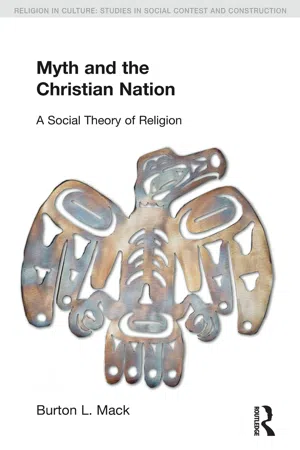
Myth and the Christian Nation
About this book
America is widely regarded as the ultimate "Christian Nation." Religious language has always been at the forefront of American politics but this has increased since the events of 9/11. 'Myth and the Christian Nation' presents a startling analysis of how and why Christianity and national identity have been woven together in recent American political discourse. Drawing on examples of religious myth-making across the ancient world 'Myth and the Christian Nation' brings the weight of history to bear on America today, a place where myth, monotheism, sovereignty and power can be harnessed together in the service of specific interests. The book invites readers to rethink the role of religion in the construction of social democracy and to see America afresh.
Information
The Religions of Other Peoples
1 Looking for Religion in the New World
When Columbus landed in 1492 on Guanahani, an island in the outer ring of the Bahamas which he christened San Salvador, the “Age of Discovery” began. The discoveries were of lands and their peoples that had not appeared on older maps of the world. Instead of the three familiar continents there was now a “new world” to challenge the tripartite conception. And instead of the older classification of the peoples of the three continents, derived from the three sons of Noah in Genesis 10, there was now another kind of people not mentioned in the Bible. As Columbus wrote in his log: “These people have no religious beliefs, nor are they idolaters. They are very gentle and do not know what evil is… They have no religion” (Diario, 143). They came to be called “Indians,” in keeping with the purpose of Columbus’s voyage to reach the Spice Islands of India by sailing west instead of around the continent of Africa, but it was soon clear to others that he had reached lands and peoples very different from those he had hoped to find. That did not keep Columbus or the other explorers of the sixteenth and seventeenth centuries from claiming the lands for the kings and queens of Europe, or from treating the natives as subjects of their sovereigns.
Columbus thought he had circumnavigated the world and landed in the Spice Islands, one of the sources of luxurious and exotic trade goods from the East. Another was China, the kingdom of the Kubla Khan, well known by now from the travels of Marco Polo in the thirteenth century and the lore about the Silk Road. But these goods—silk and spices—could be acquired only by laborious overland caravans or by sailing around the southern cape of Africa. Since Marco Polo had been by land to the easternmost limits of the oikoumene (“inhabited world”), beyond which lay ocean, once the notion that the earth was round had been accepted, it was possible to imagine sailing around the world from the western shores of Europe and its offshore islands to the eastern shores of the oikoumene and its offshore islands. The lands and seas had now been charted on the Catalan Map of the world, the one used by Henry the Navigator and Columbus. Where else could Columbus have landed after sailing due west except on the eastern shore of Asia?
Columbus persisted in thinking that he had reached the shores of Asia, despite the many differences in geography, flora, fauna, and people encountered, and the failure to find anything like the great Khan and his kingdom. But others soon realized that these lands were “new,” previously unknown to Europeans. The story of attempts to find some place for them on the old maps, or to revise the old maps without having to acknowledge that they were faulty and incapable of containing the new information about the shape of the world, can be found in an essay by Jonathan Z. Smith, “What a Difference a Difference Makes.” His study reveals an amazing stretching of the imagination of sixteenth-century Europeans in order to accommodate the reports of distinctive features of a geography and peoples that differed from those familiar to them. They unleashed an intellectual project of historic consequence for Western thinking, the beginnings of what we have come to call the academic disciplines devoted to research in the earth sciences, biological sciences, social sciences, and histories of the natural and cultural worlds. Our present study will be limited to just one discipline and set of categories generated by the discovery of the New World, those that focus upon peoples and their religions.
Peoples without Religion
Of particular interest for the subsequent quest of Europeans to understand another people and their religion is Columbus’s observation that the natives of the new world had no religious beliefs and no idolatry. This is a theme repeated many times in the diary of the first voyage. In the European world of the fifteenth century, Christianity was the definition of religion, although it was known that other people also had religions, such as Judaism, Mohammedanism, and the religions of India and China. These, however, were regarded as false religions, and a fourfold classification of religions was still standard in the seventeenth century, namely “Christianity, Mohametanism, Judaism, and Idolatry.” Since Christianity was taken for granted as the true religion, and all others known at the time were regarded as false religions, there was no need for Columbus to be more specific about the meaning of the term religion. As a category of thought and definition it had only two connotations: true and false. But to find neither religious beliefs nor idolatry among the natives of the new world confounded even this traditional classification. From reading his logs, it is clear that Columbus was having trouble comprehending how this could be. Again and again he mentioned that the Indians did not have items that belonged to the European conception of Christianity, a conception that had assimilated many of the customary marks of imperialist culture, such as clothes (they were naked), buildings (they had only palm-thatched tents that reminded him of Moorish military camps), weapons, iron, worship, prayers, agriculture, law, and a knowledge of evil. Thus the Indians had no (true) religion, but neither did they have “false religion nor are they idolaters.” This astonishment was registered many times by subsequent explorers and historians (J. Z. Smith, “Religion”). And so it was that the discovery of peoples who had no religion was to become the occasion for the study of religion in the next several centuries. The first response, of course, was to think of these indigenous peoples as in desperate need of religion and civilization. Thus the request to “Your Highnesses” to send “devout religious persons…to convert the Indians…to increase the Holy Christian Religions” (Diario, 141). It was not long, however, before Cortez landed at Vera Cruz in 1519 and discovered an advanced civilization of the Aztecs that did not match either the Christendom of the European kingdoms or the civilizations of the Muslims and other peoples to the east of Europe. The encounter resulted in conflict, as did the incursion of Pizarro into the Inca empire of Atahuallpa in 1532 (Diamond, Guns, Germs, and Steel, 61–82). The Incas were considered “infidels,” and the explorers became conquistadors. Scribes and priests commissioned to record such explorations found themselves curious about the “heathens” and began to keep diaries with their observations of native practices, a sort of primitive ethnography.
During the sixteenth and seventeenth centuries exploration turned to colonization and the sending of missionaries throughout the Americas and the Pacific Islands. In 1524 the Franciscans arrived in Mexico. In 1531 Zumarrage, the first archbishop of Mexico, reported the destruction of 500 heathen temples. In 1537 Pope Paul III declared that the American Indians were entitled to liberty and property, but that did not mean the missions to convert them were wrong. In 1540 he approved the foundation of the Jesuits, who then launched their many missions, from India to the Americas. Some voices were raised to question these designs upon the New World peoples. The lectures of Francisco de Vitoria at Salamanca from 1527 to 1540 criticized the conquest of the Indies on the basis of moral considerations. And in 1552 Bartholomé Las Casas, a Spanish historian and missionary to Hispaniola, published his account of the oppression of the Indians. But the conquests and missions continued, as did colonization throughout the seventeenth century. In 1620 the Mayflower landed at Plymouth Rock, and by the end of the century the Society for the Propagation of the Gospel in Foreign Parts was founded in London (in 1701). The logs, letters, and treatises describing the indigenous peoples from the new world and beyond began to stack up back home in Europe.
These reports, many written by Christian missionaries, entered an arena of intellectual ferment in Europe. The ferment was partly the result of the Renaissance and its new appreciation of the natural world and partly was created by the Protestant reformers and their critique of the Catholic tradition. Luther’s replacement of Catholic religion with his doctrine of “justification by faith alone” became the basis for the distinction later German theologians and scholars would make between “religion” (Catholicism) and “faith” (Protestantism) as two types of Christianity. This distinction did not immediately affect the reading of the ethnographic reports with their detailed observations of Indian practices and attempts to describe their beliefs. It did, however, contribute to the questions soon to be raised about religion, both theirs and that of Christianity, by scholars on the threshold of the Enlightenment. The intellectual excitements of the seventeenth century included the advances in astronomy and science made by Copernicus, Galileo, and Newton; the “Book of Nature,” as Galileo called it, that began to unfold as the field of mathematics was applied to the natural environment; and the distribution of knowledge made possible by the invention of the wooden printing press. It was becoming clear that there were many peoples in the world, from Africa to the south and the Canary Islands off its western coast through the Americas and the islands of the Pacific to the shores of Asia, who were living in communities with strange practices, incomprehensible ideas and rites, and without the benefit of “history,” “religion,” “civilization,” a “scientific view” of the natural world, “technology,” and “knowledge of God.” How could that be?
The ferment speeded up during the eighteenth century. Science produced natural philosophy and the Industrial Revolution. The Enlightenment produced rational philosophy, historical research, and social critique. Romanticism produced sensibility for the arts, individual introspection, and cultural critique. Locke’s treatises from the 1690s were being read: An Essay Concerning Human Understanding and The Reasonableness of Christianity. Rousseau wrote on the origin of languages, inequality among peoples, and “the noble savage.” Hume wrote A Treatise of Human Nature and An Enquiry Concerning Human Understanding. It was the age of Goethe, Voltaire, Diderot, the American and French revolutions, and the first of the modern nation-states. This intellectual climate made possible questions about the ways in which humans live in the world, understand their natural environments, think about themselves, and develop different kinds of societies and cultures. Here and there treatises began to appear that tentatively proposed viewing the New World peoples as having “spiritual dispositions” common to humankind, as Fontenelle put it in his De l’origine des fables (1724), a comparative study of Greek and Amerindian myths. It was not until the nineteenth century, however, that major studies appeared which looked for the signs of religion among native Americans.
Signs of “Primitive” Religion
The nineteenth century saw the publication of the Sacred Books of the East by Max Mueller, the corpus of Greek inscriptions, the old Icelandic Eddas (mythological and heroic poetry), portions of the Babylonian creation epic Enuma Elish, the Egyptian Book of the Dead, the Fairy Tales of the Brothers Grimm, and various collections of European folk customs regarded as remnants from pre-Christian times. This interest in exploring the myths and rituals of the past of Europeans, Ancient Near Eastern peoples, and the peoples of India was one of the ways in which Enlightenment scholars stepped outside the orientation to Christian thought and its worldview, which had been determinative for the medieval period. Texts turned into data for the study of other religions, now to be appreciated without the disparagement of being false or inferior to Christianity. And now the ethnographic reports from the Americas could also be compared. The reports from missionaries had become quite detailed, and they were being joined by ethnographies from scholars in the field. Many native tribes were being visited for first-hand observation, questioning, and the recording of their myths, ideas, and ceremonies. The nineteenth century also saw the beginnings of archeological investigations of prehistoric Europe, such as the cave paintings at Altamira in Spain and the beehive tombs of the Peloponnesus. Mannhardt’s collection and study of evidence for Forest and Field Cults in Europe appeared (1875– 77). Frazer’s Golden Bough burst on the scene (1890–1922). It was a twelve-volume compendium on myths and rituals from Late Antiquity, Africa, and elsewhere in which a king is killed and gods die and rise, as Frazer interpreted them. He thought the death–resurrection theme could also be seen in European folk festivals such as the Maypole, the Corn Mother planting and harvest festivals, and the fire festivals at Easter and other times of the year. These interpretations have since been criticized and set aside, but at the time the large collection of texts in these twelve volumes expanded the database for the study of pre-Christian and non-Christian religions, and they were pored over by scholars and others wondering what to think about these primitive practices (J. Z. Smith, “When the Bough Breaks”).
One of the more important observations about nineteenth-century scholarship is that two complementary notions played a role in many of its fields of study. One notion was that of origins, another that of evolution. Darwin published his On the Origin of Species (1859) in the field of natural sciences. Using comparative philology, linguists were looking for the origins of the Indo-Aryan languages. In the study of ancient texts, since the Renaissance and Reformation the earliest was prized. Philosophers went back to the classical texts of ancient Greece for points of departure and anchorage. And Protestants had jumped over the history of Catholicism to land at the beginning and explore the New Testament gospels and the letters of Paul for the pristine origins of the Christian faith uncontaminated by Catholicism. Origins were regarded as definitional and explanatory of later “developments.” The quest was to identify the first words, ideas, texts, myths, experiences, and ceremonies that had generated subsequent traditions and practices. Voilà! The Amerindians and other indigenous cultures of the new worlds could now be given their place in the history of religions at the beginnings of human time. They could now be viewed as “primitives,” a designation that was better than other earlier terms such as “savages,” but one that nevertheless continued to identify them negatively, solely in relation to the “higher” civilizations. The idea was that their religion, supposing they had one and that it was possible to describe it, might well reveal the origins of religion in all its subsequent developments. There was a deep irony in this move, to be sure, one which was hardly noticed. It was that the peoples who did not have religion might end up defining religion in ways that traditional Christians would be unable to recognize.
The medieval schema of human history based on the Bible was still present even if its accounts of the earliest pre-Abrahamic peoples had now to be expanded. In traditional Christian thinking the Bible documented the history of humankind as a progression that started with the creation of the world, had a bumpy start because of the sin and wickedness into which humans fell, to be given a second chance after the flood, but then narrowed in the covenant with Abraham, and finally opened out to Christendom with the advent of Christ. In Protestant thinking, Catholic Christendom was then superseded by Reformed Christianity and the Age of Reason, yielding a three-or fourfold scheme of stages from paganism through the religions of Judaism and Christianity to the Enlightenment. This notion of evolution by stages, initially tied to eighteenth-century theories of the progress of economies of subsistence (hunting to pastoralism to agriculture to commerce), was hardly adequate to account for the transitions from one to the other, but it was accepted as a general schema by rationalist thinking in many fields besides that of the history of religion. Auguste Comte published a course in positive philosophy (1830–42) in which he outlined ways of explaining the natural world in three stages: theological, by attributing creation to the gods; metaphysical, in which the philosophical concept of the absolute accounted for the world; and positivistic explanations in which natural causes were discovered by science. This pervasive origins–evolutionary scheme soon became the way in which the study of primitive peoples was taken up and focused upon the question of their religion.
Since the concept of religion in the minds of Enlightenment scholars was still defined by belief in God as a supernatural being and his worship, it was difficult to imagine that the primitives had a religion. However, the ethnographic literature on primitive societies described the ways in which primitive peoples lived in relation to their natural environments, and these features of their practices appeared to be a kind of “natural religion” or “religion of nature.” In traditional Western thinking, fascination with the mysteries and beauty of the natural world was hardly the way to worship the creator, as Petrarch’s fourteenth-century confession documents. His sense of guilt was caused by a momentary lapse of attention and adoration, focusing on the lovely valley spread out below him instead of on the divine world above. But after four hundred years Renaissance man had finally learned to appreciate the romance of the natural world. The old folk festivals still practiced in European villages and tied to the cycle of the seasons had traits that some said were religious. What if the New World primitives were religious in the same way? They were hardly ignorant of their worlds, having given names to the many animals, plants, and geographic features of their natural environment and knowing precisely how to treat its living creatures and natural cycles in the interest of their own patterns of life together. A kind of respect for the natural order on the one hand, and close observation of particular features of it on the other, described a mentality that, while very different from the European, was found to be intriguing. Detailed classification of the flora and fauna was matched by clearly outlined social relations related to tribal and kinship systems. The several kinship groups (clans) of a tribe could be named after different animals or birds (they are bears; we are eagles). The feathers from the eagle might be collected by the eagle clan, crafted into objects and ornaments for use on special occasions, and sometimes left as markers at an appropriate location away from the village as a reminder of their role in the patterns of tribal activity. Hunting and gathering were hardly haphazard practices and often involved group preparations that looked faintly like rituals to make sure the animals and the weather cooperated with the hunt. The clans and families knew their places in the tribal systems of kinship and the distribution of labor, how to work and live together, and how to handle conflicts. Feathers and furs, shells and wooden implements seemed to take on what might be called values for trading, dressing, and symbolizing status. They understood gifts and reciprocal exchange as a matter of course, both among themselves and when engaging the natural world in hunting and harvesting. The sly fox, the imperious eagle, the trickster coyote, and the dangerous snake all had names and stories that gave them characters and interests and designs upon the world that impinged upon those of the primitives themselves. Thus the Europeans found themselves taken with the picture of primitives responding to the natural world as alive, motivated, and encompassing. And the reports from missionaries were full of teasing suggestions about native references to the powers, forces, and spirits of their natural world. Why not describe their view of the world as a natural religion with a belief in spirits?
It was Sir Edward Burnett Tylor who put it all together as a theory of the origins of religion in the two volumes of Primitive Culture (1871). He knew that a redefinition of religion as “faith in spiritual beings,” as he put it, required a more precise explanation of its origins than the ethnography actually provided. And, if primitive religion really was the origin of later religions, one would also have to explain how belief in spirits could turn into belief in souls and finally gods. He struggled with the several terms that had already been used to attempt a description of primitive religion, such as fetishism, awe, magic, superstition, a “disease of language” (taking their myths of natural and imaginary agents literally), nature worship, ancestor worship, and animism. Tylor settled on the term animism. Taken from the Latin word animus meaning “mind” or “spirit,” it contained human psychological connotations without immediately suggesting the theological concept of the soul (which had its roots in the Greek term psyche), although it is not difficult to see that Tylor was much interested in deriving the concept of soul from his animistic origins theory. To do this he focused, not on the way primitives believed in all of the spirits inhabiting their world, but upon ...
Table of contents
- Cover
- Half Title
- Title
- Copyright
- Contents
- Dedication
- Preface
- Introduction
- Part I The Religions of Other Peoples
- Part II The Religion of Christianity
- Conclusion
- Bibliography
- Index
Trusted by 375,005 students
Access to over 1.5 million titles for a fair monthly price.
Study more efficiently using our study tools.
Frequently asked questions
Yes, you can cancel anytime from the Subscription tab in your account settings on the Perlego website. Your subscription will stay active until the end of your current billing period. Learn how to cancel your subscription
No, books cannot be downloaded as external files, such as PDFs, for use outside of Perlego. However, you can download books within the Perlego app for offline reading on mobile or tablet. Learn how to download books offline
Perlego offers two plans: Essential and Complete
- Essential is ideal for learners and professionals who enjoy exploring a wide range of subjects. Access the Essential Library with 800,000+ trusted titles and best-sellers across business, personal growth, and the humanities. Includes unlimited reading time and Standard Read Aloud voice.
- Complete: Perfect for advanced learners and researchers needing full, unrestricted access. Unlock 1.5M+ books across hundreds of subjects, including academic and specialized titles. The Complete Plan also includes advanced features like Premium Read Aloud and Research Assistant.
We are an online textbook subscription service, where you can get access to an entire online library for less than the price of a single book per month. With over 1.5 million books across 990+ topics, we’ve got you covered! Learn about our mission
Look out for the read-aloud symbol on your next book to see if you can listen to it. The read-aloud tool reads text aloud for you, highlighting the text as it is being read. You can pause it, speed it up and slow it down. Learn more about Read Aloud
Yes! You can use the Perlego app on both iOS and Android devices to read anytime, anywhere — even offline. Perfect for commutes or when you’re on the go.
Please note we cannot support devices running on iOS 13 and Android 7 or earlier. Learn more about using the app
Please note we cannot support devices running on iOS 13 and Android 7 or earlier. Learn more about using the app
Yes, you can access Myth and the Christian Nation by Burton L. Mack in PDF and/or ePUB format, as well as other popular books in Theology & Religion & Religion. We have over 1.5 million books available in our catalogue for you to explore.