- 376 pages
- English
- ePUB (mobile friendly)
- Available on iOS & Android
eBook - ePub
About this book
This work covers topics related to the exercise of influence by individuals and groups within organizations. It includes an introductory group of articles dealing with the nature of influence processes and power. With more than two-thirds fresh material, this new updated edition of Organizational Influence Processes provides an overview of the most important scholarly work on topics related to the exercise of influence by individuals and groups within organizations. In selecting articles for inclusion the editors were guided by the conviction that the most useful and interesting way to view organizational influence is to take a directional approach - that is, to consider the process from the perspective of downward, lateral, and upward influence. They have organized the readings around this framework, preceded by an introductory group of articles dealing more generally with the nature of influence processes and power. The book includes both classic readings and the latest cutting edge research from some of the most respected experts writing in the field. It will be equally useful for any upper level undergraduate or graduate course concerned with organizational behavior, group behavior, leadership or power and politics.
PART I
JOURNEY TO THE EAST
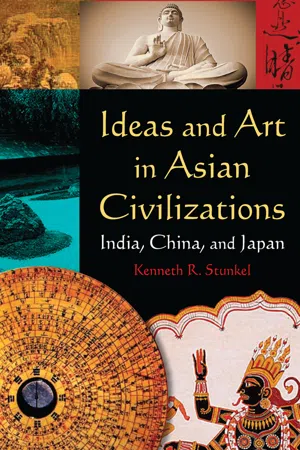
The traditional civilizations of India, China, and Japan developed complex ideas about man, society, nature, and the proper ends of life, many of which were expressed in art and architecture. The deepest commitments of those civilizations to what gives direction, purpose, and meaning to life can be read in painting, sculpture, architecture, and often in the minor arts as well. All three traditions have a long tenure in the historical record—more than 3,000 years for India and China, some 1,500 years for Japan. In all three cases there are visible continuities across time into the present. Many temples, palaces, pagodas, and other structures built long ago survive and can still be seen. Some revered arts, such as calligraphy in China and Japan, are still practiced. Ancient beliefs and practices, especially in India, have not been swept away completely by the modern world. Almost anyone receptive to non-Western perspectives on the human condition and its possibilities will find worthy possibilities in the ideas and art of India, China, and Japan.
Those perspectives are not easily brought into focus. In the case of Hinduism, the tradition is ancient and continuous, its myths are numerous, its literature is immense, and, despite many gaps and much destruction across the ages, its surviving artifacts, especially sculpture and architecture, are abundant. Even more than for conventional histories, the problem for this book is judicious selection. A great deal is left out or compressed. It is not possible to march through the centuries and review many of the details of origin, stages of development, and specific influences. Chronologies are telescoped so a complex historical phenomenon like Hinduism can be viewed as more or less complete, although in fact it emerged slowly over many centuries of growth and accretion. Much the same is true of Confucianism in China. From the time of Confucius to the Sung (Song) dynasty, a stretch of some 1,500 years, his original teachings underwent many changes and interpretations, including the creation of specific institutions to transmit and apply them. Only hints of that complexity are given here. In Japan the movement of ideas and art was not quite as intricate as in India and China, but substantial compression is unavoidable.
Because the study of any subject should never be taken for granted, the question “so what?” is blunt but justified. After all, time and energy that could be directed elsewhere are being asked of a reader. Non-Western cultures present undeniable difficulties for study, not least of which is achieving familiarity with alien vocabularies needed to understand ideas and art. Usually a valuable subject catches hold after an initial period of good faith immersion. Once an intrinsically valuable landscape comes more fully into view, and when some of its mystery is dispersed, there may be more inclination to push on and discover what lies over the next hill. An inducement to keep walking is also a promise that satisfactions await a patient explorer. Learning about other civilizations for their own sake has its virtues, but the emphasis in this volume is on durability through time of ideas and their expression in art that can enhance thought and feeling in the modern world.
1
Learning from Unfamiliar Cultural Traditions
Immersion in the great traditions of India, China, and Japan expands one’s awareness, knowledge, and sensibility. Awareness means seeing or grasping something previously hidden from view. Knowledge means accurate recognition of ideas and images supplemented by critical understanding. Sensibility means receptiveness to unfamiliar standards of excellence, meaning, and beauty.
Obviously mere exposure is not enough to produce these results. Active participation in a quest for experience, knowledge, and sensibility yields the choicest fruits. If this condition is met, the results can be surprising, gratifying, and lasting. The high cultures of India, China, and Japan will not disappoint an attentive explorer and observer. No doubt much that is unpleasant and universal in human history and experience—wars, corruption, poverty, natural disasters, brutality, incompetent rulers, class divisions, ignorance, and repression (especially of women)—disfigures these civilizations like all others. Their enduring contribution to the store of human wisdom and beauty, however, can be acknowledged despite such excesses, lapses, and misfortunes.
Ideally everyone could travel to and experience other civilizations firsthand, but not being able to do so is not a barrier to understanding. Travel can broaden one’s perspectives, but only if one’s eyes and mind are open and alert. Many foreigners who have been fortunate enough to live in India, China, or Japan, sometimes for extended periods, come away without much understanding and appreciation, and with garbled, impoverished notions of all that these cultures have to offer. While teaching oriental philosophy and Chinese history to military personnel in Japan, I encountered men and women with no curiosity about the country or its culture. They did not travel to Kyoto and other historical places; ignored famous gardens, temples, and museums; knew nothing of the literature, traditional or modern; and acquired only a smattering of the language, usually hello and goodbye and such. One army wife said she preferred the officer’s club and went into Tokyo only now and then to shop.
On the other hand, there are people who have a great appreciation for the cultures of Asia without having been there. Intellect and imagination, combined with study and research, can supply an intimate, vivid sense of the essential mind and spirit of another civilization. For example, Arthur Waley, one of the leading twentieth-century students of Chinese and Japanese literature, thought, and art, and a prolific translator of works from both languages, never visited either country. Thought, imagination, and sensibility can be nurtured by reading poetry and philosophy and contemplating images of sculpture, painting, and architecture-in short, selective exposure to the a vast domain of ideas and art that have survived over the past three thousand years.
Discovering Cultural Universals
Civilizations coping with the imperatives of life have produced works of intellect and imagination that resonate with generally educated men and women everywhere. Ideas and art can reach across historical divides. Human beings are agents for the creation of values and the varied artifacts that embody them. Most human needs and questions about the self and the world are universal, even though the means of satisfying needs and working out answers to big questions vary and change from one historical setting to the next.
The need for food, shelter, health, work, companionship, enjoyment, beauty, and purpose in life is intrinsically human. So are questions about human nature, conduct, social order, the supernatural, the past, and how humans ft into the realm of nature. No society is without responses to these questions in the form of myth, legend, theology, or philosophy. The most direct response, however, is in works of art, which are visual manifestations of perception and understanding shared within a civilization.
Political, military, economic, and social matters are largely ephemeral, albeit ubiquitous, in the perspective of time, although a requisite context for ideas and art. Subjects like literature, philosophy, and art are less transitory and can reverberate in the present. They represent attempts by human beings in often remote times and places to make sense of existence and give it expression; making sense is the work of philosophy and religion, while giving it expression is the task of literature and art, which also define canons of beauty.
No one escapes what the Buddha identified as signs of impermanent existence—illness, old age, and death—in a world perpetually subject to change and decay. The freshness of youth lasts the wink of eye and quickly flickers out. Buddha’s solution to the riddle of life in a sea of impermanence and the suffering it brings is a regimen of mind culture that secures detachment from the flux, a state of spiritual freedom he called Nirvana. The Buddha’s analysis of the human condition and its prospects is a direct challenge to those religions that feature immortality as their centerpiece.
Hindu philosophy aims at achieving closure between the human self, or soul (At-man), and unchanging, indestructible Brahman, the cosmic soul, which is held to be the ultimate ground of all being. The purpose of life in all its stages is for society, education, and family to regulate belief and action to prepare for that state of oneness and escape forever the consequence of endless rebirths. In the West, it is simply taken for granted that development and satisfaction of individual personality is what life is about. In traditional India, the opposite is true. What matters is that an ephemeral individual selflessly play a role defined by tradition and sacred texts, whose purpose is to transcend individuality altogether.
For Confucius, one of China’s first teacher-philosophers, the overriding problem of man and society was a redefinition of humanity to harmonize the world’s equilibrium by ending war, violence, and injustice. His means was a process of education that would release the “true man” by cultivating qualities of benevolence, integrity, righteousness, and reciprocity. These “superior men” (chun-tzu, or zhunzi), firm in a knowledge of right and wrong and possessing internal moral harmony, would be available to guide rulers in the direction of ethical government.
Clearly his ideal was not democratic. Leaders, he believed, are made by education and must be judged by standards of character and knowledge. Had Confucius known about Athenian democracy in the fifth century B.C.E., the immediate ancestor of all contemporary democratic institutions and ideas, he probably would have scoffed and asked where order and systematic control exists in such a loose, even chaotic system of government. While in the United States there may be something to the belief that anyone can become president, in the Confucian view the candidate would first have to be a morally superior person.
In the same period of disunity, Taoists (Daoists) proclaimed a route to harmony through personal identification with spontaneous forces of nature, called Tao (Dao), the Way, which entailed abandonment of conventional social and political life. In the Taoist view, government and moral virtue contribute to the problem of divisiveness and factionalism. The essence of assertive government and moral self-righteousness is a tendency to meddle, perhaps with good intentions, but most often with bad results. For the Taoist it was always best to leave well enough alone, a philosophy of laissez-faire in full bloom 2,400 years before Adam Smith and Herbert Spencer. In traditional China, the Confucian point of view became the doctrinal basis of the world’s most systematic, effective bureaucracy before the West caught up in early modern times. Generations of Chinese officials, steeped in values of duty, study, and propriety, often turned to Taoism in private life for release from schedules, obligations, worries, and tension. The effects on art and poetry were profound. Anyone who seeks relief from routines, rules, and responsibilities in solitude, unplanned activity, or excursions of the imagination has entered the realm of Tao.
In traditional Japan, a thread running through centuries of historical change was a reverence for nature, a readiness to attribute extraordinary dignity and significance to rocks, trees, creatures, and places of undeniable beauty, and the development of ritual observances to express wonder and gratitude. Nature worship was central Japan’s native religion, Shintoism, but was reinforced by major Buddhist sects that chose to find Bud-dhahood in impermanence. Many Western architects and artists have been enchanted with Japanese models of beauty expressive of oneness between man and the natural world. There is nothing in nature that is not good, including earthquakes and tsunamis. In traditional Japanese thought it is proper for man to bow in the presence of natural phenomena. In Zen Buddhism, enlightenment can be inspired by the humblest physical objects.
Modern men and women can easily spot counterparts in seventeenth-century Japanese urban life. Commoners living in towns, unburdened by political obligations, created a unique culture that was hedonistic, materialistic, and secular, with literature and art designed for the masses—in short, a concentrated form of popular culture based on commerce that was a forerunner of modern market-driven culture. A love of money, entertainment, consumption, fast living, and volatile relationships are not inventions of the materialistic West. All the trappings of hard-driving, unsettling secular culture were well developed in premodern Japan, associ...
Table of contents
- Cover
- Half Title
- Title Page
- Copyright Page
- Table of Contents
- Introduction
- Part I: Journey to The East
- Part II: India
- Part III: China
- Part IV: Japan
- Part V: A Summing Up
- For Further Reading
- Selected Websites
- Index
- About the Author
Trusted by 375,005 students
Access to over 1.5 million titles for a fair monthly price.
Study more efficiently using our study tools.
Frequently asked questions
Yes, you can cancel anytime from the Subscription tab in your account settings on the Perlego website. Your subscription will stay active until the end of your current billing period. Learn how to cancel your subscription
No, books cannot be downloaded as external files, such as PDFs, for use outside of Perlego. However, you can download books within the Perlego app for offline reading on mobile or tablet. Learn how to download books offline
We are an online textbook subscription service, where you can get access to an entire online library for less than the price of a single book per month. With over 1.5 million books across 990+ topics, we’ve got you covered! Learn about our mission
Look out for the read-aloud symbol on your next book to see if you can listen to it. The read-aloud tool reads text aloud for you, highlighting the text as it is being read. You can pause it, speed it up and slow it down. Learn more about Read Aloud
Yes! You can use the Perlego app on both iOS and Android devices to read anytime, anywhere — even offline. Perfect for commutes or when you’re on the go.
Please note we cannot support devices running on iOS 13 and Android 7 or earlier. Learn more about using the app
Please note we cannot support devices running on iOS 13 and Android 7 or earlier. Learn more about using the app
Yes, you can access Ideas and Art in Asian Civilizations by Kenneth R. Stunkel in PDF and/or ePUB format, as well as other popular books in Art & Asian Art. We have over 1.5 million books available in our catalogue for you to explore.