- 192 pages
- English
- ePUB (mobile friendly)
- Available on iOS & Android
eBook - ePub
About this book
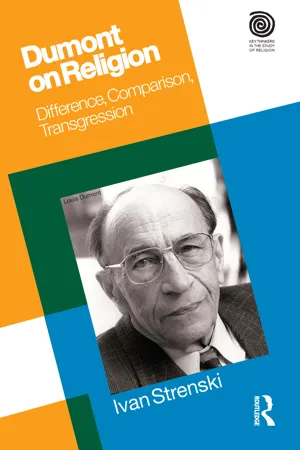
Louis Dumont was a prominent anthropologist and sociologist whose work - notably on Indian society - influenced the study of religion. 'Dumont on Religion' introduces Dumont's work on kinship studies, structural theory, and his views on idealism. Subjects of particular interest to students of religion are highlighted, including Dumont's concepts of the sacred and profane, pure and impure, transcendence, values and hierarchy. The book also presents the ethical implications of Dumont's ideas and his comparison between the world views of modern and traditional societies.
Information
Chapter One
What Can We Learn from Louis Dumont?
During the 1960s, Lévi-Strauss was the most prestigious name in the domain of the human sciences. But, for me as for some others, the work of Dumont had been the most decisive.
Tzvetan Todorov (Todorov 2002, 218)
By most conventional accounts, the chief contemporary presence of the study of religion begun by Durkheim and his immediate circle is Claude Lévi-Strauss. But while in the study of myth, ritual, totemism, or symbolism, Lévi-Strauss’ name comes readily enough to mind, little else bearing directly on the study of religion can be attributed to the father of modern structuralism. Far more directly involved in the study of religion, but oddly enough far less appreciated despite being so, is the French structuralist Louis Dumont (1911–1998). Going even further beyond just the study of religion, historian Mark Lilla claims that “after Lévi-Strauss surely the most important anthropologist in postwar France was Louis Dumont” (Lilla 1999, 41). Despite what many may imagine, as far as structural studies of religion are concerned, true pride of place should probably be yielded to Dumont as someone generally overshadowed by Lévi-Strauss’ brilliant reputation. As suggested by the recent critique of Lévi-Strauss by Maurice Godelier, at best, Levi-Strauss occupies an ambiguous position in religious studies (Godelier 1999, 21f). Given Lévi-Strauss’ denial of scientific status to the Durkheimian category of sacred, “religious anthropology ... will lose its autonomy and its specific character” (Lévi-Strauss 1963, 104). Indeed, Lévi-Strauss charted a course through his career that withdrew more and more from the study of religion even though his first substantial academic appointment was explicitly in the study of religion at the École Pratique des Hautes Études. This career in upper reaches of the French academic world began by Lévi-Strauss succeeding the religious phenomenologist, Maurice Leenhardt, in the so-called “Marcel Mauss Chair” in the Religious Sciences (Fifth) Section of the Paris École Pratique des Hautes Etudes. As soon as he was able, however, Lévi-Strauss withdrew further from institutionalized religious studies in France. In 1959, he took final leave of the institutional structures of the study of religion in France by quitting the Fifth Section for the College de France, where no disciplinary structures apply.
By contrast with Lévi-Strauss, Dumont’s work has become increasingly involved in areas recognized as the domain of the study of religion. Thus, while most students of religion may only recall Dumont’s classic study of the Hindu caste system, Homo Hierarchicus or his work on the institution of world renunciation in the religions of India, there is far more. This, of course is not to discount Dumont’s achievements in the special area studies of the religions of India, where he ranks with distinguished figures such as Sylvain Lévi, Louis Renou, or Paul Mus. But, it is to point out how much more Dumont has contributed to our understanding of religion than can be encompassed within his Indian anthropological studies. There is what I shall call the career of Dumont as humanist or moralist. Here, I seek to increase the awareness of students of religions of implications and explicit contribution of Dumont to our understanding of religious beliefs and institutions, ethics, ideology, values, world-views and such. Here, Dumont takes his place alongside congenial classic moralist authors such as Tocqueville, Durkheim, Mill and Weber, or moderns like Robert Bellah, Isaiah Berlin, Michel Foucault or Tzvetan Todorov. Here, we would need to include Dumont’s work on individualism as our modern ideology, his epistemological work on category formation of such cultural a prioris as politics, economics and religion, his lifelong devotion to the comparative studies of civilizations, and the ethical implications of his work. My purpose in writing this book is precisely to raise the level of recognition among students of religions for Dumont’s work in the humanistic and moraliste study of religion.
This volume is dedicated to bringing out how Dumont ranges farther afield from his own highly technical studies of marriage, filiation and kinship into studies with tremendous implications for the humanistic study of religion. A short list of these includes Dumont’s investigations into the historical and philosophical foundations of Western individualist ideology and “Eastern” otherworldly withdrawal from society, his sociological meditations on the paradoxical roots of fascism, totalitarianism and modern-day racism, his out-of-season querying of our ideals of equity as exhausted by the notion of equality, our conviction of the objectivity and natural character of cultural aprioris such as economy, politics and religion, our prejudices favoring conflict models of society, and so on. This volume, therefore, seeks to show how and in what sense Dumont is a “Key Thinker” in the study of religion.
Focal themes: Hierarchy, individualism and comparison
Although Dumont tackles such a wide range of issues, when examined carefully, it is clear that they cluster around two dialectically opposed notions: hierarchy and the individual. Let us consider hierarchy first. Conveniently, Dumont’s work here corresponds to the first phase of his intellectual career—his ethnographically-based writings on India. While Dumont’s idea of hierarchy developed from his field-specific work in India, hierarchy for Dumont is a cross-culturally comparative notion of great application and power. It breaks out of the culturally-specific confines of the Indian context, and shapes the rest of Dumont’s intellectual life.
In the 1960s, Dumont’s Homo Hierarchicus attempted to account for the Hindu caste system in terms of his theoretical principle of hierarchy. In doing so however, Dumont roused the moral indignation of scholars offended by what they took to be an attack on egalitarian ideals of social justice. It also stirred the political pot among French intellectuals of the left. Many suspected Dumont of cryptically approving the inequities of tasks, perhaps ultimately wanting to legitimate systems of inequity in our own society. While Dumont denied defending schemes of degradation in India (untouchability), or in America (racism), doubts still lingered. In the United States, the anthropologist Gerald Berreman of the University of California at Berkeley, also joined the chorus condemning Dumont’s apparent approval of systems of inequality. Were Dumont’s critics correct, especially about his moral and political orientations? What really is the deep logic of Dumont’s view of hierarchy? Was he really trying to foist upon the modern world an archaic system of hierarchy rooted in ancient times?
Conveniently as well, the second axis around which Dumont’s intellectual life revolves—individualism—stands both for the dominant ideology of the West, and as the dialectical opposite of hierarchy. Marking the second phase of his intellectual career, in the 1970s, Dumont, in a way, turned his back on India and hierarchy and confronted Western individualism with that same sense of strangeness as typical of an anthropological “other.” The studies of this second phase of Dumont’s intellectual career traced the genesis of Western individualism from its beginnings in Christianity to its development in modern economic and political thought. Here, Dumont turned from the role of ethnographer to one of intellectual historian, from someone immersed in the participant observers role in an exotic faraway field to a student of primary and historical texts.
In its own paradoxical way, Dumont’s approach to individualism only deepened his investigations into hierarchy. For Dumont to study individualism was to study hierarchy from its other side, so to speak. Studying India had been for him another way of studying ourselves; studying ourselves, in turn, shed light upon all those civilizations utterly at odds with ours, India included. Hierarchy was basic Hindu caste society; individualism was fundamental to our liberal democratic society in the West. Hierarchy and individualism therefore are posed as two principles dialectically opposite but internally connected. We learned about ourselves by posing us over against the other.
For Dumont, one of the problems with previous studies of individualism was the fact that it was conceived abstractly by investigators. The Enlightenment bears most of the responsibility for such an approach, since it conceived the human individual apart from its social relations, and exalted in the fact of such liberation. But Dumont wants to change this by conceiving the individual as incorporating the social dimension of human life. In short, he argues that although we have tended to see individualism as the utter negation of society and hierarchy, individualism might better be conceived—paradoxical as it may seem—as entailing hierarchy and including society. By this, he means that individualism is a product of the decision to rank—in effect, to hierarchize. The individual is placed over and above the group; the group is retained in “second place,” as it were, on a lower level.
This notion of individualism is particularly timely in light of the serious struggles now underway to decide how democratic values might be understood in such diverse contexts as the Muslim revival or in the post-communist Europe. These cultures, many with strong holistic and religious social traditions, are still seeking how to comprehend individualism in a way consonant both with their traditional religious values and their new secular aims. They desire to conceive the individual in a way which cherishes the rights essential to democratic society, but without losing sight of the collective and holistic values of community. How could one conceive the individual in such environments without at the same time simply repeating the course taken by the European Enlightenment and Reformation—two movements that have, on the whole, found it difficult to accommodate the social dimensions of being human. But these new late emerging nations and societies are eager to accommodate social life to the life of the individual. Therefore, a hierarchical construction of individualism might provide the conceptual leverage needed for this synthesis, since it includes society as integral to the individual.
Before we get on with the principal business of this treatment of Louis Dumont, let me sketch major points of his life and works.
Biographical sketch: Louis Dumont (1911—1998)
Louis Dumont was born in the Ottoman city of Salonika, Turkey in 1911, where his father had been an engineer in the service of the Turkish government. In the early 1930s, he began studies in mathematics at the École Polytechnique in Paris. But, he soon became alienated from his studies and in what he refers to as a fit of “youthful rebellion,” Dumont abandoned his program at the EP and enjoyed something of a bohemian life in Paris, where he met members of the Collège de Sociologie, most important of all, Roger Caillois. Because of his decision to abandon his studies, Dumont was virtually disowned by his family—his mother was by then a widow. His defiance of parental wishes cast him out into the world, where he had to make his own living. After some time indulging in the pleasures of the city, in 1936 Dumont began to attend lectures by Marcel Mauss at the Institut d’Ethnologie. This encounter proved to be pivotal in moving him to become an anthropologist. Here as well began Dumont’s considerable interests in India, since his teacher, Marcel Mauss, commanded this special area of expertise. In order to support himself during this period and until the late 1930s Dumont did clerical work at the Musée National des Arts et Traditions Populaires. Later this institution was to give birth to the Musée de l’Homme.
In 1939, Dumont volunteered for military service, but was captured by the Germans at the end of the so-called “Phony War” (drôle de guerre) in Spring 1940. Just before the war, Dumont would marry his first wife, Simone. She was to help him through the difficult years to follow by sending him books to read while he was imprisoned in Germany. Simone also accompanied Dumont on his field trips to India. During the time of his imprisonment in Germany, near Hamburg, Dumont learned German and later Sanskrit from the Jaina specialist, Professor Walther Schubring (University of Hamburg). With the connivance of friendly prison guards, he was able to absent himself in the evenings after his assigned factory work.
From May 1945, Dumont returned to the Musée National des Arts et Traditions Populaire, specializing on antique French furniture. Encouraged both by the great Indo-Europeanist, Professor Georges Dumézil, and the director of Musée National des Arts et Traditions Populaire, Georges-Henri Rivière, Dumont began field studies in the Provencal town of Tarascon of a festival of the Rhône River monster, “La Tarasque.” These studies bore fruit in the 1951 publication of Dumont’s first original monograph, La Tarasque.
In 1948, Dumont left on his first years of fieldwork in India, armed with the new structural methods he had learned from Lévi-Strauss. The two anthropologists had met briefly in 1936, and then, after a gap of 12 years, were reunited at the Musée National des Arts et Traditions Populaire. Taking Lévi-Strauss’ structural ideas into the field, Dumont pursued his studies in the south of India from late 1948 to 1950 in Pramalai Kallar and Tamilnadu. The results this combination of structural method and intense empirical research in India resulted in the publication in 1975 of Une Souscaste de l’Inde du Sud, and earlier, as we will note of Dumont’s great classic on caste in India, Homo Hierarchicus (1967).
From 1951–1955, Dumont moved to England where he took up a post of lecturer at the Institute of Anthropology in Oxford. Dumont tells us that his close working relation with Professor E.E. Evans-Pritchard there gave him special insights into the British anthroplogical world, and in particular to its Durkheimian clientele there, Mary Douglas and A.R. Radcliffe-Brown. Before returning to Paris after his sojourn in Oxford, Dumont returned to India in 1955 for a further 6 months of fieldwork in north India. In 1957–1958, Dumont did an additional 15 months of fieldwork in north India—in Gorakhpur
Between these fieldwork trips in 1955, Dumont assumed the post of Director d’Études at the École Pratique des Hautes Études, VIième Section, a division of the EPHE associated primarily with historians of the Annales School, such as Ferdinand Braudel. Dumont set to work immediately to establish the Centre d’Études indienne, and before leaving again for India in 1957, he collaborated with British anthropologist, David Pocock, in founding the periodical Contributions to Indian Sociology. In 1975, when the EPHE, VIth split into groupings of historians, on the one side, and social scientists on the other, Dumont would follow other social scientists in the formation of the École des Hautes Études en Sciences Sociales.
From the early 1960s, Dumont began a series of publications on caste, individualism and world renunciation in Indian religion, among them his La Civilisation indienne et nous (1964) The publication of Dumont’s great work on caste, Homo Hierarchicus, in 1965, marked a kind of high-water mark of his Indological work. His essays on world-renunciation in India would be gathered into an anthology in 1970—Religion/Politics and History in India.
From the middle 1960s onward, Dumont’s work took a turn toward a critical intellectual history of the main ideology of the West—individualism. The first essay on individualist ideology in the West appeared in 1965, and in 1977, his first book in a series on individualist ideology in the West was published, Homo Aequalis I: genèse et épanouissement de l’idéologie économique—From Mandeville to Marx (English edition). By 1982, Dumont was ready to make his strongest statement concerning the religious origins of the Western ideology of individualism, which appeared in the journal, Religion, “A Modified View of Our Origins: the Christian Beginnings of Modern Individualism.” Then shortly thererafter, he collected his shorter writings on individualism into his Essais sur l’individualisme (1983), later to appear in English translation as Essays on Individualism (1986) In 1991, the second and final volume of Dumont’s work on individualism in the West was published—Homo Aequalis II: L’idéologie allemande: France–Allemagne et retour (English translation 1994, German Ideology: From France to Germany and back.
A life
Dumont was born into a bourgeois French family, descendent from generations of artistic craftsmen, and a father who had been employed as an engineer for the Turkish government. Partly as a result of the expectations of his family, Dumont was pressed to enter higher education in the scientific, technological or mathematical fields. Perhaps already reflecting a theoretical turn of mind, Dumont chose mathematics. In his early twenties, Dumont rebelled against the strictures of this rigorous and somewhat desiccated type of education, with its predictable and direct career path into industry or government. In an act of youthful rebellion, he abandoned the studies that might have promised him a tranquil career, and launched out into the unknown. As he tells it, he was hungry for a life of reckless non-conformity, even though it caused major pain for his family: “This act of brash transgression “provoked a veritable scandal. My mother [a widow at the time], who had made sacrifices so that I could graduate, showed me the door. I refused to work. I wanted to live!” (Bruckner 1992, 68). Reveling in the cultural and artistic excitement of Paris of the late 1920s and 1930s, Dumont worked at the best jobs he could get, menial though they might be, and indulged his interests in the feverish activities of the avant-garde aesthetic, philosophical and social group of the epoch. Of those years. In particu...
Table of contents
- Cover
- Half Title
- Title
- Copyright
- Contents
- Dedication
- Acknowledgments
- Chapter 1 What Can we Learn from Louis Dumont?
- Chapter 2 A Contrarian's Most Contrarian Notion: Dumont on Hierarchy
- Chapter 3 Our Individualism and Its Religious Origins
- Chapter 4 The Comparative Risks of Comparison: On Not "Remaining Caged within Our Own Frame of Reference"
- Chapter 5 Conclusion: Dumont's Morality and Social Cosmology
- References
- Index
Trusted by 375,005 students
Access to over 1.5 million titles for a fair monthly price.
Study more efficiently using our study tools.
Frequently asked questions
Yes, you can cancel anytime from the Subscription tab in your account settings on the Perlego website. Your subscription will stay active until the end of your current billing period. Learn how to cancel your subscription
No, books cannot be downloaded as external files, such as PDFs, for use outside of Perlego. However, you can download books within the Perlego app for offline reading on mobile or tablet. Learn how to download books offline
Perlego offers two plans: Essential and Complete
- Essential is ideal for learners and professionals who enjoy exploring a wide range of subjects. Access the Essential Library with 800,000+ trusted titles and best-sellers across business, personal growth, and the humanities. Includes unlimited reading time and Standard Read Aloud voice.
- Complete: Perfect for advanced learners and researchers needing full, unrestricted access. Unlock 1.5M+ books across hundreds of subjects, including academic and specialized titles. The Complete Plan also includes advanced features like Premium Read Aloud and Research Assistant.
We are an online textbook subscription service, where you can get access to an entire online library for less than the price of a single book per month. With over 1.5 million books across 990+ topics, we’ve got you covered! Learn about our mission
Look out for the read-aloud symbol on your next book to see if you can listen to it. The read-aloud tool reads text aloud for you, highlighting the text as it is being read. You can pause it, speed it up and slow it down. Learn more about Read Aloud
Yes! You can use the Perlego app on both iOS and Android devices to read anytime, anywhere — even offline. Perfect for commutes or when you’re on the go.
Please note we cannot support devices running on iOS 13 and Android 7 or earlier. Learn more about using the app
Please note we cannot support devices running on iOS 13 and Android 7 or earlier. Learn more about using the app
Yes, you can access Dumont on Religion by Ivan Strenski in PDF and/or ePUB format, as well as other popular books in Theology & Religion & Comparative Religion. We have over 1.5 million books available in our catalogue for you to explore.