- 192 pages
- English
- ePUB (mobile friendly)
- Available on iOS & Android
eBook - ePub
About this book
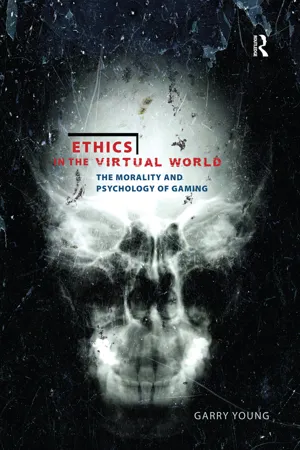
Ethics in the Virtual World examines the gamer's enactment of taboo activities in the context of both traditional and contemporary philosophical approaches to morality. The book argues that it is more productive to consider what individuals are able to cope with psychologically than to determine whether a virtual act or representation is necessarily good or bad. The book raises pertinent questions about one of the most rapidly expanding leisure pursuits in western culture: should virtual enactments warrant moral interest? Should there be a limit to what can be enacted or represented within these games? Or, is it all just a game?
Information
ONE
Introduction: playing with right and wrong
According to the Entertainment Software Association (ESA), during the period 1996–2009, in the United States alone, the number of video games sold for use on a console or personal computer increased from 73.3 million units to 273.5 million (ESA 2010). For the same period, spending on these games rose from 2.6 billion dollars to 10.5 billion (peaking in 2008 at 11.7 billion dollars). Similarly, in the United Kingdom in 2008, video games were reported to have become the UK’s most popular form of entertainment, with sales for that year estimated to be around 4.64 billion pounds (Cellan-Jones 2008). Moreover, in its 2010 report, the ESA claimed that 67 per cent of households in the US owned either a gaming console or a personal computer used to run entertainment software, that the average age of a gamer was thirty-four – with 49 per cent aged between eighteen and forty-nine – and that, on average, adult gamers had been playing video games for twelve years. The ESA report also contained a list of the top twenty console games for 2009 (based on units sold). Ranked number one in the US was Call of Duty: Modern Warfare2 (rated “mature”). In fact, Prigg (2009) reports that 4.7 million copies of this game were sold on its opening day in the US and UK alone, out-selling the previous best video game – Grand Theft AutoIV – by some distance. (Prigg also reports that of the 4.7 million sold, the sale of 1.23 million copies in the UK was a record for that country.)
Both the Grand Theft Auto and Call of Duty series are held to be extremely violent games. Call of Duty: Modern Warfare 2 is infamous for its civilian massacre scene, and Grand Theft Auto IV has courted controversy by permitting the gamer’s character to have sex with prostitutes before mugging or even killing them for their money. The possibility for simulated violence of the kind demonstrated by these games (and others), even when restricted to adults – which demographic data from the US and UK show to be a large percentage of the total gaming population (see The Average Gamer 2010) – raises a number of interesting and important moral questions. Within the context of video games, is it appropriate to judge a legitimate action or even a more sustained gaming strategy as either morally good or morally bad? When one bloodies and brutalizes a stranger to the point of death with a kitchen utensil, as it is possible to do in Manhunt 2 (for example), or when one sexually assaults a defeated female opponent (watching her cry and hearing her anguish) in Battle Raper, are these activities morally bad things to engage in? If so, in what sense are they bad and for whom should we be morally concerned? Conversely, within the game BioShock, if one chooses not to “harvest” the Little Sisters – that is, kill mutant female children – for the extra power one will obtain, but instead elects to spare them, is this a morally commendable act?
Providing a coherent and philosophically astute response to these questions is an important aim of this book, and is without doubt one of its key challenges. After all, what does it mean for x to be a morally bad thing? The answer to this question will depend, of course, on what one considers morality to be. In simple terms, if one holds that it is morally good to do one’s duty (among other things, let us say that this involves being kind to other people), then it should follow that not doing one’s duty is morally bad. However, what if one virtually enacts not doing one’s duty (one is “cruel” or, at the very least, not “kind” to a character within a game): is that morally bad also? Alternatively, what if one virtually enacts doing one’s duty: is that morally good? If it is, why should this be? After all, in this case, one has not actually done one’s duty, only simulated it (the “person” to whom one was “kind” was not a real person, just a gaming character). So if it is not morally good then how can being “cruel” to a gaming character be morally bad? Perhaps the virtual act of doing or not doing one’s duty is, in and of itself, an amoral act that only becomes of moral interest if it interferes with one’s tendency to do one’s duty for real. Thus, one may judge x to be amoral in one sense (in and of itself) but immoral in another: morally problematic if, and therefore because, it interferes with one’s tendency to do one’s duty and so be moral (something that, if it is the case, would need to be empirically verified).
Others may hold that morality is not about duty, of course, or is about more than this. But whichever system of morality one adopts, the same issue arises: namely, its application to virtual enactments. A large part of this book will therefore be taken up with just this issue: considering the applicability of different moral criteria to virtual activities within video games, and the extent to which a particular moral theory is able to provide the satisfactory and hence justificatory means – where deemed necessary – for the selective prohibition of video game content. In addition, it is ultimately my intention to argue for the importance of psychology rather than morality as a measure of what should be permitted within video games, based on the view that the selective prohibition of content should stem from what gamers are able to cope with, psychologically, rather than what is deemed morally right or wrong, or good or bad. In order to support this argument, however, it is necessary to provide a detailed philosophical assessment of what I shall call the current state of play regarding permitted and prohibited video game content (see Ch. 2). Can traditional moral theory (see Chs 3–5, 8, 9 and 10) or even more contemporary moral approaches (Chs 6 and 7) be applied to video games so as to provide a cogent argument for why certain content is or should be prohibited? Through a systematic examination of different philosophical arguments, some of which have applied traditional moral theories to video game content (mostly violent), I aim to show how each is ultimately unable to account for the current state of play or provide a cogent reason for why certain content should be prohibited but not others.
In the chapters to come, then, I shall consider the extent to which the moral theories used to provide guidance for our non-gaming activities may legitimately be applied to the world of video games. More traditional theories, such as Hume’s sentimentalism (Ch. 3), Kant’s deontological approach (Ch. 4), the consequentialism characteristic of utilitarianism (Ch. 5) and social contract theory (Ch. 10), or even the less popular ethical egoism (Ch. 9), will be critically examined to see if they are able to inform our judgements regarding the selective prohibition of video game content. In addition, I shall consider the extent to which selective prohibition should incorporate views regarding the content’s symbolic meaning (Chs 6 and 7), or the gamer’s moral character and motivation (Chs 8 and 11, respectively), and how these might best be understood within the context of video games and video gamers. Finally, by drawing on empirical research, I shall consider ways in which gamers morally manage their activities while playing video games, so as to support my argument for psychologically informed, rather than morally based, prohibition (Ch. 12).
The virtual enactments of interest throughout this book are those that represent real-world taboos:1 namely, actions that are typically both legally and morally proscribed outside the gaming environment. Such activities include discrimination, murder, rape, assault (sexual and physical), torture, incest, paedophilia, necrophilia and bestiality: virtual enactments that Monica Whitty et al. (2011) call “symbolic taboo activities” (STAs), a term I shall adopt here. Before discussing the suitability of moral theory to these, however, it is important to clarify certain key terms – namely, video game, gameplay and gamespace – and how these fit within the more general context of virtual reality. It is also important to consider video games within the wider context of fiction and play, and the relationship these constructs have to morality.
DEFINING “VIDEO GAME” AND RELATED TERMS
In defining “video game”, it is not my intention to provide a definition that is able to capture all forms of the medium; that is, satisfy what others may argue constitute different types of video game. Instead, I use the term to refer to a particular means by which one can enact STAs; in doing so, I borrow heavily from Grant Tavinor (2008) (and occasionally Juul 2005). Like Tavinor, I favour the term “video game” over, say, “computer game” or “electronic game”. By “video game”, I refer to games played on personal computers (PCs) or consoles such as X-Box 360, PlayStation 1–3 and Wii. PC games may involve one player or a number of players connected through the internet. Console games also include single- or multiplayer options (a multiplayer game is any game involving two or more players). Following Tavinor, I recognize that there are different components to video games: narratology, ludology and the interactive nature of the fiction. I also use the acronym NPC to refer to a non-player character (that is, a virtual gaming character controlled by the game software).
The video games discussed throughout the book contain some form of narrative, as the narratologists maintain. In keeping with ludology, they also have an obvious gaming quality; they are designed and marketed as games (rather than, say, training devices) and are therefore meant to be played in a way that subscribes to certain rules, explicitly or implicitly found within the gameplay (set by the game mechanics).2 By “gameplay” I follow Jesper Juul’s lead and mean “the pure interactivity of the game” (2005: 19), which is constitutive of the video game content in terms of the representations found therein and the interactions afforded. These in turn are produced through an “interaction between the rules …, the players pursuing a goal, and [their] personal repertoire and preferences” (ibid.: 199–200). By “gamespace”, I mean simply the virtual environment in which the gameplay is realized.
The terms “virtual environment” and “virtual reality” are often used interchangeably in much of the thinking and literature on the subject of video games, or cyberspace in general. Ralph Schroeder, for example, describes a virtual environment as providing users “with the sensory experience of being in a place other than the one [they] are physically in, and being able to interact with that place” (2006: 439). A further useful distinction is made by Narcis Parés and Roc Parés, who distinguish between virtual environments (VEs), which they define as static structures, and virtual reality (VR), which constitutes the structures of VEs put into action. The two are interrelated in so far as “VR is a real time experience a user can have of a VE” (Parés & Parés 2006: 528). Throughout this book, VR will be restricted to that constitutive of gamespace, and will be used in conjunction with VE, which is taken to represent the medium through which the gamer is able to experience an embodied and interactive VR. Importantly, the gamespace discussed here will not refer to an immersive VE: that is, an environment that “surrounds the body, often engulfing the senses” (Biocca 1997: 11), achieved through the use of “immersive technology” such as stereoscopic helmets, data gloves and even body suits.
Finally, video games are interactive fictions: the narrative is wholly or in part fictional (it may be set on a fictitious alien world, for example, or be set in an actual historical context such as the Second World War). (What being fictional entails will be discussed below.) The video game is interactive in so far as the player can to a greater or lesser degree alter the course of the narrative in virtue of actions carried out, including decisions made during the course of the gameplay. What counts as a game, of course, as Wittgenstein famously pointed out, is notoriously difficult to define, and, for him at least, is dependent on activities possessing certain “family resemblances” (1953: §67). That aside, “video game’, as I am using the term, fits well within Juul’s more general definition:
A game is a rule-based system with a variable and quantifiable outcome, where different outcomes are assigned different values, the player exerts effort in order to influence the outcome, the player feels emotionally attached to the outcome, and the consequences of the activity are negotiable.
(Juul 2005: 36)
In addition, I include two essential features made explicit by Tavinor (2008): (a) video games are a digital medium, and (b) they are designed, marketed and played as games. More formally, then, X is a video game if and only if:
1. It is an artefact in a digital visual medium.
2. It is intended primarily as an object of entertainment.
3. It is intended to provide such entertainment through the employment of one or both of the following modes of engagement: (a) rule-bound gameplay or (b) interactive fiction.3
Point 3 should be understood to incorporate Juul’s definition of a game (above).
GAMES, FICTION AND PLAY
Stating that what the player engages in is just a game implies, first, that those representations and actions that occur should be understood and therefore judged (by others as well as the players) not only within the context of the specific rules or structure of the game but also, and more fundamentally, within the context of it being a game. To call something “a game” is to establish a point of departure or a means of demarcation – some qualitative shift – away from other (non-gaming) activities, especially as a number of games “possess the characteristics of being social conventions that countenance violations, often substantial ones, of social conventions” (Howe 2008: 569). Not only does the reference to x being a game explain certain actions – why, for example, in a game of British Bulldog person A is trying to traverse an area of land (move from one side of a room to the other) while persons B, C, D, … try to grab them and wrestle them to the ground – but it also bestows on the action (i.e. grabbing a person and wrestling them to the ground) an air of legitimacy: it is a conventional violation of a social convention. In addition, those who insist that what the player does is just a game seek to relegate the moral importance of the event outside the space of play, thereby trivializing its need for moral scrutiny (see discussion on the amor-alist’s position in Ch. 2).
At this point, I should like to distinguish “game” from “sport”. It is common enough to say “I watched a game of football” or even “I played football”, but there is an important difference between playing games of sport and the games I wish to discuss here (but by no means the only difference). Typically, in video games, the player is represented by an avatar, and is able to interact in accordance with the abilities and skills possessed by that avatar (in conjunction with one’s own skill at playing the games in the form of that avatar).4 In sport, however, one is oneself within ...
Table of contents
- Cover
- Title Page
- Copyright Page
- Table of Contents
- Abbreviations
- 1 Introduction: playing with right and wrong
- 2 To prohibit or not to prohibit, that is the question
- 3 Hume's strength of feeling
- 4 Kant's call of duty
- 5 The cost and benefit of virtual violence (and other taboos)
- 6 Are meanings virtually the same?
- 7 There are wrongs and then there are wrongs
- 8 Virtual virtues, virtual vices
- 9 Doing what it takes to win
- 10 Agreeing the rules
- 11 Why would anyone want to do that?
- 12 Coping with virtual taboos
- 13 Conclusion
- Notes
- Bibliography
- Index
Trusted by 375,005 students
Access to over 1.5 million titles for a fair monthly price.
Study more efficiently using our study tools.
Frequently asked questions
Yes, you can cancel anytime from the Subscription tab in your account settings on the Perlego website. Your subscription will stay active until the end of your current billing period. Learn how to cancel your subscription
No, books cannot be downloaded as external files, such as PDFs, for use outside of Perlego. However, you can download books within the Perlego app for offline reading on mobile or tablet. Learn how to download books offline
Perlego offers two plans: Essential and Complete
- Essential is ideal for learners and professionals who enjoy exploring a wide range of subjects. Access the Essential Library with 800,000+ trusted titles and best-sellers across business, personal growth, and the humanities. Includes unlimited reading time and Standard Read Aloud voice.
- Complete: Perfect for advanced learners and researchers needing full, unrestricted access. Unlock 1.5M+ books across hundreds of subjects, including academic and specialized titles. The Complete Plan also includes advanced features like Premium Read Aloud and Research Assistant.
We are an online textbook subscription service, where you can get access to an entire online library for less than the price of a single book per month. With over 1.5 million books across 990+ topics, we’ve got you covered! Learn about our mission
Look out for the read-aloud symbol on your next book to see if you can listen to it. The read-aloud tool reads text aloud for you, highlighting the text as it is being read. You can pause it, speed it up and slow it down. Learn more about Read Aloud
Yes! You can use the Perlego app on both iOS and Android devices to read anytime, anywhere — even offline. Perfect for commutes or when you’re on the go.
Please note we cannot support devices running on iOS 13 and Android 7 or earlier. Learn more about using the app
Please note we cannot support devices running on iOS 13 and Android 7 or earlier. Learn more about using the app
Yes, you can access Ethics in the Virtual World by Garry Young in PDF and/or ePUB format, as well as other popular books in Philosophy & Ethics & Moral Philosophy. We have over 1.5 million books available in our catalogue for you to explore.