- 450 pages
- English
- ePUB (mobile friendly)
- Available on iOS & Android
eBook - ePub
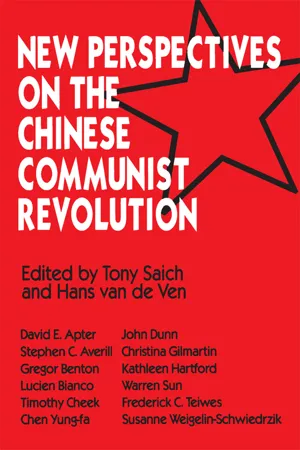
New Perspectives on the Chinese Revolution
About this book
These essays present fresh insights into the history of the Chinese Communist Party (CCP), from its founding in 1920 to its assumption of state power in 1949. They draw upon considerable archival resources which have recently become available.
Part I
EARLY ORGANIZATIONAL TRENDS
Academic study of the early CCP began in the 1950s and 1960s after the CCP had established its rule over the whole of China. The questions that figured prominently at the time were the nature of Chinese communism and its relation to China’s past culture; the attraction of communism for Chinese intellectuals; the history of the first United Front of the CCP with the GMD; and the link between the CCP and Moscow. The most influential products of this period were Benjamin Schwartz’s Communism and the Rise of Mao (1951), Maurice Meisner’s Li Ta-chao and the Origins of Chinese Marxism (1967), Alan Whiting’s Soviet Policies in China, 1917–1924 (1954), and Conrad Brandt’s Stalin’s Failure in China, 1924–1927(1952).
According to Schwartz and Meisner, Chinese intellectuals were attracted not so much to Marxism as to Leninism. The messianic message of Leninism, especially as symbolized by the October Revolution, promised a rapid transformation of the world in which its profound contemporary inequities would be overcome. Leninism also provided a seemingly practical way of realizing this transformation. Furthermore, not only did it suggest an explanation for China’s lack of economic development and national strength, but also it was interpreted to mean that China’s backwardness destined it to an important role in the communist revolution and consequently in world history. Thus Leninism was also seen as catering to wounded national pride.
Schwartz, Meisner, and Stuart Schram argued that Chinese communism was different from Russian communism in doctrinal terms. Schwartz systematically set out Mao Zedong’s views on peasant revolution, stressing their radical departure from the communist orthodoxy that holds that only the industrial proletariat can be the motive force of history and lead the revolution. Meisner argued that in Li Dazhao’s thought, which emphasized voluntarism, populism, and nationalism, one can already discern many of the essential elements of Mao Zedong’s views and Chinese communism in general. In The Political Thought of Mao Tse-tung (1969), Schram closely examined the evolution of Mao’s thought. He illustrated its roots in China’s past, especially its great popular novels and reformist thinking, and made clear how Mao reflected on Chinese society. At a time when in the West Communists everywhere were portrayed as holding identical views and as under the sway of Moscow, these views, emphasizing the Chineseness of Chinese communism, were pathbreaking.
The Comintern and especially Stalin were heavily criticized by early Western historians of the CCP. Whiting focused on the conflicting demands on policymakers in Moscow of promoting the world revolution and safeguarding the interests of the new communist state. He concluded that the latter usually won out. Brandt argued that in 1926 and 1927, Stalin persisted in following a China policy that cost Chinese Communists the victory in their battle for power with the GMD. While Stalin was fighting Trotsky for supreme leadership in the Soviet Union, his principal interest in China was not to see the revolution succeed but to win the dispute with his rival. He consequently persisted in prescribing for the CCP an impossible and fatal policy. He insisted that it continue the United Front with the GMD and endorsed the creation of an independent CCP military force only after it was much too late.
These studies on the early CCP remained unchallenged until the late 1980s, when new sources became available in China. Arif Dirlik, who published The Origins of Chinese Communism in 1989, showed that Chinese intellectuals were attracted not just to Leninism but to a wide range of radical thought, especially anarchism. In Dirlik’s view, the founding of the CCP was the result not of the symbolic impact of the October Revolution but of the activities of Comintern agents and the rise of a Chinese working class. In From Friend to Comrade, van de Ven emphasized the indigenous roots of the CCP, its early regionalism, and the diffuseness of its power structure. He furthermore argued that the CCP’s defeat in 1927 was the result neither of Stalin’s intervention nor of Chen Duxiu’s “defeatist” policies. At the time, the CCP did not have the urban or rural foundations that could have ensured it victory, and neither did it have the capacity to sustain a large military force. The realization that such a force was needed was only just emerging.
An important discovery for the study of the early CCP has been the Sneevliet Archive, held at the International Institute of Social History, Amsterdam. The documents of the archive are brought together by Saich in The Origins of the First United Front in China: The Role of Sneevliet (Alias Maring)(1991). They illustrate the complex relationship between the early CCP and the Comintern. The latter was always important, but its authority was not always accepted nor were its policies adopted without challenge. The materials illustrate the difficulties faced by Comintern agents, operating in an alien society, having to rely on a few informants, and involved in internal CCP conflicts. Chinese Communists at times disregarded the advice of Comintern agents or even traveled to Moscow to advocate their own views. Bewildered Comintern leaders were reduced to adopting resolutions designed to appease both sides.
The main thrust of recent studies of early ideological developments has been to downplay the creativity of early CCP ideologues. Dirlik, for example, has written that once Leninism was adopted as an organizational principle, in the CCP “clichés of Bolshevism substituted for independent analysis” (268–70). The strongest advocate of decoding ideological debate in terms of its roots in political struggle is Werner Meissner, who discussed the ideological developments of mainly the 1930s in Philosophy and Politics in China (1990). Michael Luk, in The Origins of Chinese Bolshevism (1990), on the other hand, analyzed ideological developments in the early CCP as the development of a distinct system of thought, not as simply a Russian import, with many Chinese Communists seen as instinctive Leninists.
The three chapters collected here seek to develop our understanding of the early CCP further. As mentioned in the Introduction, van de Ven’s chapter attempts to analyze the early CCP as a text-based political party. He takes the reflections of Chinese Communists seriously, but also seeks to take account of the fact that they were never written as part of a purely theoretical debate. Gilmartin makes the case that the CCP constituted a subculture for progressive women seeking a new life-style and a political role. Furthermore, she argues that the patriarchal attitudes of male CCP members led to the exclusion of female leaders from the formal power structure. Weigelin-Schwiedrzik reviews current Chinese discussions of the role of Li Dazhao in the early CCP. Li’s role has long remained undiscussed in China and in the West. While the principal focus of the chapter is on historiographical issues in current PRC writings on Li, it also suggests that Li played a crucial role in North China in building up communist activity, in creating a mass movement together with the GMD, in seeking a “revolution in the capital” in 1925, and in actively leading Beijing protests in 1926. Our understanding of the nature of Li’s Marxism and his connections with the regime of Yuan Shikai as well as the Progress Party are also enhanced.
Chapter 1
The Emergence of the Text-Centered Party
Hans J. van de Ven
Texts were, and are, fundamental to the Chinese Communist Party (CCP) as an organization. A substantial part of the activities of party members was consumed by the writing, reading, discussion, and dissemination of texts. Involvement with a specific genre of texts, those of Marxism-Leninism, helped set CCP members apart from the rest of Chinese society and fostered a sense of privileged insight and participation in a special mission. Marxism-Leninism constituted a language with the aura of a secret code, requiring initiation. Even if CCP texts asserted a radical secularity, in some ways the CCP was like a religious sect founded on sacred texts.
For the CCP to be effective in the pursuit of its goals, firstly, the acquisition of power, the membership had to be cohesive as well as willing to sacrifice much, travel far, and follow central directives. The focus on certain special texts helped create the sense of community, the practices, and the language that enabled members from different areas and social backgrounds to cooperate and formulate shared attitudes and goals. On the basis of these texts, a CCP political culture was built that combated the divisions among the membership of region, education, and belief.
It was in the 1920s that Chinese Communists laid the foundation for a text-centered party. The spread of print media in the late nineteenth and early twentieth century made the emergence of such a party possible. The broadening of the political realm and the creation of political parties in the same period also paved the way. In shaping the CCP the model set by the Bolsheviks was particularly important.
The focus of this chapter is not the general nature of the CCP as a text-centered party. It also does not seek to describe how members responded to texts and how this shaped the CCP—subjects that are important in chapter 8. Instead the present aims are more mundane. I describe the rise of the CCP’s internal propaganda institutions whose tasks were to focus the membership on texts and control their interpretation. I also discuss the specific ideological debates up until 1927 that made the interpretation of texts a central leadership issue and that linked the allocation of power to prestige in the ideological realm, even if leadership was never a matter of ideology alone.
Lenin’s Views of the Party Organ
Karl Marx himself did not claim that propaganda was central to revolution. For Marx it was social praxis that mattered: revolutions resulted from changes in the relations of production. Class warfare, according to Marx, was articulated in ideological terms, but ideas in themselves could not arouse such warfare.1 It was Lenin who first articulated clear ideas about how a party journal not only promoted but was essential to the creation of a revolution. Lenin lived at a time when mass periodicals had become current and when revolutionaries made frequent use of them.
When Lenin wrote What Is to Be Done? in 1902 to set out his ideas about party organization, especially the role of the party organ, he did not argue that the principal purpose of a party publication was to bring “political class consciousness” to the working class. As is well known, Lenin believed that such consciousness “can be brought to the workers only from without.”2 Censorship and political repression made it impossible to achieve this goal through the publication of mass periodicals. Instead, Lenin argued, Social Democrats—as the party of Russian Communists was known before the schism between Bolsheviks and Mensheviks in 19033—themselves “must go among all classes of the population; they must dispatch units of their army in all directions.”4 For this it was essential for the Social Democrats to have a small, centralized, and disciplined organization, operating secretly throughout Russia.5 The party organ was Lenin’s means to create such an organization.
A party organ was essential for the party leadership to inject a common purpose into the actions of scattered revolutionary groups. It was to function as a “guideline” providing direction to the individual actions of bricklayers: without it no house could be built.6 Involvement in the nationwide party organ—writing articles, compiling reports, distributing issues, etc.—provided an organizational focus for all party members and promoted their contact with the revolutionary elements o...
Table of contents
- Cover Page
- Half Title Page
- Title Page
- Copyright Page
- Contents
- Acknowledgments
- Abbreviations
- Contributors
- Introduction
- Part I. Early Organizational Trends
- Part II. Regional Variations
- Part III. The Making of Victory
- Index
Trusted by 375,005 students
Access to over 1.5 million titles for a fair monthly price.
Study more efficiently using our study tools.
Frequently asked questions
Yes, you can cancel anytime from the Subscription tab in your account settings on the Perlego website. Your subscription will stay active until the end of your current billing period. Learn how to cancel your subscription
No, books cannot be downloaded as external files, such as PDFs, for use outside of Perlego. However, you can download books within the Perlego app for offline reading on mobile or tablet. Learn how to download books offline
Perlego offers two plans: Essential and Complete
- Essential is ideal for learners and professionals who enjoy exploring a wide range of subjects. Access the Essential Library with 800,000+ trusted titles and best-sellers across business, personal growth, and the humanities. Includes unlimited reading time and Standard Read Aloud voice.
- Complete: Perfect for advanced learners and researchers needing full, unrestricted access. Unlock 1.5M+ books across hundreds of subjects, including academic and specialized titles. The Complete Plan also includes advanced features like Premium Read Aloud and Research Assistant.
We are an online textbook subscription service, where you can get access to an entire online library for less than the price of a single book per month. With over 1.5 million books across 990+ topics, we’ve got you covered! Learn about our mission
Look out for the read-aloud symbol on your next book to see if you can listen to it. The read-aloud tool reads text aloud for you, highlighting the text as it is being read. You can pause it, speed it up and slow it down. Learn more about Read Aloud
Yes! You can use the Perlego app on both iOS and Android devices to read anytime, anywhere — even offline. Perfect for commutes or when you’re on the go.
Please note we cannot support devices running on iOS 13 and Android 7 or earlier. Learn more about using the app
Please note we cannot support devices running on iOS 13 and Android 7 or earlier. Learn more about using the app
Yes, you can access New Perspectives on the Chinese Revolution by Tony Saich,Hans J. Van De Ven in PDF and/or ePUB format, as well as other popular books in History & Chinese History. We have over 1.5 million books available in our catalogue for you to explore.