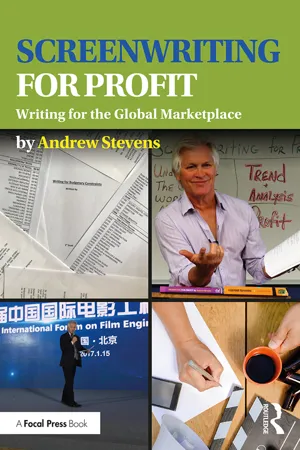
This book teaches readers how global trends define the marketplace for saleable screenplays in key international territories as well as the domestic market. Veteran writer, producer, and director Andrew Stevens gives you the insider edge you need to write for the global marketplace, sharing his decades of experience producing and financing everything from micro-budget independent films to major studio releases. In leveraging Stevens' comprehensive experience, you will learn how to determine specific subject matter, genre, and story elements to make the most of international sales trends, and harness the power of these insider strategies to craft a screenplay that is poised to sell.
- 200 pages
- English
- ePUB (mobile friendly)
- Available on iOS & Android
eBook - ePub
About this book
Information
Chapter 1
Critical Criteria Before Determining Your Subject Matter
Understanding the Global Marketplace
As I have spoken to aspiring screenwriters and filmmakers at colleges and film schools around the country, almost invariably when I talk about the realities of the global marketplace for film, it is a revelation for them. That’s because most educators teach creative theories of screenwriting or the physical practicalities of filmmaking, but are clueless as to the pragmatic reality of who or where the audience for these prospective films actually is and why certain scripts actually get made as movies, while countless others fall by the wayside.
As a victor of world wars, global superpower, and world leader, the United States of America has developed a globally naïve and ethnocentric mentality. In the film business, whether out of naiveté, arrogance, or a combination of both, most people in the U.S. tend to think of the film business as being solely American or North American and/or English speaking. This is the furthest thing from the truth. As I have illustrated in my previous film-related book, Producing for Profit: A Practical Guide to Making Independent and Studio Films, and in my DVD and download film school series, Foolproof Film School, the market for motion pictures is global, and American films are a global export product. The biggest revenues for American movies most often come from outside of the United States and Canada. In the case of almost all independent films, the general rule of thumb has always been that approximately 65% of the revenues come from international foreign territories, and approximately 35% of revenues from the U.S. and Canada and their respective territories and possessions. Aspiring screenwriters, take heed.
Whether politics, public speaking, education, filmmaking, or screen-writing, one’s mantra must be “know your audience.” Most screenwriters think about everything except who their core audience actually is when identifying subject matter, which consequently routinely results in futility, with countless unread and unproduced screenplays. Scripts that are developed and written solely according to creative paradigms are often films that have very little, if any, market appeal or value. Screenwriting is a passion, screenwriting is creative, screenwriting is a discipline, and screen-writing can be a vocation, not just a hobby or pastime, if the screenwriter is cognizant of basic fundamentals and develops material that the current marketplace has a desire for.
As I mentioned earlier, the largest market for American motion pictures and particularly independent films are all of the international territories outside of North America. Today, media is fixated on what is “trending.” Likewise, each international territory has certain criteria of the types of film trends that currently are “working,” meaning those trends that are currently desirable or salable in each individual territory. Sometimes specific salable criteria may be the same or similar in multiple territories, and sometimes a territory that may yield a very lucrative sale has a very specific element that must be incorporated into a screenplay and, in turn, the film, in order to make a sale in that territory. It is vital to understand the required salable criteria and most often a hybrid of elements, which must be identified prior to the development of the material, and incorporated into a cohesive and organically evolving story and script. The inclusion these elements will ultimately be critical to the screenplay having success and being greenlit, which is the formal commitment of financing, thereby allowing the project to move forward from the development phase to preproduction and principal photography.
Shelf Life
In both the foreign and domestic territories, trends are cyclical and change on an ongoing basis. Trends have a shelf life, but the advice I’m offering in this book has not changed over the span of my career in the entertainment business, and the vital importance of establishing a current salable trend before writing your screenplay has no shelf life.
Studio Films
There is a distinct difference between studio motion pictures and independent films. Studios are owned by global conglomerate monopolies that now have taken over almost every media outlet worldwide, as the U.S. government has turned a blind eye to anti-trust laws. Each of the big six (or seven, if you count CBS) conglomerates not only has the ability to make the movies they choose to make and force feed the public through their respective wholly owned media outlets, but they also have deep pockets of public funding to use at their discretion for the production of their film and television projects. Studio films are driven by what are known as tent pole films, which are mega-budgeted pictures with branded franchises, as we can see from the glut of superhero movies, sequels, prequels, remakes, and reboots of the same movies over and over. The majority of theatrical box office revenue for studio motion pictures is controlled by teenage to early twenties males, and every few years with a new crop of young male audiences, everything old is new again.
Distribution Costs
Films made by studio conglomerates are supported not only by public money and mega-budgets, but also by vast media spends to support the promotion, advertising, and publicity for the pictures, which at times may exceed a film’s budget. This expenditure is known as P&A, which stands for prints and advertising, and comes from the recent past when actual film prints and trailers were the way films were exhibited and there were significant multi-million-dollar costs associated with striking prints and trailers, as well as shipping and freight costs, which were factored into the costs of distribution. Today, with digital cinema packages and the advent of electronic delivery of film as digital files, there are no longer any huge print costs, but there are so many other forms of media and social media that have increased costs on the advertising side. For instance, a studio film like 2016’s Suicide Squad, with an estimated $175 million production cost and an estimated $150 million P&A and promotion costs will never recoup its money from a domestic theatrical release, even if the picture does $500 million domestic box office gross. Generally, studios split with exhibitors fifty-fifty (although there may be sliding scale formulas for revenue splits) and further have to recoup not only the cost of production but the distribution, P&A, media, publicity, and advertising costs. Exhibitors who own movie theaters use the huge promotion of these studio conglomerate films to lure people into the theaters, who pay increasingly higher ticket costs and exorbitant prices for candy, popcorn, soft drinks, and concessions. As studios generate a global awareness for a film in the U.S., this also invariably translates to box office success in the international markets, as well as significantly boosting the TV, DVD, VOD, PPV, new and emerging media, and ancillary value of any given motion picture.
Independent Films
Independent films are not supported by public money and mega-budgets. They rarely have large media spends to support promotion, advertising, and publicity. Independent films must rely on scripts, and in turn films, which are appealing to the bulk of the global marketplace in order to assure sales to key international territories, which are critical for the financing or recoupment for the cost of financing for every independent film. Thankfully, in the independent film world, one can identify movie trends that are currently selling in the preponderance of the international territories, as well as in the U.S. and Canada.
The majority of independent films never receive a theatrical release, meaning that they will never be seen in a movie theater in any significant way. They must rely on the ancillary markets for their revenue and the understanding of current salable and desirable trends in the most lucrative territories in order to assure the financing and or recoupment of the financing for each and every picture. (Ancillary markets are generally non-theatrical venues such as cable, satellite, terrestrial, DVD, VOD, PPV, free TV, pay TV, Internet, airlines, hotels, oil rigs, ships at sea, and any and all new and emerging media.)
Consequently, in the independent world, as discussed earlier, if the foreign revenues are double the estimated domestic revenues, the desires of the foreign audience are twice as important as those of the audience in the U.S. and Canada. Writers, know your audience!
Understanding Sales Agents
If you are like me, the stock market is somewhat of an enigma, which I have very little understanding of, and seems like high-risk gambling. However, there are trained professionals who have made lifelong lucrative careers out of giving professional advice and sharing expertise with clients prior to investing in stocks and equities based on their empirical knowledge of the market, trends, historical rises and falls, as well as the awareness of other financial bailout vehicles that may emerge should there be a precipitous drop in stock value. In the film business, and particularly in the independent film business, there are similarly trained professionals, known as sales agents, who not only may produce their own films, but who also acquire films from outside producers for international sales as commissioned salesmen.
Years ago, we used to call sales agents foreign distributors, but they do not really distribute movies, they sell film rights to international territorial distributors. In the independent film business they are as valuable as a stockbroker, as sales agents not only understand and have their finger on the pulse of the current global marketplace, but they have proprietary relationships with buyers in most international territories worldwide. They are in constant communication with international buyers and do constant due diligence on the market, updating their knowledge on what films are being sold and what makes them salable, what films are not selling, and if not, why not. They establish what the monetary value of those films may be in each territory, based on specific elements, what new media may be arising to which the proposed film may be an appropriate sale, and what the term of the sale (the number of years) to a particular international territory for specific media may be. Through communication with clients and international buyers, foreign sales agents are constantly questioning buyers to try to get them to articulate what specific creative story and screenplay components the buyers may require in order to be able to make a sale in that territory. This up-to-the-moment information about what is trending is invaluable to writers.
Sales Agents’ Responsibility to Buyers
Sales agents have a responsibility to their buyers, buyers have a responsibility to their distributors, and distributors have a responsibility to their audiences to deliver stories, screenplays, and finished films that are true to the advertised promise of creative elements and genre. Hence, they want to be involved in the creative process, from the development of the script to the final edit, in order to insure that they collectively deliver on their promise.
Independent filmmaking is a numbers game, without the backstop of big, public, conglomerate money if the film isn’t successful. The numbers either add up or they do not, and this is usually calculated prior to the film being greenlit (given a go-ahead for finance and production) and dictates whether or not a film gets made. Critically, if a screenwriter, as the architect of the film, has the ability to understand the global marketplace, its unique criteria, and often hybrid elements that may need to be incorporated into a screenplay in order to appeal to a current desirable and salable market trend, that writer will be leagues ahead of others writers who have no concept of the business and how to integrate creative screenwriting into a script that will sell and deliver those specific criteria to buyers.
How Films Are Bought and Sold
Studio conglomerates have their own domestic distribution for their movies and acquisitions. They have either their own distribution outlets or strategic alliances for distribution in almost all key international territories. If there are any remaining unsold or available territories, they may be sold at film markets. In the independent film world, unless a sales agent has a standing output deal with a particular territorial distributor, the bulk of all international rights are sold at film markets.
Film Markets
Film markets are trade shows where business is done, and the purpose of the event is to bring the industry together to buy and sell films. There are four major film markets around the world. The first film market is the American Film Market in November in Santa Monica, California. The next film market is in Berlin, called the European Film Market and held concurrently in February with the Berlin Film Festival. The third film market is in March in Hong Kong, called the Hong Kong FILMART, and the fourth is the Cannes Film Market, which is held concurrently with Cannes Film Festival. Over the years, certain film festivals have evolved into concurrent, smaller film markets, such as the Sundance Festival in January, the Toronto International Film Festival in September, and the Venice Film Festival, also in September.
Film markets are business trade shows for buying and selling filmed entertainment product. If you’ve ever attended a trade show of any kind, a film market is no different. Sales agents are like every other seller who exhibit new prototypes and new products for sale to distributors and retailers. At film markets, sales agents set up sales booths in convention halls or hotel rooms. Buyers from all over the world attend these markets to place purchase orders for the new product, which in this case is film. Sellers pay a participation fee as well as attendance costs and market-related expenses including exhibition panels, screenings, audiovisual equipment, posters, flyers, furniture rentals, Internet, telephones, food, and entertainment to have a presence at a film market and to meet and interface with buyers in an attempt to attract buyers to purchase their new filmed entertainment product. Buyers also incur market attendance costs as well as travel and living expenses. At any given film market, you will see motion pictures ranging from the development stage to preproduction, production, post-production, and finished films ready for delivery, which are generally for sale for all rights, all media, in all territories worldwide. You will also see older films, known as reissues or library titles, whose first cycle rights have expired in certain territories and the rights for those films become available again in those expired territories. (This is why films have a perpetuity value.)
Film Festivals
Film festivals are distinctly different from film markets. Festivals attract creative talent, who want to celebrate their work on a creative level and also with the hope of being acknowledged by their peers, audiences, or juries who often select films to receive awards or acknowledgments. Festivals are generally a feel-good, ego-boosting celebration of the art of film, actors, writers, directors, producers, and filmmakers, and often are responsible for the discovery of new artists and talent. Alt...
Table of contents
- Cover
- Title
- Copyright
- Contents
- Introduction
- Prologue
- 1 Critical Criteria Before Determining Your Subject Matter
- 2 The Independent Film and Television Alliance and the American Film Market: Services and Opportunities That Benefit Screenwriters
- 3 The Cannes Film Market and Festival
- 4 Writing for the Marketplace
- 5 Building a Career—Everyone Starts Somewhere
- 6 Historical Context of the Recent Evolution of Media Gives Writers Perspective
- 7 Screenplay Structure and Components
- 8 Inspiration, Sequels, Remakes, and Reboots
- 9 Character Development From an Actor’s Perspective
- 10 A Screenwriter’s Perspective
- 11 A Director’s Perspective
- 12 A Producer’s Perspective
- 13 Writing for Cost-Effective Budgets
- 14 Financing
- 15 Writing Is a Team Sport
- 16 Studio Due Diligence: How the Big Boys Cater to the Little Boys
- 17 New Media—New Model—As Significant as the Majors
- 18 Non-Union vs. Union Writers’ Agreements
- 19 Writers’ Protections
- 20 Non-Disclosure, Non-Circumvention, and Confidentiality Agreements
- 21 Screenplay Submissions
- 22 The Pitch
Trusted by 375,005 students
Access to over 1.5 million titles for a fair monthly price.
Study more efficiently using our study tools.
Frequently asked questions
Yes, you can cancel anytime from the Subscription tab in your account settings on the Perlego website. Your subscription will stay active until the end of your current billing period. Learn how to cancel your subscription
No, books cannot be downloaded as external files, such as PDFs, for use outside of Perlego. However, you can download books within the Perlego app for offline reading on mobile or tablet. Learn how to download books offline
Perlego offers two plans: Essential and Complete
- Essential is ideal for learners and professionals who enjoy exploring a wide range of subjects. Access the Essential Library with 800,000+ trusted titles and best-sellers across business, personal growth, and the humanities. Includes unlimited reading time and Standard Read Aloud voice.
- Complete: Perfect for advanced learners and researchers needing full, unrestricted access. Unlock 1.5M+ books across hundreds of subjects, including academic and specialized titles. The Complete Plan also includes advanced features like Premium Read Aloud and Research Assistant.
We are an online textbook subscription service, where you can get access to an entire online library for less than the price of a single book per month. With over 1.5 million books across 990+ topics, we’ve got you covered! Learn about our mission
Look out for the read-aloud symbol on your next book to see if you can listen to it. The read-aloud tool reads text aloud for you, highlighting the text as it is being read. You can pause it, speed it up and slow it down. Learn more about Read Aloud
Yes! You can use the Perlego app on both iOS and Android devices to read anytime, anywhere — even offline. Perfect for commutes or when you’re on the go.
Please note we cannot support devices running on iOS 13 and Android 7 or earlier. Learn more about using the app
Please note we cannot support devices running on iOS 13 and Android 7 or earlier. Learn more about using the app
Yes, you can access Screenwriting for Profit by Andrew Stevens in PDF and/or ePUB format, as well as other popular books in Medios de comunicación y artes escénicas & Películas y vídeos. We have over 1.5 million books available in our catalogue for you to explore.