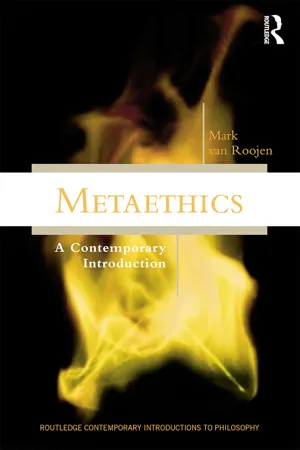
Metaethics: A Contemporary Introduction provides a solid foundation in metaethics for advanced undergraduates by introducing a series of puzzles that most metaethical theories address. These puzzles involve moral disagreement, reference, moral epistemology, metaphysics, and moral psychology. From there, author Mark van Roojen discusses the many positions in metaethics that people will take in reaction to these puzzles. Van Roojen asks several essential questions of his readers, namely: What is metaethics? Why study it? How does one discuss metaethics, given its inherently controversial nature? Each chapter closes with questions, both for reading comprehension and further discussion, and annotated suggestions for further reading.
- 310 pages
- English
- ePUB (mobile friendly)
- Available on iOS & Android
eBook - ePub
About this book
Information
Topic
PhilosophySubtopic
Philosophical MetaphysicsBibliography
- Adams, R. (1979). Divine command ethics modified again. Journal of Religious Ethics, 7(1), 66–79.
- Aharoni, E., Sinnott-Armstrong, W. & Kiehl, K. (2012). Can Psychopathic Offenders Discern Moral Wrongs? A New Look at the Moral/Conventional Distinction, Journal of Abnormal Psychology, 121(2).
- Anscombe, G. E. (1958). Modern moral philosophy. Philosophy, 33(124), 1–19.
- Arpaly, N.(2000). On acting rationally against one’s best judgment. Ethics, 110(3), 488–513.
- Arpaly, N.(2003). Unprincipled virtue. Oxford: Oxford University Press.
- Ayer, A. J. (1946). Language, truth and logic (Rev. ed.). London: Victor Gollancz.
- Bach, K.G.Russell & D. G.Fara(2011). Meaning and communication. In G.Russell & D. G.Fara (Eds.), Routledge companion to the philosophy of language (pp. 79–90). New York, NY: Routledge.
- Bagnoli, C.E. N.Zalta(2011). Constructivism in metaethics. In Stanford encyclopedia of philosophy (Spring2014 Edition), E. N.Zalta (Ed.), http://plato.stanford.edu/archives/win2014/entries/constructivism-metaethics/
- Baker, L. R. (2007). The metaphysics of everyday life. Cambridge: Cambridge University Press.
- Barker, S.(2000). Is value content a component of conventional implicature? Analysis, 60(267), 268–279.
- Bar-On, D., & Sias, J. (2013). Varieties of expressivism. Philosophy Compass, 8, 699–713.
- Barry, M. (2007). Realism, rational action and the Humean theory of motivation. Ethical Theory and Moral Practice, 10(3), 231–242.
- Bedke, M. (2009). Intuitive non-naturalism meets cosmic coincidence. Pacific Philosophical Quarterly, 90(2), 188–209.
- Bird, A. (1998). Dispositions and antidotes. Philosophical Quarterly, 48(191), 227–234.
- Blackburn, S. (1984). Spre...
Table of contents
- Cover
- Half Title Page
- Title Page
- Copyright Page
- Dedication Page
- Table of Contents
- Acknowledgments
- A Brief Introduction
- A Subject Matter for Ethics?
- Moral Epistemology and the Empirical Underdetermination of Ethical Theory
- The Practicality of Morality and the Humean Conception of Reason and Motivation
- Error Theory
- Simple Subjectivism
- The Cognitivist Heirs of Simple Subjectivism: Ideal Observers and Ideal Agents
- Noncognitivist Heirs of Simple Subjectivism
- Fictionalism
- Externalist Backlash
- Scientific Naturalism I: Cornell Realism
- Scientific Naturalism II: Moral Functionalism and Network Analyses
- Nonnaturalism and Antireductionism
- Odds, Ends, and Morals
- Glossary
- Bibliography
Trusted by 375,005 students
Access to over 1.5 million titles for a fair monthly price.
Study more efficiently using our study tools.
Frequently asked questions
Yes, you can cancel anytime from the Subscription tab in your account settings on the Perlego website. Your subscription will stay active until the end of your current billing period. Learn how to cancel your subscription
No, books cannot be downloaded as external files, such as PDFs, for use outside of Perlego. However, you can download books within the Perlego app for offline reading on mobile or tablet. Learn how to download books offline
Perlego offers two plans: Essential and Complete
- Essential is ideal for learners and professionals who enjoy exploring a wide range of subjects. Access the Essential Library with 800,000+ trusted titles and best-sellers across business, personal growth, and the humanities. Includes unlimited reading time and Standard Read Aloud voice.
- Complete: Perfect for advanced learners and researchers needing full, unrestricted access. Unlock 1.5M+ books across hundreds of subjects, including academic and specialized titles. The Complete Plan also includes advanced features like Premium Read Aloud and Research Assistant.
We are an online textbook subscription service, where you can get access to an entire online library for less than the price of a single book per month. With over 1.5 million books across 990+ topics, we’ve got you covered! Learn about our mission
Look out for the read-aloud symbol on your next book to see if you can listen to it. The read-aloud tool reads text aloud for you, highlighting the text as it is being read. You can pause it, speed it up and slow it down. Learn more about Read Aloud
Yes! You can use the Perlego app on both iOS and Android devices to read anytime, anywhere — even offline. Perfect for commutes or when you’re on the go.
Please note we cannot support devices running on iOS 13 and Android 7 or earlier. Learn more about using the app
Please note we cannot support devices running on iOS 13 and Android 7 or earlier. Learn more about using the app
Yes, you can access Metaethics by Mark van Roojen in PDF and/or ePUB format, as well as other popular books in Philosophy & Philosophical Metaphysics. We have over 1.5 million books available in our catalogue for you to explore.