eBook - ePub
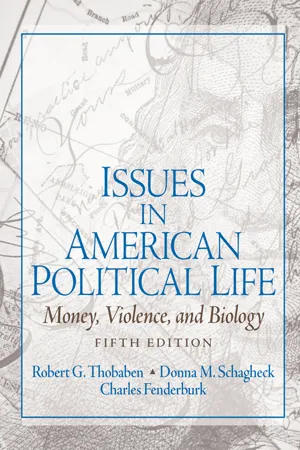
Issues in American Political Life
Money, Violence and Biology
- 272 pages
- English
- ePUB (mobile friendly)
- Available on iOS & Android
eBook - ePub
Issues in American Political Life
Money, Violence and Biology
About this book
A core text for undergraduate courses in American Public Policy, or supplemental reading in such courses as Introduction to American Government or Politics, American Public Policy Analysis, Introduction to Political Science. A substantive alternative to typical "issues" texts-which cover too many issues, too superficially-this intriguing and comprehensive text offers a more in-depth and coherent approach to contemporary policy problems and solutions. It provides a conceptual framework in which students can become comfortable actually doing policy analysis, and in learning skills beyond reading about certain political issues. Thematically organized, it looks at nine specific issues grouped into three broad categories that hold an enduring importance in American political life-money and politics, violence and politics, and biology and politics. All nine chapters and their respective topics (campaigns, corruption, welfare, crime, terrorism, arms control, the environment, biomedical issues, and biotechnology) have a strong conceptual base with current political dimensions and policy concerns woven throughout. Students not only learn the context, status, and prospects of issues confronting the U.S. government, but also see how these issues now cross our domestic borders into a global realm.
Information
Part I
Money and Politics
INTRODUCTION
Politics and economics are inevitably intertwined. Government decisions about taxing, spending, and borrowing have economic as well as political consequences. Since the beginning of the American republic, government has been involved in the nation’s economic affairs through its activities in promoting commerce, regulating economic activity, and adjusting levels of taxation and spending in response to business cycles. The budgets of modern American government are sufficiently large that routine decisions about taxes and spending have significant economic impact.
How Much Government Costs
The U.S. government spends more than one fifth of the nation’s gross domestic product (GDP) to deliver services, enforce regulations, and provide for national defense. About half this sum is returned to individual citizens in the form of payments and benefits. The remainder goes to fund government programs in domestic politics, homeland security, and national defense; to pay the costs of government, including salaries and pensions of civilian and military employees; and to pay interest on money the government has borrowed. This last item is sizable because the U.S. government borrows significant amounts of money to pay for spending not covered by available tax revenues. For example, in 2002 the government paid $178 billion to cover the interest due on the national debt. A glance at Table I.1 shows patterns of U.S. government spending and borrowing from 1978 until 2003. Although government spending has increased as the U.S. economy and population have grown, U.S. government spending has ranged from about 18 to 20 percent of GDP since 1960.
Deficit Spending. The table shows a persistent pattern of deficit spending by the U.S. government. When government spends more than its income, the result is a deficit in revenue. Reliance by the U.S. government on deficit financing is a feature of contemporary American politics. Strategies for managing budget deficits may involve a mixture of tax increases and spending cuts, or the deficit may be financed by borrowing money through the sale of government securities. The latter alternative has proven attractive to American politicians because it enables them to cut taxes, and to avoid or postpone tax increases and spending reductions, by borrowing money. The national debt includes past yearly deficits not yet repaid and the interest required to service the debt.
TABLE I.1 Federal Government Expenditures 1978–2003
| Billions of Dollars (% of Total) | ||||
| Category | 1978 | 1988 | 1998 | 2003 |
| Defense | 118 (25%) | 298 (27%) | 302 (17%) | 376 (18%) |
| Social Security | 91 (19%) | 214 (19%) | 370 (21%) | 479 (22%) |
| Medicare | 25 (05%) | 87 (08%) | 217 (12%) | 245 (12%) |
| Medicaid | 11 (02%) | 32 (03%) | 102 (06%) | 151 (08%) |
| Net Interest Paid | 35 (07%) | 148 (13%) | 226 (13%) | 161 (08%) |
| Surplus/Deficit | −32 (07%) | −121 (11%) | 73 (04%) | −303 (15%) |
| Total Spending | 478 | 1119 | 1771 | 2140 |
Source: Bureau of Labor Statistics, Table 6, http://www.bls.gov/govs/cffr/99cffus.txt, and U.S. Census Bureau, Statistical Abstract of the United States: 2003, Table No. 476, p. 322.
Since 1980 the national debt has increased from one third to about two thirds of the nation’s GDP. The federal budget has run deficits in most years since 1960, the only exceptions being 1969 and 1998–2001. The latter period was the second term of the Clinton administration when the president and Congress agreed to restrain government spending. This policy and a period of unprecedented economic growth produced four years of budget surpluses. Decisions by the second Bush administration to go to war in Afghanistan and Iraq, to build a missile defense system, and to provide a prescription drug benefit for Medicare beneficiaries, while cutting taxes twice between 2001 and 2003, have assured that deficit spending will continue to be the norm for the foreseeable future.
What Government Buys
Budgetary priorities refer to what government spends taxpayers’ money for—that is, what goods and services government buys and what services it delivers. There has been a gradual reordering of spending priorities in American government. Spending for defense, which was 46 percent of federal spending in 1965, equaled 18 percent in 2003. Rather than indicating reductions in the size of the defense budget, this percentage drop reflects a major reordering, with emphasis on increases in spending for human services and resources.
Entitlements and Indexed Programs. Underlying this development are two concepts relatively new in the American political economy. The first is the notion that citizens are entitled to certain economic benefits. Various government programs (called entitlements) have been enacted since 1935. Entitlements are social programs providing services and benefits to which citizens have a legal right if they meet the qualifications for that program. Examples include Social Security, Medicare, and veterans’ benefits. A second important development, which occurred during the 1960s and 1970s, is the concept of indexed programs, in which benefits increase automatically with the cost of living. The indexing of programs such as Social Security to increases in the Consumer Price Index ensures that benefits (and government spending) will increase with inflation. In addition to the proliferation of social programs and the expansion of benefits, the costs of medical care, technology, and human services have increased steadily as the American population has aged. The growth of entitlements has had an impact on government spending. Government payments to individuals increased from 24 percent of total spending in 1965 to 61 percent in 2002. Social Security payments to retired persons, which totaled 19 percent of federal spending in 1978, are projected to increase to nearly one fourth of the total by the year 2008. Medicare is the program of health-care benefits for Social Security retirees. Medicare spending has increased from 5 percent of federal spending in 1978 to a projected 17 percent in 2008. This reflects both the increasing numbers of retirees in the United States and increases in the costs of health care and medical technology. Spending for the Social Security and Medicare programs combined is expected to approach 40 percent of total spending by 2008.
Controlling the costs of entitlements is complicated by the fact that 60 percent of entitlement spending goes to pay for benefits for the elderly, mainly in the form of Social Security and Medicare. Although the elderly constitute only about 12 percent of the population, the number of elderly Americans is increasing rapidly, as is their political influence. There are more than 30 million recipients of Social Security and Medicare benefits, and the American Association of Retired Persons (AARP) has the largest membership of any organized interest group in the United States. Many elderly and retired Americans regard attempts to control the cost of entitlements as a direct assault on their interests. The political influence of Social Security beneficiaries has been demonstrated repeatedly. When the Reagan administration proposed reductions in Social Security benefits (for early retirees) and in cost of living increases, Congress was swamped with complaints from senior citizens. Democrats were quick to exploit this political advantage, denouncing the administration as unconcerned about the elderly. The result of the Reagan administration’s painful lesson was that “social security became virtually untouchable.”1
To summarize, sometimes decision makers must spend money because their options are limited by decisions that were made years, or even decades, earlier. Programs are created, benefits are conferred, expectations are established, and policies become entrenched. The beneficiaries of programs who become accustomed, or even entitled, to benefits constitute a political constituency in support of the programs. Governing consists partly of finding monetary sources to finance public services and partly of deciding who will pay these costs and who will receive the benefits. Politics is the process of deciding not only who gets what, when, and how, but also who pays and how much.
Technological change plays a prominent role in American economics and politics. The pace of social change in America accelerated in the latter half of the twentieth century because of the impact of advanced technology. The questions of how society will pay for government programs (taxing and borrowing) and what government will spend the money for (policy priorities) have become increasingly important because advanced technology is expensive. Medical technology, computers, airplanes, and mi...
Table of contents
- Cover Page
- Half Title page
- Title Page
- Copyright Page
- Contents
- Preface
- Introduction
- Money and Politics
- The Politics of Poverty and the Welfare State
- The Politics of Health Care
- Money in Public Office: Campaign Finance, Graft, and Corruption
- Glossary
- Violence and Politics
- The Politics of Crime in America
- The Politics of Terrorism
- The Politics of Arms Racing and the Proliferation of Weapons of Mass Destruction
- Glossary
- Biology and Politics
- Biomedical Issues
- Biotechnology
- The Ecological Crisis
- Glossary
- Index
Trusted by 375,005 students
Access to over 1.5 million titles for a fair monthly price.
Study more efficiently using our study tools.
Frequently asked questions
Yes, you can cancel anytime from the Subscription tab in your account settings on the Perlego website. Your subscription will stay active until the end of your current billing period. Learn how to cancel your subscription
No, books cannot be downloaded as external files, such as PDFs, for use outside of Perlego. However, you can download books within the Perlego app for offline reading on mobile or tablet. Learn how to download books offline
Perlego offers two plans: Essential and Complete
- Essential is ideal for learners and professionals who enjoy exploring a wide range of subjects. Access the Essential Library with 800,000+ trusted titles and best-sellers across business, personal growth, and the humanities. Includes unlimited reading time and Standard Read Aloud voice.
- Complete: Perfect for advanced learners and researchers needing full, unrestricted access. Unlock 1.5M+ books across hundreds of subjects, including academic and specialized titles. The Complete Plan also includes advanced features like Premium Read Aloud and Research Assistant.
We are an online textbook subscription service, where you can get access to an entire online library for less than the price of a single book per month. With over 1.5 million books across 990+ topics, we’ve got you covered! Learn about our mission
Look out for the read-aloud symbol on your next book to see if you can listen to it. The read-aloud tool reads text aloud for you, highlighting the text as it is being read. You can pause it, speed it up and slow it down. Learn more about Read Aloud
Yes! You can use the Perlego app on both iOS and Android devices to read anytime, anywhere — even offline. Perfect for commutes or when you’re on the go.
Please note we cannot support devices running on iOS 13 and Android 7 or earlier. Learn more about using the app
Please note we cannot support devices running on iOS 13 and Android 7 or earlier. Learn more about using the app
Yes, you can access Issues in American Political Life by Robert Thobaben,Charles Funderburk,Donna Schlagheck in PDF and/or ePUB format, as well as other popular books in Politics & International Relations & National Security. We have over 1.5 million books available in our catalogue for you to explore.