eBook - ePub
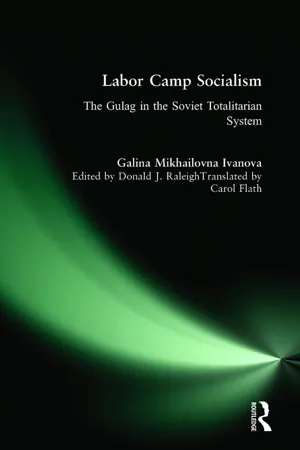
Labor Camp Socialism: The Gulag in the Soviet Totalitarian System
The Gulag in the Soviet Totalitarian System
- 234 pages
- English
- ePUB (mobile friendly)
- Available on iOS & Android
eBook - ePub
Labor Camp Socialism: The Gulag in the Soviet Totalitarian System
The Gulag in the Soviet Totalitarian System
About this book
This is the first historical survey of the Gulag based on newly accessible archival sources as well as memoirs and other studies published since the beginning of glasnost.
Over the course of several decades, the Soviet labor camp system drew into its orbit tens of millions of people -- political prisoners and their families, common criminals, prisoners of war, internal exiles, local officials, and prison camp personnel. This study sheds new light on the operation of the camp system, both internally and as an integral part of a totalitarian regime that "institutionalized violence as a universal means of attaining its goals". In Galina Ivanova's unflinching account -- all the more powerful for its austerity -- the Gulag is the ultimate manifestation of a more pervasive and lasting distortion of the values of legality, labor, and life that burdens Russia to the present day.
Information
Chapter 1
Repression and Punishment
The Soviet repressive system originated in the chaos of revolution and was several years in the making. Forced-labor camps, previously unknown in Russia, began to appear after the October Revolution, taking their places alongside traditional places of incarceration. These new camps were to become the primary channel for enforcing the Soviet state’s punitive policies.
The first camps appeared on Soviet territory during the summer of 1918. On August 9, Lenin, in his capacity as chairman of the Council of People’s Commissars (Sovnarkom, SNK), instructed the Penza Provincial Executive Committee to “conduct a merciless campaign of mass terror against kulaks, priests, and White Guardists; suspicious persons are to be incarcerated in a concentration camp outside city limits.”1 The new punitive facilities were authorized by a Sovnarkom Decree of September 5, 1918, entitled “On the Red Terror.” This document prescribed execution by shooting for persons “implicated in White Guard organizations, plots, and rebellions” and imprisonment in concentration camps for “class enemies.”2 Casting aside all generally accepted procedural norms and legal guarantees, the Bolsheviks launched a systematic program of extermination of real and potential opponents. Hostage taking, a new measure that had not been applied in Russia before the revolution, was introduced to suppress opposition among various groups of the population.
In their struggle for survival, the Bolsheviks aimed, if not to annihilate all their enemies physically, at least to isolate them and break down their spirit and morale by placing them under guard and forcing them to work for them. The various camps—concentration, forced-labor, special designation, corrective-labor, and so on, whose names had no real significance in distinguishing their nature and functions—were perfectly suited for this purpose and were relatively simple and inexpensive to establish.
Legal regulation of camp operations began with the decree of the All-Russian Central Executive Committee (VTsIK) “On Forced-Labor Camps,” published in Izvestiia on April 15, 1919. The initial organization and management of forced-labor camps was entrusted to provincial extraordinary commissions. The administration of the NKVD camps was turned over to the Central Camp Administration, created by agreement with the All-Russian Extraordinary Commission for the Struggle against Counterrevolution, Sabotage, and Work-Related Crime (VChK or Cheka). On May 17, 1919, the VTsIK issued a resolution “On Forced-Labor Camps,” pursuant to the April 15 decree, setting forth detailed procedures and conditions for organizing the camps. It recommended that the initial planning should take into account local conditions, “both within city limits and on the estates, in the monasteries, at the country homes, and so on, located nearby.” The decree required the establishment within stipulated time limits of camps with a capacity of at least 300 prisoners each in all the provincial capitals. The overall administration of all the camps on the territory of the RSFSR was entrusted to the NKVD’s Department of Forced Labor. It was assumed that the costs of running the camps would be covered by the labor of the prisoners (only people capable of physical labor were sent to camps). Attempts to escape were punished severely: for the first attempt, the prisoner’s sentence was increased tenfold; for the second, he could be sentenced by a revolutionary tribunal to be shot.3 These documents in effect legalized the activity of the camps, which had emerged during a period of political terror, extrajudicial reprisals, and civil war.
The number of camps grew quickly: at the end of 1919 there were a total of 21 in the RSFSR; in the summer of 1920, the number had grown to 49; by November there were 84; in January 1921, the number had reached 107; and by November 1921 there were 122 camps in all.4 In 1921 there were fifty-two provinces and regions in the Russian Federation, which meant an average of two camps for each province. In reality, these hastily established facilities were distributed unequally. Moscow and Moscow Province, for example, had a total of eight concentration camps.
The NKVD report for 1920 recorded four types of forced-labor camps under its authority: “(1) ‘special designation’—the Andronev and Ivanov camps in Moscow for foreigners and other prominent prisoners, persons convicted before the end of the Civil War, and those serving long terms; (2) regular concentration camps; (3) prisoner-of-war camps; (4) one screening facility, Novopeskovskii in Moscow, which temporarily held prisoners before they were sent on to other camps.”5 In the relevant documents the terms “concentration camps” and “forced-labor camps” tend to be used synonymously to refer to the same facilities; these documents also contain the terms “forced-labor concentration camps” and “special designation concentration camps.” Occasionally the term “concentration camps” refers to places of incarceration for a particular category of prisoners, hostages and captives, or to camps under the jurisdiction of the Cheka, which for the most part held citizens who had been arrested administratively, without judicial procedure, ‘just in case.”
We do not have reliable information as to the total number of people imprisoned during the civil war years in Cheka–NKVD camps. The fragmentary data available show that in September 1921, 60,457 prisoners were held in 117 NKVD camps. Of these, 44.1 percent had been sentenced by the Cheka, 7.9 percent by other administrative agencies, 24.5 percent by people’s courts, 8.7 percent by revolutionary tribunals, 11.6 percent by revolutionary military tribunals, and 3.2 percent by other courts (regimental or comrades’ courts). According to the official statistics of the repressive bodies themselves, approximately 17 percent of prisoners served time for counterrevolutionary crimes. The largest group (30.3 percent) was made up of prisoners serving terms of up to five years; the others were serving from three months to three years.6 In 1921 there were almost 50,000 prisoners in Cheka camps.7
As the camp system developed, the administrative structures became more refined. The NKVD Department of Forced Labor was reorganized in 1921 into the Chief Administration of Forced-Labor Camps, which had two sections—one for administrative affairs and the other for economic management. The overall number of central administrative personnel was forty-seven.
In 1922 three agencies were responsible for punitive policy in the Soviet state: (1) the People’s Commissariat of Justice (NKIu), specifically its Central Department of Corrective Labor; (2) the State Political Administration (GPU), which had its own camps and prisons; (3) the People’s Commissariat of Internal Affairs (NKVD), where this sphere of activity was managed by the Chief Administration of Forced Labor and the Chief Militia (Glavmilitsiia), which administered houses of arrest. It is interesting to note that these governmental structures viewed punitive policy not as a part of overall state policy but as one of their own internal functions. For example, the Statute on General Places of Incarceration in the RSFSR of November 15, 1920, developed by the People’s Commissariat of Justice, explicitly specified that local punitive departments were responsible for “carrying out the principles underlying the punitive policy of the People’s Commissariat of Justice.”8
The places of incarceration under the People’s Commissariat of Justice included prisons, which numbered 251 at the end of 1920; agricultural colonies and farms, whose number was increasing rapidly (in 1922 there were 32 colonies and 28 farms); as well as corrective institutions for juveniles and the chronically ill.9 The People’s Commissariat of Justice understandably wanted to retain the right to conduct its “own” punitive policy and considered it necessary to concentrate all penitentiary institutions under its administration. The NKIu maintained a very cautious attitude toward the camps. One of the draft resolutions of the Sovnarkom, proposed by the Commissariat of Justice, reads: “Incarceration in forced-labor camps is to be abolished as a form of punishment. All persons sentenced to deprivation of liberty by judicial institutions are to be kept in general and special places of incarceration under the jurisdiction of the NKIu.”10 Another document drafted at the beginning of 1922 by a special Central Executive Committee commission created to reexamine the institutions of the RSFSR stated: “The People’s Commissariat of Internal Affairs (NKVD) is required immediately to begin turning over all its concentration camps to the People’s Commissariat of Justice…. The People’s Commissariat of Justice is instructed to integrate the camps into the overall system of places of incarceration for housing prisoners serving light sentences.”11
But the camps were here to stay. The Fifth All-Russian Congress of Directors of Administrative Departments of Provincial Executive Committees in 1922 came out in favor of retaining and expanding them. In its discussion on long-term planning in the area of punitive policy, the congress approved of the policy of “basing punitive policy on forced-labor camps; the NKVD has a more powerful administrative system than the NKIu.”12
In justifying their point of view, NKVD representatives gave the following argument:
Over the past four years, the NKIu has not only been unable to improve the prison system that was in fairly good shape when it was turned over to them, but it has in fact seriously neglected it; for example, the district prisons have been practically completely dismanded.* Meanwhile, in less than three years the Chief Administration of Forced Labor has created a strong system of camps literally out of thin air, thereby freeing themselves from state support.13
The congress weighed the arguments of the NKVD representatives and came out in favor of transferring all places of deprivation of liberty to the People’s Commissariat of Internal Affairs.
In our view, the differences in opinion between the two competing agencies—the Commissariats of Justice and Internal Affairs—in the area of punitive policy can be explained by the fact that at that time there were a significant number of so-called “bourgeois experts” in the NKIu, major specialists in the law, legal practitioners and scholars who, although they did adapt and adjust their views, nevertheless could not reconcile themselves to the illegal actions of the Bolshevik authorities. Meanwhile, many of the officials of the NKVD were professional revolutionaries for whom the elevation of terror to the level of official policy was a matter of principle.
On July 25, 1922, the Sovnarkom passed a resolution concentrating all places of incarceration under the sole administration of the NKVD. On October 12 of the same year, the NKVD and the NKIu worked out a joint agreement reorganizing and dividing their authorities. The NKVD Chief Administration of Forced Labor and the Central Department of Corrective Labor were disbanded, and their functions and subsidiary agencies were turned over to the new Chief Administration of Places of Incarceration under the NKVD. The NKIu retained the rights of prosecutorial oversight.14
The desperate state of the economy and the overall devastation and famine in the country made life in the camps unbearable. Physically healthy people became disabled within very short periods of time. At the end of 1921, NKVD officials noted “desperate conditions in the camps due to severe reductions in rations and increased mortality from emaciation and the epidemic diseases that have emerged under these conditions.”15
The critical situation in the concentration camps was exacerbated by a lack of budgetary allocations for their support. Unable to run the camps, many provinces proposed closing them. One of the reasons for the crisis was the transfer of fiscal responsibility for their maintenance to local budgets in August 1922. The state budget continued to fund only fifteen places of incarceration that were considered to be of national importance. These included the largest isolation prisons, workhouses for juveniles, and prisons for people convicted of political crimes. Unwilling to overburden their already meager budgets, local authorities rejected all requests for material support from places of incarceration. In some cases, provincial executive committees passed resolutions refusing to accept prisoners from outside their borders.16
Unable to cope with the critical situation on its own, the NKVD applied to the Sovnarkom for assistance. ‘The entire network of places of incarceration,” states a February 19, 1925, memorandum by A.G. Beloborodov, people’s commissar of internal affairs,
which was designed for approximately 73,000 prisoners, at present holds 100,924. Everyone’s rations have to be cut in order to feed those 30,000 prisoners not accounted for in the supply plan…. As a result, thousands of prisoners are starving; unsanitary conditions in the camps have brought on the threat of epidemics, and escapes from places of incarceration cannot be prevented, because of the lack of personnel. The People’s Commissariat of Internal Affairs of the RSFSR for the Chief Administration of Places of Incarceration considers the situation critical and requests that the central authorities provide immediate aid to local budgets to cover the needs of places of incarceration.17
During the first half of the 1920s, Soviet authorities issued various early-release orders and amnesties freeing thousands of prisoners from prisons and camps. In our view these “outbursts of humanitarianism” can be explained by the critical material conditions in the camps. In any case, this policy of “airing out the cells,” as it was called by prison staff, was ineffective, since within a few days the prisons would fill up again with a new supply of prisoners.
NKVD places of incarceration were regulated by the Corrective-Labor Code of the RSFSR of October 16, 1924. Interestingly, camps are not included among the institutions listed in the code “for implementing social defense measures of a correctional nature.”18 The report of the Chief Administration of Places of Incarceration of the Republic, presented at the Eleventh Congress of Soviets, claims that by 1923 concentration camps had been completely eliminated or converted into general-profile places of incarceration.19 But that is not quite accurate, for in fact two punitive systems continued to function in the country. Now, however, they were no longer under the authority of the NKIu and the NKVD, but had become a part of the NKVD and the State Political Administration and Combined State Political Administration (GPU–OGPU).
The GPU, which replaced the Cheka within the NKVD in February 1922, was transferred from the People’s Commissariat of Internal Affairs in 1923 to the Sovnarkom. The GPU took with it the special, separate system of repression, which included GPU facil...
Table of contents
- Cover
- Half Title
- Title Page
- Copyright Page
- Dedication
- Table of Contents
- List of Abbreviations
- Editor’s Introduction
- Author’s Note to Readers of the English-Language Edition
- Preface
- Introduction: Courts and Convicts in Tsarist Russia
- Chapter 1: Repression and Punishment
- Chapter 2: The Camp Economy
- Chapter 3: Gulag Personnel
- Conclusion: What Was the Gulag?
- Afterword
- Notes
- Index of Personal Names
- Index of Camp Names
Trusted by 375,005 students
Access to over 1.5 million titles for a fair monthly price.
Study more efficiently using our study tools.
Frequently asked questions
Yes, you can cancel anytime from the Subscription tab in your account settings on the Perlego website. Your subscription will stay active until the end of your current billing period. Learn how to cancel your subscription
No, books cannot be downloaded as external files, such as PDFs, for use outside of Perlego. However, you can download books within the Perlego app for offline reading on mobile or tablet. Learn how to download books offline
Perlego offers two plans: Essential and Complete
- Essential is ideal for learners and professionals who enjoy exploring a wide range of subjects. Access the Essential Library with 800,000+ trusted titles and best-sellers across business, personal growth, and the humanities. Includes unlimited reading time and Standard Read Aloud voice.
- Complete: Perfect for advanced learners and researchers needing full, unrestricted access. Unlock 1.5M+ books across hundreds of subjects, including academic and specialized titles. The Complete Plan also includes advanced features like Premium Read Aloud and Research Assistant.
We are an online textbook subscription service, where you can get access to an entire online library for less than the price of a single book per month. With over 1.5 million books across 990+ topics, we’ve got you covered! Learn about our mission
Look out for the read-aloud symbol on your next book to see if you can listen to it. The read-aloud tool reads text aloud for you, highlighting the text as it is being read. You can pause it, speed it up and slow it down. Learn more about Read Aloud
Yes! You can use the Perlego app on both iOS and Android devices to read anytime, anywhere — even offline. Perfect for commutes or when you’re on the go.
Please note we cannot support devices running on iOS 13 and Android 7 or earlier. Learn more about using the app
Please note we cannot support devices running on iOS 13 and Android 7 or earlier. Learn more about using the app
Yes, you can access Labor Camp Socialism: The Gulag in the Soviet Totalitarian System by Galina Mikhailovna Ivanova,Donald J. Raleigh,Galina Mikhailovna,Carol A. Flath in PDF and/or ePUB format, as well as other popular books in Politik & Internationale Beziehungen & Sozialgeschichte. We have over 1.5 million books available in our catalogue for you to explore.