eBook - ePub
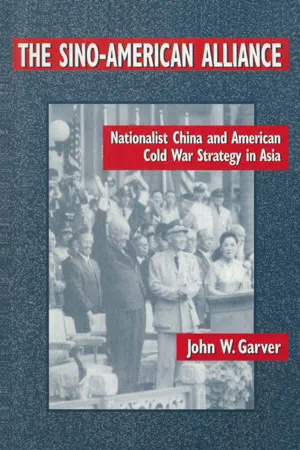
The Sino-American Alliance
Nationalist China and American Cold War Strategy in Asia
- 450 pages
- English
- ePUB (mobile friendly)
- Available on iOS & Android
eBook - ePub
About this book
This study provides an analysis of the role the United States alliance with Nationalist China played in US strategy to contain first the Sino-Soviet alliance and then China during the 1950s and 1960s.
Information
1 Introduction
DOI: 10.4324/9781315699011-1
This book is about the ways in which the United States’ relationship with Nationalist China served U.S. policy interests in Asia during the 1950s and 1960s. It attempts to weigh the various components of the U.S.-Nationalist relation in terms of their utility, or their disservice, to U.S. policy objectives. The thesis of this study is that the United States’ relationship with the Nationalist regime on Taiwan was an important and valuable element of U.S. strategy in Asia during the two decades between 1950 and 1971. U.S. leaders of that era believed that this was the case, and a dispassionate retrospective judgment leads to a similar conclusion. The multifaceted U.S. alliance with the Nationalist regime on Taiwan played an important role in U.S. strategy for splitting the Sino-Soviet bloc and containing the revolutionary expansion of China during the early Cold War era in Asia.
The utility of Nationalist China to U.S. strategy was multifaceted. Utilization of Taiwan by U.S. military forces and denial of it to the military forces of the Sino-Soviet bloc maintained the integrity of the offshore island chain along the eastern coastline of the Eurasian continent. This allowed the United States to secure threatened sea lines of communication between North America and forward positions around the periphery of the Sino-Soviet bloc in East Asia. Once Nationalist military forces had been reorganized by the mid-1950s, the mobilization of the military resources of Nationalist China made a major contribution toward offsetting the Sino-Soviet bloc’s superiority in ground forces, and provided a means of containing the enemy land offensives expected to characterize the beginning of a general East-West war. In peacetime, the existence of a militarily potent and potentially aggressive Nationalist regime off the coast of the People’s Republic of China (PRC) compelled Beijing to divert resources away from economic development and improvement of popular living standards, thereby fostering dissent and possibly accelerating the long-term delegitimization of the regime. Of course, the Nationalist-U.S. threat also worked the other way as well, helping to legitimize the repression of the Chinese Communist Party (CCP). The Nationalist regime also provided a useful way of isolating the People’s Republic of China internationally, since relations with the former automatically precluded relations with the latter.
The existence of a non-Communist and prosperous Chinese polity off the coast of the PRC also contributed to undermining the Communist model of development among the people of China and of Asia. While the effects of the Taiwan development model were not fully felt until the 1970s and 1980s, well after the time frame of this book, much of the basic architectural design work for that model was done during the 1950s and 1960s. From a long-term perspective, the amorphous power of example generated by a successful modern, democratic Chinese polity on Taiwan may well prove to be the most durable benefit deriving from the U.S.-Nationalist alliance of the 1950s and 1960s. It therefore behooves us to consider the early U.S. midwifery of what later became the Taiwan model. Finally, cooperation with Nationalist China offered the United States effective intelligence assets with which to penetrate the veil of state secrecy in Communist China. In sum, cooperation with Nationalist China gave the United States important advantages in dealing first with the hostile combination of the Union of Soviet Socialist Republics (USSR) and the PRC and, after 1960, with the PRC alone.
The premise of this book is that, during the decades between 1950 and 1971, the United States and the People’s Republic of China engaged in a protracted political struggle, with each side using all means short of outright war to injure and punish the other side. The leaders of both countries chose to keep this confrontation below the level of declared belligerency, but the conflict was nonetheless bitter. Men fought and died. Whatever means could be used to hurt, weaken, demoralize, or confuse the other side were used. Both sides deemed the use of all means short of war legitimate.
From one perspective, this book constitutes a study of the secret history of Sino-U.S. relations during the 1950s and 1960s. In their long political war, both Beijing and Washington mobilized whatever forces were available within and beyond their national boundaries. Sometimes this was done with the consent of governments exercising sovereignty over that territory, sometimes without. Because of the political costs associated with violation of the sovereignty-based norms of the international order, and because of the sentiments of public opinion in the Western democracies, both Washington and Beijing kept much of their activity secret. Many of the battles of this two-decade-long political war were sub rosa—and many of them are elucidated in the following pages. What follows is only a partial history of the “secret war,” however, as the Chinese side of the ledger is absent. A balanced history of the secret Sino-U.S. war would include Beijing’s clandestine campaigns against the United States in Asia, Africa, Latin America, and Europe.
This book assumes that the U.S. link with Taiwan, and even more generally the strategy of containment from which that link derived, was not itself the primary cause of the U.S.-PRC confrontation during the 1950s and 1960s. Were the Sino-American confrontation during that period essentially about the U.S. presence on Taiwan and U.S. involvement with the Nationalist competitor to the Chinese Communist Party, then whatever advantages the United States might derive from its links with Taiwan, in terms of a favorable structure of power vis-à-vis a hostile China, would be illusory. If U.S. nonengagement with Nationalist China on Taiwan would have ended PRC hostility toward the United States, there would have been no need to contain China. Indeed, U.S. engagement with Nationalist China would have produced the very problem—a hostile China—that it was intended to address.
PRC historiography insists that this was, in fact, the case; the roots of U.S.-PRC confrontation lay in President Harry S. Truman’s 27 June 1950 interposition of the Seventh Fleet into the Taiwan Strait, and U.S. support for Nationalist China over the subsequent twenty years was the major cause of Sino-American hostility.
I view the problem differently. During the U.S.-PRC ambassadorial talks in Geneva and Warsaw in 1955–56, and again during the Sino-American discussions leading up to the Shanghai Communiqué of 1972, the Taiwan issue was indeed the most sensitive and difficult one. But beneath that issue lay an array of issues having to do with the global balance of power. In 1955–56 Washington and Beijing recognized few if any convergent interests in these areas: the growth of Soviet global power, decolonization and its aftermath, the Japan-U.S. alliance, Soviet control over Eastern Europe, and so on. Given these divergent interests, there was no impetus to compromise. In 1971–72 the two sides were able to set aside the Taiwan issue because they now agreed on a wide range of major global issues: global strategy for dealing with the Soviet Union, U.S.-Japanese relations, the Indian Subcontinent, the Indochina war, arms control, Soviet-European relations, and so on. One striking aspect of the rapprochement of the early 1970s was the rapidity with which robust cooperation on a range of important issues replaced conflict over Taiwan. The conclusion is inescapable: multiple convergent interests pushed Washington and Beijing to compromise over Taiwan. Which was more fundamental, the Taiwan issue or the degree of divergence or convergence of interests on other global issues? It seems to me that the latter was the more fundamental. Until the tight bipolar world disintegrated with the collapse of the PRC-USSR alliance, there would be no impetus for Beijing and Washington to compromise over Taiwan. Once that occurred and Chinese and U.S. interests began to converge, the Taiwan issue was easily set aside. The global balance of power was the most important element.
The Sino-American confrontation of the 1950s and 1960s was about far more than Taiwan. It was about the fate of East and Southeast Asia. Were the countries of that region to develop under the tutelage of elites committed to Leninist socialism, or under the tutelage of elites committed to liberal capitalism? For reasons of both ideology and the security of the new revolutionary Chinese state they had founded, China’s Communist leaders sought the former.
A recent study by Professor Chen Jian mines newly available Chinese sources to analyze CCP perceptions in 1949.1 Chen stresses the revolutionary aspirations of CCP leaders. Mao Zedong’s overriding objective as the revolutionary movement he led approached nationwide victory, was to sustain the momentum of that movement. Now that the first stage of the revolution was nearly complete, it was imperative to move the revolution into its second, socialist stage. The social and political structures of the old order had to be destroyed, and structures of a new socialist order established. The revolution could not be allowed to stall because the goals of its initial stage had been achieved. There was bound to be strong internal opposition to transition to socialism. The resistance of the bourgeoisie and the petite bourgeoisie, especially sections of the intelligentsia, would have to be crushed. Mao’s foreign policies were an extension of these domestic imperatives. A policy of militant, revolutionary struggle internationally was conducive to overcoming internal opposition to the revolutionization of China’s society.
Internationally, Mao viewed world affairs through the prism of Marxism-Leninism. The confrontation under way between the USSR and the Western countries led by the United States was a manifestation of class struggle. The United States led the world’s reactionary forces. The hostility of U.S. imperialism to the Chinese revolution was inevitable, while New China could look to the USSR for necessary assistance in economic, military, and political construction.2
Mao was especially concerned with the success of revolutionary movements in areas around China’s periphery. Indochina and Korea had been tributaries of China before wars by France and Japan in the 1880s and 1890s. But Mao and his comrades also paid great attention to revolutionary struggles elsewhere in East and Southeast Asia. If those movements were successful, China’s new revolutionary state would be more secure against threat and pressure by U.S. imperialism. Chinese assistance to those movements would thus enhauce PRC security. It was also in accord with Marxism-Leninism’s prescription of proletarian internationalism. In addition, it provided a way for New China to play a more important role in Asian affairs.3
Alliance with the USSR followed from this analysis. During a visit by a CCP delegation to Moscow in July–August 1949, Stalin and CCP leader Liu Shaoqi discussed cooperation in support of world revolution. Stalin proposed that while the USSR was to remain the leader of the world proletarian revolution, China should play a more active role in advancing the rising tide of revolution in East Asia. Liu agreed and said China would try to do more to support Asian revolutionary movements.4 Shortly afterward, the People’s Liberation Army (PLA) transferred several divisions of ethnic Koreans to Kim Il Sung and began large-scale military assistance to Ho Chi Minh’s Viet Minh forces in Indochina.
For reasons of ideology and the security of the state they led, U.S. leaders concluded they should seek to thwart the revolutionary efforts of the new Chinese state. American liberal ideology deemed repugnant the system of Communist Party dictatorship and command economy extolled by Communism. U.S. leaders of the late 1940s also generally believed that American power ought to serve the cause of freedom in the world. In terms of security, U.S. security would be enhanced if the territories and resources of various East Asian states were controlled by elites sympathetic to the United States and its values. It would be diminished were those lands and resources mobilized under the direction of elites dedicated to antithetical values and institutions.
Two decades of confrontation through all means short of war was the result of the clash of these ideological and state security perspectives. It is necessary to reiterate this key assumption: the U.S.-PRC confrontation was, in large part, about the future of Asia. Conflict over Taiwan was secondary to this broader struggle between Leninist-led and non-Leninist-led development throughout East Asia.
There was widespread revolutionary ferment in post–World War II Asia. In the words of one study, there was “nearly ubiquitous” regime collapse in that region, with elites and political structures widely discredited by association with Western colonialists and Japanese occupiers. Government’s hold on the countryside had weakened, and political situations were highly fluid.5
The contest between China and America was fought out in two geographic zones. The first zone included Korea, Taiwan, and Indochina, the second zone the Philippines, Malaysia, Indonesia, and Japan. In the first zone there was sharp and direct confrontation between the United States and the People’s Republic of China. In the second zone the conflict was less intense and less direct but nonetheless quite real. Throughout the region, both the United States and the PRC mobilized and applied national power to direct development along the desired lines, working with sympathetic local elites in the process.6
A corollary of this view is that the national power of one great power was constrained and checked by that of the other. Many important factors other than the relative power capabilities of China and the United States were, of course, involved. The argument here is not that either American or Chinese power was the sole or necessarily the most important factor that determined the destinies of various regions and countries. Some extremely important variables emerged out of the historic and social processes internal to the countries of these two zones. Yet the relative power capabilities of the United States and China also played a very important role. The power of the United States and China checked each other along the thirty-eighth parallel of the Korean peninsula and down the Taiwan Strait. China’s national power played an extremely important role in defeating the American effort in Indochina and directing that region along the socialist path of development. Had the relative application of either American or Chinese power been substantially greater or less in Korea, Taiwan, or Indochina, the outcomes could well have been different. In the second zone, China supported revolutionary movements in Malaysia, the Philippines, and Indonesia, and “anti-imperialist” movements in Japan. But American power was too great in this region, and Chinese power too weak, for Chinese policy to win.
It follows from this analysis that the construction of a relatively more powerful position for the United States benefited that nation and the goals sought by American power. In other words, the U.S. alliance with Nationalist China played an important role in constructing a structure of power favorable to the attainment of U.S. interests in Asia. Nationalist China was, of course, only one element of this structure. Focusing on this one element does not imply that it was the most important element. Rather, the proposition is merely that it was one important element.
The interpretation of the U.S.–Nationalist China relation developed in this book and summarized above differs somewhat from previous U.S. scholarship on this issue. This study constitutes the first in-depth look at the United States’ relationship with Nationalist China during the 1950s and 1960s. Several other scholars have, however, dealt with that relationship as part of broader studies. Warren I. Cohen, in his seminal study of Sino-U.S. relations, touched on the U.S.-Nationalist relationship of that era, emphasizing almost exclusively the costs of that relationship to the United States. U.S. support for Nationalist China isolated the United States “almost as much as it did the People’s Republic,” according to Cohen.7 It also greatly increased Beijing’s hostility toward the United States; Beijing no longer required “ideological reasons for its virulent hostility to the United States.”
In a recent and impressive study of U.S. policy toward Taiwan and Hong Kong, Nancy B. Tucker also stresses the debit side of the account. The Nationalist regime was a discredited dictatorship which tarnished the United States by association. Chiang Kai-shek tried to maneuver the United States into conflict with the PRC and defied U.S. efforts to reduce tension with Beijing. U.S. ties with the Nationalists created problems for the United States with friendly and allied countries in Asia and in Europe. The United States accepted this because of its “anti-Communist crusade.”8 Tucker’s analysis, like Cohen’s, gives no sense of the major benefits that the United States derived from its association with Nationalist China. Michael Schaller goes further, judging the U.S.-Nationalist link an unmitigated catastrophe: “The most significant and ultimately disastrous aspect of the American response to the North Korean attack [of June 1950] was the decision to draw a military barrier around Communist China and become uninvolved in the civil war. … Not only would South Korea be defended, but now Taiwan would be shielded from invasion.”9
The problem with these earlier studies is not that they are wrong, but that they are one-sided. They place nearly exclusive stress on conflicts within the U.S.-Nationalist alliance, on the unattractive aspects of the Nationalist regime, and on the failure of various Nationalist operations on the mainland. These scholars presented a one-sided view, overlooking the many substantial gains the United States derived from association with Nationalist China. No policy is without costs, difficulties, and risks. Certainly the U.S. alliance with Nationalist China was fraught with these. Several of the cooperative ef...
Table of contents
- Cover Page
- Half Title Page
- Title Page
- Copyright Page
- Dedication
- Contents
- Figures and Tables
- Abbreviation
- 1 Introduction
- 2 Contradictory Policies: Encouraging Chinese Titoism and Consolidating the Offshore Perimeter
- 3 Nationalist China and the Korean War
- 4 Formation of the U.S.-Nationalist Alliance
- 5 Containment Versus Liberation
- 6 Covert Operations Against the Mainland
- 7 The Offshore Islands
- 8 The Burma Campaign: Operation Paper and Its Aftermath
- 9 The Tibetan Operation: Joint Support for the Tibetan Resistance
- 10 Joint Intelligence Operations Against the Mainland
- 11 Taiwan and the Vietnam War
- 12 Nationalist China and the Containment of PRC Influence
- 13 U.S. Policy and the Taiwan Model
- 14 The 1971 Debacle at the United Nations
- 15 The Alliance and U.S.-PRC Rapprochement
- 16 Conclusions
- Index
Trusted by 375,005 students
Access to over 1.5 million titles for a fair monthly price.
Study more efficiently using our study tools.
Frequently asked questions
Yes, you can cancel anytime from the Subscription tab in your account settings on the Perlego website. Your subscription will stay active until the end of your current billing period. Learn how to cancel your subscription
No, books cannot be downloaded as external files, such as PDFs, for use outside of Perlego. However, you can download books within the Perlego app for offline reading on mobile or tablet. Learn how to download books offline
Perlego offers two plans: Essential and Complete
- Essential is ideal for learners and professionals who enjoy exploring a wide range of subjects. Access the Essential Library with 800,000+ trusted titles and best-sellers across business, personal growth, and the humanities. Includes unlimited reading time and Standard Read Aloud voice.
- Complete: Perfect for advanced learners and researchers needing full, unrestricted access. Unlock 1.5M+ books across hundreds of subjects, including academic and specialized titles. The Complete Plan also includes advanced features like Premium Read Aloud and Research Assistant.
We are an online textbook subscription service, where you can get access to an entire online library for less than the price of a single book per month. With over 1.5 million books across 990+ topics, we’ve got you covered! Learn about our mission
Look out for the read-aloud symbol on your next book to see if you can listen to it. The read-aloud tool reads text aloud for you, highlighting the text as it is being read. You can pause it, speed it up and slow it down. Learn more about Read Aloud
Yes! You can use the Perlego app on both iOS and Android devices to read anytime, anywhere — even offline. Perfect for commutes or when you’re on the go.
Please note we cannot support devices running on iOS 13 and Android 7 or earlier. Learn more about using the app
Please note we cannot support devices running on iOS 13 and Android 7 or earlier. Learn more about using the app
Yes, you can access The Sino-American Alliance by John W. Garver in PDF and/or ePUB format, as well as other popular books in Politics & International Relations & 20th Century History. We have over 1.5 million books available in our catalogue for you to explore.