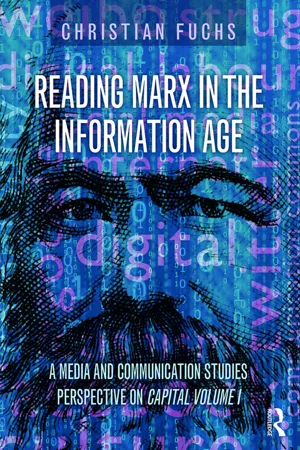
Renowned Marxist scholar and critical media theorist Christian Fuchs provides a thorough, chapter-by-chapter introduction to Capital Volume 1 that assists readers in making sense of Karl Marx's most important and groundbreaking work in the information age, exploring Marx's key concepts through the lens of media and communication studies via contemporary phenomena like the Internet, digital labour, social media, the media industries, and digital class struggles. Through a range of international, current-day examples, Fuchs emphasises the continued importance of Marx and his work in a time when transnational media companies like Amazon, Google, and Facebook play an increasingly important role in global capitalism. Discussion questions and exercises at the end of each chapter help readers to further apply Marx's work to a modern-day context.
eBook - ePub
Reading Marx in the Information Age
A Media and Communication Studies Perspective on Capital Volume 1
- 402 pages
- English
- ePUB (mobile friendly)
- Available on iOS & Android
eBook - ePub
Reading Marx in the Information Age
A Media and Communication Studies Perspective on Capital Volume 1
About this book
Information
Introduction
Reading Marx in the Information Age: A Media and Communication Studies Perspective on Capital Volume 1
1 Why Should I read Marx? I’d Rather Go on Facebook and Have Some Fun There…
The reader of this book may ask: Why should I read Capital Volume 1? And what has it to do with communications? Marx obviously did not write it on a laptop; he did not have a blog and a Facebook profile and wasn’t on Twitter. Such media have become ubiquitous in our lives; we use them for work, politics, and in everyday life. What many of them share is that they are organised by profit-oriented businesses. They are a manifestation of what Marx termed the “accumulation of capital”. At the same time they enable us to inform ourselves, communicate, and maintain social relations. Information, communication, and sociality is their “use-value”, which is a term that Marx uses for describing how goods satisfy human needs.
Communications companies do not always foreground that they are profit-oriented, but rather often only stress their use-value: Facebook, for example, says that it “helps you connect and share with the people in your life”. Twitter argues it allows you to “connect with your friends—and other fascinating people”. These claims are not untrue, but only one side of the story. Marx would say that they are ideologies that overstate or, as he says, “fetishise” use-value in order to distract attention from exchange-value, from the fact that communications companies are out to make lots of money. Marx still matters because we live in a capitalist communications world and many forms of communications spread ideologies and are organised as for-profit businesses. Capitalism is a somewhat different capitalism today than at the time Marx lived in the 19th century—it is global; finance, technology, transport, consumer culture and advertising plays a larger role, etc. Yet Marx already saw the foundations of all these phenomena and anticipated their future relevance. And he stressed that society is historical: Capitalism develops and obtains new qualities and discontinuities in order to reproduce its underlying foundational structures, the structures of capital accumulation. And Marx cared about ethics and politics: He was convinced that we need alternatives to capitalism because we do not live in the best possible world. So Marx would welcome the social side of contemporary capitalist media, but argue that they should be changed so that we can overcome their capitalist design and usage. And he would have supported struggles for such a different world.
So Marx has a lot of relevance to tell us about contemporary communications. In order to understand laptops, mobile phones, Twitter, Facebook, etc. we need to engage with Marx. He is an essential thinker for understanding the information and Internet age critically. So Marx and Facebook are not opposites. You cannot understand the second without the first and the first gives us a critical perspective on the second. This book is a companion for obtaining such an understanding. It is a step-by-step guide on how to read Capital Volume 1 from a media and communication studies perspective.
Why Read Capital from a Media and Communications Perspective?
Many introductory books to Marx’s Das Kapital, Band 1 (Capital Volume 1) have been written since the first edition was published in 1867. It is up to everyone’s own judgment how feasible and helpful s/he finds a particular introduction to Marx’s most widely read work. The book at hand has a somewhat different purpose. It is not another general introduction or accompanying guide. Its task is to provide assistance to the reader of Marx’s Capital Volume 1 for asking questions about the role of media, information, communication, the computer, and the Internet in capitalism. It provides an introduction and is an accompanying guide for reading Capital Volume 1 for people interested in media and communication studies. It is a contribution to the foundations of the critique of the political economy of media, information, and communication.
Why is such a book needed? Why should one read Marx’s Capital from the perspective of and with a focus on media and communication? Claims that we live in the information, knowledge, or network economy and society are often overdrawn and advance the view that we live in an economy/society that is completely new and has nothing in common with the 19th-century capitalism that Marx analysed. Such assertions often serve the purpose of communicating that new technologies have in capitalism created great economic opportunities for everyone and that the capitalist mode of production has inherent potentials for democracy, wealth, freedom, and stability. The history of capitalism is, however, a history of war, inequality, control, and crisis. Capitalism’s reality undermines and puts into questions liberal ideology. Information society euphoria is one-dimensional and uncritical. One should be sceptical of it.
It is a wrong reaction to information society euphoria to belittle and ignore the role of information, the media, and communication in capitalism. If one looks at statistics that display the profits, revenues, capital assets, and stock market values of the largest transnational corporations in the world, then one sees that quite a few of them are located in economic sectors and branches such as advertising, broadcasting and cable, communications equipment, computer hardware; culture, entertainment, and leisure; computer services, computer storage devices, electronics, Internet platforms, printing and publishing, semiconductors, software, and telecommunications. The information economy may not be the dominant sector of capitalism; it is, however, just like other capitalist industries, of significance for understanding capitalism. Contemporary capitalism is an informational capitalism just like it is finance capitalism, imperialist capitalism, crisis capitalism, hyper-industrial capitalism (the importance of fossil fuels and the mobility industries), etc. Capitalism is a multidimensional economic and societal formation. Information is one of these dimensions. To study the role and contradictions of information in capitalism is an important undertaking and dimension of a critical theory of society.
Critique of the Political Economy of the Media and Communication
The critique of the political economy of the media and communication is one of the subfields of media and communication studies. It has resulted in a significant academic infrastructure that includes, for example, the following:
- introductory text books (Mosco 2009; Hardy 2014);
- an academic network of scholars (the International Association of Media and Communication Research’s Political Economy Section);
- handbooks (Wasko, Murdock, and Sousa 2011);
- journals (tripleC: Communication, Capitalism & Critique— http://www.triple-c.at; The Political Economy of Communication— http://www.polecom.org);
- introductory readers (Mattelart and Siegelaub 1979, 1983; Golding and Murdock 1997); and
- most importantly, an active community of scholars who have a political interest in a better world and an academic interest in understanding capitalism and communication. I have been fortunate to enjoy the company of and discussions with scholars in this community, from which I have learned a lot and for which I am very grateful. This community’s continuous effort to maintain and develop the field of the critique of the political economy of media and communication is important and inspiring.
Graham Murdock and Peter Golding (1973) argued in their seminal article “For A Political Economy of Mass Communications” that critique of the political economy of communications means to critically study capitalism and communication: “The obvious starting point for a political economy of mass communications is the recognition that the mass media are first and foremost industrial and commercial organizations which produce and distribute commodities” (Murdock and Golding 1973, 205–206). “In addition to producing and distributing commodities, however, the mass media also disseminate ideas about economic and political structures. It is this second and ideological dimension of mass media production which gives it its importance and centrality and which requires an approach in terms of not only economics but also politics” (Murdock and Golding 1973, 206–207).
For Murdock and Golding, media in capitalism have a double role as fostering (a) commodification and (b) ideologies. This analysis corresponds to two important aspects that Marx points out as important for the critique of capitalism’s political economy in Capital Volume 1:
- (a) The logic of commodities: “The wealth of societies in which the capitalist mode of production prevails appears as an ‘immense collection of commodities’; the individual commodity appears as its elementary form. Our investigation therefore begins with the analysis of the commodity” (125). The critique of the political economy of communication asks questions about how the commodity form shapes communications and the contradictions and struggles connected to it.
- (b) Commodity fetishism: Ideologies present phenomena such as commodities as endlessly existing and absolutely necessary for human existence. They discard that social phenomena are made by humans in social relations and can therefore be changed. Capitalist media are important spaces, where ideologies are constructed, disseminated, reproduced, contradicted, and contested.
It is nothing but the definite social relation between men themselves which assumes here, for them, the fantastic form of a relation between things. In order, therefore, to find an analogy we must take flight into the misty realm of religion. There the products of the human brain appear as autonomous figures endowed with a life of their own, which enter into relations both with each other and with the human race. So it is in the world of commodities with the products of men’s hands. I call this the fetishism which attaches itself to the products of labour as soon as they are produced as commodities, and is therefore inseparable from the production of commodities. (Marx 1867, 165)
Vincent Mosco in his seminal introductory book The Political Economy of Communication defines this field as “the study of the social relations, particularly the power relations, that mutually constitute the production, distribution, and consumption of resources, including communication resources” (Mosco 2009, 2). Janet Wasko (2014, 260)...
Table of contents
- Cover Page
- Half Title page
- Title Page
- Copyright Page
- Contents
- Figures
- Tables
- Acknowledgement
- Introduction Reading Marx in the Information Age: A Media and Communication Studies Perspective on Capital Volume 1
- I Commodities and Money
- II The Transformation of Money into Capital
- III The Production of Absolute Surplus-Value
- IV The Production of Relative Surplus-Value
- V The Production of Absolute and Relative Surplus-Value
- VI Wages
- VII The Process of Accumulation of Capital
- 23 Simple Reproduction
- 24 The Transformation of Surplus-Value into Capital
- 25 The General Law of Capitalist Accumulation
- VIII So-Called Primitive Accumulation
- Appendix 1 Thomas Piketty's Book Capital in the Twenty-First Century, Karl Marx, and the Political Economy of the Internet
- Appendix 2 Knowledge, Technology, and the General Intellect in the Grundrisse and Its “Fragment on Machines”
- References and Further Readings
- Index
Trusted by 375,005 students
Access to over 1.5 million titles for a fair monthly price.
Study more efficiently using our study tools.
Frequently asked questions
Yes, you can cancel anytime from the Subscription tab in your account settings on the Perlego website. Your subscription will stay active until the end of your current billing period. Learn how to cancel your subscription
No, books cannot be downloaded as external files, such as PDFs, for use outside of Perlego. However, you can download books within the Perlego app for offline reading on mobile or tablet. Learn how to download books offline
Perlego offers two plans: Essential and Complete
- Essential is ideal for learners and professionals who enjoy exploring a wide range of subjects. Access the Essential Library with 800,000+ trusted titles and best-sellers across business, personal growth, and the humanities. Includes unlimited reading time and Standard Read Aloud voice.
- Complete: Perfect for advanced learners and researchers needing full, unrestricted access. Unlock 1.5M+ books across hundreds of subjects, including academic and specialized titles. The Complete Plan also includes advanced features like Premium Read Aloud and Research Assistant.
We are an online textbook subscription service, where you can get access to an entire online library for less than the price of a single book per month. With over 1.5 million books across 990+ topics, we’ve got you covered! Learn about our mission
Look out for the read-aloud symbol on your next book to see if you can listen to it. The read-aloud tool reads text aloud for you, highlighting the text as it is being read. You can pause it, speed it up and slow it down. Learn more about Read Aloud
Yes! You can use the Perlego app on both iOS and Android devices to read anytime, anywhere — even offline. Perfect for commutes or when you’re on the go.
Please note we cannot support devices running on iOS 13 and Android 7 or earlier. Learn more about using the app
Please note we cannot support devices running on iOS 13 and Android 7 or earlier. Learn more about using the app
Yes, you can access Reading Marx in the Information Age by Christian Fuchs in PDF and/or ePUB format, as well as other popular books in Social Sciences & Political Economy. We have over 1.5 million books available in our catalogue for you to explore.